Military Aircraft
Boeing P-8 Poseidon
ICAO: P8
The British bomber America built under license, still flying high-altitude science missions for NASA.
Updated: by Tim de Vries
The latest aviation news and stories sent to your inbox.
The Martin B-57 Canberra was the British English Electric Canberra built under license in Baltimore for the U.S. Air Force, which accepted 403 of them between 1953 and 1957. It flew as a night intruder and reconnaissance jet in Vietnam, fought for Pakistan in two wars with India, and survives today as NASA’s high-altitude WB-57F research aircraft.
Live Fleet Activity (WB57)
Fetching live data…


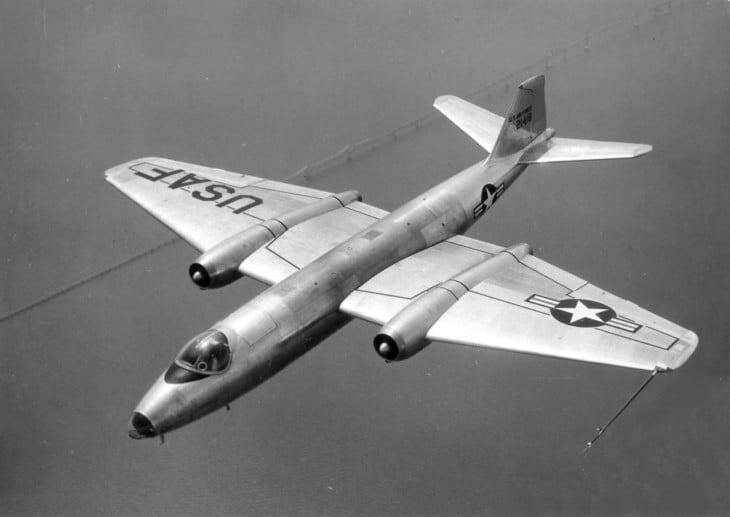
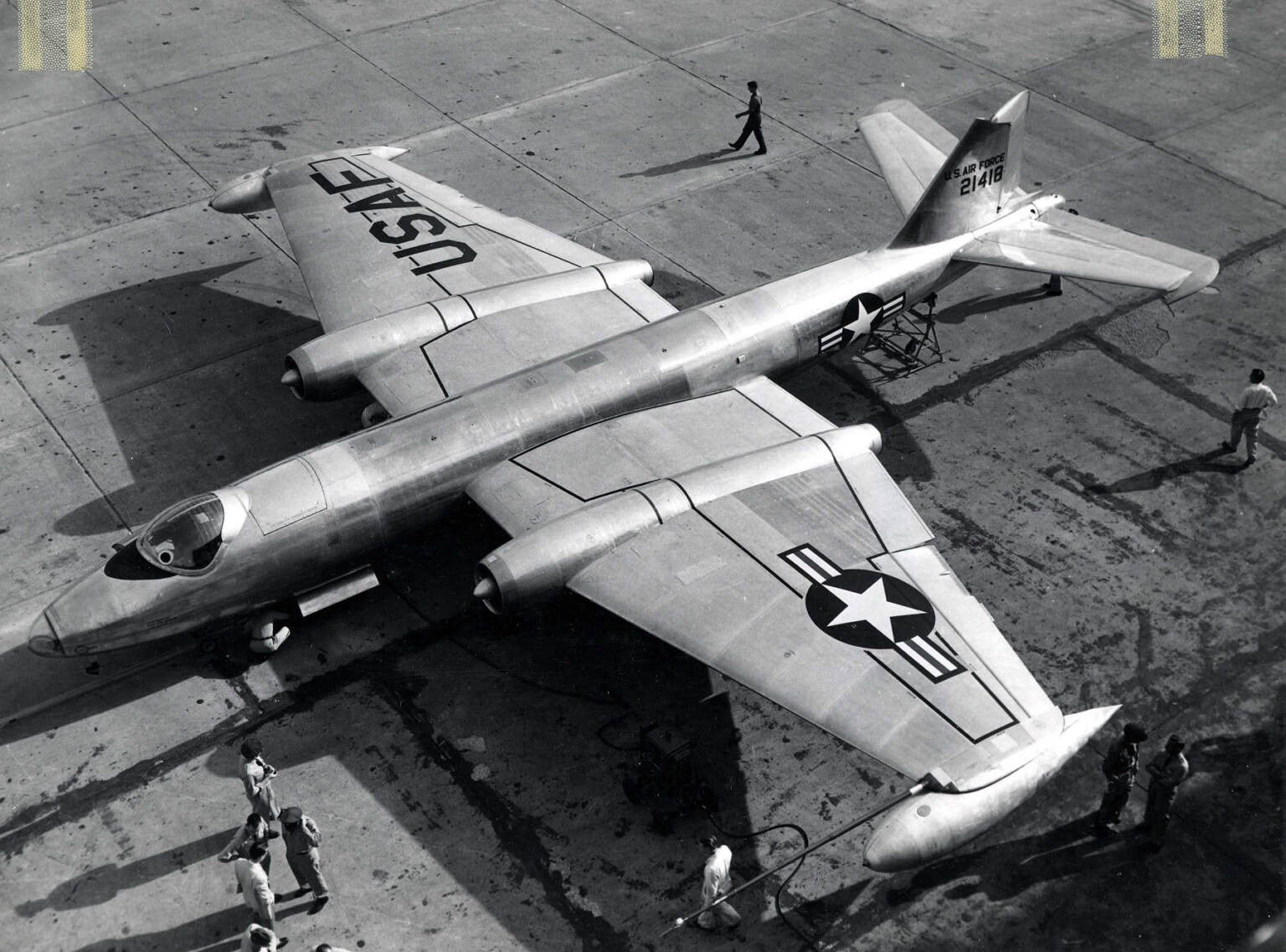
The Martin B-57 Canberra is the British English Electric Canberra bomber, built under license by the Glenn L. Martin Company in Baltimore for the U.S. Air Force. Buying it broke a long-standing U.S. tradition against mass-producing a foreign military design, and the Air Force accepted 403 of them between 1953 and early 1957.
It was bought as a stopgap for the Korean War and arrived too late to fight there. It then found a second life in almost every role a twin-jet airframe could fill: night intruder, photo and electronic reconnaissance, high-altitude spy plane, target tug, electronic aggressor and nuclear test sampler.
Three rebuilt examples still belong to NASA as WB-57F high-altitude research aircraft, so the design is still flying science missions in 2026.
When the Korean War began in 1950, the USAF’s tactical bomber was the piston-engined Douglas B-26 Invader, a World War II design that was suffering heavy losses. The Air Force wanted a jet that could find and hit targets at night and in bad weather, from rough forward airfields, with conventional or atomic weapons.
No American design was ready, so the USAF did something it had avoided for decades and looked abroad. On 26 February 1951 the Canberra flew a head-to-head demonstration at Andrews Field in Maryland against the Martin XB-51, the North American B-45 and AJ Savage, and the Avro Canada CF-100.
The British jet won decisively. Days earlier, test pilot Roland Beamont had flown a Canberra B.2 nonstop from England to Newfoundland in 4 hours 37 minutes, the first unrefueled transatlantic crossing by a jet.
English Electric’s own factories were full of Royal Air Force orders, so on 24 March 1951 the USAF signed a letter contract with Martin to build the aircraft in Maryland as the B-57A. Martin’s company designation was the Model 272, which is still the name on the type’s ICAO record.
To save time, the B-57A was built to a “minimum change” formula and looked almost identical to the British Canberra B.2. The visible differences were wingtip fuel tanks, a crew cut from three to two, and a rotating bomb door that swung the bombs out of the fuselage instead of opening clamshell doors into the airflow.
The biggest change was hidden in the nacelles. In place of the Rolls-Royce Avon, the Air Force chose the Armstrong Siddeley Sapphire, license-built by Curtiss-Wright as the J65, because it wanted more thrust for hot climates and heavier takeoff weights.
Engine deliveries ran late, and the Korean armistice was signed before the Air Force accepted its first B-57A. Only eight B-57As were completed, all used for testing, and the next 67 airframes became RB-57A photo reconnaissance jets.
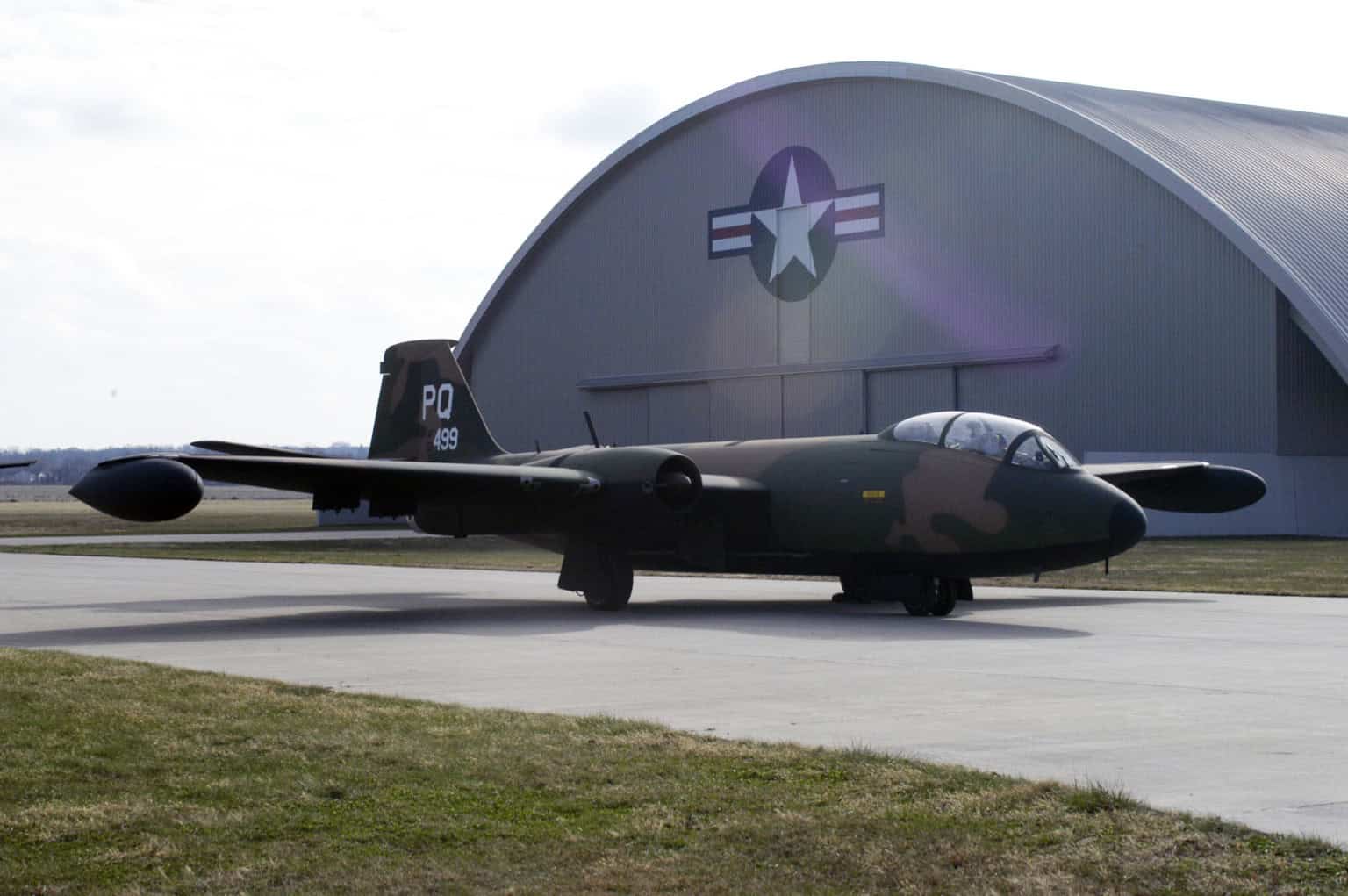
The definitive bomber was the B-57B, which first flew on 18 June 1954. It replaced the glazed bombing nose with a fighter-style canopy over two tandem seats, added four underwing hardpoints, and put guns in the wings: eight .50-caliber machine guns on the first 90 aircraft, then four 20 mm M39 cannons.

Martin delivered the last two B-57Bs in May 1956, for a total of 202. The Office of Air Force History put the flyaway cost at $1.26 million per aircraft, of which the airframe alone was about $853,000.
The full specification table for the B-57B is on this page. A few of its figures get quoted against each other, and they measure different things.
The range in the panel is a ferry figure, flown without bombs. With 5,250 lb (2,380 kg) of bombs aboard, the combat range falls to 825 nm, or 950 miles (1,530 km). Short reach was a known weakness: the Air Force judged air refueling too expensive to add and relied on external ferry tanks instead.
The top speed of 598 mph (963 km/h) was measured at just 2,500 feet, where it works out to about Mach 0.79. That is a subsonic low-level dash, and by the end of 1957 USAF tactical squadrons were already re-equipping with the supersonic F-100 Super Sabre.
The maximum payload combines two places to carry weapons: about 4,500 lb in the rotating bomb bay and 2,800 lb on the four wing pylons. In Vietnam a typical load was nine 500 lb bombs inside and four 750 lb bombs under the wings.
Published figures vary more than usual for this aircraft. The National Museum of the U.S. Air Force, for example, publishes a lower top speed, a higher ceiling and a heavier maximum weight than the panel. Where sources disagree, the panel follows Gunston and Gilchrist’s Jet Bombers and NASA’s Quest for Performance, the references behind the most widely used B-57B specification.
Yes. The 1951 requirement the Canberra was bought to meet called for delivering “conventional or atomic weapons,” and the B-57B’s combat-readiness program of 1955 to 1957 installed the low-altitude bombing system (LABS) and modified its special-weapon bomb-bay doors.
The B-57 also served the nuclear program in a second way. B-57Bs flew as radioactive-cloud samplers during the Operation Redwing tests in the Pacific in 1956, and later sampling versions flew with the Air Force Special Weapons Center at Kirtland AFB, New Mexico.
The B-57’s designation list is famously tangled, with the same prefix sometimes covering aircraft in completely different configurations. The main production and conversion families were these.
The first B-57s in South Vietnam were not bombers. Under the classified Patricia Lynn project, two RB-57E reconnaissance jets arrived in April 1963 and flew their first mission on 7 May 1963, using infrared sensors to find Viet Cong camps at night that daytime RF-101 crews had flown straight over.
Patricia Lynn crews flew over South Vietnam, Laos and Cambodia until mid-1971, losing two aircraft to ground fire and none of their crews.
The bomber squadrons, the 8th and 13th Bomb Squadrons, arrived at Bien Hoa Air Base in August 1964 and flew their first combat mission on 19 February 1965. That mission is widely credited as the first time a U.S. jet bomber dropped bombs in combat.

The Canberra turned out to be well suited to the war it had not been designed for. Its guns, bomb load and roughly four hours of endurance made it an effective dive-bomber and truck hunter along the Ho Chi Minh Trail, and crews who reached 100 truck kills joined an informal “Centurion Club.”
The cost was high. On 16 May 1965 an armed B-57B exploded on the ramp at Bien Hoa and set off a chain reaction that destroyed 10 more Canberras, 11 A-1 Skyraiders and an F-8 Crusader.
Across the war, 58 B-57s were recorded lost: 26 to ground fire, 10 in the Bien Hoa explosion, five to mortar and ground attacks, four in mid-air collisions, and the rest to operational or unknown causes. The last B-57B left Southeast Asia in November 1969.
The type came back once more. The B-57G, built under the Tropic Moon III program, deployed to Thailand in late 1970 to hunt trucks at night with laser-guided bombs and stayed until spring 1972. You can see how it compares with the other jets of the conflict in our guide to the fighter jets of the Vietnam War.
The Pakistan Air Force was the other major B-57 operator, receiving B-57Bs, B-57Cs, RB-57Bs and RB-57Fs from 1959. In the 1965 war with India its B-57s flew 167 sorties and dropped more than 600 tons of bombs, arriving over Indian airfields in a stream, about 15 minutes apart, which badly disrupted the Indian Air Force’s operations.
The PAF used the type again in the 1971 war, opening with a night raid on 12 Indian runways, and retired its last B-57s in 1985.
The high-flying RB-57D served Strategic Air Command from 1956 to 1964 until wing fatigue and the U-2 ended its career. Taiwan’s air force flew RB-57A and RB-57D aircraft over mainland China, and one RB-57D was shot down by an SA-2 in 1959, recorded as the first successful operational engagement by a surface-to-air missile.
Those missions earned the Canberra a place among the most important spy planes ever flown.
From 1959, Martin began filling retired RB-57A bomb bays with electronic countermeasures gear. As EB-57A, EB-57B and EB-57E, these aircraft flew with Defense Systems Evaluation Squadrons, playing the enemy by jamming radars and dropping chaff so that American air defense crews could train against a realistic threat.

That aggressor mission moved to the Air National Guard and kept the B-57 in uniform long after its bombing days. The Guard’s EB-57s were replaced in the 1980s by the EF-111A Raven, and the USAF retired the type in 1983, closing the era of the dedicated tactical bomber.
The B-57 was never an easy aircraft to fly. By the end of 1957, 47 of the 403 had already been destroyed in major accidents, and before its control and stabilizer systems were modified, the aircraft could become uncontrollable if one engine failed during takeoff or landing.
NASA has flown WB-57F Canberras from Ellington Field in Houston since the early 1970s, and today operates three: N926NA, N927NA and N928NA. They are rebuilt RB-57F airframes with the long wing and turbofans, which let them work at 63,000 feet with up to 8,800 lb of instruments and cameras.
The fleet has had an eventful 2026. On 27 January, one of the three made a gear-up landing at Ellington after what NASA called a mechanical issue, and no one was hurt. On 12 August, a WB-57F flew along the path of the total solar eclipse off Iceland at about 50,000 feet to photograph the Sun’s corona.
As of September 2026, NASA’s airborne science schedule lists N926NA on an imagery support tasking, N928NA in a major inspection until January 2027, and N927NA in maintenance until June 2027.
The National Museum of the U.S. Air Force in Dayton, Ohio, displays B-57B 52-1499, which flew combat from Phan Rang for two and a half years and was restored to its Vietnam bomber configuration in 2010. The same museum also shows an RB-57D.
Other survivors include the B-57E at the Pima Air and Space Museum in Tucson, EB-57s at March Field Air Museum and Wings Over the Rockies, and two RB-57As at the Glenn L. Martin Maryland Aviation Museum near the Baltimore plant where they were built.
For the wider family the Canberra belongs to, see our overview of the types of bomber planes.
NASA operates the only B-57s known to be in regular flying service: three WB-57Fs based at Ellington Field in Houston. As of September 2026, NASA’s schedule lists one on a flying tasking and the other two in inspection or maintenance, one of them after a gear-up landing in January 2026.
Yes. The 1951 USAF requirement called for delivering conventional or atomic weapons, and the B-57B received a low-altitude bombing system (LABS) and special-weapon bomb-bay doors in its 1955 to 1957 modification program.
Tactical Air Command phased out its B-57B and B-57C bombers between 1958 and 1959, but Vietnam and the electronic aggressor mission kept the type in service. The USAF retired it in 1983, and Pakistan retired its last B-57s in 1985. NASA’s WB-57Fs still fly.
RB-57Es flew night infrared reconnaissance from 1963 to 1971, B-57Bs flew bombing, strafing and night interdiction missions from 1965 to 1969, and B-57Gs hunted trucks at night with laser-guided bombs from late 1970 to 1972. In all, 58 B-57s were recorded lost in the war.
It is the same basic design built under license, but not the same aircraft. The B-57 used Wright J65 engines instead of Rolls-Royce Avons, carried wingtip tanks and a rotating bomb door, and from the B-57B onward had a tandem fighter-style cockpit, wing guns and underwing pylons.
Martin built 403 B-57s in Baltimore: 8 B-57As, 67 RB-57As, 202 B-57Bs, 38 B-57Cs, 20 RB-57Ds and 68 B-57Es. The B-57G, RB-57F and WB-57F were rebuilds of existing airframes, not new production.
No. The Stratofortress is the Boeing B-52, a much larger eight-engine strategic bomber. The B-57 Canberra is a twin-engine tactical bomber built by Martin.
In the reconnaissance role the RB-57A gave way to the Douglas RB-66 and the RF-101 by 1958. As a tactical bomber it was replaced by fighter-bombers such as the F-100, and in the electronic aggressor role by the EF-111A Raven.
Sources and references used for research and fact-checking.