Fighter Jets
The first production swing-wing aircraft, built to strike deep at low level in any weather.
Updated: by Tim de Vries
The latest aviation news and stories sent to your inbox.
The General Dynamics F-111 Aardvark was the first production swing-wing aircraft and a supersonic, all-weather strike jet built to cross enemy territory at treetop height. It first flew on December 21, 1964 and served the U.S. Air Force from 1967 until the last EF-111A Raven left service in 1998. The Royal Australian Air Force flew its own F-111s until December 3, 2010.
Live Fleet Activity (F111)
Fetching live data…


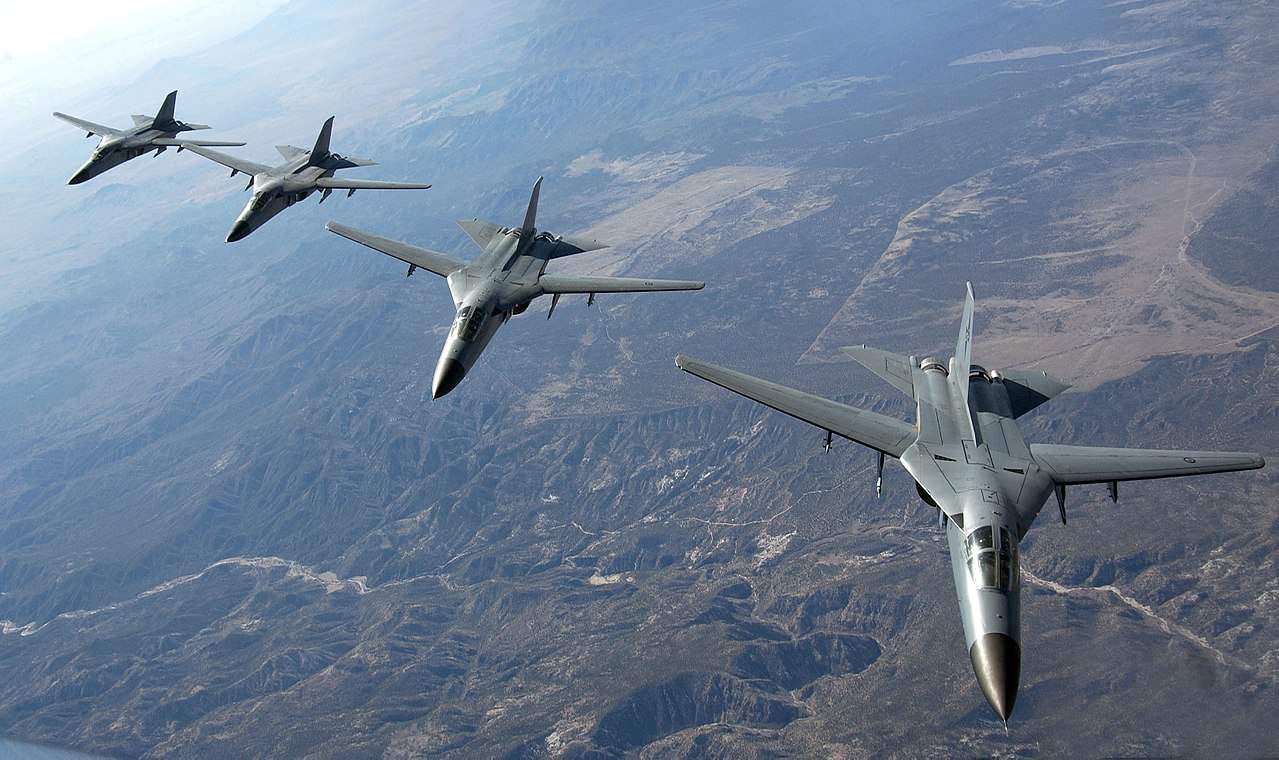


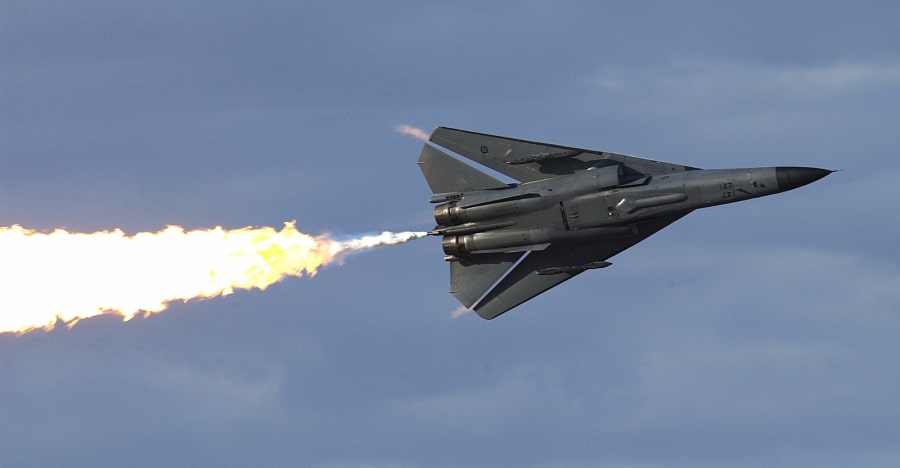
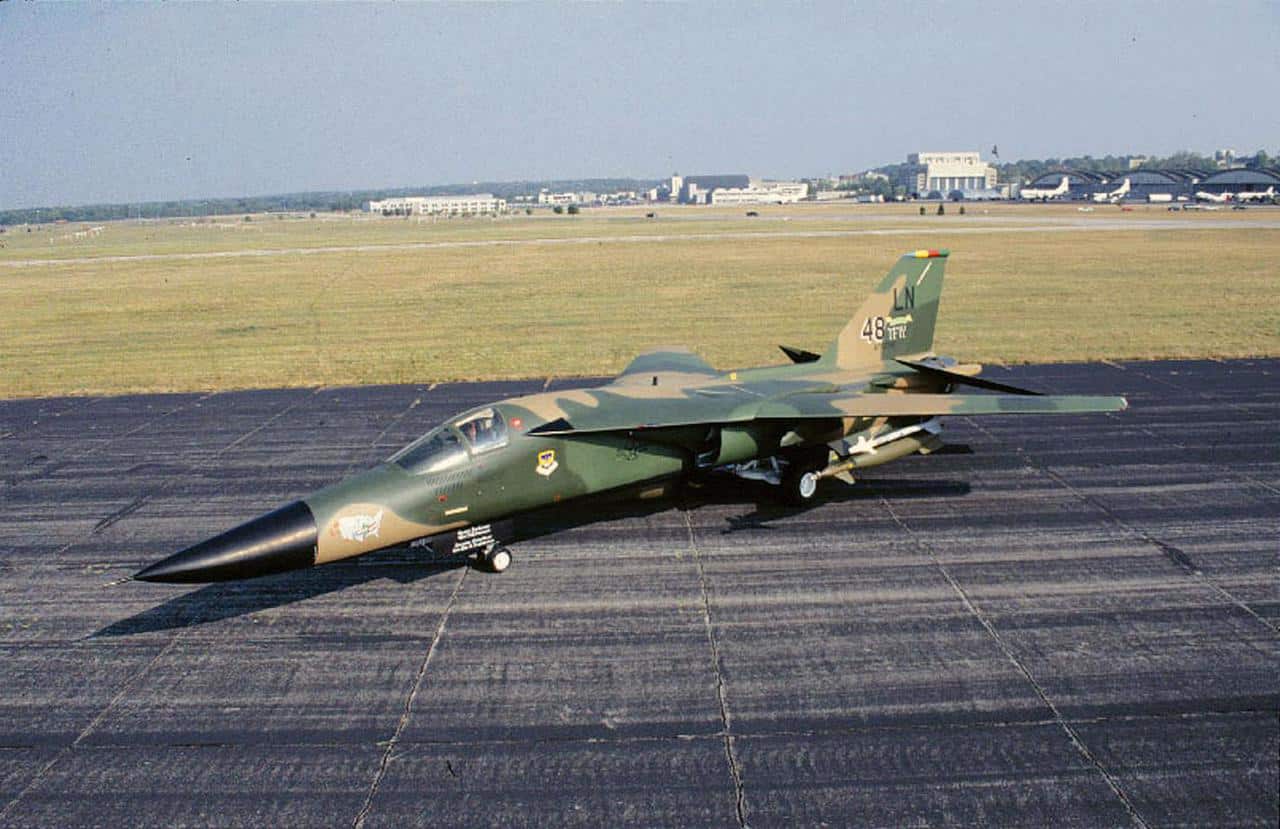
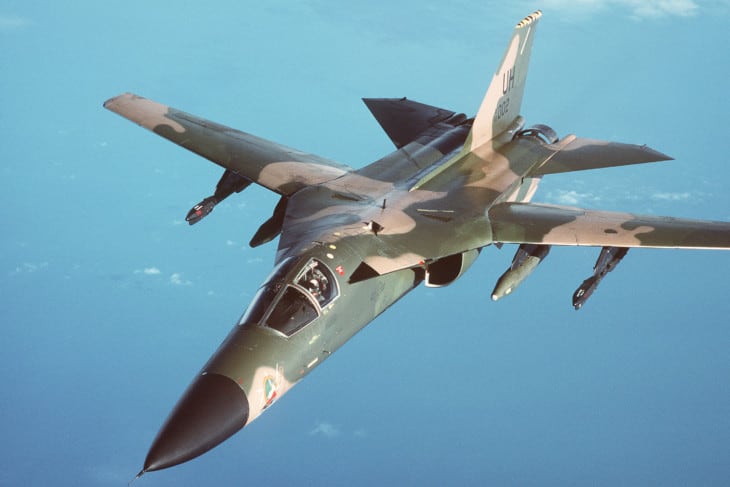
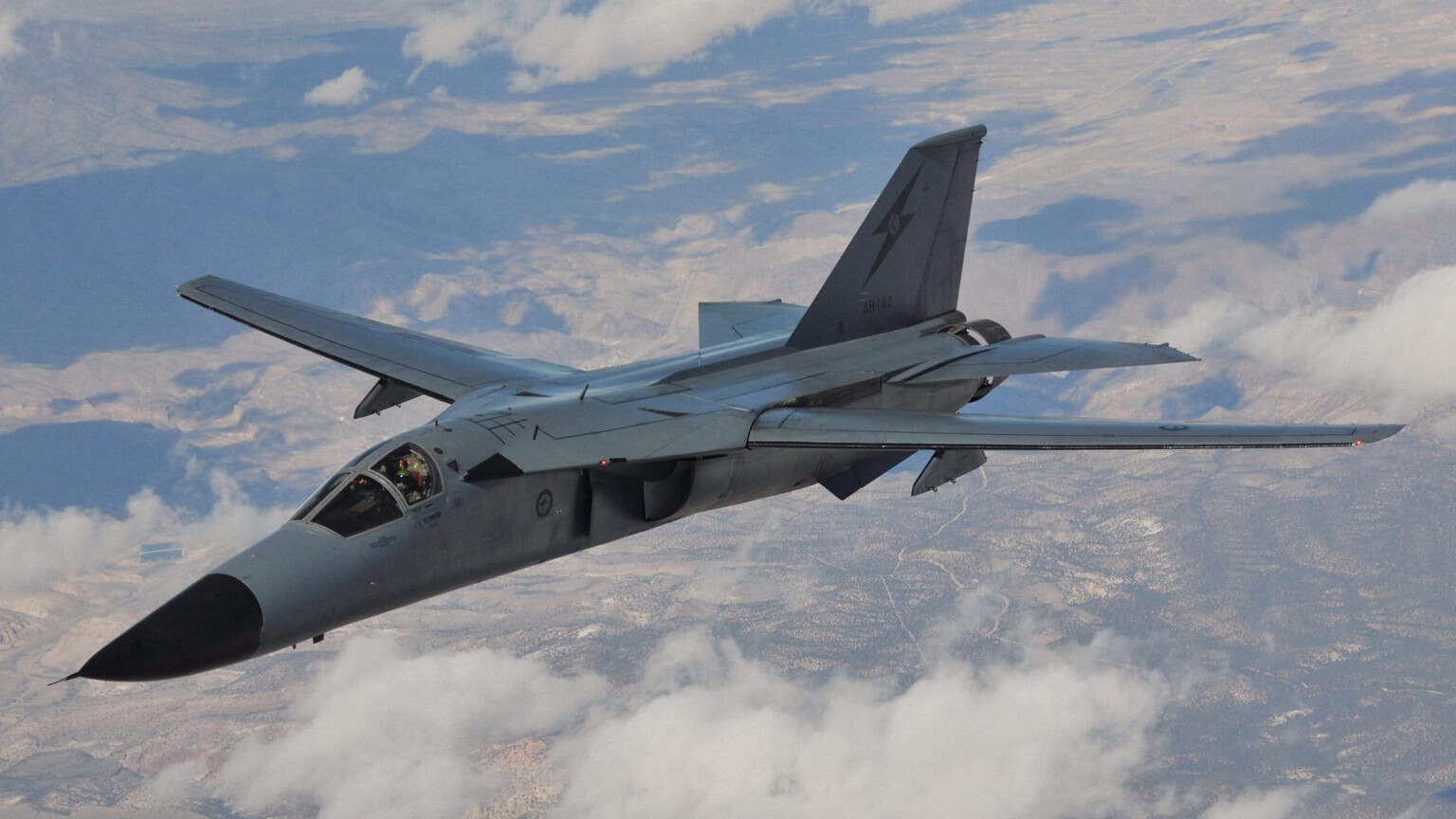
The General Dynamics F-111 Aardvark is a retired supersonic, medium-range fighter-bomber, and it was the first production aircraft with variable-sweep wings. The United States built it in Fort Worth, Texas, and it first flew on December 21, 1964.
It was designed to cross hostile territory at very low altitude, at high speed, in any weather. Its wings swung forward for takeoff and efficient cruise, then swept back for fast, low flight.
The U.S. Air Force flew it from 1967 until the last EF-111A Raven left service in 1998. The Royal Australian Air Force kept its own F-111s flying until December 3, 2010.
About 563 F-111s of all types were built, including 76 FB-111A strategic bombers. The full specification table for the aircraft is on this page, and the sections below explain the numbers that need context.
The F-111 began as a compromise. In 1961, Defense Secretary Robert McNamara ordered the Air Force to develop one aircraft, called TFX, for both the Air Force and the Navy.
The two services wanted different things. The Air Force wanted a low-level strike aircraft with tandem seats, while the Navy wanted a shorter interceptor with side-by-side seats so a pilot and radar operator could share one display.
A selection board repeatedly recommended Boeing’s design. In November 1962, McNamara chose General Dynamics instead, citing its greater commonality between the Air Force and Navy versions.
A congressional investigation looked at the choice and did not change it. The decision drew its own review, and the program went on to run into engine, structural and cost problems.
The Navy version, the F-111B, was canceled in 1968 over weight and performance problems. Seven were built for testing and none entered fleet service. The Navy’s fleet-defense role went to the Grumman F-14 Tomcat, another swing-wing design.
The wing sweep ranged from 16 degrees, full forward, to 72.5 degrees, full back. Leading-edge slats and double-slotted flaps ran along the full length of the wing.
The F-111 was also among the first production aircraft with an automated terrain-following radar tied to the autopilot. It let the crew fly hands-off as low as 200 feet in most weather, which is what made it so hard for air defenses to catch.
The two crew members sat side by side in an escape capsule instead of on separate ejection seats. This crew capsule was one of the new technologies the type brought to production aircraft.

Power came from two Pratt & Whitney TF30 afterburning turbofans. Early flights suffered compressor stalls, and engineers redesigned the engine inlet between 1965 and 1966, leading to the “Triple Plow” intakes.
The speed row on the panel is the top speed at altitude, about Mach 2.5. Near the ground the F-111F could reach about Mach 1.2 with full afterburner.
The panel gives the range as 3,210 nm (3,690 mi). That is the ferry range of the F-111F with external drop tanks, not the distance it could fly and fight. Real missions were flown differently, and the 1986 Libya raid needed repeated in-flight refueling.
The panel’s 31,500 lb (14,300 kg) payload is the hardpoint capacity. Each wing carried four underwing pylons, the inner two of which swiveled to stay aligned with the fuselage as the wing swept. An internal weapons bay held bombs, a removable 20 mm M61 cannon or extra fuel.
The engine row lists the F-111F’s TF30-P-100, with 25,100 lbf (112 kN) of thrust each with afterburner. Early F-111As used the TF30-P-3 instead, and the F-111F’s engines delivered about 35 percent more thrust than the F-111A and F-111E.
The F-111A was the first production version. A total of 159 were built, counting 30 preproduction aircraft rebuilt to production standard. It combined an attack radar with a separate terrain-following radar.
The F-111C was the export version for Australia. It paired the F-111A with longer wings from the F-111B and a strengthened landing gear. Australia later added 15 F-111Gs, former FB-111A bombers converted to a tactical role.
The F-111D brought newer digital avionics and an early glass cockpit, but the new systems caused substantial problems. The F-111E was a simpler stopgap that kept the older analog avionics. One F-111 pilot described it as all analog, but said it worked.
The F-111F, which entered production in 1970, was the final tactical version. It had the stronger TF30-P-100 engines, a strengthened wing carry-through box and cheaper avionics. One former F-111 pilot called it “the Cadillac of the F-111 force.”
Strategic Air Command wanted an interim bomber to replace the B-58 Hustler and the oldest B-52s. The FB-111A had longer wings, more fuel and a star tracker for navigation. It could carry AGM-69 SRAM nuclear missiles, and deliveries ran from 1969 to 1971.
Grumman converted 42 F-111As into electronic warfare aircraft, which are recognizable by the equipment bulge on top of the tail. The type is covered on its own page, the Grumman EF-111A Raven.
The United Kingdom ordered 50 F-111Ks in 1967 after canceling its BAC TSR-2. It canceled them again in January 1968 over rising costs, and no F-111K entered service.
The F-111’s first combat test went badly. Six F-111As deployed to Southeast Asia in March 1968 under the name Combat Lancer and flew 55 night missions against North Vietnam.
Three aircraft were lost. Two went down in late March, and the cause of those two is unknown because the wreckage was never recovered.
The third, lost on April 22, was traced to a failed hydraulic control-valve rod in the horizontal stabilizer. That caused an uncontrollable pitch-up, and inspections found 42 other aircraft with the same potential defect.
The F-111 returned in 1972 and flew 154 low-level missions during Operation Linebacker II. North Vietnamese forces called it “Whispering Death.”
On April 14, 1986, F-111s flew from RAF Lakenheath in the United Kingdom to strike targets in Tripoli during Operation El Dorado Canyon. France and Spain refused to allow overflight, so the aircraft flew around them and through the Strait of Gibraltar.
The round trip covered about 6,400 miles and took roughly 13 hours. Each aircraft needed 8 to 12 in-flight refuelings, and the mission was described as the longest fighter combat mission in history.
One F-111, call sign Karma 52, was lost, probably to a surface-to-air missile. Captains Fernando Ribas-Dominicci and Paul Lorence were killed.
In the Gulf War, F-111Fs completed 3.2 successful strike missions for every unsuccessful one, better than any other U.S. strike aircraft. The 66 F-111Fs dropped almost 80 percent of the war’s laser-guided bombs, using the Pave Tack targeting pod to designate targets.

The Air Force credited F-111s with destroying more than 1,500 Iraqi tanks and armored vehicles, a tactic crews nicknamed “tank plinking.”
The name Aardvark is Afrikaans for “earth pig,” and it fits the aircraft’s long nose. It is credited to F-111A instructor pilot Al Mateczun in 1969.
The Air Force never gave the aircraft an official name while it served. It formally adopted “Aardvark” at the F-111’s retirement ceremony on July 27, 1996.
In Australia, the F-111 was affectionately known as the “Pig,” a direct translation of the name.
Australia ordered 24 F-111Cs to replace its English Electric Canberras. Structural problems delayed the type, and the first six reached RAAF Base Amberley on July 1, 1973.
The F-111 never saw combat with the RAAF. It still gave Australia an independent long-range strike capability, and in 2006 an F-111 scuttled the North Korean ship Pong Su with two GBU-10 bombs.
The RAAF flew 43 F-111s in total, counting its F-111Cs, four ex-USAF F-111As and 15 F-111Gs. Seven F-111Cs and one F-111G were lost in crashes that killed five crews.
The type retired on December 3, 2010, after 37 years of service. A8-125, the last aircraft to land, was also the first to land at Amberley on delivery in 1973.
The F-111 was expensive to keep flying. One pilot said it made up 9 percent of Tactical Air Command’s fleet but consumed 25 percent of its maintenance budget.
Fatigue cracks in the wing attachment points were found in 1968 during ground testing, and a crash the following year was attributed to a cracked wing box. Costs rose too, and the projected unit cost climbed by about a third during 1965.
One of its stranger missions came on February 14, 1986. Two FB-111As flew from Pease Air Force Base, New Hampshire, to Tinker Air Force Base, Oklahoma, to collect a donor heart and deliver it to a waiting helicopter at Bradley International Airport.

A search of current reports in October 2026 turned up no flyable F-111. Surviving airframes are on static display in museums and air parks in the United States and Australia.
The RAAF Museum at Point Cook, Victoria, shows an F-111G. If you want to see the swing-wing design up close, that is a good place to start.
For how the F-111 compares with other combat jets, see the ranking of the best fighter jets in the world and the best bombers in the world.
The United States. General Dynamics built it in Fort Worth, Texas. The U.S. Air Force and the Royal Australian Air Force flew it in service.
Three F-111As were lost during the 1968 Combat Lancer deployment alone, two in late March and one on April 22. One published tally puts total Vietnam combat losses at six across more than 4,000 missions, but mission totals differ between sources, so treat that as approximate.
Aardvark is Afrikaans for “earth pig.” Australian crews shortened the translation to “Pig,” and the nickname stuck throughout the RAAF’s service.
The F-111 Aardvark, which General Dynamics developed under the TFX program. It is classed as a fighter-bomber, and its roles ranged from low-level interdiction to strategic bombing, with the EF-111A version flying electronic warfare.
About Mach 2.5 at altitude, and about Mach 1.2 at sea level for the F-111F. The panel on this page shows the top speed in knots, miles per hour and kilometers per hour.
The selection board favored Boeing’s design, but Secretary of Defense Robert McNamara chose General Dynamics in November 1962. A congressional investigation reviewed the decision and left it in place, and the program then suffered engine problems, wing-box cracks and rising costs.
Yes. On February 14, 1986, two FB-111As flew a donor heart from Tinker Air Force Base in Oklahoma to Bradley International Airport in Connecticut, where a helicopter was waiting to take it on.
Two crew members sat side by side in a single escape capsule, so the pilot and the radar operator could share the displays. The Navy had insisted on that layout, and the Air Force accepted it in the compromise TFX design.
Sources and references used for research and fact-checking.