
Military Propellor Planes
Martin B-26 Marauder
ICAO: B-26
First all-metal monoplane bomber in US service
Updated: by Tim de Vries

The latest aviation news and stories sent to your inbox.
The Martin B-10 was the first American all-metal monoplane bomber built in quantity. It flew in February 1932, entered Army Air Corps service in 1934 and could outrun most fighters of its day. Export versions fought in China, the Dutch East Indies and Thailand, where the last B-10s retired in 1949.
Live Fleet Activity (B10)
Fetching live data…


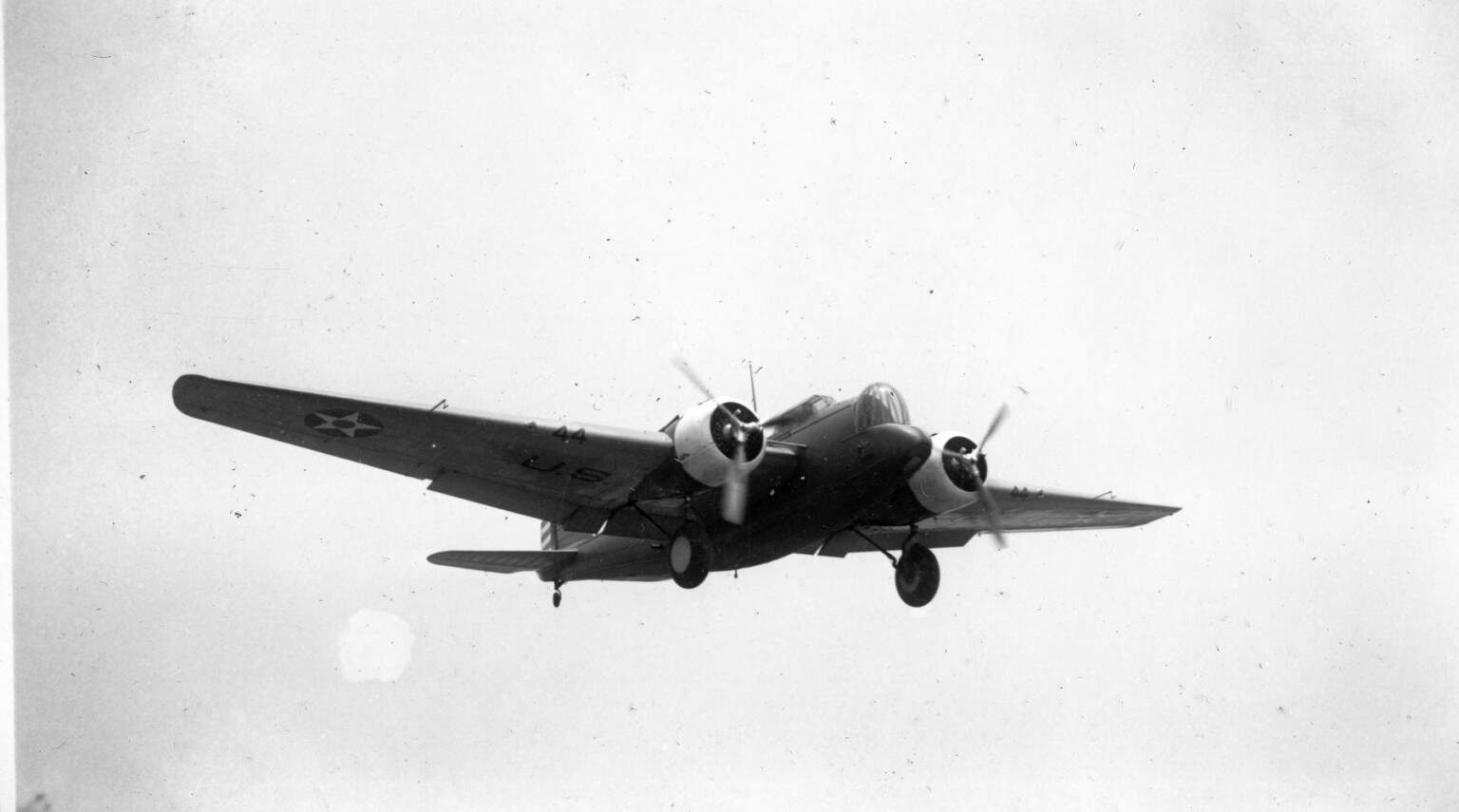


The Martin B-10 was the first all-metal monoplane bomber the US Army Air Corps bought in quantity. It replaced a generation of fabric-covered biplane bombers with a fast, streamlined twin-engine design.
It had retractable landing gear, an internal bomb bay and an enclosed rotating gun turret. Lockheed Martin’s own history of the type calls it America’s first large all-metal monoplane.
General Henry H. Arnold called the B-10B the “airpower wonder of its day”, a line Wikipedia quotes.
The B-10 began as a private venture by the Glenn L. Martin Company of Baltimore. The Model 123 first flew on February 16, 1932, with a crew of four, an internal bomb bay and retractable main landing gear.
It was delivered to the Army on March 20, 1932 as the XB-907. After testing, Martin rebuilt it as the XB-10 with NACA engine cowlings, more powerful Wright Cyclone engines, a wing about 8 ft (2.4 m) wider and an enclosed nose turret.
In June 1932 trials the XB-10 reached 197 mph at 6,000 ft. The Army ordered 48 aircraft on January 17, 1933, and the first 14 YB-10 service-test bombers reached Wright Field from November 1933.
Lockheed Martin credits the design with the 1932 Collier Trophy for Glenn Martin. Its history feature also notes that Martin had the bomb bay moved from under the wings to inside the fuselage.

The B-10B, the main production version, is 44 ft 9 in (13.64 m) long. Its tail height is 15 ft 5 in (4.70 m), its wing span is 70 ft 6 in (21.49 m), and the full specification table for the aircraft is on this page.
It carries a crew of four. Armament was three .30 in (7.62 mm) Browning machine guns and a bomb load of about 2,260 lb (1,025 kg).
Power comes from two Wright R-1820-33 Cyclone nine-cylinder radial engines, each rated at 775 hp. Each drives a three-bladed variable-pitch propeller.
Lockheed Martin says the enlarged fuselage and twin engines earned it the nickname “the Flying Whale”. It also calls the rotating turret the first enclosed one of its kind.
The B-10B tops out at 185 kt (213 mph) in the Wikipedia spec block, with a cruise speed of 168 kt (193 mph). Lockheed Martin quotes a slightly lower 207 mph and says that was 22 mph faster than its competition.
The gap between the two figures is a difference in sources and versions, not an error on either side. Either way, the B-10 was far quicker than the biplane bombers it replaced.
One account cited by Wikipedia says the B-10B was half again as fast as any biplane bomber and faster than any contemporary fighter. That is a single secondary claim, so treat it as a description of the era rather than a record.
The range is 1,080 nm (1,240 mi, 2,000 km). Lockheed Martin quotes about 1,400 miles for the type, which again reflects a different published figure rather than a different aircraft.
The Air Corps put the B-10 on the front page in 1934. Ten of them flew from Washington to Alaska, used Fairbanks as a base and photographed more than 200,000 square miles of uncharted territory, according to Lockheed Martin.
The type served in every bombardment group in the Air Corps during the 1930s. Lockheed Martin also credits it with the first test of the Norden bombsight in 1935.
B-10Bs began shipping in July 1935 to units at Langley, Mitchel, March Field, the Panama Canal Zone and the Philippines. Wikipedia counts 103 ordered in 1935 in its text and 105 built in its variant list, and does not reconcile the two.
In February 1936, 13 B-10Bs of the 49th Bomb Squadron dropped supplies to isolated islanders in Chesapeake Bay. The type was a peacetime workhorse in the United States.

Martin sold the type widely. Argentina took 35 aircraft in Army and Navy versions, China 9, Turkey 20 and Siam (Thailand) 6, and the Netherlands bought well over 100 across several variants. The Soviet Union received a single demonstrator for evaluation.
In China, two B-10s joined a strike on Japanese landing forces at Liuhe on August 25, 1937. Three took part in an attack on Shanghai on October 14, 1937, and two flew a night leaflet raid over Japan on May 19, 1938.
The Dutch operated the type in the Netherlands East Indies. Dutch Martins fought in the Malayan campaign from December 1941 and flew raids over Borneo from December 16 to 28, 1941.
Thailand used six B-10s as its medium bomber force in the 1940-41 Franco-Thai War. The first mission was on December 15, 1940 and the last on January 28, and the type later supported the 1942 invasion of Burma.

Yes, but not mainly by the United States. By the time America entered the war, the B-10 had been eclipsed, and Wikipedia gives no specific US wartime combat record for it.
Export B-10s did see action. Dutch aircraft fought in the Malayan campaign in December 1941, Thai aircraft flew until 1949, and Turkey used its aircraft for Black Sea surveillance and kept 12 of its last 16 operational in 1946.
The B-10 on display at the National Museum of the US Air Force is painted to represent a B-10 from the 1934 Alaskan flight. According to Wikipedia, it is actually an Argentine export example.
The B-10B had a maximum speed of 185 kt (213 mph) and a cruise speed of 168 kt (193 mph). Lockheed Martin quotes 207 mph, so published figures vary by a few miles per hour.
Yes, by other air forces. Dutch B-10s fought in the Malayan and Borneo campaigns in December 1941, Thai aircraft supported the 1942 invasion of Burma, and Turkey used them for Black Sea patrols. By the time the US entered the war the type was obsolete there.
The B-10 is not a strong candidate. Wikipedia describes it as eclipsed by the time the US entered the war, but it was a leap forward when it entered service in the 1930s. Rankings of the “worst” are opinion, not measurement.
No. The Warthog is the Fairchild Republic A-10 Thunderbolt II, a different aircraft. Likewise, the Martin B-26 Marauder is a separate, later aircraft.
The B-10B carried a crew of four.
The Glenn L. Martin Company of Baltimore built it, starting as a private venture.
Sources and references used for research and fact-checking.