

Table of Contents
There is a specific kind of hunger that only happens at 35,000 feet. You boarded at 6am without breakfast, the drink cart is somewhere behind row 40, the only thing for sale is a shrink-wrapped cheese plate at an unreasonable price, and you still have three hours to go. Everyone has been there. The fix is not complicated, and it costs almost nothing: pack your own food before you leave the house.
Good airplane snacks have to clear a few hurdles that ordinary snacks do not. They need to survive being squashed under a laptop in an overhead bin. They need to pass through security without a bag check. They need to be eaten one-handed, in a seat with almost no table, without crumbs, without smell, and without a spill that ends up on the stranger beside you. Once you know those constraints, choosing what to pack becomes surprisingly easy.
These 25 ideas cover every kind of flight and every kind of traveler: quick 90-minute hops, red-eyes where you want to sleep, long-haul flights that need a real meal, and journeys with kids who get hungry every 40 minutes. Some are five-minute assemblies from your pantry. Some you buy after security. Pick three or four that suit your route, pack them the night before, and never rely on the cart again.
01. Build a Custom Trail Mix
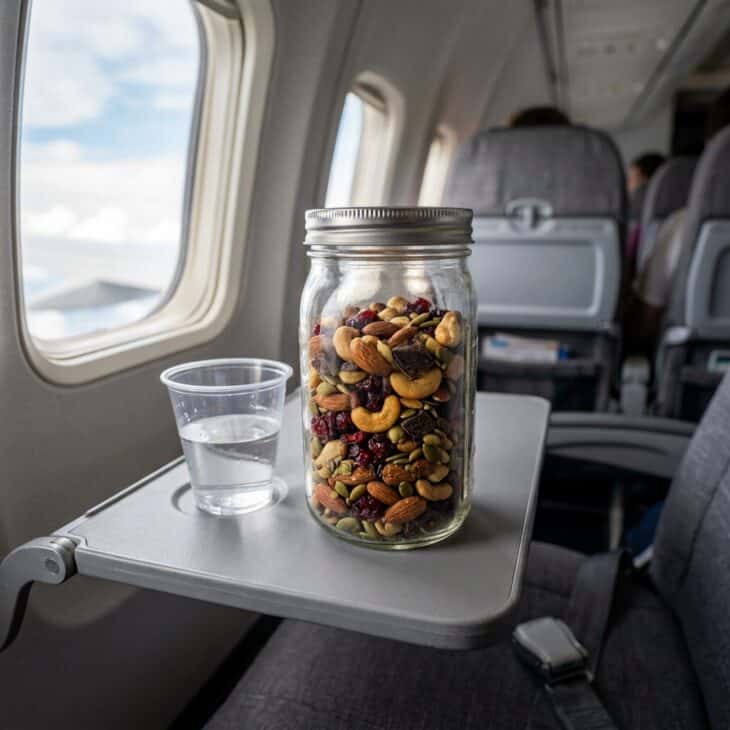
What you see A clear screw-top jar packed with almonds, cashews, dried cranberries, pumpkin seeds and rough chunks of dark chocolate, sitting on a tray table in a shaft of window light. Nothing about it is fancy. It is just food that looks like it was made by a person rather than a factory, and it is the single most reliable thing in the bag.
Why it works Trail mix is the only snack that solves salt, sugar, fat and protein in one container, which means it satisfies whichever craving shows up mid-flight. It does not melt, crush, leak or smell. It also rations itself naturally: a handful at a time makes a small jar last a whole transatlantic leg.
How to get it Build your own instead of buying a pre-made bag, which is usually 70 percent peanuts and raisins. Start with two nuts you actually like, add one dried fruit, one seed for crunch, and one small treat such as dark chocolate or yogurt-covered raisins. Keep the treat ratio low or you will eat it all in the first 20 minutes. Pack it in a rigid jar rather than a zip bag so it does not turn to dust under a laptop. Make a double batch and leave one in your carry-on permanently for unplanned delays.
02. Beef Jerky and Meat Sticks
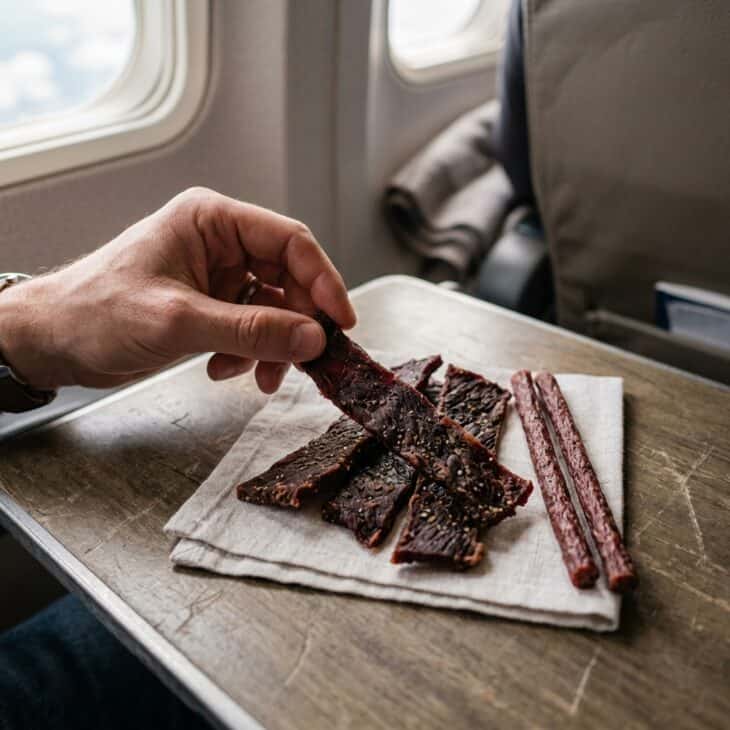
What you see Dark, matte strips of jerky laid out on a napkin, deep mahogany and red-brown, with the visible grain of real muscle rather than a pressed rectangle. A hand reaches in for one. It looks like the most serious food on the tray table, and in nutritional terms it is.
Why it works Protein is what actually stops hunger, and jerky delivers roughly ten grams per small handful with no refrigeration, no crumbs and no mess. It is the antidote to the carbohydrate-only snacking that leaves you hungry again an hour later. It also keeps for months, so a spare packet can live in your bag between trips.
How to get it Choose a lower-sodium variety if you are flying long-haul, because the cabin is already dehydrating you. Open the packet before boarding and transfer the jerky into a small resealable bag, since tearing foil in a quiet cabin is louder than you think. Avoid heavily smoked or teriyaki-glazed styles, which have a strong smell in a confined space. If you are crossing an international border, check the destination’s rules first: many countries prohibit meat products entirely, including sealed commercial jerky. Eat it early in the flight rather than late, so you are not thirsty during descent.
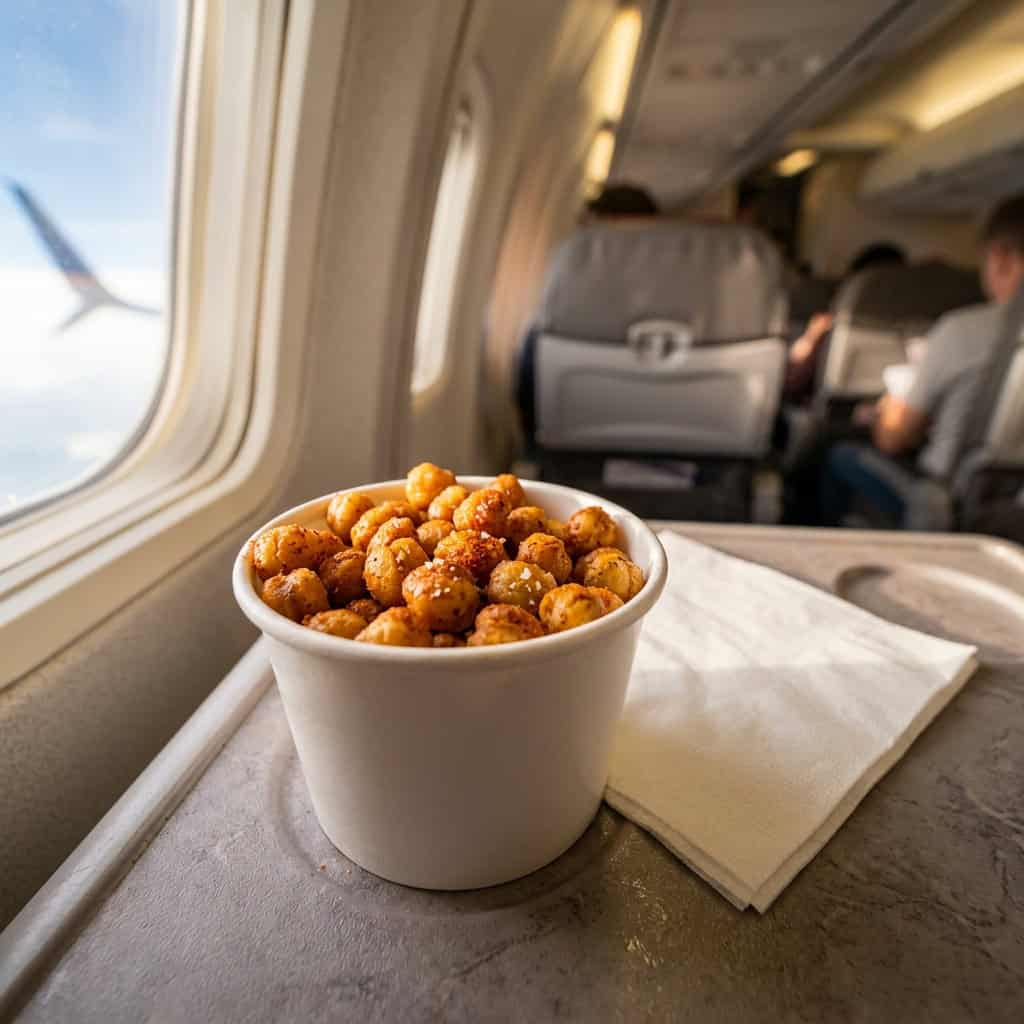
03. Roasted Chickpeas for Crunch Without Crumbs
What you see Golden, blistered chickpeas dusted with paprika and flaky salt, sitting in a small paper cup where the light from the window catches every rough edge. They look like something between a nut and a crouton. The texture is the entire point: they crack rather than crumble.
Why it works The craving on a plane is usually for crunch, and chips deliver it while also delivering a lap full of shards. Roasted chickpeas give you the same satisfaction with fiber and protein behind it, and they stay whole in a bag. They also hold up to bold seasoning, which matters because cabin conditions genuinely dull your palate. If you have ever wondered why airplane food tastes bland, the same dry air and background noise are working against your snacks too, so season more aggressively than you would at home.
How to get it Drain and thoroughly dry a can of chickpeas, toss with olive oil and salt, and roast at 200C or 400F for 30 to 40 minutes until they rattle in the pan. Dry is the key word: any residual moisture makes them chewy instead of crisp. Season them after roasting, not before, so the spices do not scorch. Let them cool completely before bagging or they will steam themselves soft. Store-bought versions exist in most supermarkets if you do not want to make them.
04. Nut Butter Squeeze Packs and Apple Slices
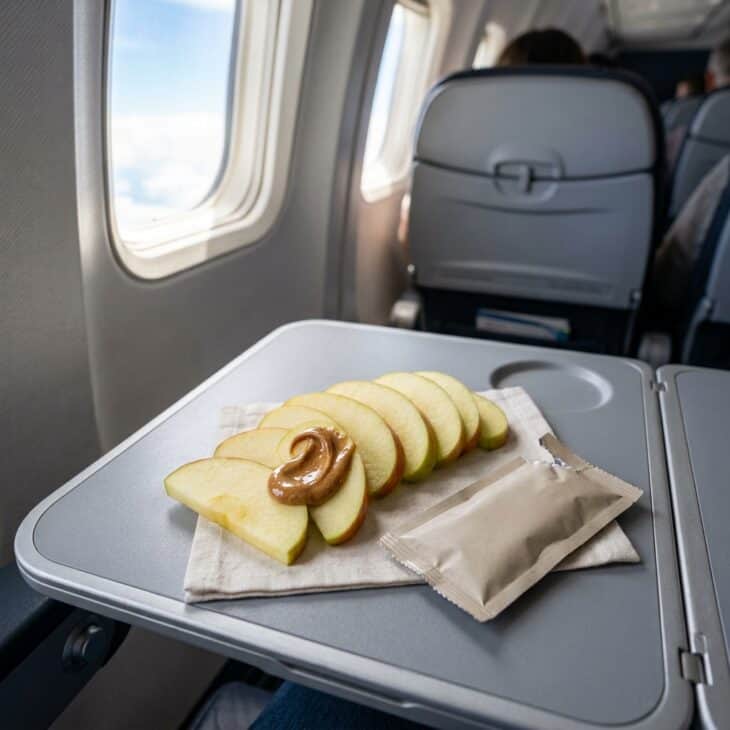
What you see A single-serve squeeze packet of almond butter beside a fan of crisp apple slices, one of them already topped with a glossy ribbon of nut butter. Bright, clean, and about as close to a fresh homemade snack as a tray table gets.
Why it works The combination of fiber and fat keeps you full far longer than either alone, and the fresh element is exactly what you crave after two hours of recycled air. Squeeze packets are portion-controlled, do not need a knife, and cannot spill inside your bag the way a jar can.
How to get it Buy single-serve nut butter packets rather than decanting from a jar: nut butter counts as a gel under the liquids rule, and anything under the standard 3.4 ounce or 100 millilitre limit passes security without argument. Slice the apple at home and toss the pieces in a little lemon juice so they do not brown by the time you board. Pack them in a hard container, not a bag, so they arrive as slices and not as apple sauce. A firm variety such as a Braeburn or Pink Lady survives the journey far better than a soft one. Sunflower seed butter is a safe substitute on flights where nut allergies have been announced.
The 3.4 ounce rule applies to food too
Security treats spreadable, pourable and squeezable foods as liquids. Hummus, yogurt, jam, soft cheese, salsa and nut butter all count as gels, so keep them under 3.4 ounces or 100 millilitres per container and put them in your liquids bag. Solid food, including sandwiches, nuts, jerky and whole fruit, has no volume limit at all.
05. A Cheese and Cracker Snack Kit
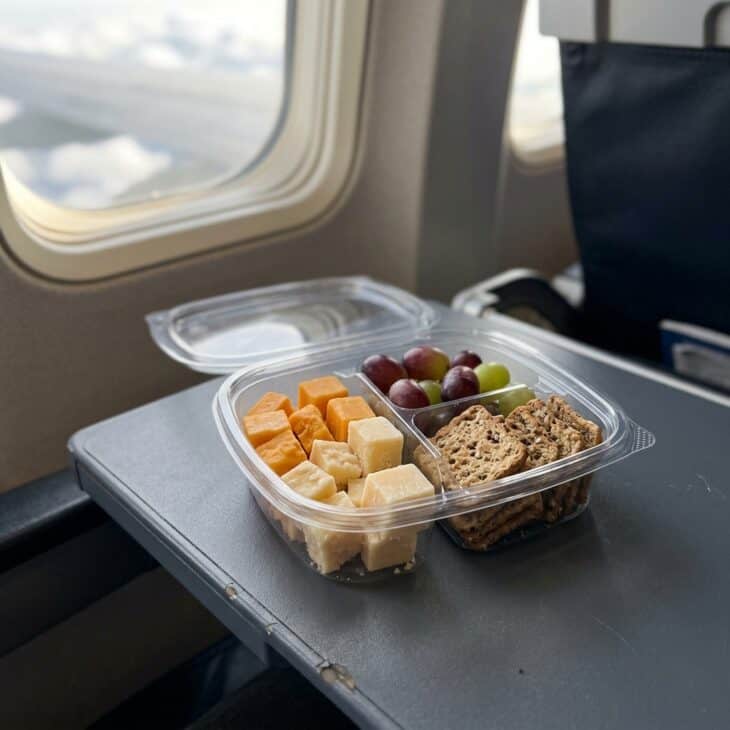
What you see Cubes of aged cheddar and gouda in warm golden and cream tones, lined up beside whole-grain crackers in a compact clear container, with a few grapes tucked into the corner. It reads as a proper little meal rather than a snack, which is exactly the effect you want three hours in.
Why it works Hard cheese is stable at room temperature for hours, delivers protein and fat, and feels like an indulgence rather than a compromise. Paired with a cracker it becomes a small structured ritual, which does more for a long flight than simply eating something quickly out of a bag.
How to get it Stick to hard and semi-hard cheeses: cheddar, gouda, manchego, parmesan. Soft cheeses such as brie or cream cheese are treated as gels at security and will be pulled from your bag if the container is oversized. Cut the cheese into cubes at home and pack it with a small ice pack if the flight is long, though four to six hours at cabin temperature is generally fine for a hard cheese. Choose sturdy crackers, since anything thin and delicate arrives as sand. Cheese also carries strict import rules in some countries, so finish it before you land if you are crossing a border.
06. A Veggie and Hummus Bento Box
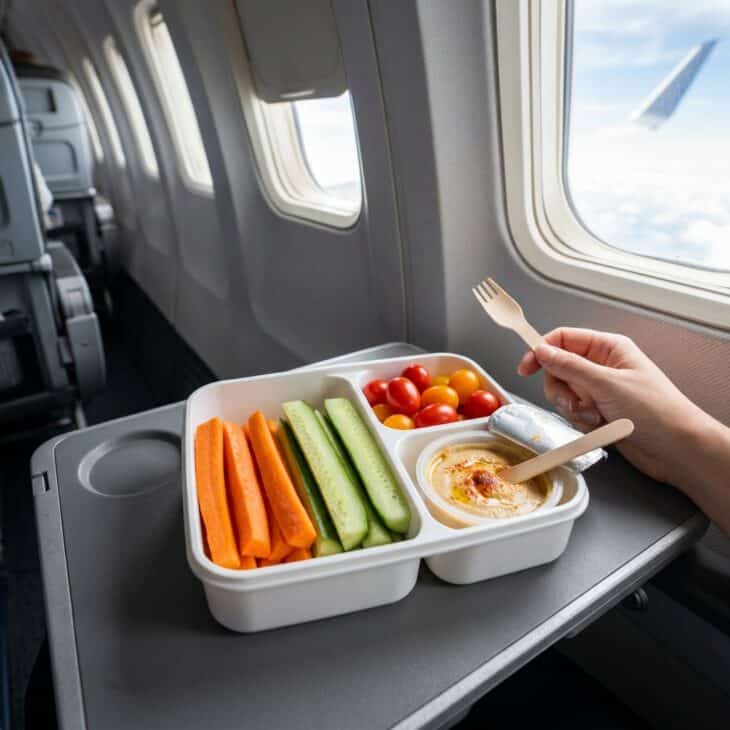
What you see Carrot sticks, cucumber batons and cherry tomatoes packed into the compartments of a white bento box, with a small hummus cup in the corner. Vivid orange, green and red against a plain container, and in a cabin full of beige packaged food it looks almost radical.
Why it works Vegetables are the one thing you will not find anywhere on an aircraft, and after a few hours of dry air and salty packaged food, crunchy raw produce is genuinely restorative. It is also high in water content, which quietly helps with the dehydration problem that every flight creates.
How to get it Cut everything the night before and store the pieces dry, since moisture is what turns cut vegetables limp. Use single-serve hummus cups under 3.4 ounces so security has nothing to question, or skip the dip entirely and rely on a light salt seasoning. Bell peppers, carrots, cucumber, sugar snap peas and cherry tomatoes all travel well. Celery and lettuce do not. A bento box with a locking lid is worth the small investment if you fly often, because it protects the contents from being crushed in an overhead bin.
07. Homemade No-Bake Energy Bites
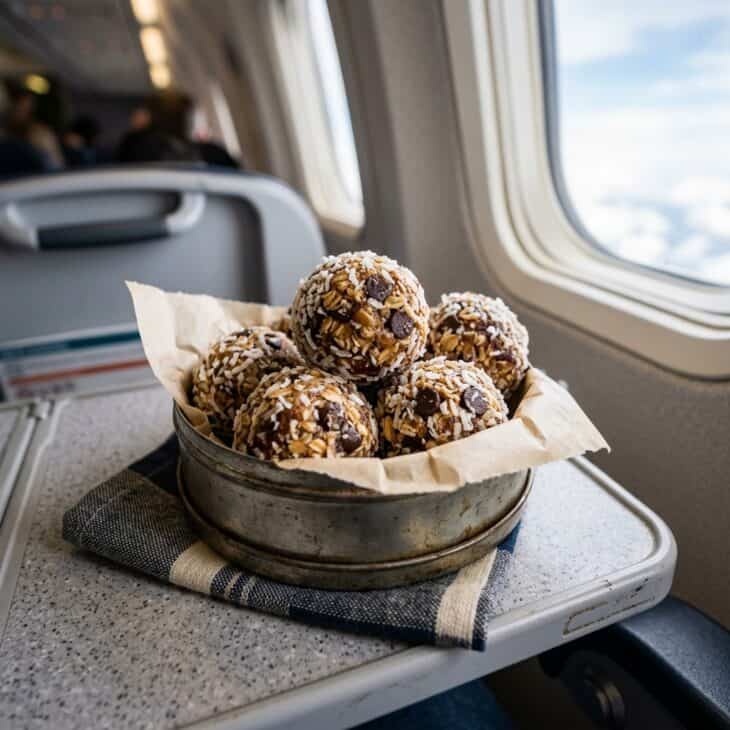
What you see Six rough, handmade spheres of oats, dates, peanut butter and chocolate chips, some rolled in coconut, packed into a small tin. They look homemade because they are, and next to a foil-wrapped bar they look like a gift you gave yourself.
Why it works An energy bite is a protein bar without the packaging, the price or the ingredient list you cannot pronounce. Two of them are a genuinely filling snack, they are naturally sweet enough to kill a sugar craving, and because they are solid rather than spreadable, security ignores them completely.
How to get it Blend rolled oats, pitted dates, a nut butter and a spoonful of honey until the mixture holds together, then roll into balls and chill for an hour. Add chia seeds, cocoa powder or protein powder to adjust the nutrition. Roll them in desiccated coconut or cocoa so they do not stick to each other in the tin. They keep for a week in the fridge and freeze well, so make a batch on a Sunday and take a handful on every trip that month. Pack them in a rigid tin, because they will absolutely flatten in a soft bag.
08. Protein Bars, the Backstop Snack
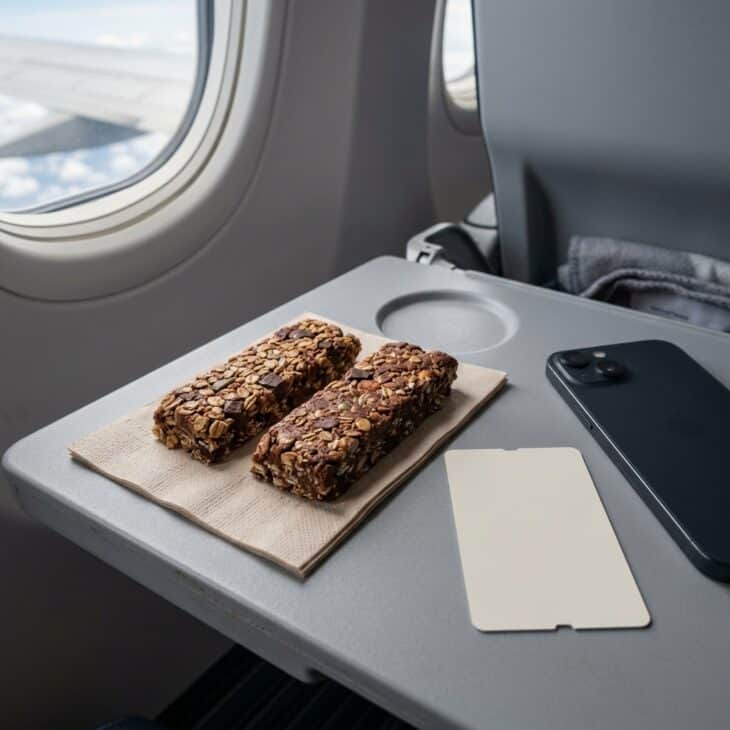
What you see Two dense oat and chocolate bars sitting unwrapped on a napkin, beside a phone lying face down. Unremarkable, unglamorous, and the reason you did not have to buy a nine dollar sandwich during a four hour delay.
Why it works Every other idea on this list requires a little preparation. A protein bar requires none, survives anything, and is small enough that there is no reason not to have one in the bottom of your bag at all times. It is insurance rather than a treat, and on the day a flight diverts or a connection collapses, it is the best decision you made all week.
How to get it Look for at least 10 grams of protein and under 10 grams of added sugar, otherwise you are eating a candy bar with a health label. Avoid chocolate-coated bars in summer, since they melt into the wrapper and become a two-handed problem in a tight seat. Buy a box, keep two permanently in your carry-on, and replace them whenever you use one. Test any bar on the ground before you commit to it at altitude, because a high-fiber bar can be unpleasantly bloating in a pressurised cabin.
09. Air-Popped Popcorn
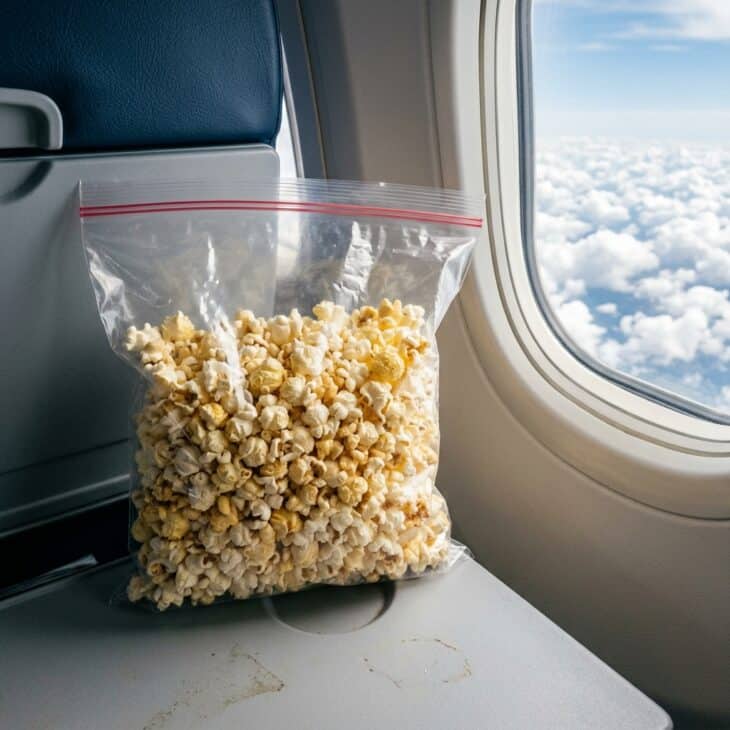
What you see A big, airy bag of pale golden popcorn on the tray table, lit by daylight coming through the window with clouds sliding past outside. It takes up more space than anything else you packed and weighs almost nothing, which is the whole trick.
Why it works Popcorn is the best volume-to-calorie ratio in the snack world, so a large satisfying portion barely registers nutritionally. It is quiet to eat, it does not smell, and it lasts a long time because you eat it one piece at a time. Pair it with the view: it is the closest thing to a cinema snack while you sit at the window watching the world go by, and it goes well with a flight spent hunting for a good window seat photo.
How to get it Air-pop it at home rather than buying microwave bags, which are heavy on oil and often intensely buttery in smell. Season it lightly with salt, or with nutritional yeast for a savory cheese-like flavor that does not linger in the cabin. Skip the kettle corn and heavy caramel styles, which get sticky in your fingers and there is nowhere to wash your hands. Pack it in a bag with the air pressed out, because a sealed bag of trapped air expands noticeably as the cabin pressure drops during climb and can pop open in the overhead bin.
10. Pinwheel Sandwich Spirals
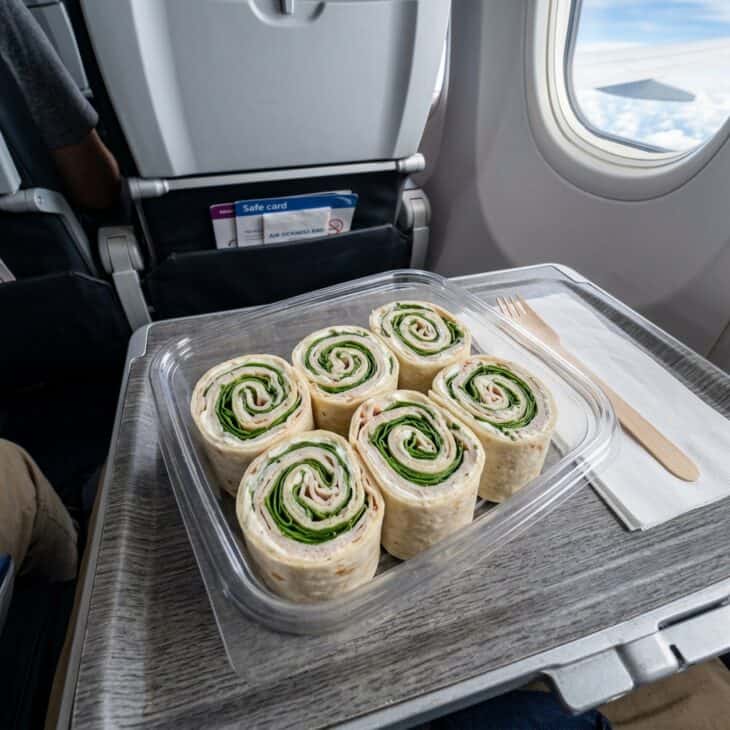
What you see Six tight spirals cut from a rolled tortilla, the green of spinach and the cream of soft cheese swirling through each one, arranged cut-side up in a clear box. It is a sandwich that has been engineered for a tray table barely bigger than a magazine.
Why it works A normal sandwich falls apart the moment you pick it up in a cramped seat. A pinwheel is a sandwich reorganised into bite-sized units that hold themselves together, need one hand, and drop nothing into your lap. It also happens to look far better than it has any right to.
How to get it Spread a large tortilla with cream cheese or hummus, layer thin fillings such as turkey, spinach and shredded carrot, roll it tight, then chill for 30 minutes before slicing so the spirals hold. Keep the fillings dry: tomato and dressing will make the wrap soggy by the time you board. Slice with a serrated knife in a sawing motion so you do not crush the roll. Pack cut-side up in a shallow container. Avoid tuna, egg and anything strongly aromatic, which is less a food rule than a matter of basic cabin citizenship.
11. An Instant Oatmeal Cup
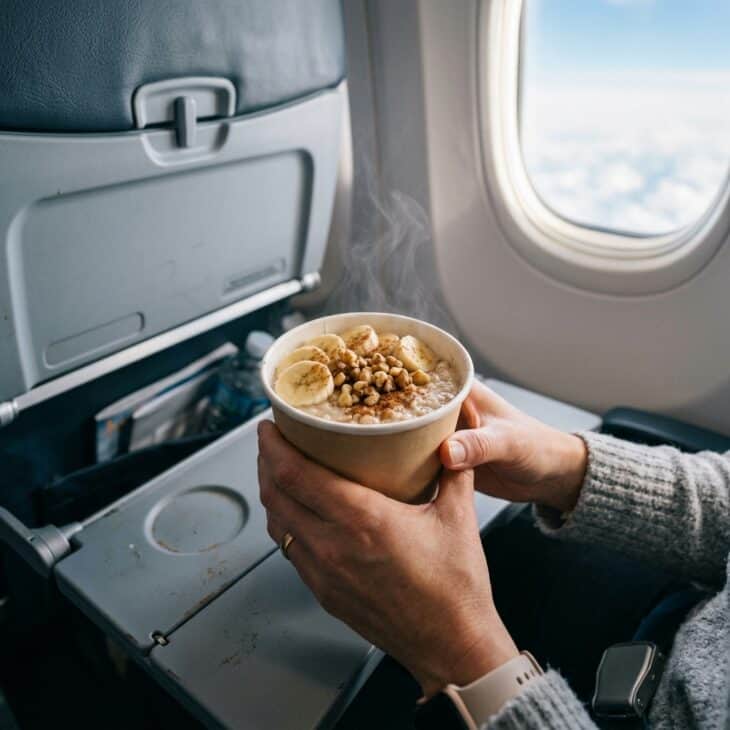
What you see A paper cup of oatmeal with steam curling off the top, sliced banana and walnuts scattered across the surface, held in two hands. Warm and creamy against a cool grey cabin, on a flight that left before the sun did.
Why it works This is the single best snack for an early departure, because it is the only genuinely hot, comforting thing you can produce in seat 24C. Cabin crew will give you hot water on request on almost any flight. Oatmeal is slow-release, filling, and it makes a 6am flight feel civilised rather than punishing.
How to get it Bring instant oats in a lidded cup, or decant your own oats plus cinnamon, a spoon of milk powder and a pinch of salt into a container at home. Ask a flight attendant for hot water once the drink service has passed rather than during it, when they are busiest. Add a sliced banana or a small packet of dried fruit for sweetness. Bring your own spoon, because you cannot count on getting one. Let it stand for three minutes with the lid on so the oats hydrate properly.
12. Instant Miso Soup or a Cup of Noodles
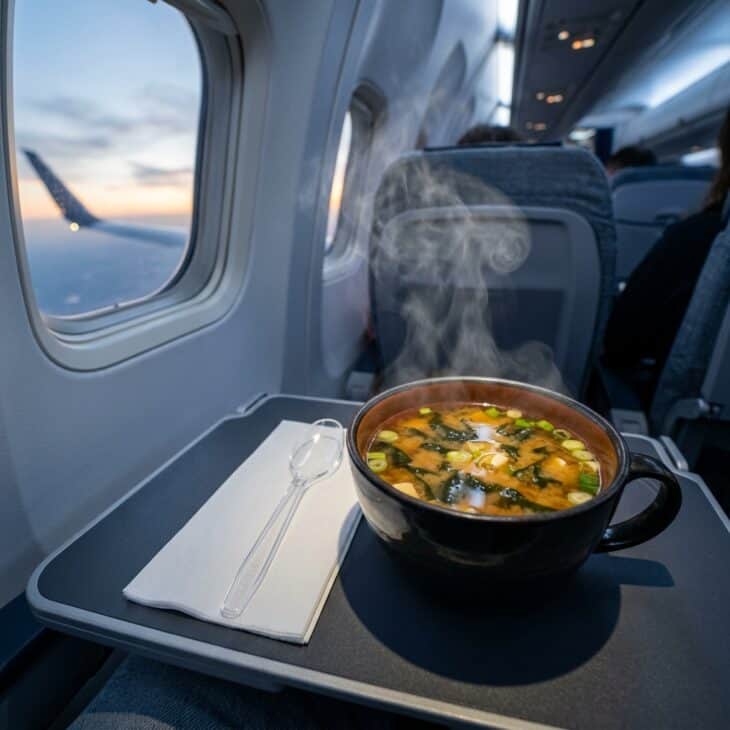
What you see Amber broth in a paper cup with flecks of seaweed and spring onion floating on the surface, steam rising into the light of a cabin window at dusk. A spoon and a napkin beside it. On hour nine of a long-haul, it is the most comforting thing on the aircraft.
Why it works Something savory, warm and salty hits differently on a long flight, and a dry soup sachet weighs nothing while turning free hot water into an actual course. The salt and warm liquid together are also a fast fix for the slightly hollow feeling that sets in on the back half of an overnight sector.
How to get it Pack a couple of dry miso or instant soup sachets, which are flat, light and cost almost nothing. Bring a collapsible silicone cup if you want a proper vessel, or use the cup the crew gives you. Ask for hot water outside the busiest service periods. Choose a mild flavour rather than a heavily spiced ramen, because strong aromas travel a long way in a sealed cabin. Instant noodle cups work too but need more water and more time, so ask early.
Cabin courtesy: the smell test
Before you pack anything, imagine smelling it for eight hours in a sealed metal tube with 200 strangers. Tuna, hard-boiled eggs, curries, durian, heavily spiced instant noodles and anything deep-fried all fail this test. If it smells strong at home, it will smell overwhelming at 35,000 feet.
13. Dried Mango and Other Dried Fruit
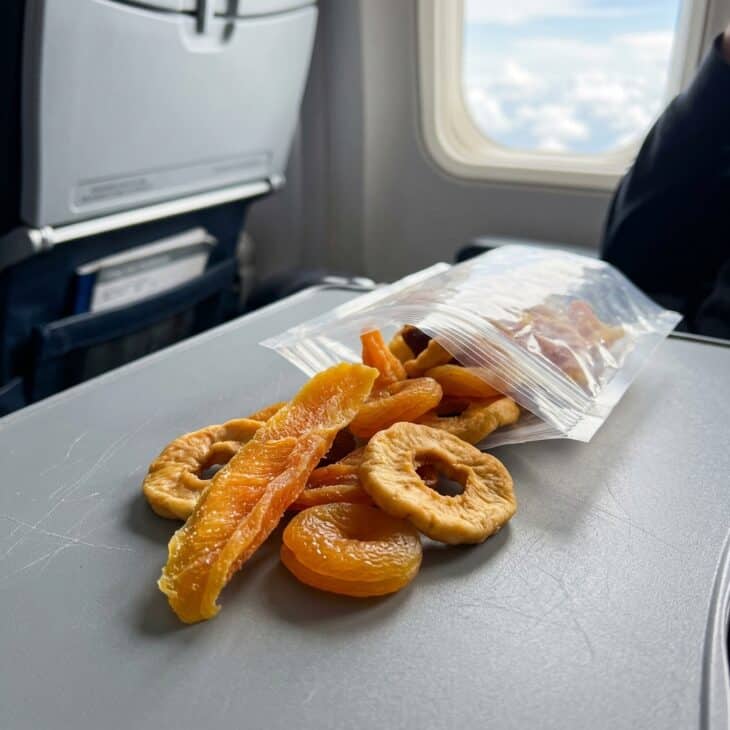
What you see Bright orange strips of dried mango, amber apricots and pale apple rings spilling out of a small pouch, translucent at the edges where the window light passes through them. Chewy, concentrated, and about as far from a packet of pretzels as a snack can get.
Why it works Dried fruit scratches the sugar itch without a chocolate crash, weighs almost nothing, and never gets crushed. It is also chewy, which slows you down and makes a small portion last. On a flight where the sweet option is a shortbread biscuit in cellophane, dried mango is a genuine upgrade.
How to get it Buy unsweetened varieties where you can, since the added sugar in most commercial dried fruit is unnecessary given how sweet the fruit already is. Mango, apricot, apple rings, pineapple and banana chips all travel well. Sticky varieties such as dates and figs are best kept in a separate small container so they do not glue everything else together. Portion it out before you fly, because a large bag of dried mango disappears faster than you think. Dried fruit is generally accepted at international borders, unlike fresh fruit, which makes it the safer choice on long-haul routes.
14. Seaweed Snack Sheets
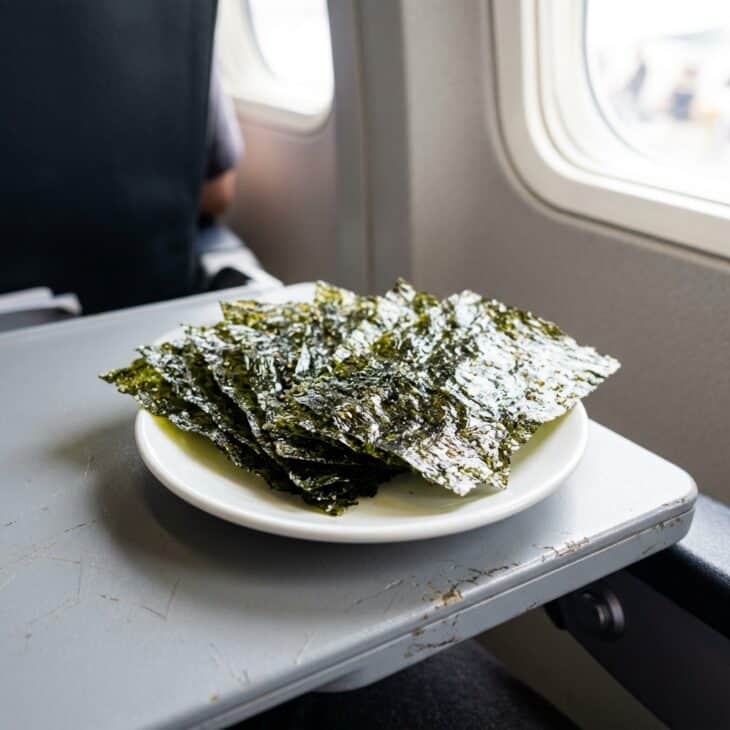
What you see Paper-thin sheets of roasted seaweed, dark green with a faint sesame sheen, fanned out on a small plate. They are so light they almost float, and they shatter into salty flakes the moment you bite one.
Why it works Seaweed snacks are the ultimate low-effort, low-calorie salt hit: a whole pack is often under 60 calories, weighs nothing, and satisfies the specific craving for something savory that the cabin seems to generate on schedule. They are also completely mess-free, which is more than you can say for a bag of chips.
How to get it Buy the small single-serve packs rather than a large sheet pack, since seaweed goes chewy within minutes of opening in humid air. Sesame and sea-salt varieties are the most crowd-pleasing; wasabi versions are best kept for flights where nobody is sitting next to you. They crush easily, so slide the packs into a book, a laptop sleeve or the side pocket of your bag rather than the bottom. Pair them with something more substantial, because on their own they will not keep you full.
15. Dark Chocolate Squares
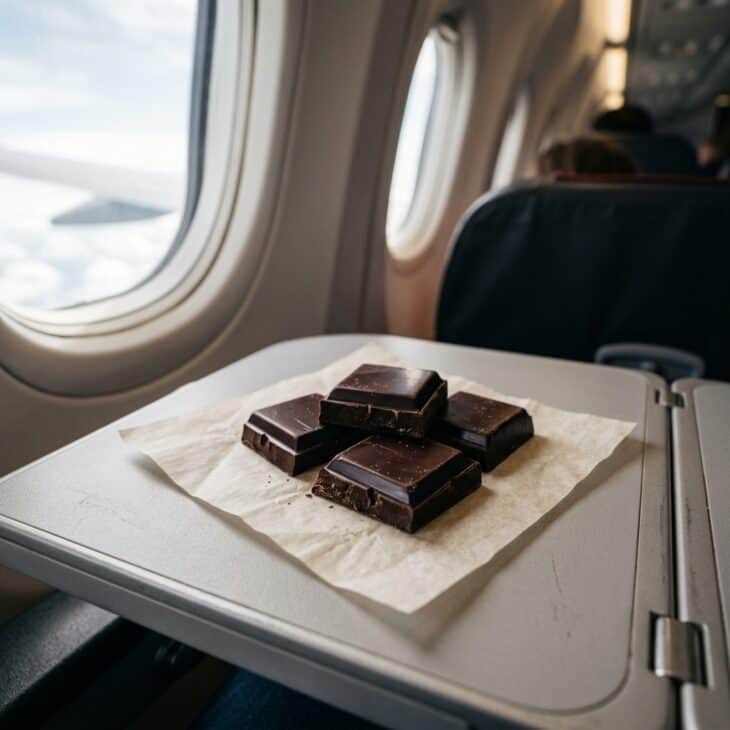
What you see Four squares snapped from a bar of dark chocolate, glossy and deep brown, sitting on a scrap of parchment paper with window light raking across the surface. A very small quantity of a very good thing.
Why it works Chocolate is not a nutritional strategy, it is a morale strategy, and a long flight needs one. Two squares of a good 70 percent bar deliver a disproportionate lift for their size, and dark chocolate is far less prone to becoming a melted disaster than milk chocolate. Save it for the last hour, when the cabin is stale and the arrival still feels far away.
How to get it Choose 70 percent cocoa or higher, which holds its shape better and satisfies faster than sweeter bars. Break it into squares at home and wrap them in parchment or foil so you are not fighting with a large bar in a small seat. Keep it in the middle of your bag rather than against the warm side near your laptop. In summer, or if you have a long taxi on a hot apron, add a small ice pack. If you are packing chocolate as a gift, keep it in your carry-on rather than the hold, where temperatures swing far more.
16. Freeze-Dried Fruit Crisps
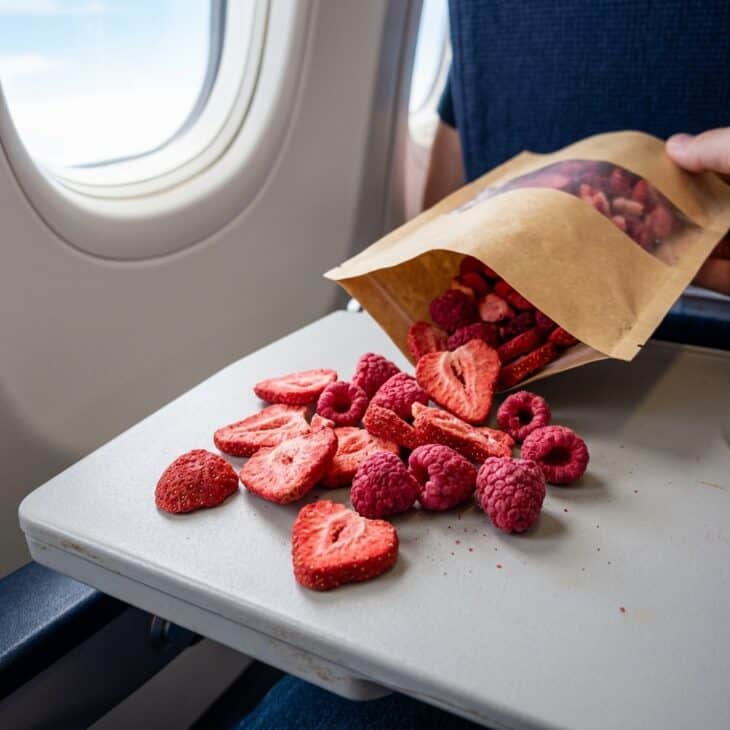
What you see Vivid red and pink freeze-dried strawberries and raspberries, dry and porous with seeds still visible, spilling out of a small pouch. The color is almost unreal against the grey of a cabin, and they dissolve on the tongue rather than chew.
Why it works Freeze-dried fruit is the closest thing to fresh berries you can carry without refrigeration, a container or the risk of a squashed mess. It weighs practically nothing, it cannot leak, it does not stain, and children in particular love the strange melting texture. It also carries none of the sticky residue that dried fruit leaves behind.
How to get it Look for pouches with a single ingredient listed, since some brands add sugar to what is already a naturally sweet product. Strawberry, raspberry, mango and apple are the most reliable. They are extremely fragile, so keep the pouch upright and away from the bottom of your bag, or you will arrive with fruit powder. Buy small pouches rather than large ones, because they go soft quickly once opened in humid air. They pair well with a handful of nuts, which supplies the protein they lack.
17. Roasted Edamame
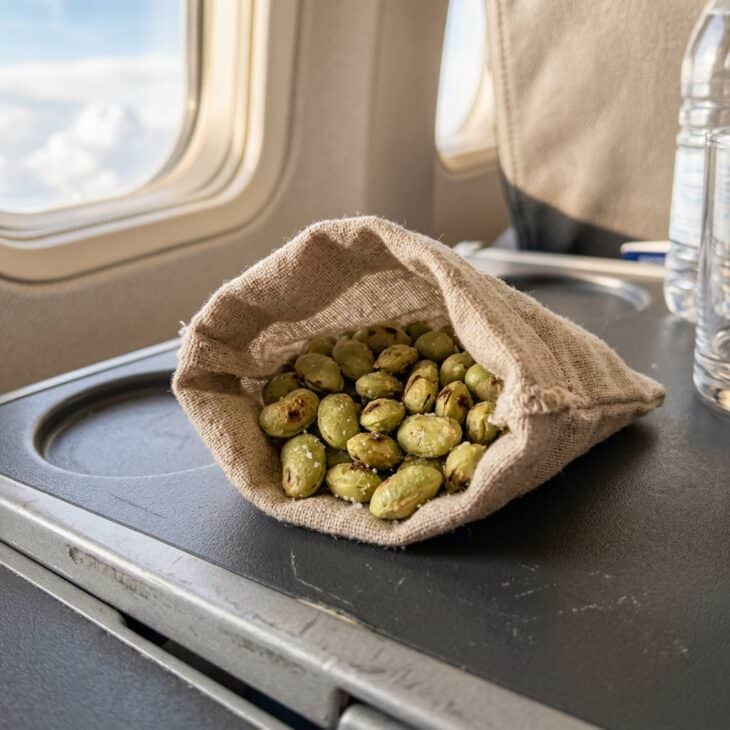
What you see Pale green roasted edamame with a dry, salted surface, sitting in an open cloth pouch on the tray table. They look like something between a nut and a pea, and they snap cleanly when you bite one.
Why it works Roasted edamame is one of the highest-protein plant snacks you can buy, with roughly 13 grams per serving, which puts it in the same league as jerky for staying power. It is also the ideal option for vegetarian travelers who want more than another handful of almonds, and it is completely nut-free, which matters on flights where a nut allergy has been announced.
How to get it Buy dry-roasted rather than freeze-dried, which has a much better crunch. Look for the lightly salted version, since some are aggressively seasoned and will leave you reaching for water on a flight where you are already dehydrated. They keep for months unopened, so buy a few packs and keep one in your travel bag. They are also quiet to eat, unlike chips, which is a real consideration on a red-eye where half the cabin is asleep. Portion into a small bag rather than taking a large pack you will finish out of boredom.
18. Chewing Gum and Mints for Your Ears
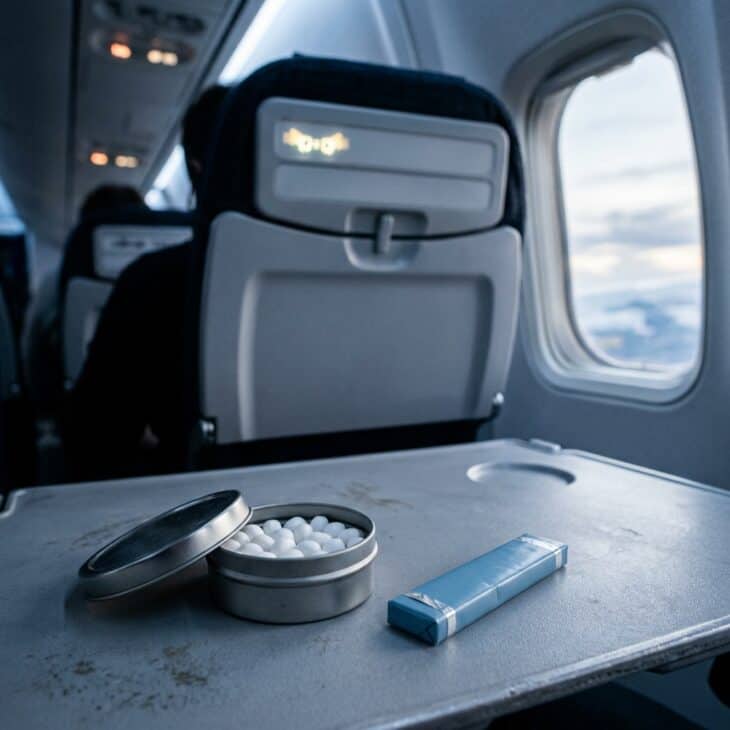
What you see An open tin of white mints and a strip of gum on the tray table, with the seatbelt sign glowing softly out of focus behind them. It is the smallest item you will pack and, on the wrong descent, the one you will be most grateful for.
Why it works Chewing and swallowing repeatedly opens the eustachian tube and equalises the pressure behind your eardrum, which is exactly the mechanism that goes wrong during descent. This is not folklore. It is the reason your ears pop on an airplane in the first place, and the reason a stick of gum is the cheapest comfort item in aviation. It also handles the stale-mouth feeling that eight hours in dry air produces.
How to get it Start chewing at the top of descent, not when your ears already hurt, because it is far easier to prevent the pressure difference than to fix it. Keep the pack in your seat pocket or jacket rather than in the overhead bin, since you may not be able to stand up when you need it. Sugar-free is the sensible choice on a long flight. For young children who cannot chew gum, a drink through a straw or a lollipop produces the same swallowing reflex. If you are flying with a cold, add a decongestant before boarding, since blocked sinuses make descent genuinely painful.
19. Electrolyte Tablets and an Empty Bottle
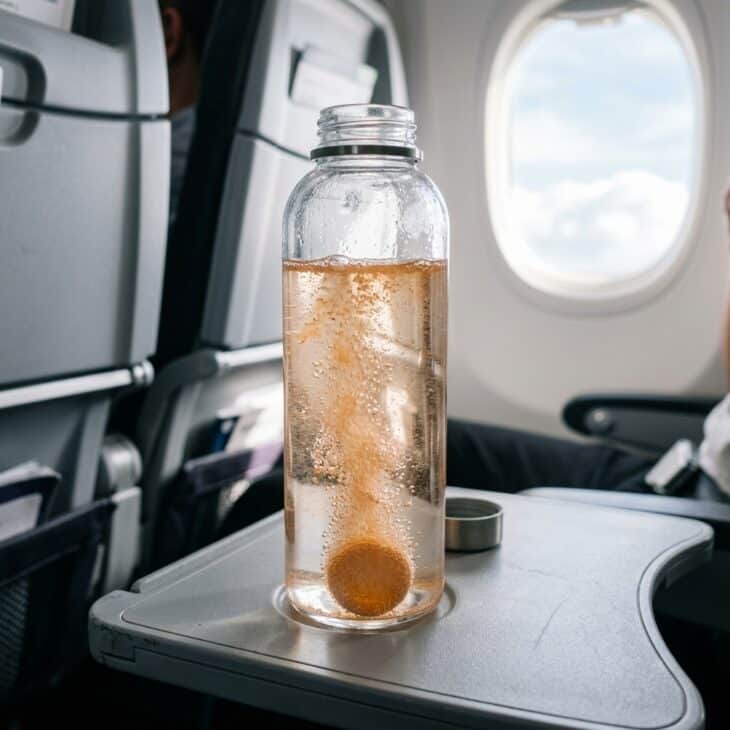
What you see A clear reusable bottle on the tray table with an electrolyte tablet fizzing away inside it, a faint orange color diffusing through the water and small bubbles climbing to the surface, backlit by the window. Technically not a snack. Practically, the most important thing on this list.
Why it works Cabin humidity typically sits between 10 and 20 percent, drier than most deserts, which is a direct consequence of the thin, cold outside air being compressed and heated to keep the cabin comfortable at the altitudes airliners actually cruise at. Most of what people describe as post-flight fatigue is straightforward dehydration. The little cups the crew hands out are not enough, and a bottle you refill yourself is the fix.
How to get it Bring an empty reusable bottle through security and fill it at a water fountain or refill station on the far side, which is free and legal everywhere. Drop in an electrolyte tablet once you are seated for a faster fix than plain water. Aim for roughly 250 millilitres of water per hour in the air, and skip or limit alcohol and coffee, both of which make it worse. Ask the crew to refill your bottle rather than accepting the small cups, since most are happy to do it. A collapsible bottle takes up almost no space once empty.
20. A Kids’ Compartment Snack Box
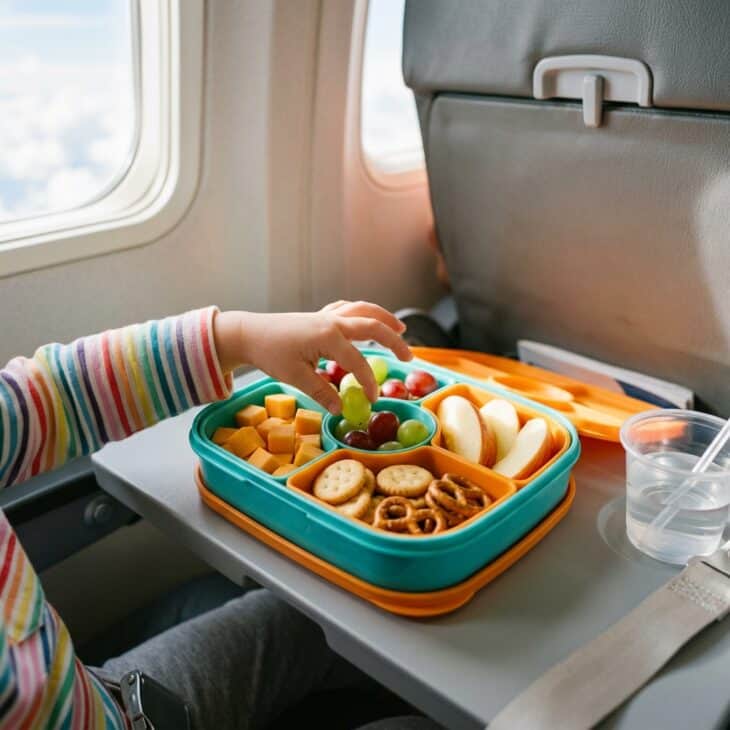
What you see A compartment box filled with cheese cubes, grapes, crackers, mini pretzels and apple slices, each in its own little section, with a small hand reaching in for a grape. Bright, orderly, and completely absorbing to a five year old.
Why it works For children, a compartment box is not just food, it is an activity. Working through the sections one at a time occupies real minutes of a flight, and the variety means one rejected item does not become a crisis. The same compartment trick that makes a snack tray work at an airplane birthday party works at 35,000 feet, for exactly the same reason: small portions of many things beat a large portion of one.
How to get it Use a bento box with a locking lid so it does not empty itself into your bag during turbulence. Fill five or six compartments with a mix of textures and colors, and include at least one thing you know they will definitely eat. Avoid anything that stains, anything with a stone or pit, and anything that shatters. Pack a second, hidden box for the descent, when boredom peaks and blood sugar dips. Bring wet wipes, because you will need them, and a small bag for the rubbish so the tray table stays usable.
21. Frozen Yogurt Tubes
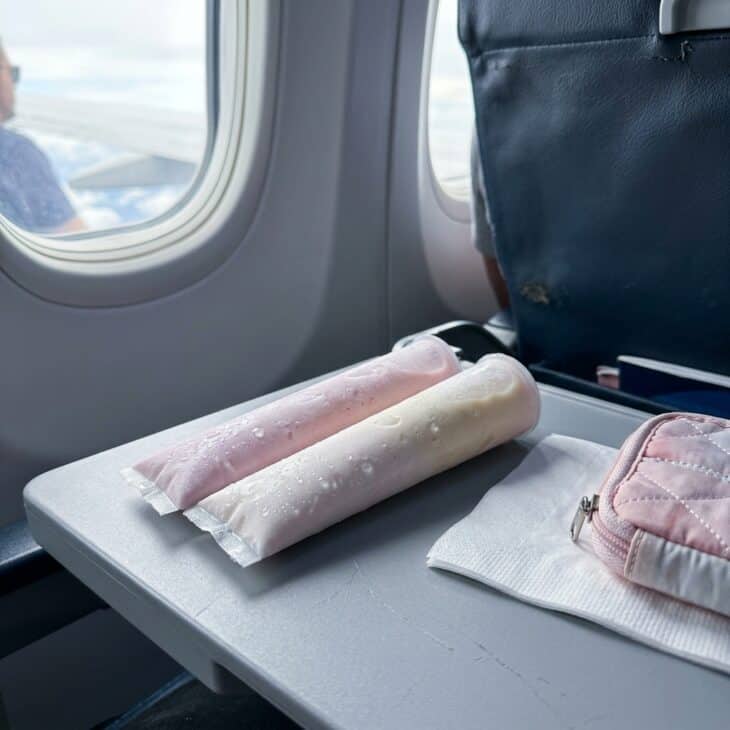
What you see Two yogurt tubes with a light frost still clinging to the plastic and condensation beading along the sides, lying next to a small insulated pouch. Cold, and on a hot afternoon flight that is a rarity worth engineering for.
Why it works Yogurt counts as a gel at security, which normally rules it out. Frozen solid, it does not: solid food is exempt from the liquids limit, and a frozen tube stays frozen long enough to pass the checkpoint and then thaws to perfect eating consistency around an hour into the flight. It doubles as an ice pack for everything else in the bag on the way there.
How to get it Freeze the tubes solid overnight, not for an hour, because partially frozen means slushy, and slushy means it is a liquid again in the eyes of a screening officer. Pack them in an insulated pouch to slow the thaw. Be prepared to explain them if you are selected for a bag check, and be prepared to lose them if the officer disagrees, since screening decisions are made case by case. This trick works for other frozen items too, including yogurt pots and small ice packs. Keep them upright and away from anything they should not drip on once they soften.
22. A Grown-Up Charcuterie Box for Long-Haul
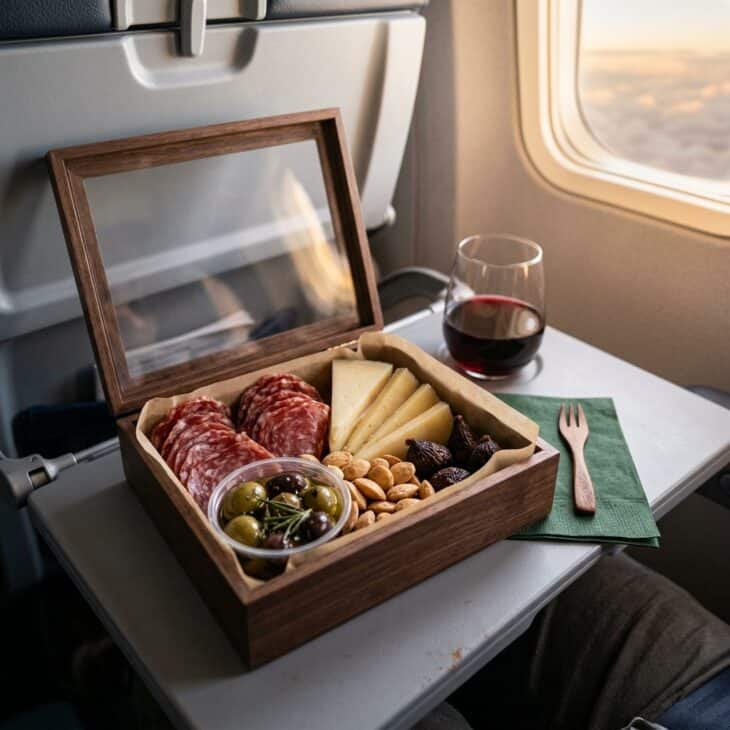
What you see Cured salami folded into rosettes, wedges of manchego, marcona almonds, a small sealed cup of olives and two dried figs, laid out on a tray table in the low evening light of a cabin somewhere over an ocean. It is a small act of defiance against the plastic-wrapped alternative.
Why it works On a ten hour flight, the difference between eating and dining is entirely psychological, and it is worth manufacturing. A charcuterie box turns a snack into an event that takes 40 minutes instead of four, which is 40 minutes of a long-haul you have pleasantly disposed of. Pair it with a good aviation book and the middle third of the flight, usually the worst part, takes care of itself.
How to get it Build it in a shallow rigid container so nothing gets crushed, and keep every element dry and firm: cured meat, hard cheese, nuts, dried fruit, and crackers packed separately so they stay crisp. Olives must go in a sealed cup under 3.4 ounces or they count as a liquid. Skip anything requiring a knife, since you will not have one. Assemble it the night before and keep it refrigerated until you leave. Remember that cured meat and cheese are frequently prohibited at international borders, so plan to finish it before you land.
Fresh food and international borders
Fresh fruit, vegetables, meat and dairy are restricted or banned on arrival in many countries, including the United States, Australia and New Zealand, and fines for an undeclared apple can run into the hundreds. Eat fresh items before landing, or declare anything left over. When in doubt, declare it: declaring costs you nothing, failing to declare can cost a lot.
23. Whole Fruit That Actually Survives Your Bag
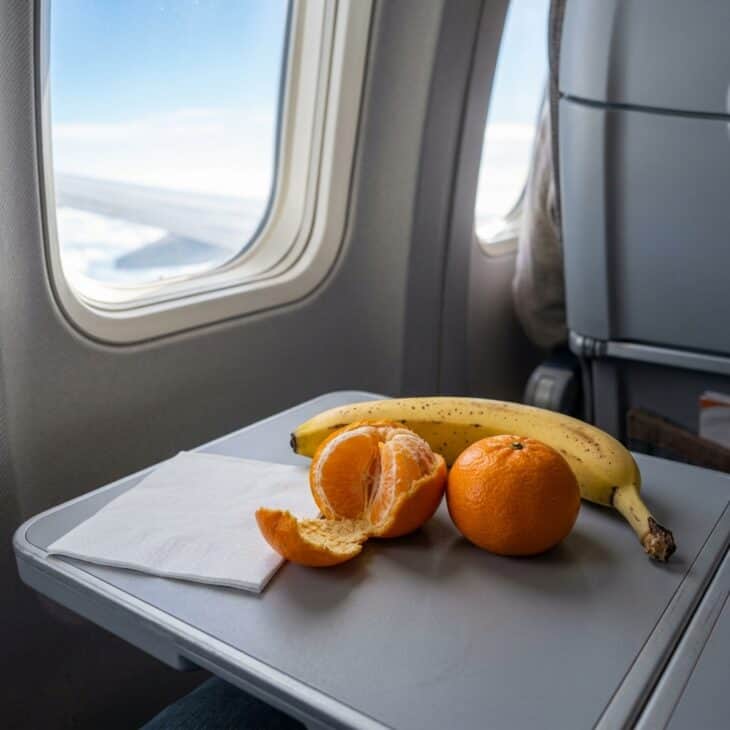
What you see Two mandarins and a firm banana on the tray table, one mandarin already half peeled, the orange and yellow almost aggressive against the grey plastic around them. Simple, free, and the thing your body is quietly asking for by hour three.
Why it works Whole fruit needs no container, no preparation, no security explanation and no cutlery. Mandarins in particular are close to the perfect flight snack: they peel cleanly, they come in their own packaging, the smell is fresh rather than intrusive, and they are mostly water, which helps with the dryness. They cost almost nothing and require zero planning.
How to get it Choose fruit that resists bruising: mandarins, oranges, firm apples and slightly underripe bananas. Avoid peaches, pears, berries and anything already ripe, which will be a wet mess by the time you are airborne. Wrap a banana in a napkin and keep it at the top of your bag, not the bottom. Take a small bag for the peel, since crew do not always come through with rubbish collection before descent. Most importantly, eat fresh fruit before you land on an international flight, because agricultural rules at many borders are strict and the penalties are real.
24. Bring Your Own Tea Bags for Red-Eyes
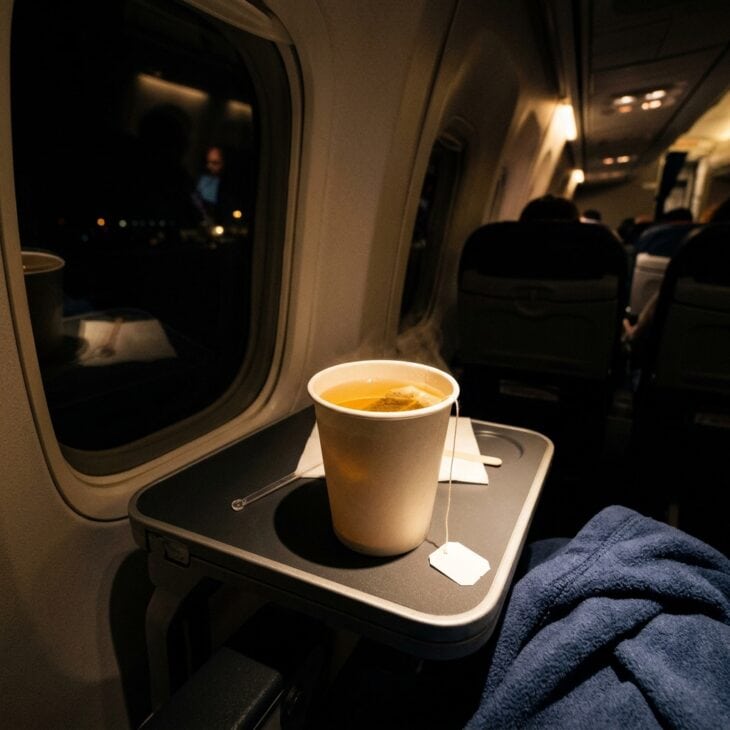
What you see A paper cup of pale chamomile tea glowing gold in a darkened cabin, the tag hanging over the rim, a folded blanket just in frame and the window beside it black except for a faint reflection of the reading lights. The entire flight is asleep and you are two minutes from joining it.
Why it works The tea on board is almost always ordinary black tea, which is the last thing you want on a night flight. A chamomile, rooibos or valerian bag from your own pocket costs nothing, weighs nothing, and turns free hot water into a genuine sleep ritual. On a red-eye flight, where the entire objective is to be unconscious as quickly as possible, that ritual is worth more than any snack.
How to get it Slip three or four caffeine-free bags into a side pocket of your carry-on and forget about them until you need one. Ask for hot water shortly after the meal service, before the crew dims the cabin and settles in. Skip anything with caffeine after boarding on a night flight, including green tea, which many people wrongly assume is caffeine-free. Pair it with an eye mask and earplugs for the full effect. Keep a peppermint bag in reserve for the morning, when you need the opposite result.
25. A Terminal Grab: Sushi, Onigiri or a Rice Bowl
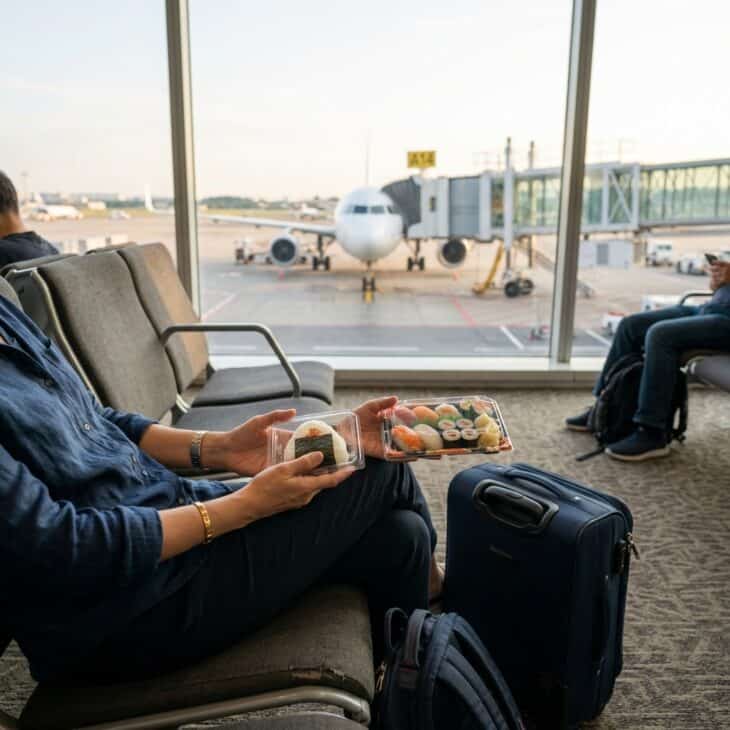
What you see A traveler at a gate seat holding a boxed rice ball and a small sushi pack, an aircraft parked at the jet bridge behind the glass in soft afternoon light, carry-on at their feet. Nothing was prepared at home, and the food is still better than anything that will be sold on board.
Why it works Not every trip allows for a night of meal prep, and buying after security is a completely legitimate strategy: solid food has no volume limit, so anything you buy airside can go straight onto the aircraft. Rice-based food in particular travels well, holds its texture at cabin temperature and does not smell strong. If you have hours to fill anyway, food is only one of the things to do on a long layover, and a good gate-side meal beats a rushed one every time.
How to get it Buy after security, never before, so nothing gets confiscated at the checkpoint. Choose cooked or vegetarian options over raw fish if the flight is long, since seafood held at cabin temperature for eight hours is not a gamble worth taking. Rice balls, cooked sushi rolls, bao and rice bowls all hold up well. Ask for the chopsticks and the napkins at the counter, because you will not find either on board. Do it early rather than at the last call, and use the spare time at the gate to watch the ramp: it is the best free show in the terminal, and a little plane spotting makes the wait disappear.
FAQ
Sources and references used for research and fact-checking.
- What Can I Bring? Food - Transportation Security Administration
- Prohibited and Restricted Items: Bringing Food into the United States - U.S. Customs and Border Protection
- Airline food tastes better with the right soundtrack - Cornell Chronicle
- Standard 161: Air Quality within Commercial Aircraft - ASHRAE
- Ear Barotrauma and Air Travel - American Academy of Otolaryngology, Head and Neck Surgery
Get the Newsletter
The latest aviation news and stories sent to your inbox.
About the Author

Hanna writes AeroCorner's aviation-lifestyle and decor guides, turning a love of flight into ideas for your home, celebrations, and gift lists.