


Table of Contents
The best four-engine passenger plane ever built is the Boeing 747. Boeing built 1,574 of them over 54 years, and no other quadjet comes close on numbers, longevity or impact.
Behind it come the Boeing 707 that launched the jet age, the Airbus A380 superjumbo and Concorde. The rest of the list runs from the first jetliner, the de Havilland Comet, to the Ilyushin Il-62.
Only three of the twelve still fly scheduled airline passengers in 2026, and in shrinking numbers: the 747, the A380 and the A340. Further down, we cover where they still fly and why airlines stopped buying four engines.
| Rank | Aircraft | First flight | Number built | Engines |
|---|---|---|---|---|
| 1 | Boeing 747 | 1969 | 1,574 | 4 turbofans |
| 2 | Boeing 707 (incl. 720) | 1957 | 1,010 | 4 jets |
| 3 | Airbus A380 | 2005 | 251 | 4 turbofans |
| 4 | Concorde | 1969 | 20 | 4 Olympus 593 turbojets |
| 5 | de Havilland Comet | 1949 | 114 | 4 turbojets |
| 6 | Douglas DC-8 | 1958 | 556 | 4 jets |
| 7 | Airbus A340 | 1991 | 377 | 4 turbofans |
| 8 | Lockheed Constellation family | 1943 | 856 | 4 piston engines |
| 9 | Vickers Viscount | 1948 | 445 | 4 turboprops |
| 10 | BAe 146 / Avro RJ | 1981 | 387 | 4 turbofans |
| 11 | Vickers VC10 | 1962 | 54 | 4 turbofans |
| 12 | Ilyushin Il-62 | 1963 | about 290 | 4 turbofans |
How this ranking works
Best is a judgment, so we weighed three things: what each aircraft changed in air travel, how many were built and flown, and how long it served. Only aircraft built to carry passengers qualify, which rules out four-engine bombers and military transports such as the C-130. Jets, turboprops and one piston airliner all count, because a searcher asking for four-engine planes means all of them.
1. Boeing 747

The 747 first flew on February 9, 1969, and entered service with Pan Am on January 22, 1970. It turned long-haul travel from a luxury into something ordinary people could afford.
Boeing had to build a new factory to make it. The Everett plant north of Seattle is still the largest building in the world by volume.
Capacity grew with each version. The original 747 typically seated 366 passengers in three classes, the 747-400 seated 416, and the final 747-8 Intercontinental seats 467.
Its famous hump is a partial upper deck, not a full second floor. That distinction belongs to the A380, further down this list.
The jumbo also took on jobs no other airliner could. Two modified 747-200Bs fly the US president as the VC-25A, and two NASA 747s carried the Space Shuttle on their backs as Shuttle Carrier Aircraft.
Production ran until the 1,574th and final 747, a 747-8F freighter, was delivered to Atlas Air on January 31, 2023. Nicknamed the Queen of the Skies, it earned the top spot on longevity alone.
The 747 that beat a 41-year record
In February 2020, a British Airways 747 crossed the Atlantic in 4 hours 56 minutes, the fastest crossing ever by a subsonic airliner. The record it broke had stood since 1979, and it belonged to another quadjet on this list: the Vickers Super VC10.
2. Boeing 707

The Boeing 707 is the airliner that made jet travel normal. Its prototype, the Dash 80, flew on July 15, 1954, and the production 707 followed on December 20, 1957.
Pan Am flew the first commercial 707 service on October 26, 1958, from New York’s Idlewild Airport to Paris with a fuel stop in Gander. It also started the 7×7 naming habit, which we explain in why Boeing plane models start with a 7.
Boeing built 1,010 aircraft in the family, including 154 Boeing 720s. The 720 was a lighter, shorter-range version that first flew on November 23, 1959, and entered service with United Airlines on July 5, 1960.

The first 720 built, N7201U, later became The Starship, the private airliner Led Zeppelin toured America in during the 1970s. Few jets have a better rock and roll story.
3. Airbus A380
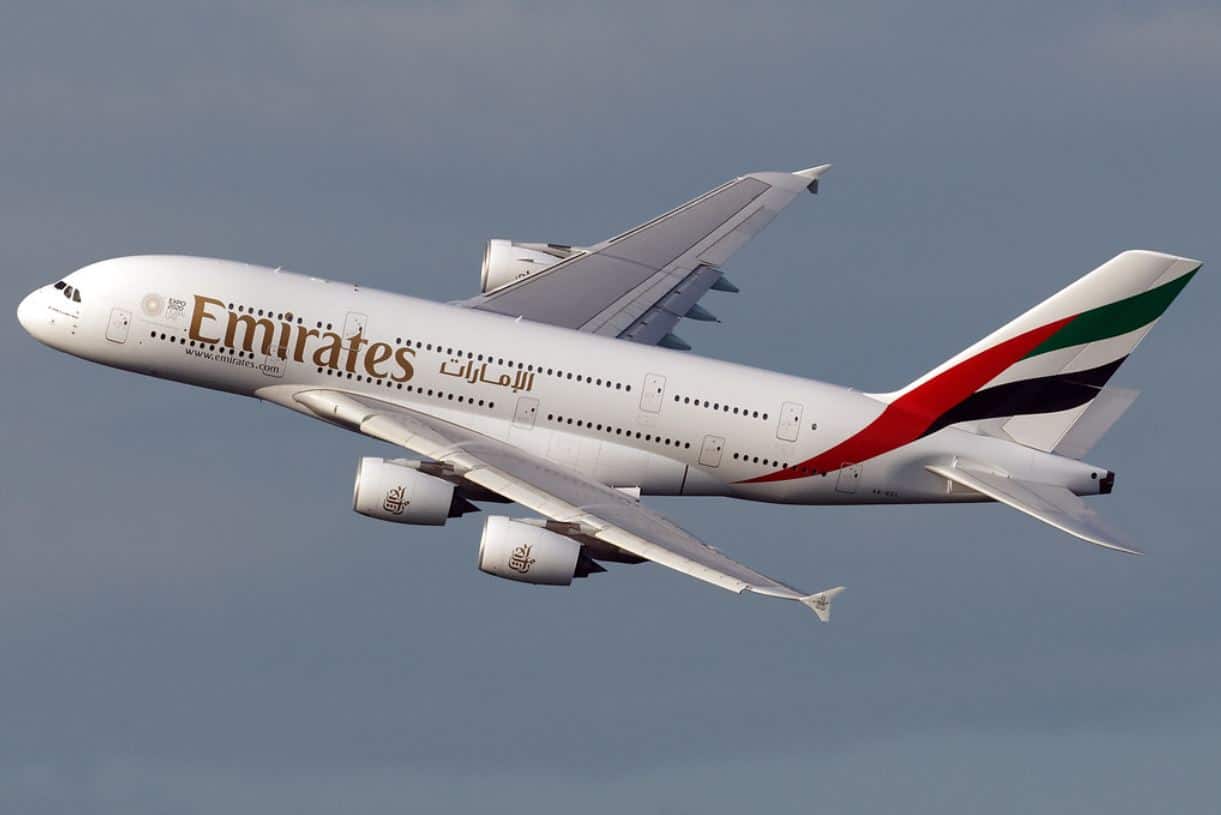
The Airbus A380 is the largest passenger airliner ever built and the only full-length double-deck jet airliner. Airbus quotes a typical layout of 525 seats, and it is certified for up to 853.
It first flew on April 27, 2005, and entered service with Singapore Airlines on October 25, 2007, between Singapore and Sydney.
Its safety record is spotless: no A380 has ever been lost in an accident. The closest call was Qantas Flight 32 in November 2010, when an engine suffered an uncontained failure and the crew landed safely with no injuries.
Airlines, though, struggled to fill it. Airbus delivered only 251, the last to Emirates on December 16, 2021, and the estimated $25 billion development cost was never recouped, a story told in airplanes that were too big.
4. Concorde

Concorde first flew on March 2, 1969, and entered service with Air France and British Airways on January 21, 1976. It cruised at about Mach 2.02, roughly 1,340 mph (2,160 km/h), with about 100 passengers aboard.
Its four Rolls-Royce/Snecma Olympus 593 engines used afterburners only for takeoff and to push through the transonic range. Once supersonic, it cruised without them.
On February 7, 1996, a British Airways Concorde flew from New York to London in 2 hours, 52 minutes and 59 seconds, helped by a strong tailwind. No airliner has crossed faster.
Only 20 were built, including six prototype, pre-production and development aircraft. After the Air France Flight 4590 crash on July 25, 2000, which killed all 109 aboard and four people on the ground, Air France retired its fleet in May 2003 and British Airways followed on October 24, 2003.


What about the Tupolev Tu-144?
The Soviet Tu-144 flew first, on December 31, 1968, two months before Concorde, and an early version reached Mach 2.35. But its first engines needed afterburner even in cruise, its range was short, and it carried passengers on only 55 scheduled flights between November 1977 and June 1978. Concorde flew scheduled supersonic service for 27 years, which is why it makes this list and the Tu-144 does not.
Sixteen airworthy Tu-144s were built. One found a second life as NASA’s Tu-144LL flying laboratory for supersonic research between 1996 and 1999.
5. de Havilland Comet
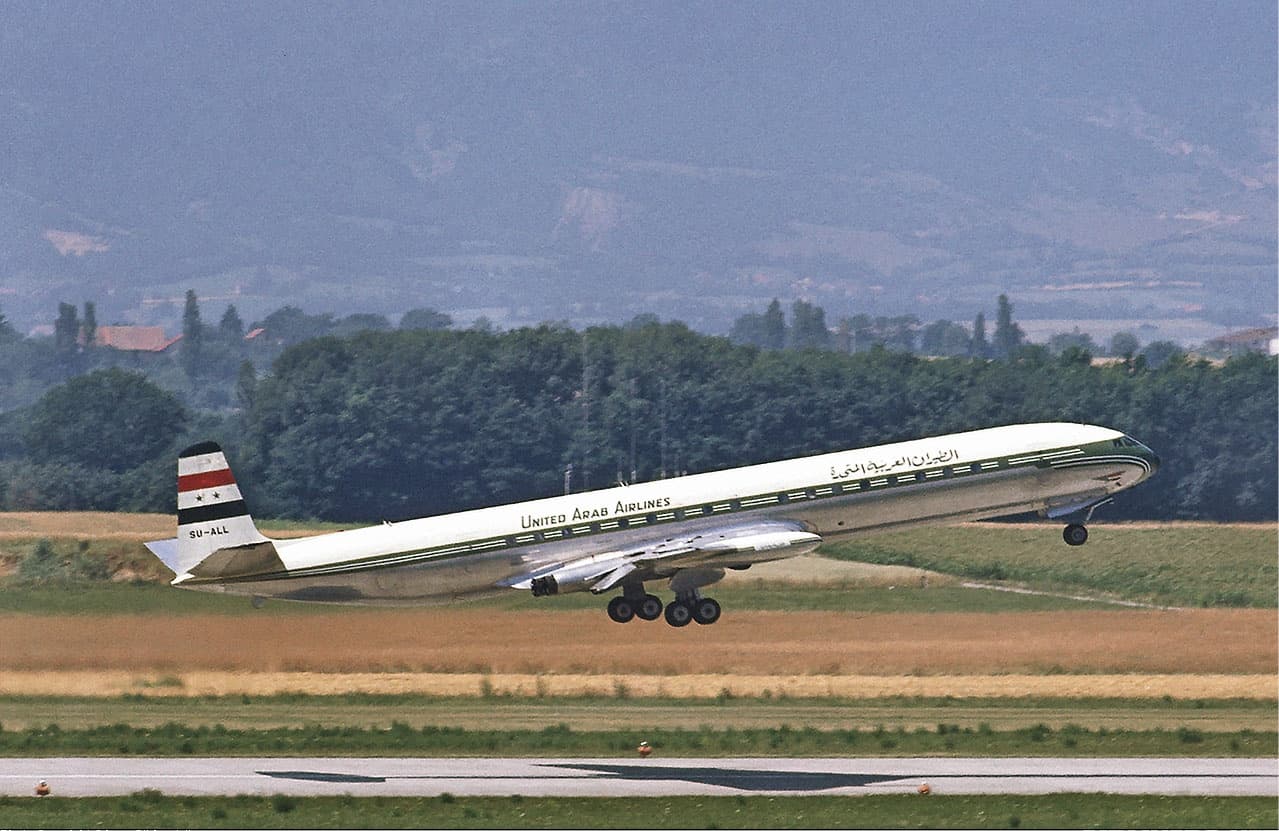

The de Havilland Comet was the world’s first jetliner. It first flew on July 27, 1949, with four de Havilland Ghost turbojets buried in its wing roots.
On May 2, 1952, a BOAC Comet flew the first jetliner service with fare-paying passengers, from London to Johannesburg.
Then two Comets were lost within three months in 1954, off Elba and near Naples, and the fleet was grounded. Investigators traced the cause to metal fatigue around square cut-outs for the direction-finding antennas above the cockpit, not the passenger windows often blamed.
The redesigned Comet 4 opened the first regular transatlantic jet service on October 4, 1958, three weeks before Pan Am’s 707. In all, 114 Comets were built, and the RAF’s Nimrod derivative flew until 2011.
6. Douglas DC-8

The Douglas DC-8 was the 707’s great rival. It first flew on May 30, 1958, and entered service with Delta and United on September 18, 1959.
On August 21, 1961, a DC-8-43 went supersonic in a dive, reaching Mach 1.012. It became the first civilian jet to fly faster than sound, years before Concorde.
The stretched DC-8-61 of the late 1960s could seat 259 passengers in a high-density layout. Douglas built 556 DC-8s before production ended in 1972.
7. Airbus A340

The Airbus A340 was Airbus’s long-range quadjet. It first flew on October 25, 1991, and entered service with Lufthansa and Air France on March 15, 1993.
Its range set records. From 2004 to 2013, Singapore Airlines flew an A340-500 nonstop between Newark and Singapore, a flight of a little over 18 hours.
Airbus ended the program after delivering 377. Lufthansa remains the largest operator, with 16 active A340s in February 2026.
8. Lockheed Constellation

Before jets, the most glamorous way to cross an ocean was a Lockheed Constellation. Its curving fuselage and distinctive triple tail made it instantly recognizable.
The first Constellation flew on January 9, 1943, and most were powered by four Wright R-3350 Duplex-Cyclone radial engines. Lockheed built 856 Constellations between 1943 and 1958.
The stretched L-1049 Super Constellation first flew in 1950 and became the best-selling version, with 579 built for airlines and the military. The final L-1649 Starliner entered service in 1957, just as the jets arrived.
9. Vickers Viscount

The Vickers Viscount brought turbine power to short-haul flying. It first flew on July 16, 1948, on four Rolls-Royce Dart turboprops.
British European Airways launched the world’s first scheduled turboprop airline service with it on April 18, 1953.
Vickers built 445 Viscounts, more than any British jet airliner. It was one of the most successful and profitable transport aircraft of the postwar years.
10. BAe 146 / Avro RJ

The BAe 146 proved four engines could work on a small regional jet. It first flew on September 3, 1981, and Dan-Air launched it in 1983.
The original 146 used four Lycoming ALF 502 turbofans, and the later Avro RJ switched to Honeywell LF 507s. Most versions seat up to 112 passengers, and it was chosen for its ability to use small city airports such as London City.
From 1986, The Queen’s Flight used three BAe 146-100s to carry members of the Royal Family. With 387 built, the 146 and RJ family is the most successful British civil jet airliner program.
Swiss retired the last of its RJ100s in 2017, but the type still works hard. Converted 146s and RJ85s fight wildfires in North America, and National Jet Express flies 146 freighters for Qantas Freight in Australia.
11. Vickers VC10

The Vickers VC10 was built for hot, high African airports, where its four rear-mounted Rolls-Royce Conway engines gave it excellent hot-and-high performance. It first flew on June 29, 1962, and entered service with BOAC on April 29, 1964.
A Super VC10 set the fastest Atlantic crossing by a subsonic airliner, 5 hours and 1 minute, in 1979. That record stood for 41 years.
Only 54 were built, but the VC10 had a long second career as an RAF tanker and transport. The last ones retired on September 20, 2013.
12. Ilyushin Il-62

The Ilyushin Il-62 was the Soviet answer to the long-range jetliner, with four rear-mounted engines like the VC10. It first flew on January 3, 1963, and Aeroflot opened service with it on September 15, 1967, from Moscow to Montreal.
It could seat up to 198 passengers in a single-class layout. The factory records 292 built, while other counts put production at about 289.
Russia removed its Il-62s from scheduled passenger flights in late 2008. A handful still fly for governments, including Russia’s and North Korea’s, where Air Koryo operates the government’s Il-62Ms.
Which four-engine passenger planes still fly in 2026?
Three quadjets still carry airline passengers. The A380 is the biggest group: 189 of the 251 built were in service with 12 operators in May 2025, and Emirates alone had about 116.
The A340 is fading fast. In February 2026, 71 were in active service with 27 operators, and Lufthansa plans to retire its A340-600s in autumn 2026 and its A340-300s by 2028.
Passenger 747s are rarer still. In early 2024, Lufthansa, Air China, Saudia and Korean Air were the last airlines flying the jumbo on regular passenger routes, and that list keeps shrinking as freighters carry the type on.
Why airlines stopped buying four-engine planes
For decades, long routes over oceans were restricted to three- and four-engine aircraft. If an engine failed far from land, the extra engines were the safety margin.
ETOPS rules changed that. In 1995 the Boeing 777 became the first airliner cleared at entry into service to fly 180 minutes from the nearest diversion airport, and in 2014 the Airbus A350 received a 370-minute rating covering 99.7% of the Earth’s surface.
With two engines now trusted on almost any route, airlines moved to twins, and both the 747 and the A380 ended production without a four-engine successor. Bigger engine counts are rarer still, as our guide to the best airplanes with six engines shows.
FAQ
Sources and references used for research and fact-checking.
- Wikipedia, Boeing 747
- Wikipedia, Boeing 747-8
- Wikipedia, Boeing 747-400
- Wikipedia, Boeing Everett Factory
- Wikipedia, Boeing 707
- Wikipedia, Boeing 367-80
- Wikipedia, Boeing 720
- Wikipedia, Airbus A380
- Wikipedia, Concorde
- Wikipedia, Tupolev Tu-144
- Wikipedia, de Havilland Comet
- Wikipedia, Douglas DC-8
- Wikipedia, Airbus A340
- Wikipedia, Singapore Airlines Flights 21 and 22
- Wikipedia, Lockheed Constellation
- Wikipedia, Lockheed L-1049 Super Constellation
- Wikipedia, Lockheed L-1649 Starliner
- Wikipedia, Vickers Viscount
- Wikipedia, British Aerospace 146
- SWISS, SWISS retires its last Avro RJ100
- Wikipedia, Vickers VC10
- Wikipedia, Ilyushin Il-62
- Aviacionline, Another airline schedules the final flight for its passenger Boeing 747s
- Wikipedia, ETOPS
- Wikipedia, Boeing 777
- Wikipedia, McDonnell Douglas MD-11
- Dassault Aviation, Falcon aircraft lineup
Get the Newsletter
The latest aviation news and stories sent to your inbox.
About the Author

Salomon has been interested in aviation ever since his parents took him on a Boeing 720 to see his relatives. When he’s not writing his latest aviation article, he can be found planespotting, reading up on on aviation news or in the cockpit of his favorite aircraft!