

Table of Contents
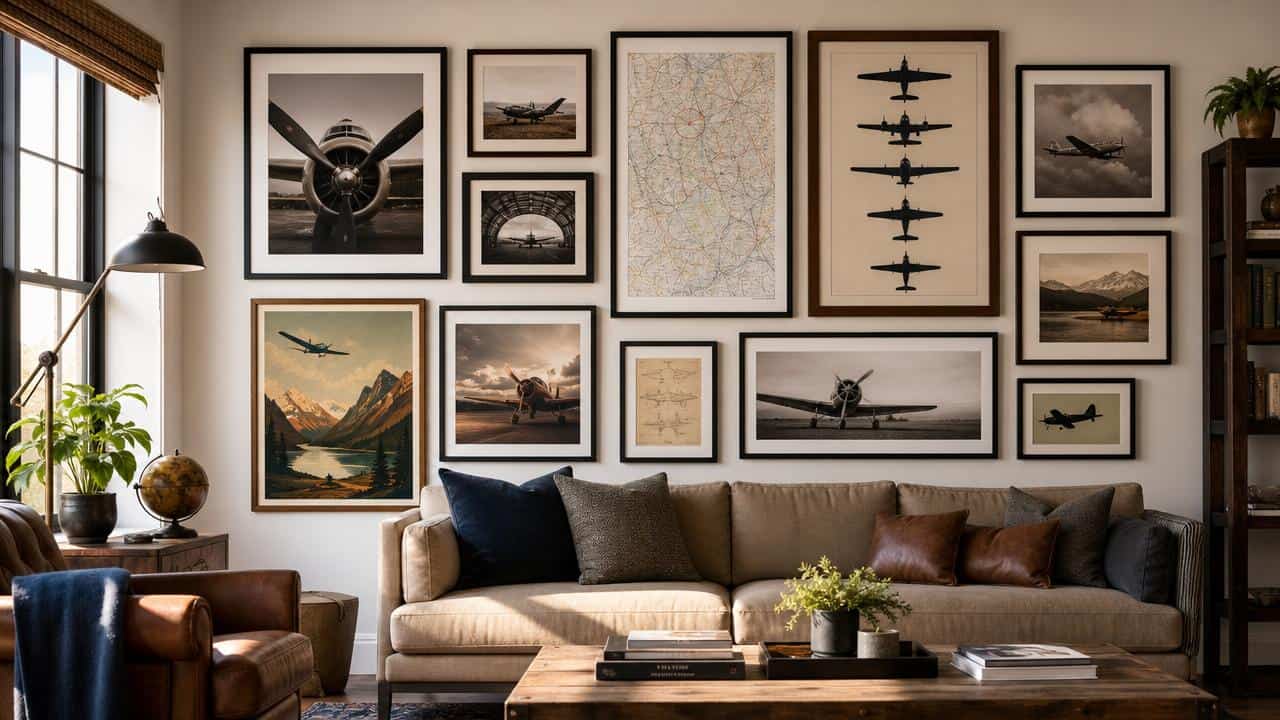
A single aviation print can feel like an afterthought, but a gallery wall turns the same interest into a real design statement. Grouping several pieces together gives a room depth, rhythm, and a story that one frame alone rarely tells.
Gallery walls also solve a practical problem: they let you mix formats. Photos, charts, model shadow boxes, and travel posters can share one wall without looking cluttered, as long as the layout ties them together.
Use these aviation gallery wall ideas as starting layouts. Pick one arrangement style, settle on a palette or frame finish before you start hanging, and plan the full composition on the floor first.
01. The Classic Grid Layout
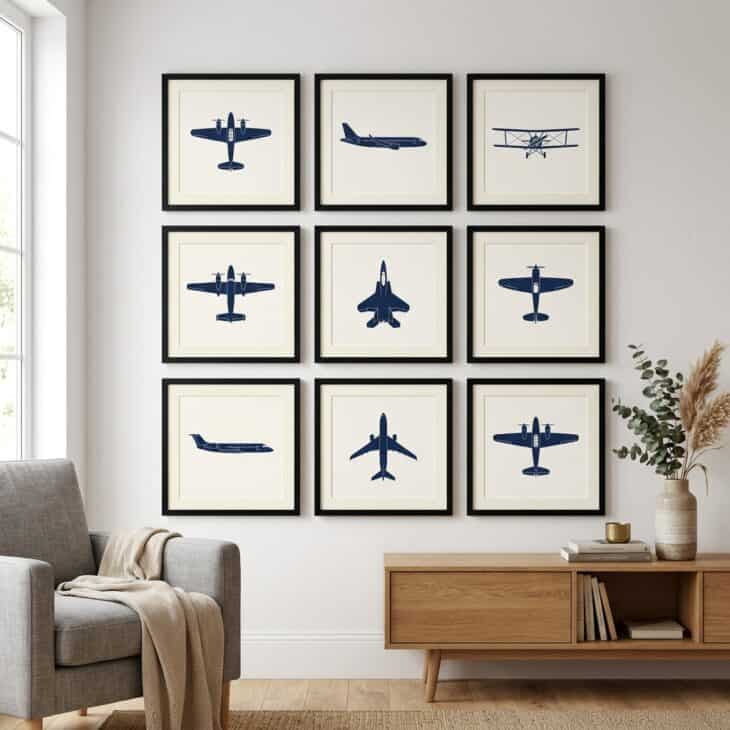
What you see Nine identical black frames hold nine different aircraft silhouettes, each drawn in the same navy line style. Even margins and equal spacing make the whole wall read as one composed piece rather than nine separate prints.
Why it works A grid is the most forgiving layout for beginners because every measurement repeats. It also suits collectors who want to keep adding prints later, since the pattern can extend in either direction.
How to get it Buy same-size frames from one product line so depth and molding match exactly. Mark the wall with painter’s tape at consistent 2 to 3 inch gaps before hammering a single nail. Hang the center row at eye level, then build outward symmetrically.
02. Salon-Style Mixed Frame Wall
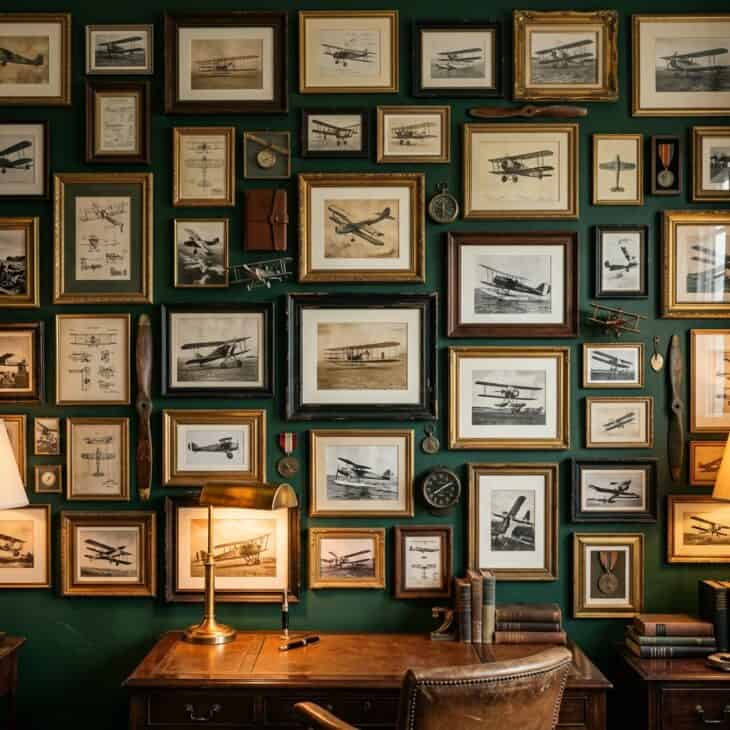
What you see Dozens of frames in gold, walnut, and black climb a deep green wall with almost no visible gap between them. Sizes and orientations vary, but every piece connects back to flight.
Why it works Salon-style walls thrive on variety, which makes them ideal for anyone collecting pieces over years rather than buying a set at once. It fits naturally alongside other vintage aviation decor already in the room.
How to get it Lay every piece on the floor first and rearrange until the color and size balance feels right. Anchor the layout with two or three larger pieces, then fill gaps with smaller frames. Keep the outer edge roughly rectangular so the cluster still reads as one shape.
03. Sectional Chart Anchor Wall
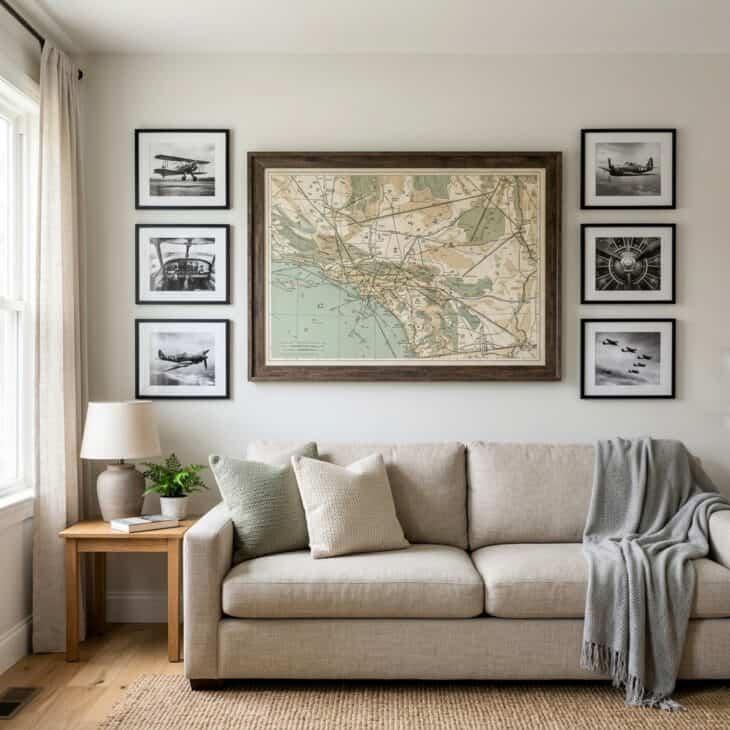
What you see One large sectional chart sits dead center, its muted terrain colors surrounded by six matching black-framed photographs. The smaller prints orbit the chart in a loose ring rather than a strict grid.
Why it works Sectional charts already have the rich detail of a piece of aviation wall art, so giving one center stage lets smaller, quieter prints support it without competing for attention.
How to get it Choose a retired chart, since current editions should stay available for actual flight planning. Frame it under UV-filtering acrylic first, hang it at the visual center of the wall, then arrange the smaller prints around it using consistent 3-inch spacing.
04. Black-and-White Photography Staircase Wall
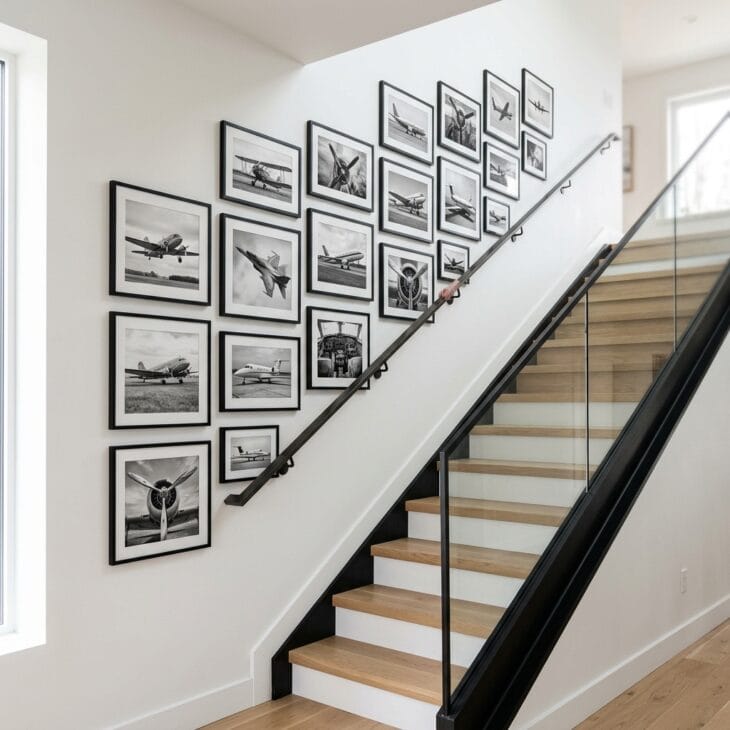
What you see A row of slim black frames follows the staircase at a steady diagonal, each holding a monochrome aircraft photograph. The uniform frame width keeps the eye moving smoothly up the stairs.
Why it works Staircases are awkward to decorate because the wall angle keeps changing, and a repeating diagonal line solves that instantly. Black-and-white photography also reads well from a distance, which matters on a wall people usually pass rather than study.
How to get it Use your own window seat photos converted to black and white, or licensed stock photography. Cut a paper template of the staircase angle, mark consistent frame centers along it, then hang frames working from the bottom step upward.
05. Push-Pin Travel Map Gallery Wall
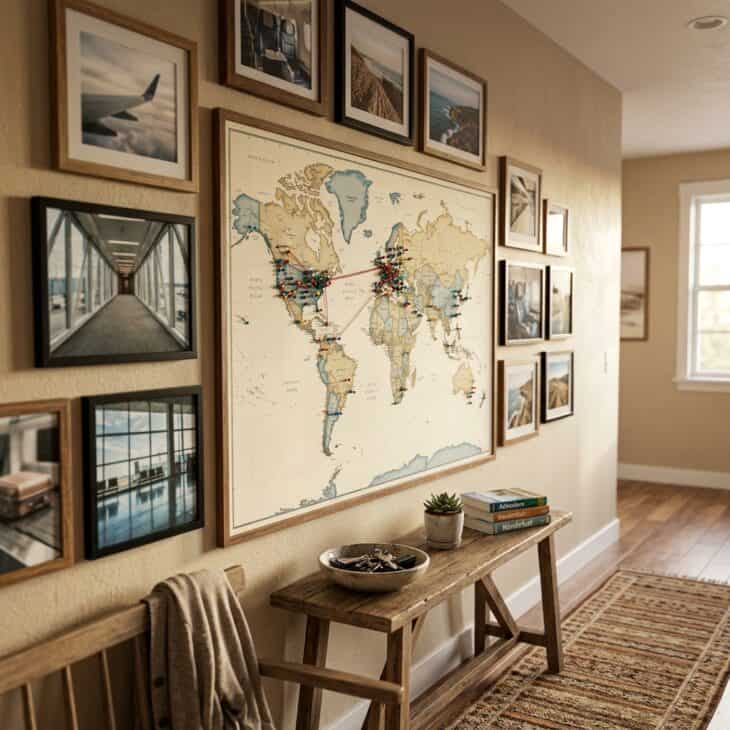
What you see A large canvas or corkboard map dominates the center of the wall, dotted with colored pins. Framed trip photos surround it in a loose, informal cluster rather than a strict pattern.
Why it works The map turns the wall into a running record rather than a fixed display, which suits anyone chasing an aviation bucket list. Guests naturally start conversations about the trips behind each pin.
How to get it Choose a large-format map poster or canvas and mount it centrally. Add pins as trips happen rather than filling the map at once. Frame four to eight photos in matching thin frames and space them evenly around the map’s outer edge.
Plan on the floor first
Before any wall goes up, lay the full arrangement out on the floor or a large table. It is far easier to move paper or frames than to patch extra nail holes.
06. Vintage Travel Poster Trio
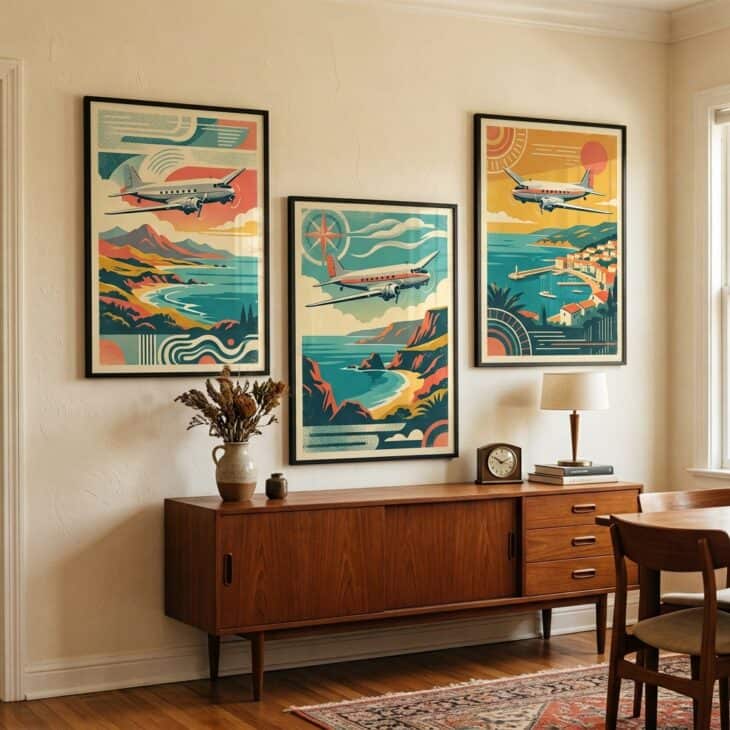
What you see Three bold posters hang at slightly staggered heights, each showing a stylized silver airliner over a different imagined coastline. Matching black frames keep the varied colors from feeling chaotic.
Why it works Golden-age posters carry the same optimistic energy that made early airliners like the Douglas DC-3 feel glamorous, and a trio gives that energy room to breathe without overwhelming the wall.
How to get it Buy licensed reproductions from a reputable print seller rather than scanning copyrighted originals. Choose three posters that share one dominant color, stagger their heights by 4 to 6 inches, and center the group over the table.
07. Playroom Airplane Gallery Wall
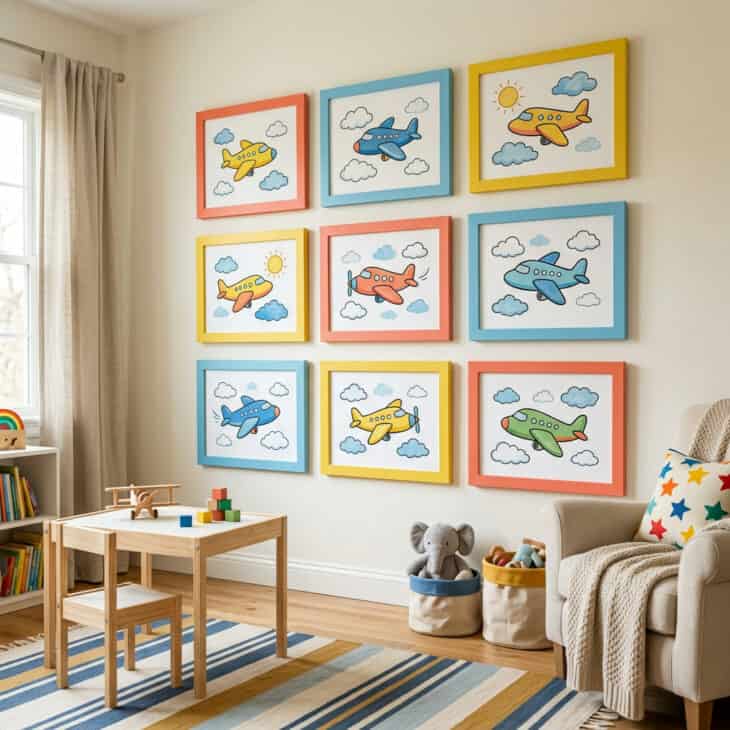
What you see Cheerful cartoon airplanes and puffy clouds fill a cluster of colorful frames, hung noticeably lower than a standard adult gallery wall. Yellow, sky blue, and coral repeat across the frames to tie the group together.
Why it works Hanging art at a child’s eye level makes the wall feel like it belongs to them, extending the same idea behind an airplane nursery into an older kid’s playroom. Bright, simple shapes also hold up to years of a child pointing at them.
How to get it Use inexpensive removable print sets so the display can grow with the child. Hang the center of the cluster around 40 inches from the floor rather than the usual 57-inch adult standard. Choose washable frames since little hands will touch them.
08. Propeller-Anchored Asymmetrical Wall
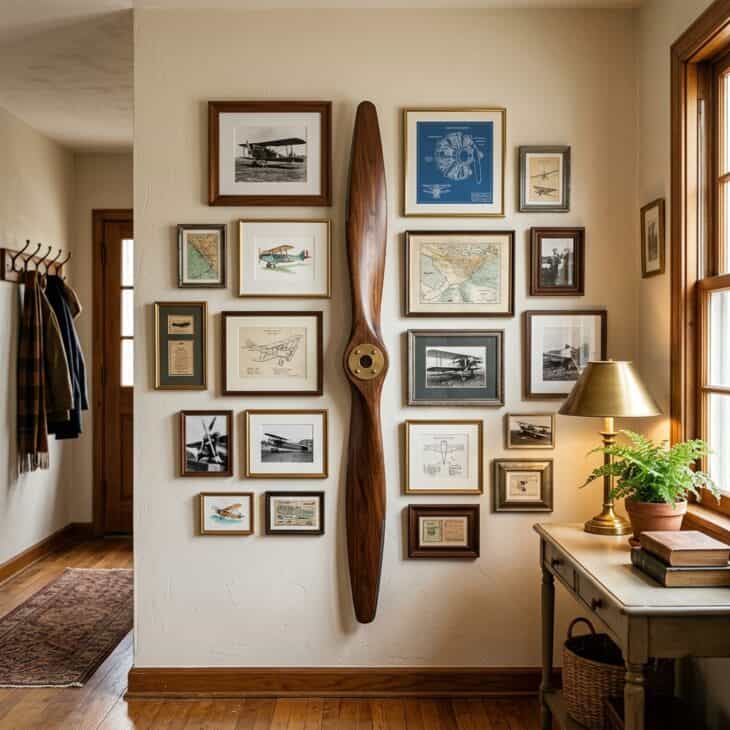
What you see A dark walnut propeller stands upright off to one side, its curved blades catching warm light. Smaller framed prints cluster loosely around it in an offset, unbalanced arrangement.
Why it works A single sculptural object like a propeller gives an asymmetrical wall a clear focal point, which is what keeps the twist that helps airplane propellers move air from feeling like decoration alone. The rest of the wall can then stay relaxed and uneven.
How to get it Choose a lightweight decorative replica propeller and mount it first on a concealed metal bracket. Add smaller frames around it gradually, keeping the overall shape loosely triangular so the arrangement feels intentional rather than random.
09. Cockpit Instrument Dial Grid
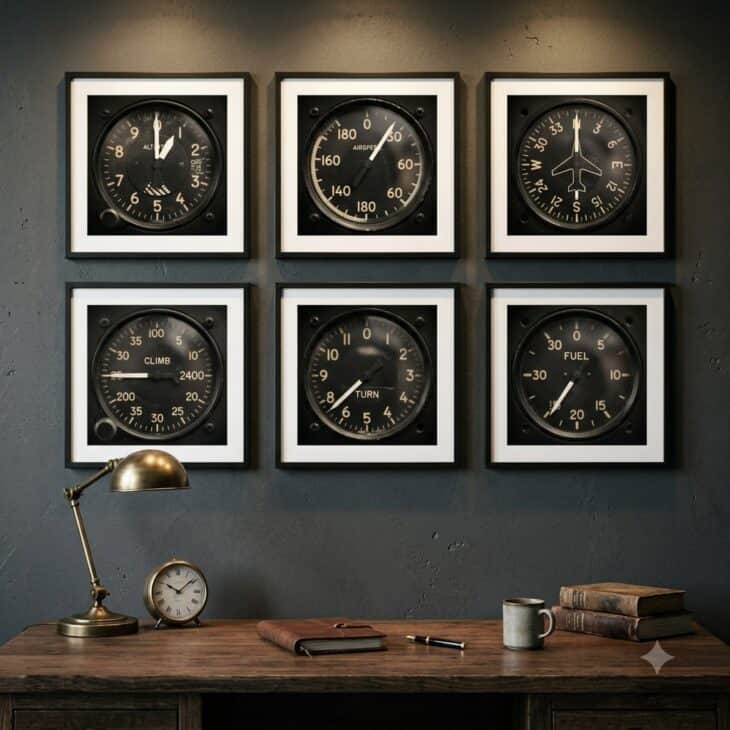
What you see Six square black frames hold close-up photographs of aged instrument dials, each cropped so the circular face fills the frame. Uniform spacing and a matched monochrome palette keep the grid feeling deliberate.
Why it works Enlarged this way, dials read as abstract graphic shapes rather than cockpit clutter, which suits anyone curious about how real cockpit instruments work. The repeating circles also give an office wall a satisfying rhythm.
How to get it Source macro photography from a licensed aviation photographer or museum print shop. Order six matching square frames and prints at identical crops. Hang them in two rows of three with equal gaps, centered above the desk.
10. Boarding Pass and Ticket Stub Shadow Box Wall
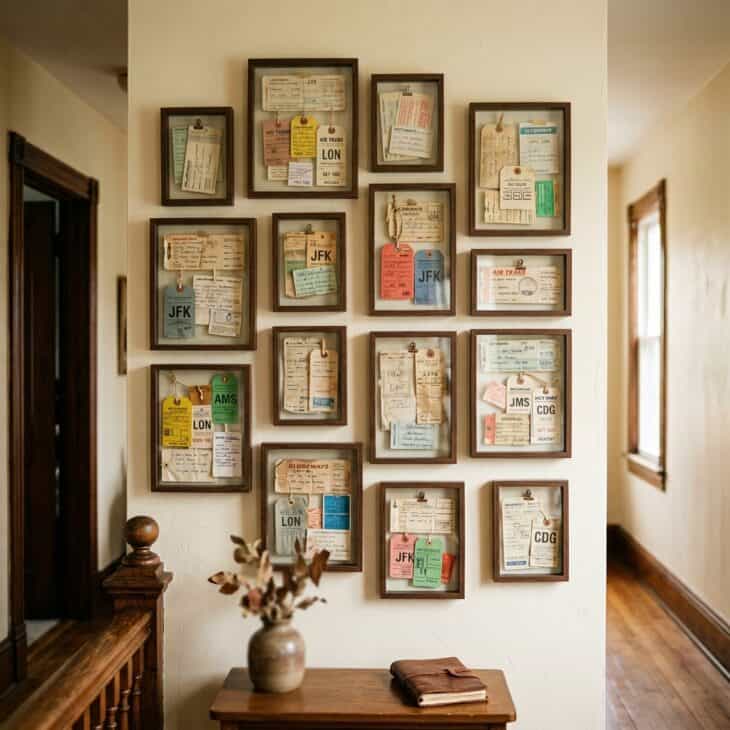
What you see Slim glass shadow boxes hold real paper keepsakes: boarding stubs, luggage tags, a folded ticket sleeve. They sit in a loosely staggered grid, close enough together to read as one collection.
Why it works Unlike printed art, these pieces are genuinely yours, turning a wall into a record of real trips the way a stack of stubs from a long layover never quite manages on a shelf. That personal history is what makes visitors linger and ask questions.
How to get it Save physical stubs and tags for a year before starting, since a sparse shadow box wall looks unfinished. Use acid-free mounting inside each box to keep paper from yellowing. Arrange boxes in a staggered grid with 2-inch gaps, largest keepsakes in the center.
11. Horizontal Row Above a Console Table
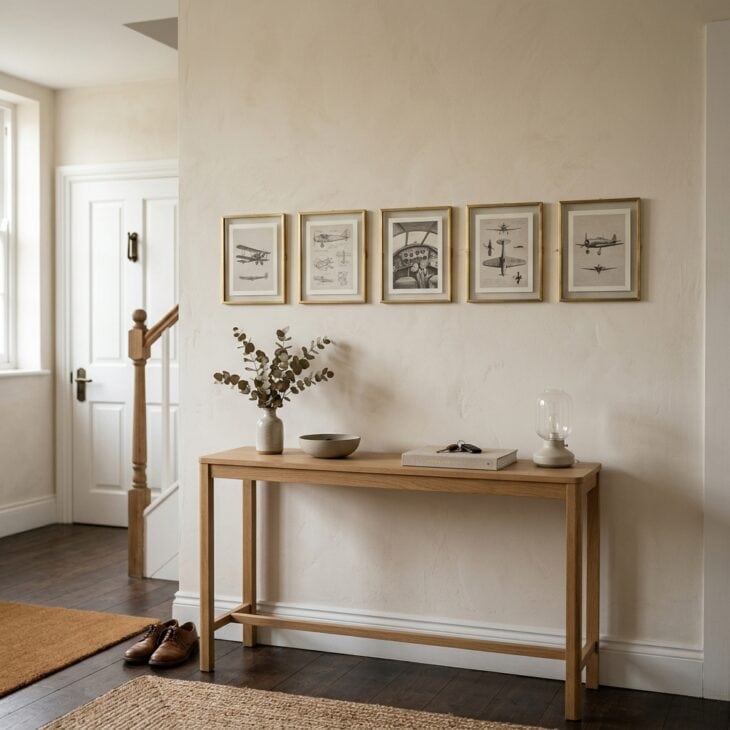
What you see Five small brass-framed prints line up in one straight horizontal row, spaced evenly above a narrow console table. The restrained layout leaves plenty of open wall above and below.
Why it works A single row is the easiest layout to keep level and the least visually demanding, which suits a busy entryway or an aviation home office where the wall shouldn’t compete with the desk below it. It also reads well from either end of a hallway.
How to get it Measure the console’s width and keep the row about two-thirds that length. Space frames 3 inches apart and center the row roughly 4 inches above the furniture. Hang the outer frames first, then fill in evenly toward the middle.
12. Model Aircraft Shadow Box Cluster
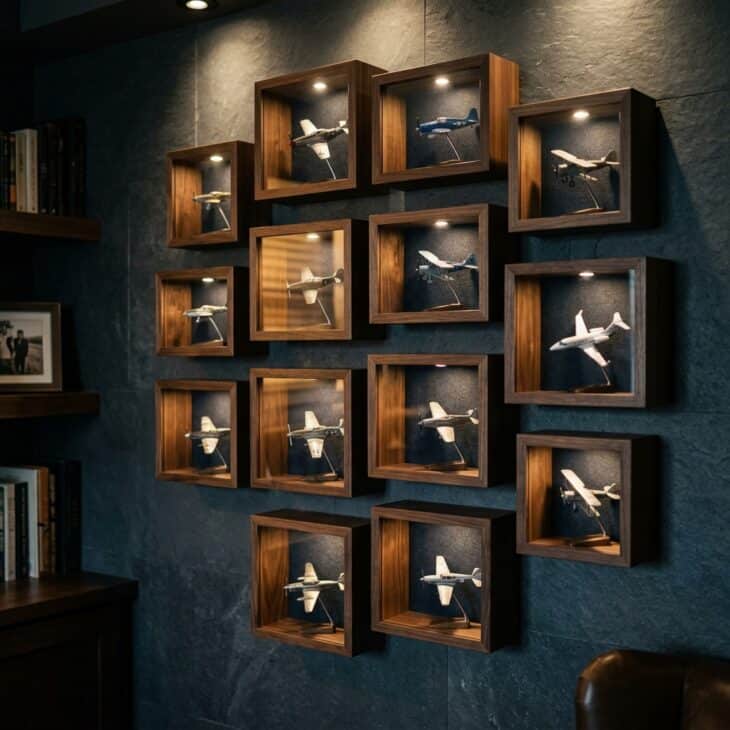
What you see Six deep glass-front boxes each hold one small model aircraft, angled slightly for visual interest. Focused accent lighting picks out the models against the slate-gray wall.
Why it works Mounting models on the wall frees up shelf space while protecting them from dust, extending the same collector logic behind model airplane display ideas into a true gallery format. Glass fronts also let the models double as sculptural wall art.
How to get it Buy deep shadow boxes sized to your largest model plus clearance for the stand. Use a small dot of museum wax to secure each model against vibration. Cluster boxes in an uneven grid, keeping at least 2 inches between edges.
13. Technical Blueprint Wall
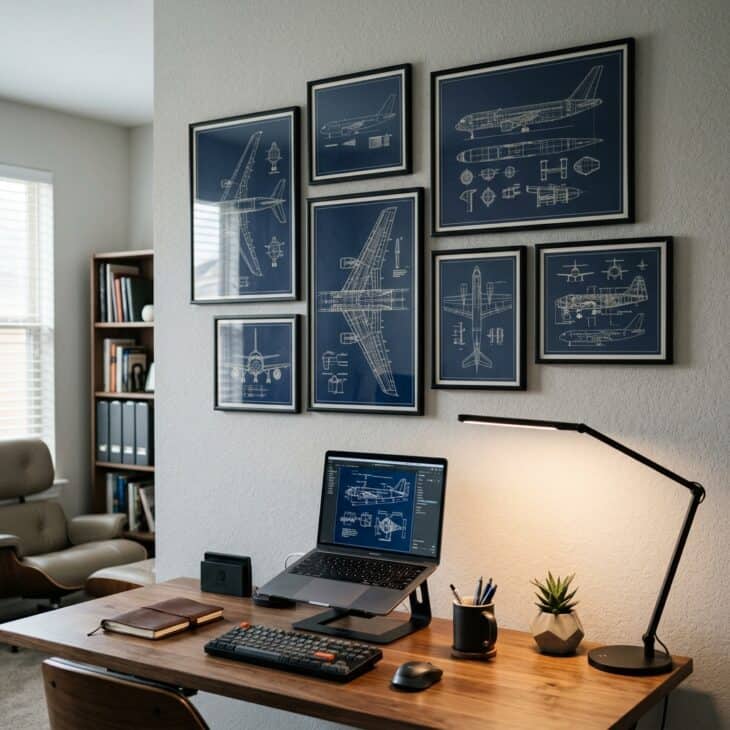
What you see Several navy-and-ivory schematic drawings hang together in matching black frames, each showing a generic aircraft from a different angle or system view. The uniform frame color keeps the technical detail from feeling busy.
Why it works Blueprint-style drawings, similar in spirit to the engineering diagrams behind aircraft like the Boeing 747-8, read as architectural rather than decorative, which suits offices and studies where a more literal aviation theme would feel too playful.
How to get it Buy a coordinated set of blueprint-style prints or commission custom line art of a favorite aircraft type. Keep labels decorative rather than presenting an invented drawing as a genuine engineering document. Use identical frames and consistent 2-inch spacing throughout.
14. Airport Code Typography Wall
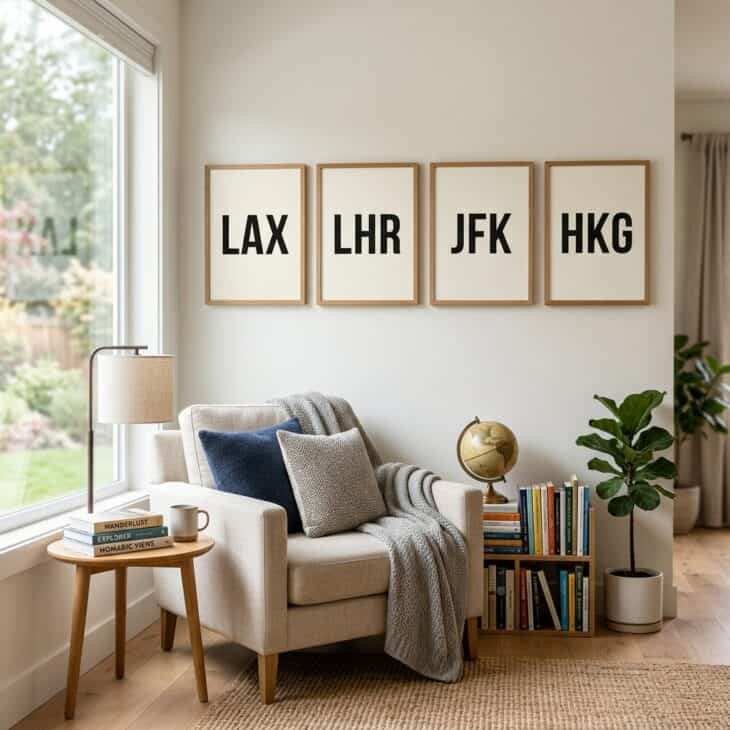
What you see Large sans-serif letters spell out three-letter airport codes, one per print, in matching oak frames. The bold, simple typography leaves plenty of white space around each code.
Why it works Airport codes are instantly recognizable to frequent flyers without needing a photo or map, and IATA maintains the official three-letter system that makes each code unambiguous worldwide. Picking codes meaningful to your own travel makes the wall personal rather than generic.
How to get it List five or six airports that matter to your family, order matching typography prints, and use identical oak frames throughout. Hang them in a single row at eye level, spaced 3 inches apart, in an order that tells a story such as a honeymoon route or a childhood home.
15. Warbird Heritage Wall
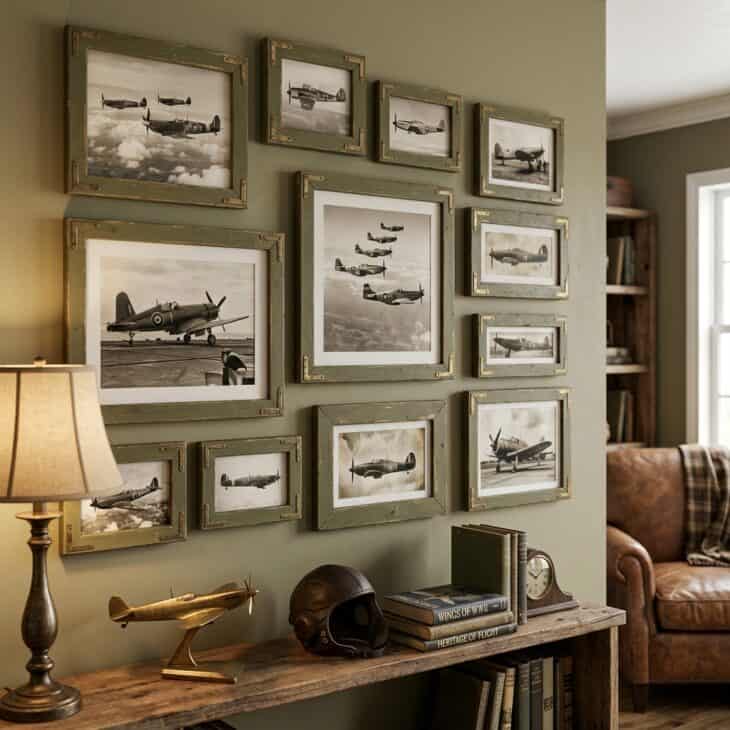
What you see Weathered olive-green and brass frames hold vintage-style prints of propeller fighters and bombers, arranged in a loose cluster on a muted khaki wall. Warm lamplight gives the whole display a quiet, respectful weight.
Why it works Warbird prints connect a wall to real aircraft history, from mass-produced fighters to icons like the Supermarine Spitfire. Treating the display with restraint, rather than novelty-heavy decor, keeps it feeling like tribute rather than costume.
How to get it Source prints from museum shops or licensed aviation art print sellers rather than unverified reproductions. Choose weathered wood or brass frames in two or three finishes at most. Group prints loosely by era so related aircraft sit near each other.
16. Ascending Staircase Gallery Wall
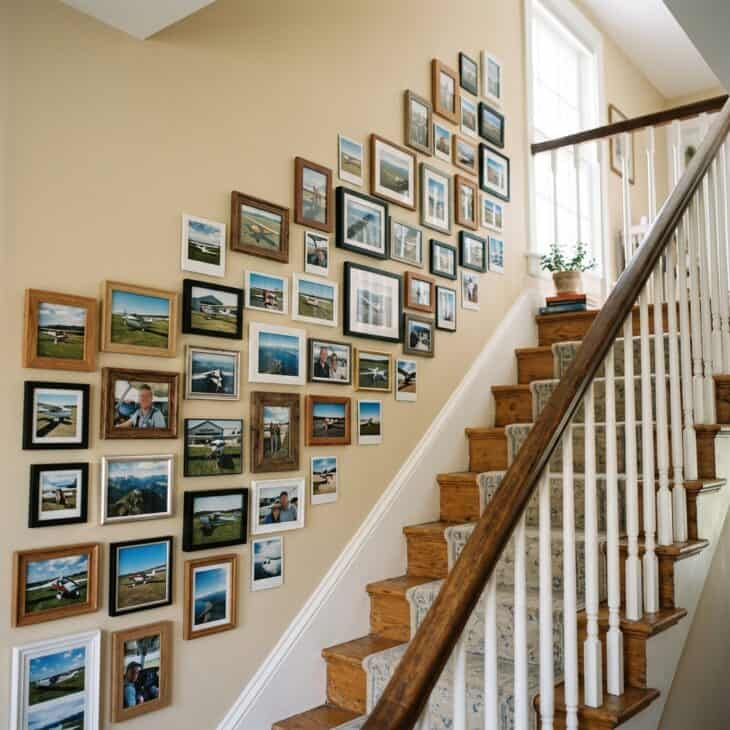
What you see Mixed-size frames scatter upward along the staircase wall, generally rising with the steps but never locking into a perfect line. The looseness gives the display a candid, journal-like feel.
Why it works A scattered ascent is more forgiving to hang than a precise diagonal grid, which matters on a wall people usually see while moving. It is a natural home for the kind of shots collected during plane spotting outings over the years.
How to get it Print photos at two or three consistent sizes so the scatter still feels controlled. Start with the largest frame near the bottom step and let frame size decrease slightly as the wall climbs. Step back from below every few frames to check the overall rhythm.
17. Round and Oval Frame Cluster
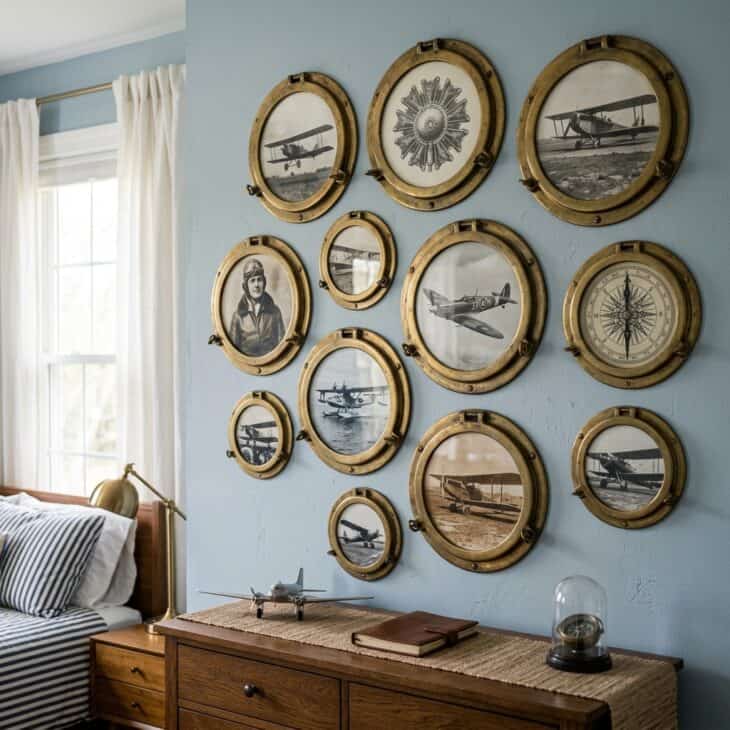
What you see Brass-rimmed round and oval frames cluster together on a pale blue wall, their curved shapes standing out against the usual rectangles. Each holds a different aviation photograph or illustration.
Why it works Porthole-style frames borrow the rounded windows once found on early pressurized airliners, giving the wall a softer, more sculptural feel than sharp-edged rectangles. The shape shift alone makes an otherwise familiar photo cluster feel new.
How to get it Mix two or three round frame sizes with one or two ovals for variety. Keep the brass or bronze finish consistent across every frame. Cluster them tightly, with edges nearly touching, so the round shapes feel like a single connected form.
18. Minimalist Triptych Statement Wall
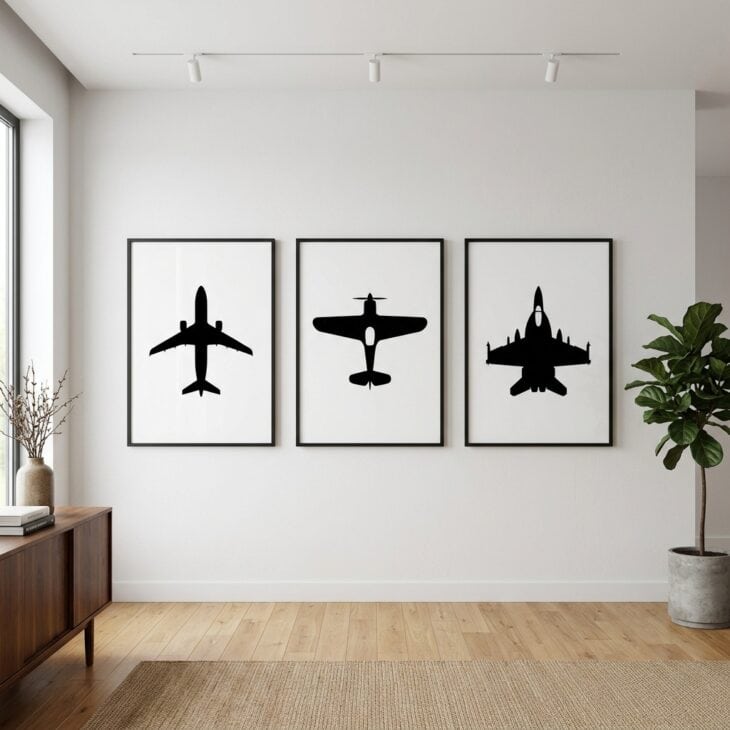
What you see Three identical large frames sit far apart across a long white wall, each holding one simple aircraft silhouette. The generous negative space between them does as much work as the art itself.
Why it works Not every gallery wall needs density. Wide spacing between a few large, matching pieces reads as confident rather than sparse, and it suits long hallways or open-plan rooms where a dense cluster would feel cramped.
How to get it Choose one strong image and repeat its style across all three prints rather than mixing subjects. Measure the wall and divide it into three equal sections so each frame centers in its own third. Resist the urge to add a fourth piece.
19. Golden-Age Commercial Aviation Wall
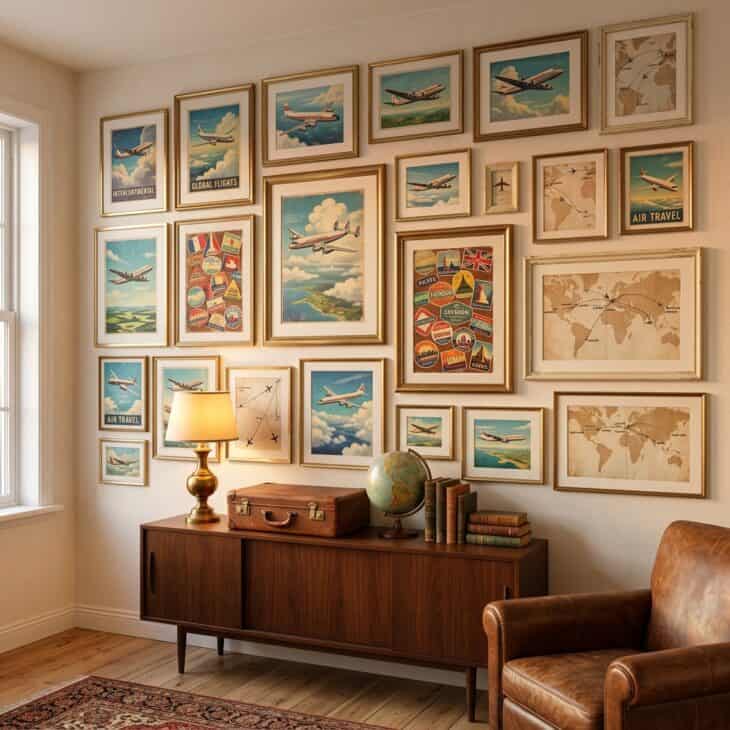
What you see Warm brass and cream frames hold a mix of stylized vintage airliner illustrations, luggage label art, and fragments of old route maps. The palette stays consistently warm and slightly faded, like a sun-bleached postcard.
Why it works The early jet era, when aircraft like the Boeing 747-100 first put commercial travel within reach for far more people, still carries an outsized sense of glamour. A themed cluster lets that nostalgia set the tone for an entire wall.
How to get it Look for reproduction luggage labels, timetable art, and route-map fragments sold as decorative prints rather than authentic historical documents. Keep frame finishes limited to brass and cream. Arrange pieces loosely, letting a few overlap slightly for a lived-in feel.
20. Helicopter and Rotorcraft Corner Wall
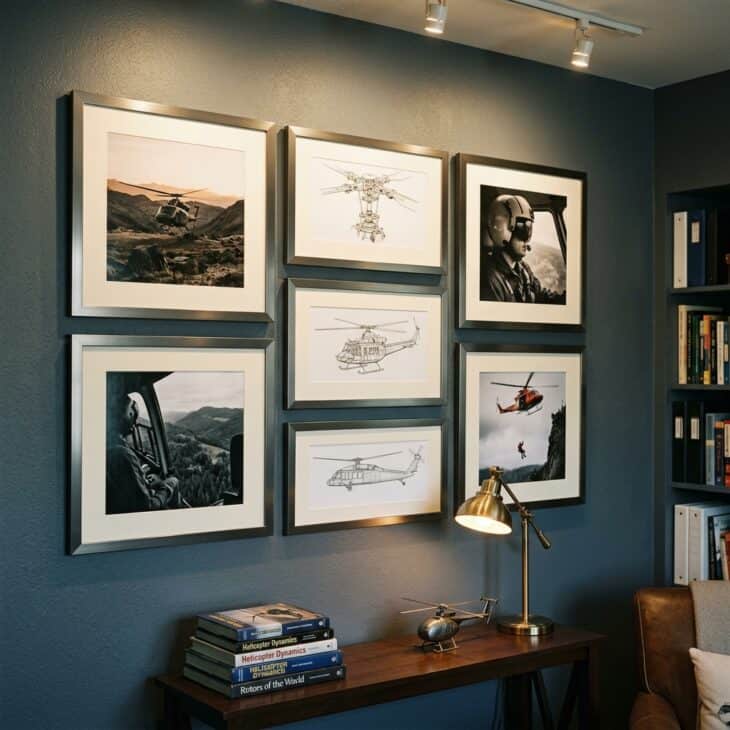
What you see A tight cluster of gunmetal frames fills a den corner, each holding a helicopter photograph or illustration. The dark, uniform frames give the small display a focused, technical feel.
Why it works Fixed-wing aircraft dominate most aviation decor, so a wall dedicated to some of the most famous helicopters and rotorcraft designs stands out as a distinct interest rather than an afterthought. Corners are also often left empty, making them easy real estate to claim.
How to get it Choose five or six prints spanning military, rescue, and civilian rotorcraft for variety. Keep every frame the same dark metal finish. Wrap the cluster gently around the corner angle rather than confining it to one flat wall.
21. Wraparound Corner Gallery Wall
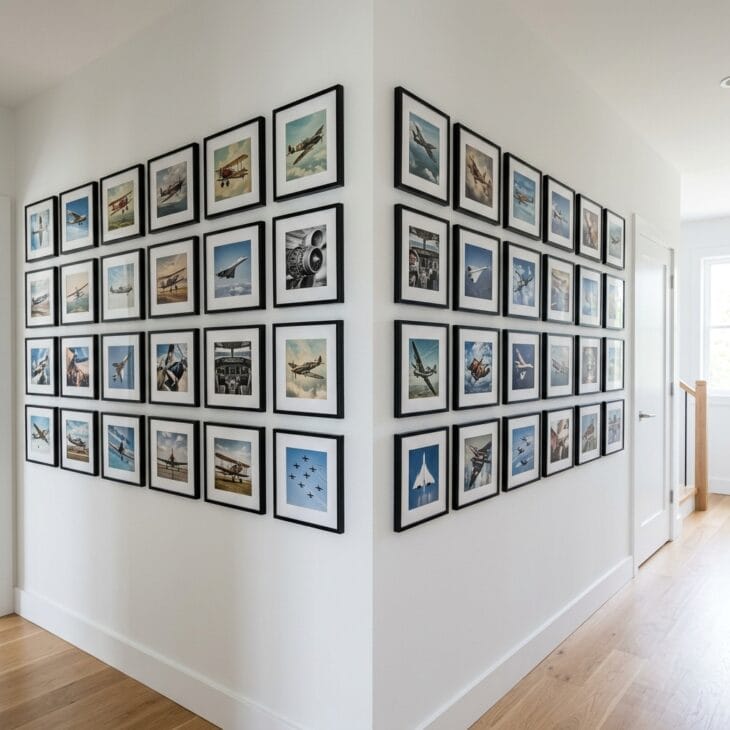
What you see Small matching frames continue in an even line across two adjoining walls, treating the corner as a bend rather than a stopping point. The spacing stays consistent through the turn.
Why it works Most gallery walls stop at the corner and leave the adjacent wall bare, which can look unfinished in a hallway seen from multiple angles. Wrapping the arrangement keeps the eye moving instead of hitting a dead end.
How to get it Measure both wall faces together as one continuous run before placing any frame. Keep the same spacing through the corner, even if the last frame on one wall sits closer to the edge than usual. Use lightweight frames near the corner itself for easier hanging.
22. Hero Print With Satellite Frames
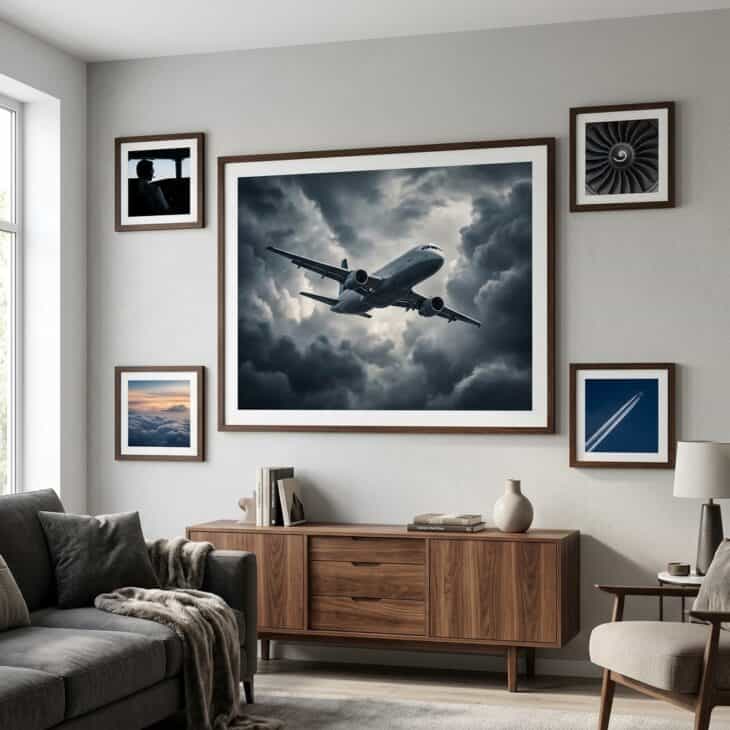
What you see One large, dramatic photograph of a jet banking through clouds dominates the wall, with four small frames tucked near its corners. The scale contrast makes the large piece feel even bigger.
Why it works A single hero image gives visitors an obvious focal point, while the small satellites add detail without diluting its impact. It is an easy layout for someone who owns one striking piece but only a handful of smaller ones.
How to get it Hang the large print first, centered at eye level. Add the four small frames roughly 4 to 6 inches out from each corner, keeping their placement symmetrical. Choose satellite images that share a color or tone with the hero piece.
23. Bold Graphic Illustration Wall
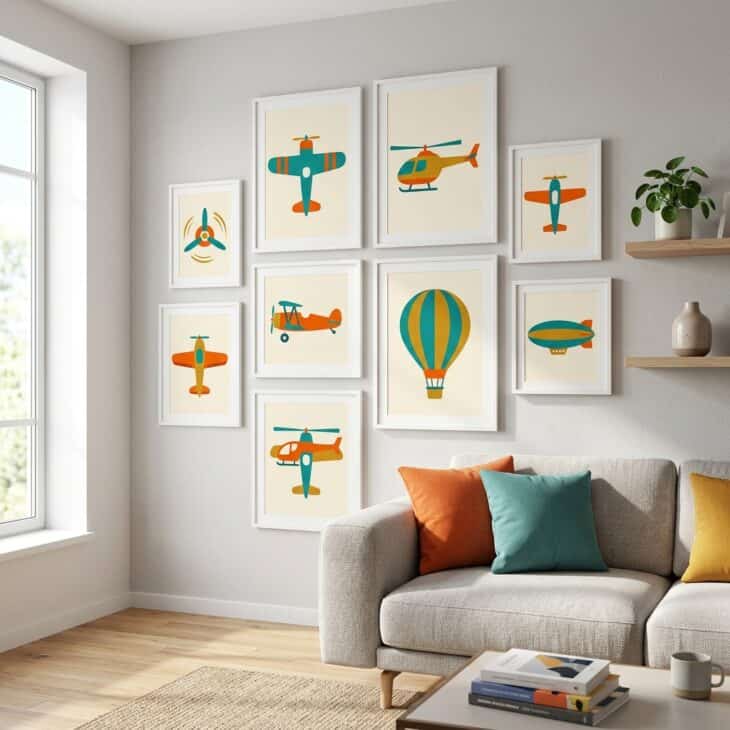
What you see Flat, simplified aircraft shapes fill a cluster of white frames in saturated orange, teal, and mustard. The graphic style trades realism for bold color and clean geometry.
Why it works A modern illustration style keeps the aviation theme from skewing too traditional, which suits a family room that needs to feel current rather than nostalgic. The bright palette also holds its own against busy furniture and toys.
How to get it Look for independent illustrators who sell aviation-themed prints in a consistent flat graphic style. Pick three colors and stick to them across every piece in the cluster. Use identical white frames so the color, not the frame, carries the design.
24. Sepia Heirloom Aviation Wall
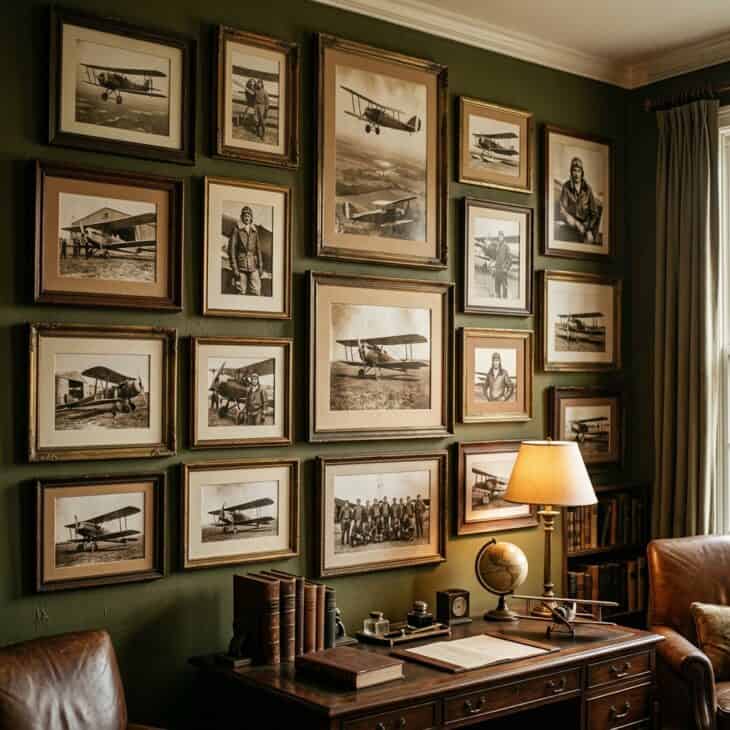
What you see Sepia-toned photographs and antique-style prints fill aged brass and dark wood frames, arranged closely on a warm study wall. The uniform tone makes photos from different eras feel like one continuous family record.
Why it works Converting mixed-era photos to a single sepia palette hides inconsistencies in original quality while adding warmth. The result feels like an heirloom display even when some pieces are recent reproductions.
How to get it Digitize any real family photos before printing, then convert every image, old or new, to a matching sepia tone in editing software. Use aged-finish frames from one product line. Cluster tightly, leaving only about an inch between frames.
Consistency over quantity
A wall of eight well-matched pieces almost always looks more finished than fifteen mismatched ones. When in doubt, edit the collection down rather than adding more.
25. Doorway-Framing Gallery Wall

What you see Two matching vertical columns of small black-framed prints run up either side of a doorway. The mirrored symmetry draws the eye straight through the opening.
Why it works Doorways already have a natural symmetry, and echoing it with matched columns of art makes the opening feel more architectural. It also puts a gallery wall in a spot most people would otherwise leave completely bare.
How to get it Choose an odd number of frames per side, three or five, so the columns feel intentional rather than accidental. Measure from the door frame outward and keep both columns an identical distance from the trim. Hang one side fully, then mirror every measurement on the other.
FAQ
Sources and references used for research and fact-checking.
Get the Newsletter
The latest aviation news and stories sent to your inbox.
About the Author

Hanna writes AeroCorner's aviation-lifestyle and decor guides, turning a love of flight into ideas for your home, celebrations, and gift lists.