

Table of Contents
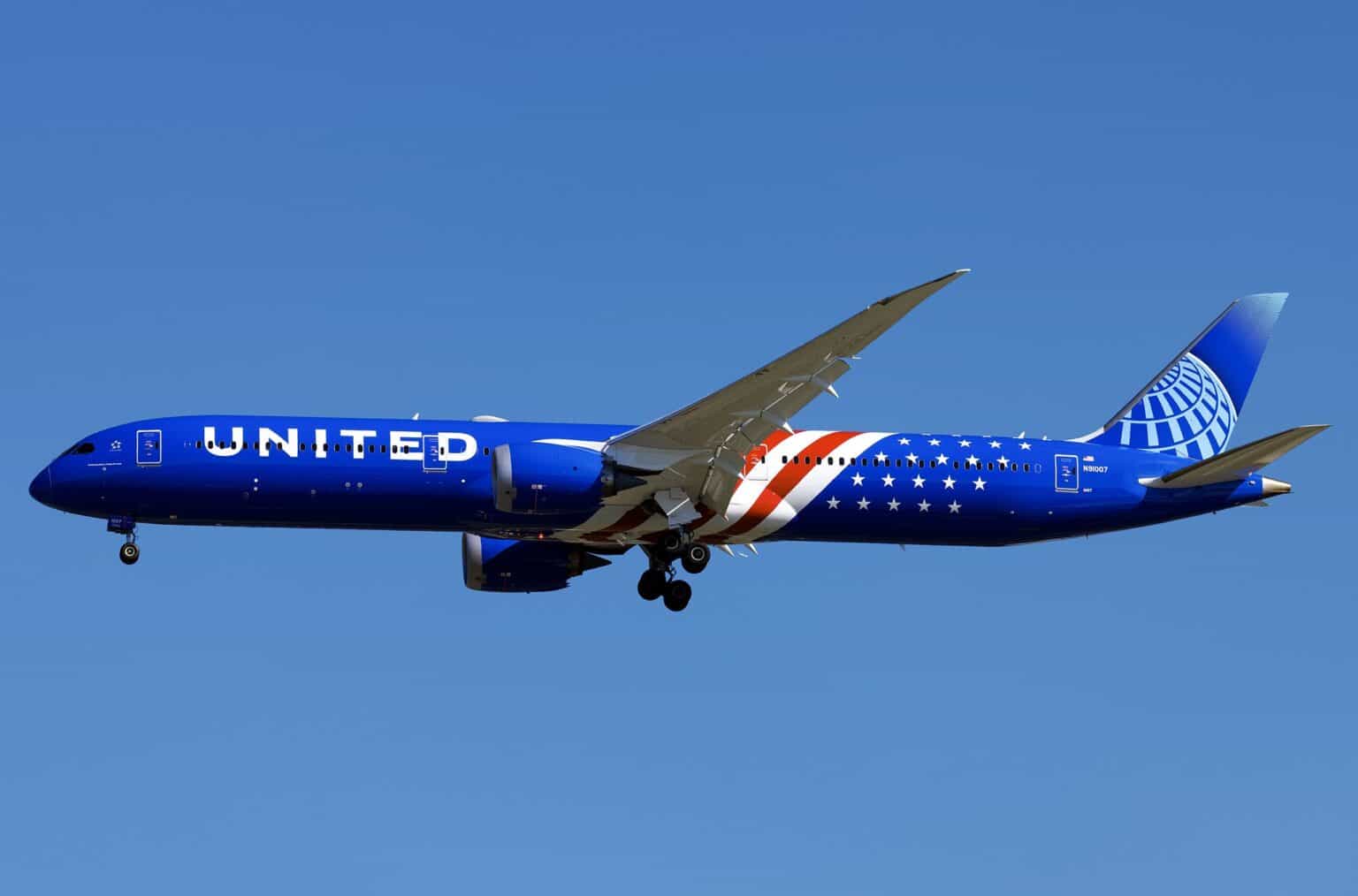
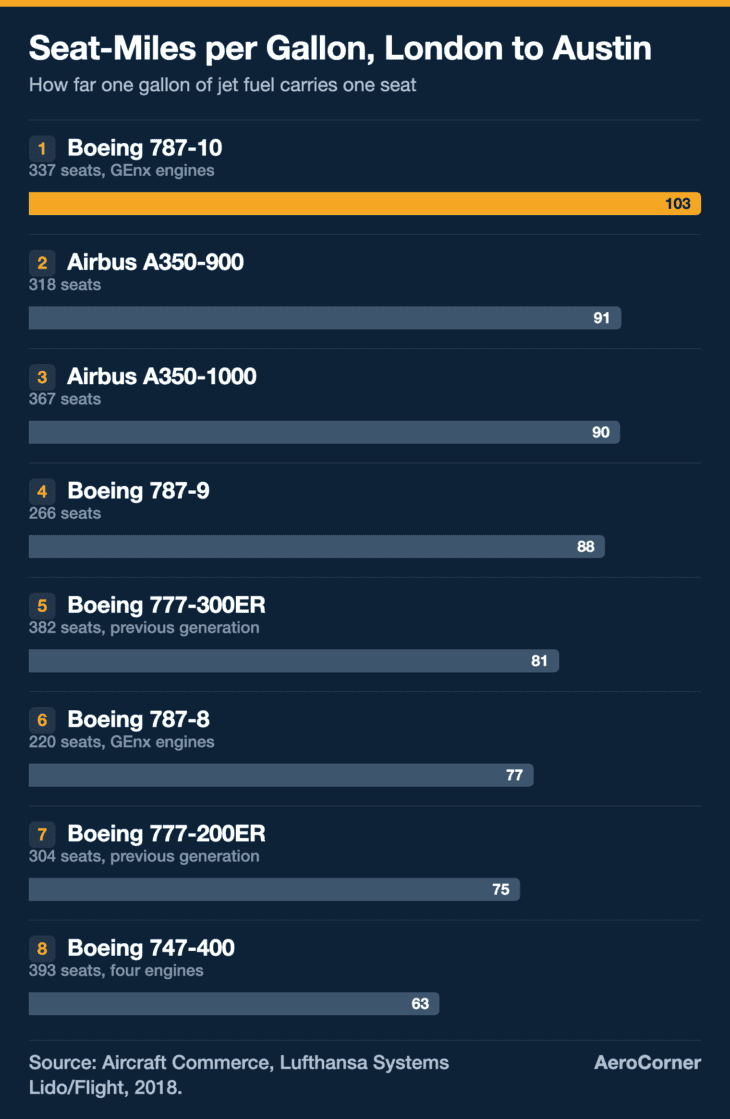
The most fuel-efficient airliner per seat is the Boeing 787-10. In independent flight-planning data for a London to Austin flight, it carried each seat about 103 miles on one gallon of jet fuel (2.29 liters per 100 km per seat), 13% better than the next best type.
That data comes from Aircraft Commerce, which ran 14 widebody variants through Lufthansa Systems’ Lido/Flight planning software on the same routes, with the same rules. It is the most consistent like-for-like comparison we found, and it ranks our long-haul entries.
Short-haul jets and turboprops have no equivalent public dataset, so they are listed by type class with each maker’s own per-seat claim, labelled as a claim. Everything here is current as of November 2026.
| Rank | Aircraft | Fuel per seat | Status |
|---|---|---|---|
| 1 | Boeing 787-10 | 103 seat-miles per gallon | In service |
| 2 | Airbus A350-900 | 91 seat-miles per gallon | In service |
| 3 | Airbus A350-1000 | 90 seat-miles per gallon (367 seats) | In service |
| 4 | Boeing 787-9 | 88 seat-miles per gallon | In service |
| 5 | Airbus A321neo and A321XLR | At least 20% less per seat (Airbus claim) | In service |
| 6 | Airbus A220-300 | 25% less per seat (Airbus claim) | In service |
| 7 | Boeing 737 MAX 8 | 20% less fuel use (Boeing claim) | In service |
| 8 | Embraer E195-E2 | 25.4% less than the E195 in flight tests | In service |
| 9 | ATR 72-600 | 69 g of CO2 per seat per km (ATR claim) | In service |
| 10 | Boeing 777-9 | 20% less fuel use (Boeing claim) | In certification, first delivery 2027 |
How this ranking works
We rank by fuel burned per seat, not per aircraft, because a plane that carries more people on the same fuel is the more efficient one. Seat-miles per gallon is seats times distance flown, divided by block fuel from gate to gate. Entries 1 to 4 come from one independent study in which every type flew the same five London routes at long-range cruise speed with full cabins; we quote the London to Austin results, about 4,750 nautical miles. Entries 5 to 10 have no comparable independent dataset, so each carries its maker’s claim and the baseline it uses, and they are ordered by aircraft size rather than by a number.
Long-haul: ranked by independent data
The Aircraft Commerce study, published in December 2018, compared the 787 and A350 families with the older 777, A330 and 747-400 on five London routes to North and South America. Lufthansa Systems’ Lido/Flight planned every flight with real winds, real airways and each type’s own weights.
The table below is the full London to Austin result. Seat counts are the two-class layouts the study used, and they matter as much as the airframe, as the A350-1000’s two rows show.
| Aircraft | Seats | Block fuel (US gal) | Seat-miles per gallon | Fuel per seat vs 787-10 |
|---|---|---|---|---|
| Boeing 787-10 (GEnx) | 337 | 17,907 | 103 | Baseline |
| Boeing 787-10 (Trent 1000) | 337 | 18,293 | 101 | +2% |
| Airbus A350-900 | 318 | 19,157 | 91 | +13% |
| Airbus A350-1000 | 367 | 22,266 | 90 | +14% |
| Boeing 787-9 | 266 | 16,422 | 88 | +17% |
| Airbus A350-1000 | 327 | 21,825 | 82 | +25% |
| Boeing 777-300ER | 382 | 26,095 | 81 | +27% |
| Boeing 787-8 (GEnx) | 220 | 15,434 | 77 | +33% |
| Boeing 777-200ER | 304 | 22,244 | 75 | +37% |
| Boeing 747-400 | 487 | 35,901 | 75 | +37% |
| Airbus A330-300 | 274 | 20,276 | 74 | +38% |
| Airbus A330-200 | 248 | 19,145 | 71 | +45% |
| Boeing 747-400 | 393 | 34,589 | 63 | +64% |
1. Boeing 787-10
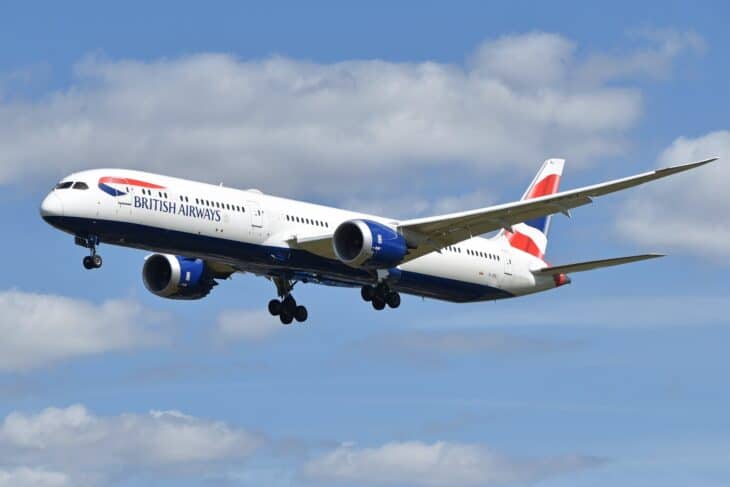
The Boeing 787-10 burned 17,907 US gallons (67,785 liters) from London to Austin with GE GEnx engines and 337 seats. That is about 53 gallons (201 liters) per seat for a flight of more than 5,400 miles (8,800 km), or 103 seat-miles per gallon.
Aircraft Commerce found the 787-10 had the lowest fuel burn per seat of every type it tested. It carries 19 more seats than the A350-900 in the study’s cabins, yet burned 1,250 fewer gallons on this route.
The catch is range. Boeing lists the 787-10 at up to 7,500 nautical miles, against 9,000 for the A350-1000, so it wins on routes like this one rather than on the longest ultra-long-haul flights.
Better than a car with one person aboard
At 103 seat-miles per gallon, a full 787-10 moves each passenger farther on a gallon of fuel than a 50 mpg hybrid does with its driver alone. The car only pulls ahead with three people aboard.
2. Airbus A350-900
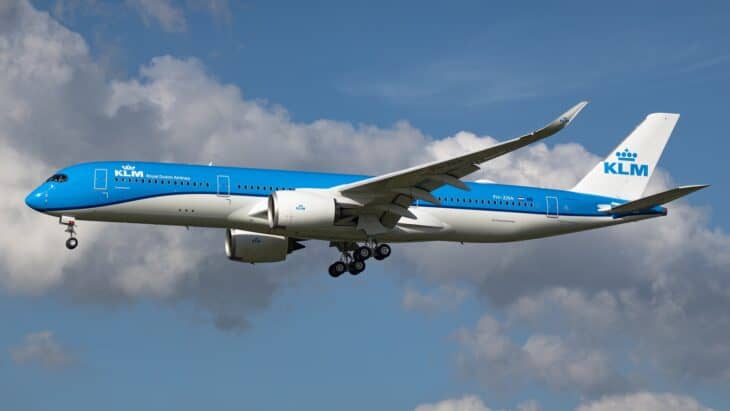

The Airbus A350-900 managed 91 seat-miles per gallon with 318 seats, burning 19,157 gallons on the same flight. Airbus lists a range of 8,500 nautical miles, far more than this mission needs.
Airbus says the A350 needs 25% less fuel than the 777-200ER and 777-300ER it replaces. In the Lido data, the A350-900 burned 11% less per seat than the 777-300ER and 17% less than the 777-200ER, a smaller gap because each type ran its own real-world seat count.
For a side-by-side look at the two families, see our A350 vs 777 comparison.
3. Airbus A350-1000
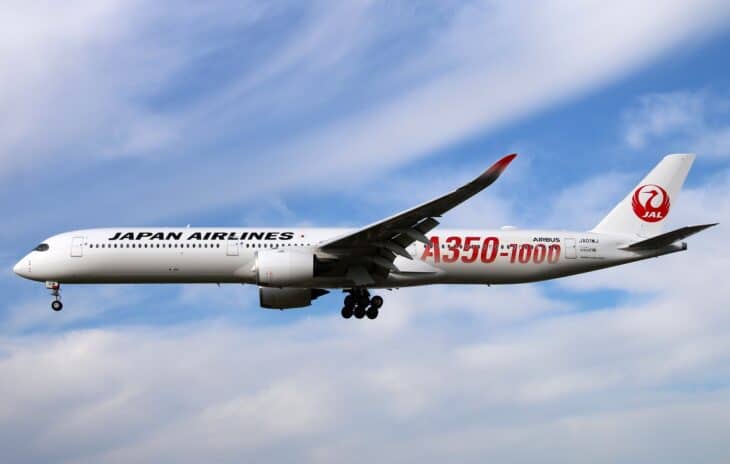
The Airbus A350-1000 is the clearest proof that seats decide this ranking. With 367 seats it reached 90 seat-miles per gallon, nearly tied with the A350-900. With 327 seats, the average airlines were flying, it fell to 82.
The airplane burned almost the same fuel in both layouts, 22,266 gallons against 21,825. Forty extra seats spread that fuel over more people, which is why a dense cabin can beat a better airframe.
Airbus lists the A350-1000’s range at 9,000 nautical miles, the longest of any type in this top four.
4. Boeing 787-9
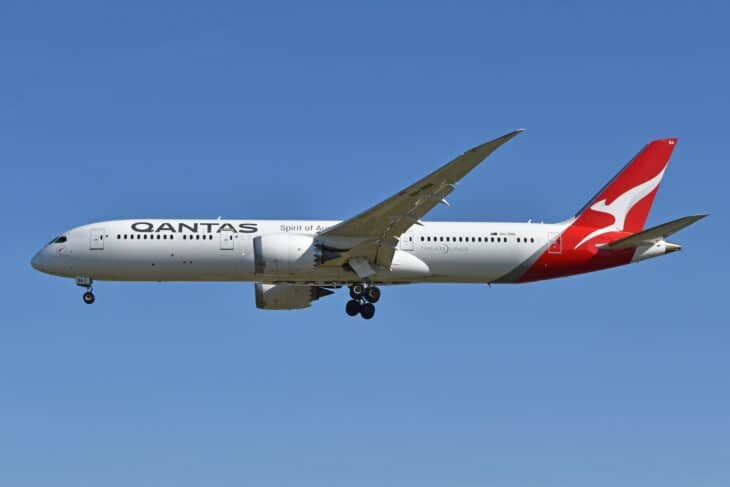

The Boeing 787-9 burned just 16,422 gallons from London to Austin, less than any type in the test except the smaller 787-8. Per seat it ranks fourth at 88 seat-miles per gallon, because the study gave it only 266 seats.
That makes it about 17% thirstier per seat than the 787-10, despite the lower total burn. Boeing says the 787 family cuts fuel use by 25% compared with the airplanes it typically replaces.
The smaller 787-8 placed sixth at 77 seat-miles per gallon with 220 seats, behind even the older 777-300ER.
Short-haul and regional: the makers’ claims
We found no independent per-seat test that covers today’s single-aisle jets and turboprops on the same terms. The figures below are what each manufacturer states on its own aircraft page, with the comparison it makes.
Treat them as each airplane’s gain over its own predecessor, not as a head-to-head ranking. For how much fuel these types burn per hour and per trip, see how much fuel aircraft use.
5. Airbus A321neo and A321XLR
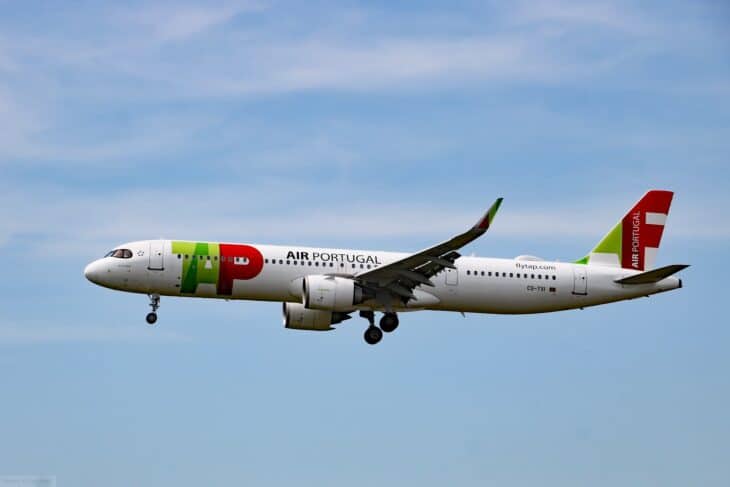
Airbus says the A320neo family delivers at least 20% less fuel burn and CO2 per seat. The A321neo is the largest member, with up to 244 seats and a range of 4,000 nautical miles.
The A321XLR stretches that to 4,700 nautical miles, and Airbus claims 30% lower fuel burn per seat than previous-generation competitor aircraft. Iberia took the first one on October 30, 2024.
That range lets airlines fly long, thinner routes with a single-aisle jet instead of a half-empty widebody.
6. Airbus A220-300
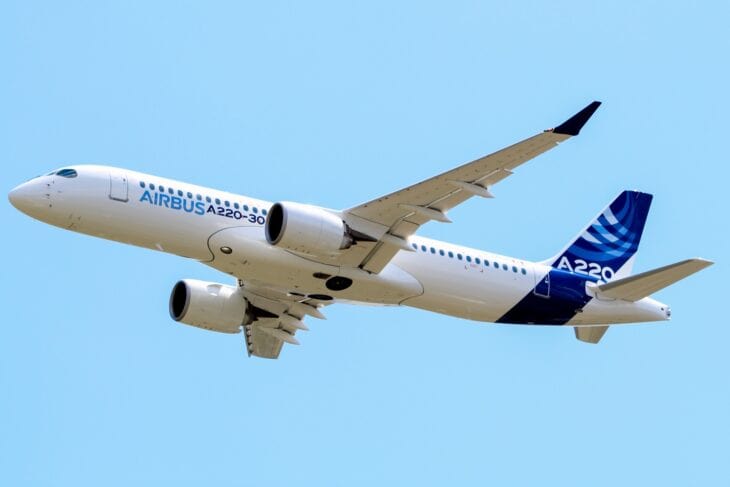

The Airbus A220-300, designed by Bombardier as the CSeries, was designed for the 100 to 160 seat market. Airbus claims 25% lower fuel burn and CO2 per seat.
It seats up to 160 and flies 3,400 nautical miles.
7. Boeing 737 MAX 8
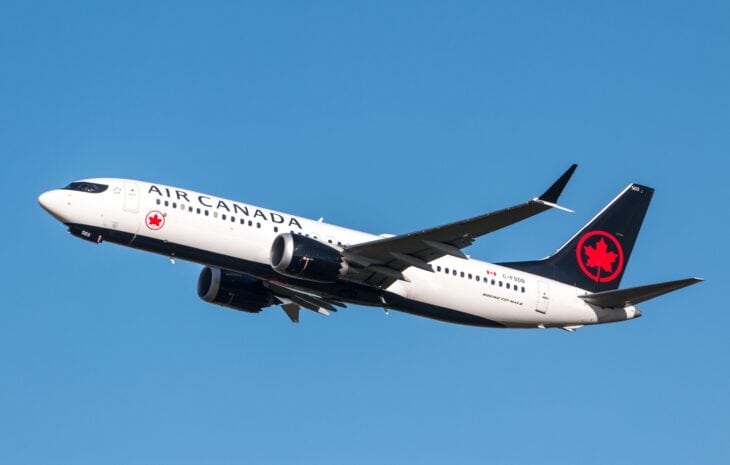
Boeing says technology on the 737 MAX results in a 20% reduction in fuel use and CO2. Its page does not name the baseline for that figure.
The MAX 8 is certified for up to 210 seats and flies 3,500 nautical miles. On paper its claim matches the A320neo family’s.
8. Embraer E195-E2
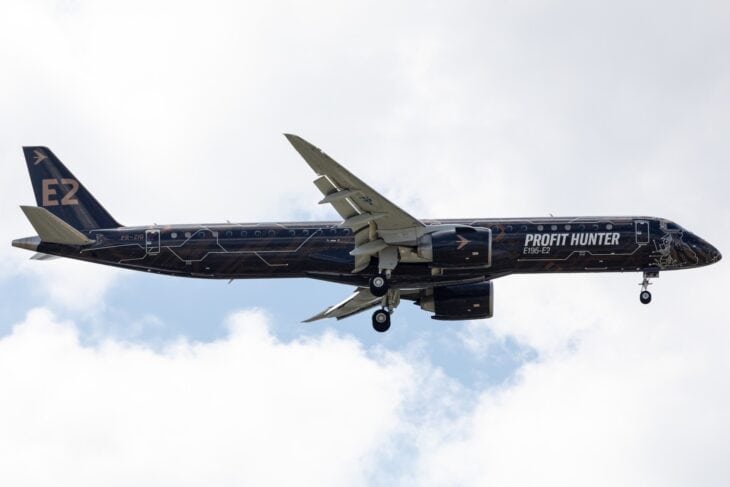

The Embraer E195-E2 beat its own target in flight testing. Embraer reported fuel burn 1.4% better than expected, 25.4% better than the first-generation E195.
Brazil’s ANAC, the FAA and EASA all certified it on April 15, 2019.
9. ATR 72-600
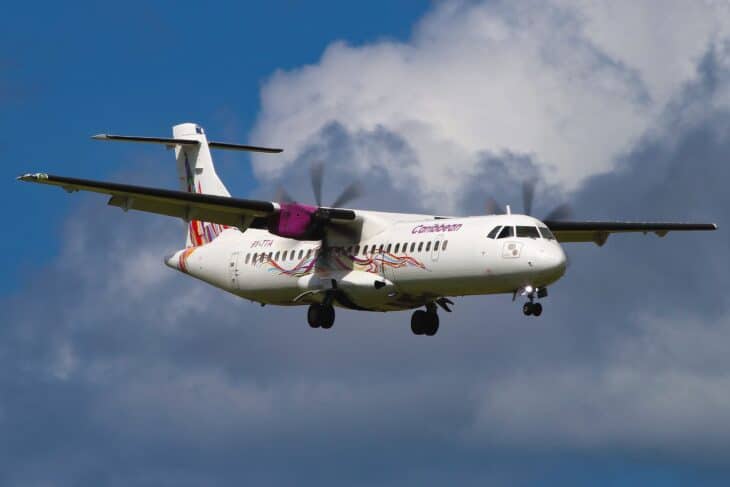
The ATR 72-600 is the only propeller airplane on this list. ATR gives its emissions as 69 grams of CO2 per seat per kilometer, about 3.9 ounces per seat-mile, and calls it by far the most fuel-efficient regional aircraft.
It carries 44 to 78 passengers and has a range of 724 nautical miles with a full cabin. Turboprops trade speed for fuel, which is why they still dominate short regional routes, as we explain in why turboprops are still used.
10. Boeing 777-9
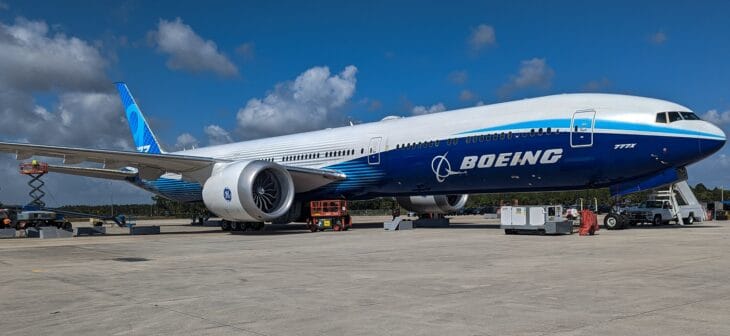
The Boeing 777-9 is not flying passengers yet. Boeing says it will achieve 20% lower fuel use and emissions than the airplanes it will replace.
Boeing seats it at 375 to 450 in two classes. On July 29, 2026, Boeing said the seventh test aircraft had flown and that certification and first delivery are planned for 2027.
When it enters service it is the likeliest new challenger to the 787-10 and A350-1000 on fuel per seat, but no independent per-seat figure exists for it yet.
Why the biggest plane is not the most efficient
What about the 747 and its 487 seats?
More seats help only when the airplane does not burn more fuel to carry them. The Lido data gave a two-class 747-400 487 seats, the most of any type tested, and it still burned 37% more fuel per seat than the 787-10. In a 393-seat three-class layout the gap grew to 64%. Four older engines and a heavier airframe cost more than the extra seats save.
The same logic explains why cabin layout moves the numbers so much. A premium-heavy cabin with fewer seats raises fuel per passenger on any airplane, which is why one airline’s A350 can beat another airline’s 787.
Airlines also choose how fast to fly. Many now plan with a cost index, which weighs the price of fuel against time-related costs, so the same airplane can burn more or less on the same route depending on who flies it.
New fuels are the other lever. Our guide to sustainable aviation fuel covers how airlines hope to cut emissions beyond what airframes alone can do.
FAQ
Sources and references used for research and fact-checking.
- Aircraft Commerce, A350-900/-1000 fuel burn & operating performance
- Boeing, Boeing 787 Dreamliner by design
- Airbus, Airbus A350
- Airbus, A320 Family
- Airbus, A321XLR
- Airbus, Airbus delivers first A321XLR to Iberia
- Airbus, Airbus A220
- Boeing, Boeing 737 MAX
- AIN, Embraer Celebrates E195-E2's Certification Triumvirate
- ATR, ATR 72-600
- Boeing, Boeing 777X
- Boeing, Seventh 777-9 completes first flight
Get the Newsletter
The latest aviation news and stories sent to your inbox.
About the Author

Tim is the owner and lead editor of AeroCorner since 2019, overseeing aviation content covering aircraft, airlines, airports, and the broader aviation industry. Through years of researching, writing, editing, and publishing aviation-focused content, he has developed extensive practical knowledge of commercial aviation and air travel. Based in Asia and a frequent traveler himself, Tim also brings firsthand passenger experience to AeroCorner’s coverage. Outside of publishing, he has also explored aviation firsthand through hands-on flight training in New Zealand.