



Table of Contents
A350 vs 777 at a glance
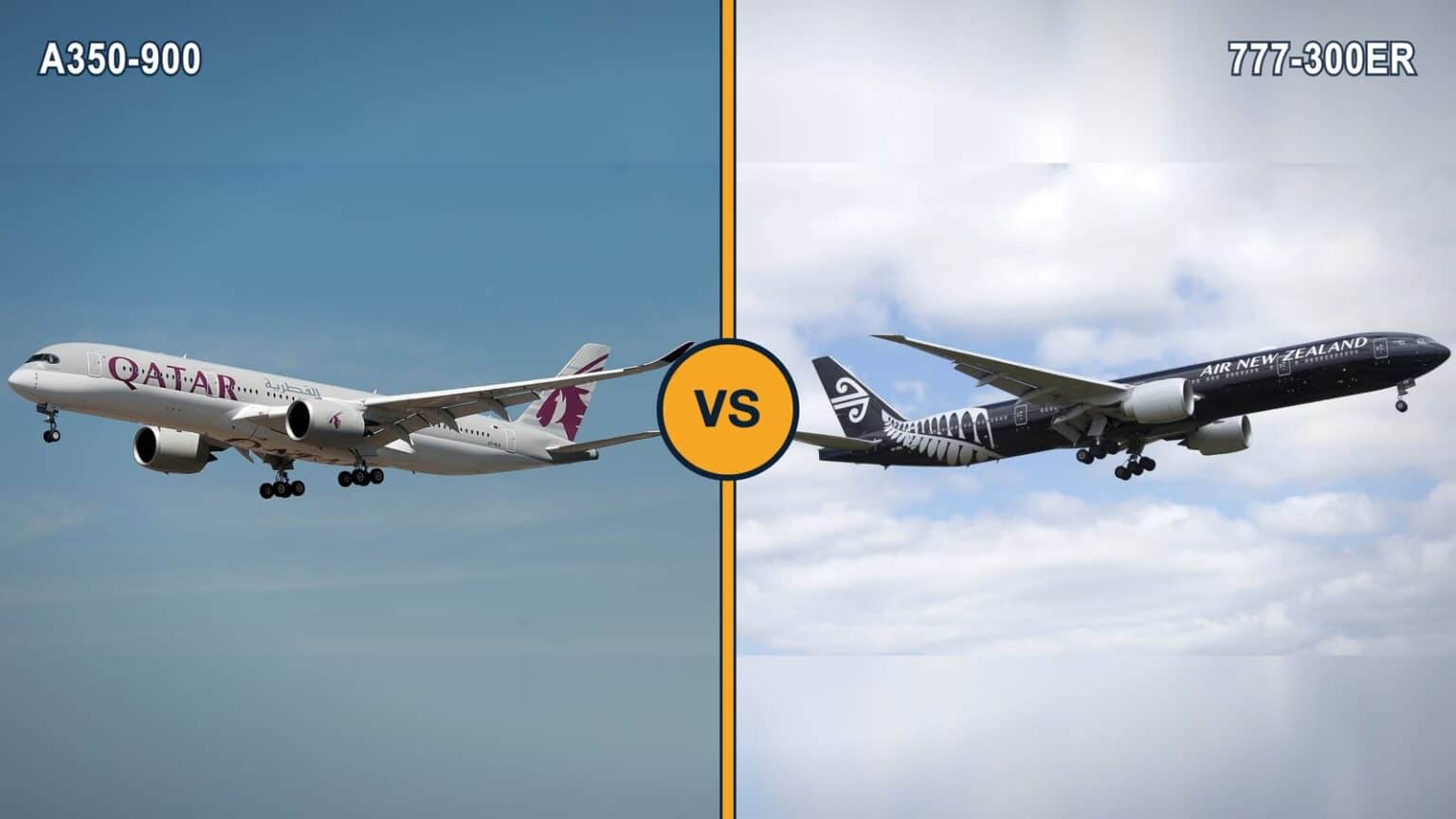
The Airbus A350-900 and the Boeing 777-300ER are the two long-haul twinjets that most airlines choose between. They fly many of the same routes, but they come from different generations.
The A350 is the newer, lighter design. The 777-300ER is the bigger, more powerful one.
This page compares the A350-900 with the 777-300ER. The spec widget above sets the numbers side by side. The table below covers what it does not.
| Airbus A350-900 | Boeing 777-300ER | |
|---|---|---|
| First flight | June 14, 2013 | February 24, 2003 |
| Entered service | January 2015, with Qatar Airways | 2004, with Air France |
| Typical economy layout | 9 abreast (3-3-3) | 10 abreast (3-4-3) |
| Airframe material | More than half composite by weight | Mostly aluminum alloy, with composite tail surfaces |
| Production status | In production | Passenger production ended in 2024 |
| Newer, larger sibling | A350-1000 | 777-9 |
Size and weight: where the 777 wins
The 777-300ER is the bigger aircraft by every measure that counts for capacity. It is 242 ft 4 in (73.86 m) long against 219 ft 2 in (66.80 m) for the A350-900.
Its cabin is wider too, at 19 ft 3 in (5.86 m) against 17 ft 9 in (5.40 m). That extra width is why airlines can fit ten seats across in economy.
The wings are nearly identical. The A350-900 spans 212 ft 5 in (64.75 m) and the 777-300ER spans 212 ft 7 in (64.80 m).
The weight gap is large. Maximum takeoff weight is 775,000 lb (351,500 kg) for the 777-300ER and 624,000 lb (283,000 kg) for the A350-900.
Compare the right variants
The A350-900 is the most common A350, but it is the smaller one. The A350-1000 is about the same length as the 777-300ER, so it is the closer rival. The two tables on this page use the A350-900 against the 777-300ER, the most common version of each.
Range and efficiency: where the A350 wins
The A350-900 is rated for 8,500 nm (9,780 mi, 15,740 km). The 777-300ER is rated for 7,500 nm (8,630 mi, 13,890 km).
The A350 manages that on a much smaller fuel load. Its tanks hold 37,200 gal (140,800 L), against 47,900 gal (181,300 L) for the 777-300ER.
The reasons are weight and engines. The A350 airframe is more than half composite, and its two Rolls-Royce Trent XWB engines make 84,200 lbf (375 kN) each. The 777-300ER needs two General Electric GE90-115B engines at 115,300 lbf (513 kN) each to lift its higher weight.
Lower weight also helps at the gate. The A350-900 needs 8,550 ft (2,600 m) of runway to take off, against 10,500 ft (3,220 m) for the 777-300ER.
Cargo and payload: the 777 carries more
The 777-300ER has the bigger hold. Its baggage volume is 7,550 ft³ (213.8 m³), against 6,088 ft³ (172.4 m³) for the A350-900.
Maximum payload follows the same order, at 154,000 lb (70,000 kg) against 117,500 lb (53,500 kg).
That matters on routes where belly cargo pays a large share of the bills. Airlines that carry a lot of belly cargo get more room for it on the 777-300ER.

Cabin and passenger experience
Passengers feel the difference in two places. The A350 has nine seats across in most economy cabins, while the 777-300ER usually has ten.
Fewer seats across is one reason many travelers say they prefer the A350. The 777 can feel tighter in a dense layout, although seat width depends on the airline, not the aircraft.
Check the seat map before you book. The airline decides the layout, and the same aircraft type can be comfortable on one carrier and cramped on another.

Cost and status
The list price follows the size. The A350-900 lists at $317.4 million (2018) and the 777-300ER at $375.5 million (2019).
List prices are rarely paid. Airlines negotiate large discounts, so treat both figures as a way to compare the two, not as a bill.
The bigger difference is the future. The A350 is still in production, with the longer A350-1000 on offer. The 777-300ER passenger line has ended as Boeing moves to the 777X, led by the 777-9.
Engines and airport performance
The two aircraft use very different engines. The A350-900 has two Rolls-Royce Trent XWB-84 turbofans, and the 777-300ER has two General Electric GE90-115B turbofans.
The GE90-115B was built to push a heavy aircraft off the ground. Its 115,300 lbf (513 kN) of thrust per engine is one of the highest ratings among airliner engines in service.
Runway needs split in a surprising way. The A350-900 takes off in a shorter distance, but it lands in 6,550 ft (2,000 m) against 5,850 ft (1,780 m) for the 777-300ER.
For most airlines this does not decide anything. Both aircraft fly from the same large international airports.
The newer rivals: A350-1000 and 777-9
Both makers have a larger follow-up. Airbus stretched the A350 into the A350-1000, which is about the same length as the 777-300ER.
Boeing answered with the 777X, led by the 777-9. It has a new composite wing and new GE9X engines, and its program has seen several delays.
Airlines that want to replace the 777-300ER now choose between those two. That is why many search results for this comparison drift toward the A350-1000 and the 777-9.
Which one is better?
Neither wins everywhere. The A350-900 is the better choice for long, thin routes where fuel and runway matter.
The 777-300ER is the better choice for high-demand routes where capacity and cargo count more.
For a closer size match, compare the 777-300ER with the A350-1000. For the newer generation, the 777-9 is Boeing’s answer.
FAQ
Sources and references used for research and fact-checking.
About the Author

Tim is the owner and lead editor of AeroCorner since 2019, overseeing aviation content covering aircraft, airlines, airports, and the broader aviation industry. Through years of researching, writing, editing, and publishing aviation-focused content, he has developed extensive practical knowledge of commercial aviation and air travel. Based in Asia and a frequent traveler himself, Tim also brings firsthand passenger experience to AeroCorner’s coverage. Outside of publishing, he has also explored aviation firsthand through hands-on flight training in New Zealand.