



Table of Contents
| Measure | Airbus A350-900 | Boeing 787-9 |
|---|---|---|
| Role | Long-haul twin-aisle airliner | Long-haul twin-aisle airliner |
| First flight | June 14, 2013 | September 17, 2013 |
| Service entry | January 15, 2015, Qatar Airways | August 9, 2014, Air New Zealand |
| Engine choice | One: Rolls-Royce Trent XWB | Two: General Electric GEnx or Rolls-Royce Trent 1000 |
| Structure | Largely carbon-fiber-reinforced polymer | One-piece composite fuselage barrels |
| Economy seat width, nine across | About 17.7 inches (45 cm) | About 17.2 inches (43.7 cm) |
How we compare the A350-900 and the 787-9
The A350 and the 787 are two families, and each has several lengths. We compare the A350-900 with the 787-9, the pair that airlines most often weigh against each other.
The spec widget above sets out the dimensions, weights, range and speeds. This page covers what it cannot: how they are built, how the cabins differ and who flies them.
Full specifications for the Airbus A350-900 and the Boeing 787-9 sit in our aircraft database.
They arrived within months of each other
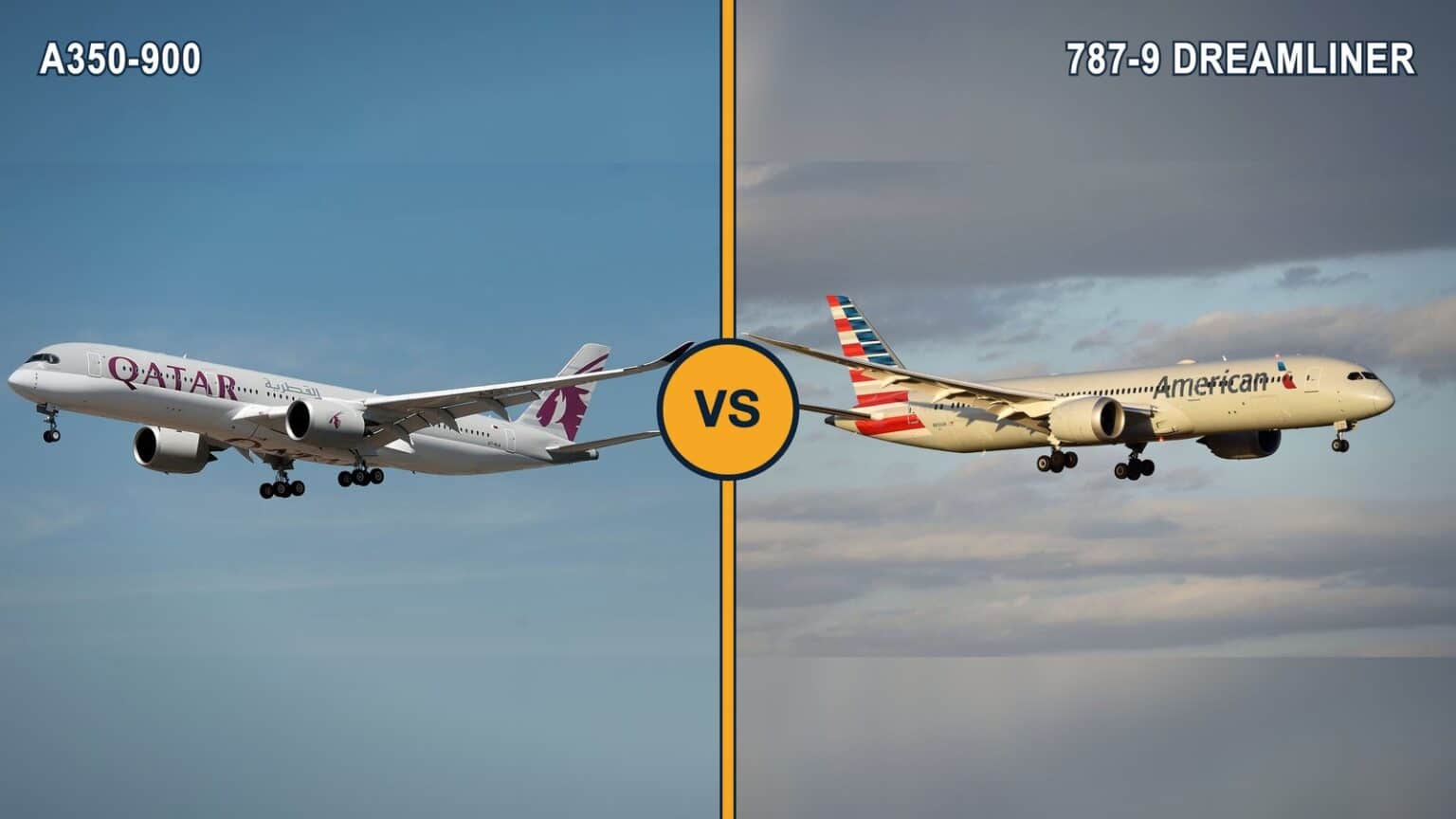
The A350-900 first flew on June 14, 2013. The 787-9 first flew on September 17, 2013. Both are mostly composite long-haul twins, and both were built to replace older four-engine and three-engine aircraft on long routes.
Which is better, the A350-900 or the 787-9?
Neither wins everywhere. The A350-900 is the bigger aircraft, with a wider fuselage and a longer, wider wing, as the widget shows.
The 787-9 is the lighter aircraft. It stays closer to the A350 on range and speed than its size suggests.
So the answer depends on the route and the cabin. For passenger width, the A350. For a smaller, lighter twin with a choice of engines, the 787-9.
Where the A350-900 wins
Cabin width and seat comfort
The A350 is built around a nine-across economy cross-section, 3-3-3. Some airlines fit ten across, 3-4-3, on select aircraft.
In the same nine-across layout the A350 seat is about 17.7 inches (45 cm) wide, roughly half an inch wider than a 787 seat.
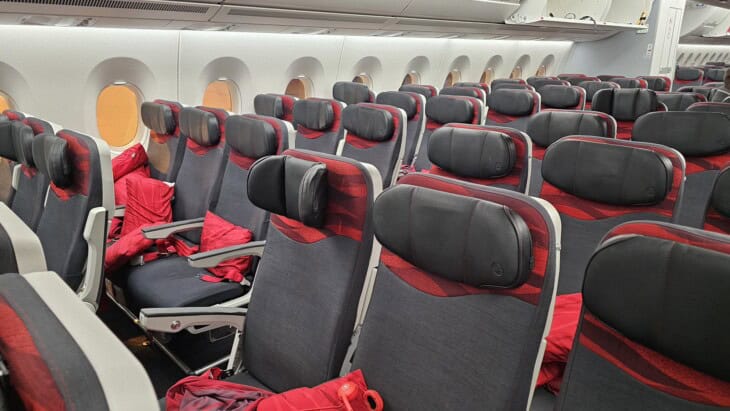
That half inch is the comparison most passengers feel. It is also why the A350 gets the comfort edge in most reviews.
A bigger aircraft
The A350-900 is longer, with a wider wingspan and a heavier maximum takeoff weight than the 787-9. The widget gives every figure.
It also has a single engine option, the Trent XWB-84, so every A350-900 shares one engine family.

Where the 787-9 wins
Engine choice
Airlines can order the 787-9 with General Electric GEnx or Rolls-Royce Trent 1000 engines. That lets a fleet match the engine type it already maintains.
A lighter airframe
The 787-9 has a lower maximum takeoff weight than the A350-900, and it needs a shorter takeoff run by the widget’s figures.
The 787 was the first production airliner with a fuselage of one-piece composite barrel sections instead of aluminum sheets joined by many fasteners.
It reached airlines first
The 787-9 entered service on August 9, 2014 with Air New Zealand. The A350-900 followed on January 15, 2015 with Qatar Airways.

Myth check: the A350 and the 787 are rivals on every route
They overlap, but they are not the same size. The A350-900 is the larger aircraft, and the A350 family stretches further up in size than the 787-9. Airlines often pick by route length and seat count, not by a rivalry between the two types.
Windows and cabin air
The 787 made passenger comfort part of its pitch. Its cabin windows measure 10.7 by 18.4 inches (27 by 47 cm), and its dimmable windows replace the plastic shade.
The 787 also holds a cabin pressure equivalent to 6,000 feet (1,830 m), against 8,000 feet (2,440 m) on older aircraft. Boeing says a joint study with Oklahoma State University found this improves passenger comfort.
The A350 started with conventional manual window shades. In 2020 Airbus announced electrochromic dimmable windows, like those on the 787, as an option.
So the 787 led on windows, and Airbus closed part of the gap. The A350 keeps its edge in seat width.
The families around each aircraft
Neither type is a single aircraft. The A350-900 has a longer sibling, the A350-1000, which entered service on February 24, 2018 with Qatar Airways.
The 787 family has three lengths: the 787-8, the 787-9 and the 787-10. The 787-9 sits in the middle, and the 787-8 was the first to fly, on December 15, 2009.
That is why the A350-900 and 787-9 are the usual pairing. They sit in the same middle of each family, even though the A350 family goes larger at the top.
Safety and teething problems
Both types have had early problems. The FAA grounded every 787 in January 2013 over its lithium-ion batteries, and cleared a revised battery design in April 2013.
The A350 has had no passenger or crew deaths. On January 2, 2024, a Japan Airlines A350-900 collided with a Japan Coast Guard Dash 8 after landing at Tokyo Haneda and was destroyed by fire. All 367 passengers and 12 crew on the A350 survived.
That accident is the A350’s one hull loss, and five people on the Coast Guard aircraft died. It was a runway collision, not a fault in the airliner.
Both families are young
The A350 entered service in January 2015, and the 787 in 2011 with the 787-8. Compared with the 747 or the 777, both have had less time to build a long safety record.
How to tell them apart from the outside
Start with the wing tips. The A350-900 has blended, curved wing tips, and the 787-9 has raked tips that sweep back in a straight line.
Next look at the nose. The A350 nose is derived from the A380, with a six-panel flight deck windscreen. The 787 has a smoother, more rounded nose.
Finally count the engine makers. If the engine is a Rolls-Royce Trent XWB, it is an A350. A 787 carries either GEnx or Trent 1000 engines, so the engine alone does not give it away.
Who flies them
The A350-900 entered service with Qatar Airways. Airlines in our photo database that fly it include Singapore Airlines, Turkish Airlines, Cathay Pacific, Finnair and Lufthansa.
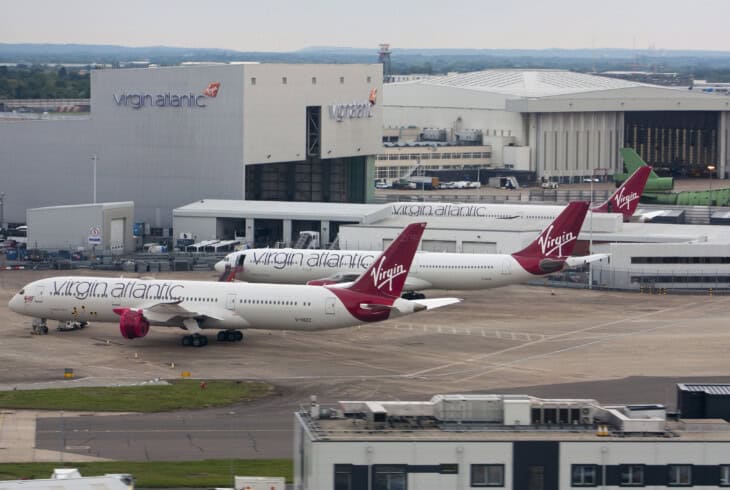
The 787-9 started with Air New Zealand. Operators in the database include Virgin Atlantic, Japan Airlines, Air Canada, Etihad and American Airlines.
The lists are not complete. They only show which airlines appear in our photo galleries.
A350 vs 787: the verdict
Pick the A350-900 for the wider cabin and the bigger airframe. Pick the 787-9 for the lighter airframe and the engine choice.
Both are mostly composite long-haul twins that flew within months of each other. Passengers feel the cabin more than the spec sheet.
To see who flies the wider seats, see our ranking of the best economy class airlines.
FAQ
Sources and references used for research and fact-checking.
About the Author

Tim is the owner and lead editor of AeroCorner since 2019, overseeing aviation content covering aircraft, airlines, airports, and the broader aviation industry. Through years of researching, writing, editing, and publishing aviation-focused content, he has developed extensive practical knowledge of commercial aviation and air travel. Based in Asia and a frequent traveler himself, Tim also brings firsthand passenger experience to AeroCorner’s coverage. Outside of publishing, he has also explored aviation firsthand through hands-on flight training in New Zealand.