

Table of Contents
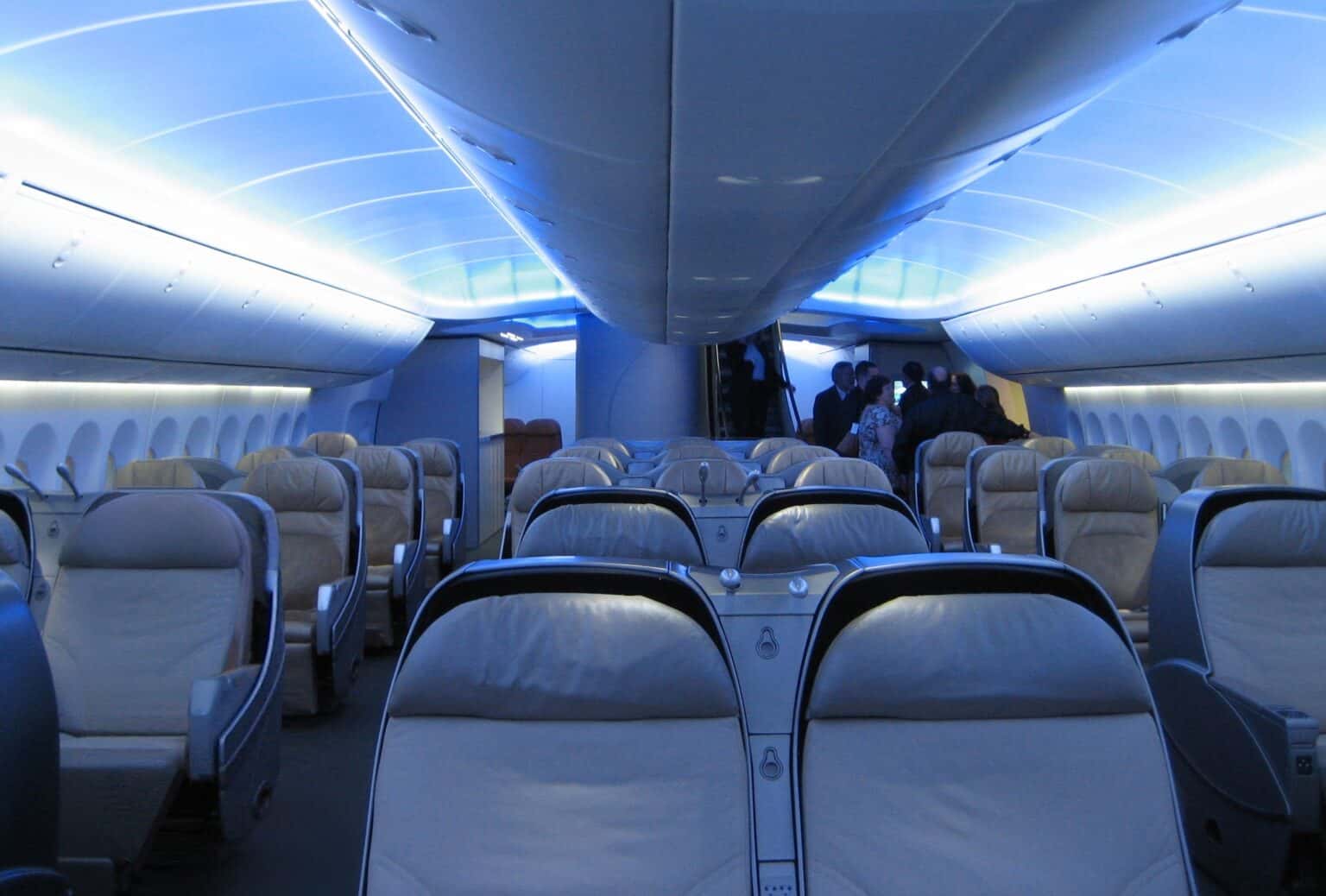
A Boeing 747 seats 467 passengers in a typical three-class layout, if you mean the newest version, the 747-8. That is the figure in Boeing’s own airport planning document for the type, revised in January 2026.
The 747s you can actually board carry far fewer. The three airlines still flying the 747-8 with passengers, Lufthansa, Korean Air and Air China, fit between 348 and 368 seats. The FAA’s certification allows up to 605.
How Many Seats Are on a 747?
There is no single answer, because the 747 was built in half a dozen passenger versions over more than 50 years, and every airline designs its own cabin. Typical three-class figures run from 276 seats on the short 747SP to 467 on the stretched 747-8.
At Lufthansa, Korean Air and Air China, the airlines flying most passenger 747s in 2026, the real range is 348 to 371 seats. The top of that range is a Lufthansa 747-400 with 371, according to AeroLOPA seat maps and Lufthansa’s published fleet data.
747 seats at a glance
Boeing typical, three classes: 467 on the 747-8, 416 on the 747-400ER, 400 on the 747-400. Airlines today: Lufthansa 364 and 371, Korean Air 368, Air China 365. Certified maximum on the 747-8: 605, with 495 on the main deck and 110 upstairs. Most people ever carried: 1,088, on an El Al 747 in May 1991.
Seats on every 747 version
Each new 747 got longer or gained a bigger upper deck, and the typical seat count climbed with it. The table uses Boeing’s planning documents where Boeing still publishes them, and Wikipedia’s figures for the older jets.
| Version | Typical seats | Layout | What changed |
|---|---|---|---|
| 747-100 and 747-200 | 366 | Three classes | The original, with a short upper deck |
| 747SP | 276 | Three classes | Fuselage cut short for range |
| 747-300 | Up to 400 | Three classes | Stretched upper deck |
| 747-400 | 400 | Three classes | 42 business seats upstairs, 358 below |
| 747-400ER | 416 | Three classes | 500 in Boeing’s two-class layout |
| 747-8 Intercontinental | 467 | Three classes | Longer fuselage and upper deck |
Boeing’s 747-8 layout puts 48 business seats on the upper deck, then 19 first, 96 business and 352 economy seats on the main deck. That is a generic reference cabin for airport planners, not one any airline actually bought.
Width explains the big numbers. Economy on the 747’s main deck is normally 10 seats across, in a 3-4-3 layout, while the narrower upper deck fits six across in economy (3-3) or four in first class (2-2).
That is why the upper deck matters so much for the total. Each extra row upstairs adds four to six seats, and each extra row downstairs adds up to ten.
The 747SP is the odd one out. Boeing cut it short to fly farther, so it seated fewer people than the 747 it was derived from. Its story is on our 747SP page.
How many seats airlines actually install
Only four airlines still sell seats on a 747, as our count of how many 747s are still flying shows. Their cabins are built around lie-flat business seats, which take up far more floor than Boeing’s reference layout allows for.
| Airline and aircraft | Total | First | Business | Premium economy | Economy |
|---|---|---|---|---|---|
| Lufthansa 747-400 | 371 | 0 | 67 | 32 | 272 |
| Korean Air 747-8 | 368 | 6 | 48 | 0 | 314 |
| Air China 747-8 | 365 | 12 | 54 | 66 | 233 |
| Lufthansa 747-8 | 364 | 8 | 80 | 32 | 244 |
| Lufthansa 747-8 (Allegris cabin) | 348 | 8 | 80 | 40 | 220 |
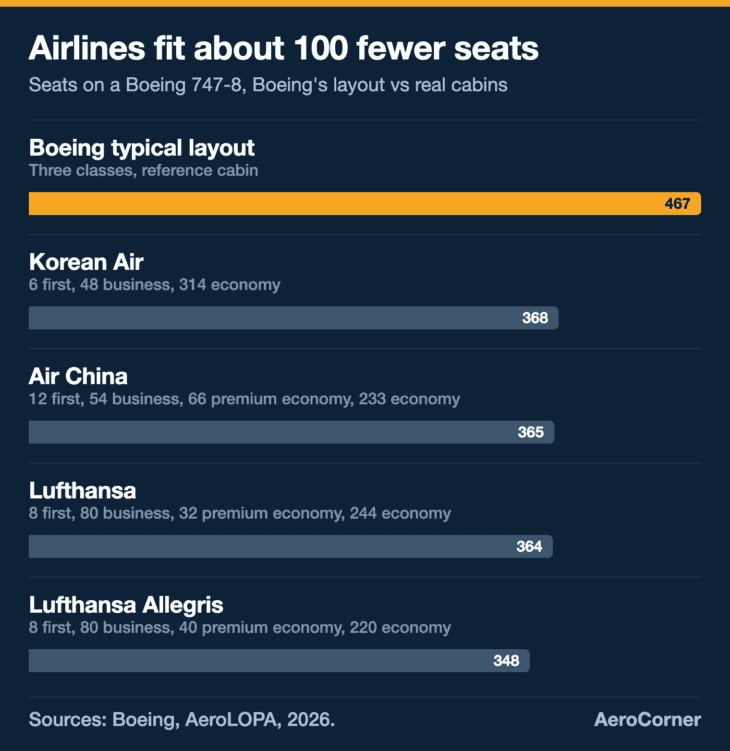
Rossiya, the fourth airline, flies a small number of older 747-400s. We found no current seat map for them, so they are left out here.
The pattern is the same everywhere: the more premium seats, the fewer seats in total. Lufthansa’s 747-8 has 80 business seats against Korean Air’s 48, and it ends up with 70 fewer economy seats.
Lufthansa’s new Allegris cabin pushes that further. Its refitted 747-8 drops to 348 seats, trading 24 economy seats for eight more premium economy seats.
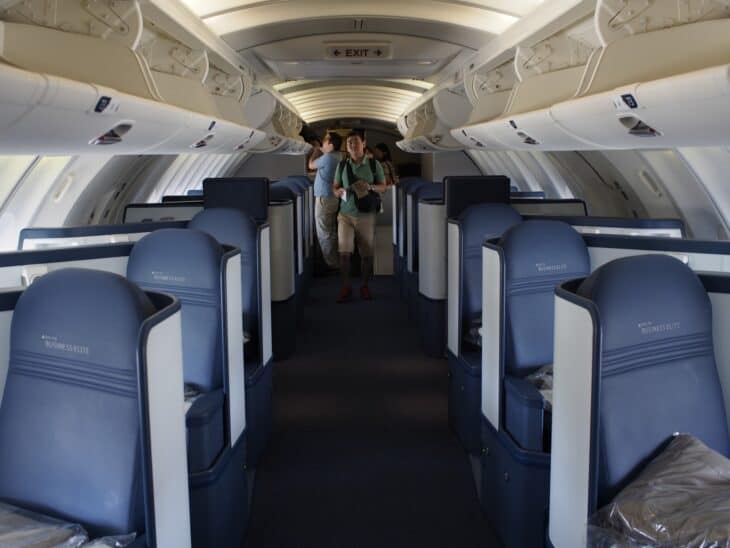
The upper deck, the hump behind the cockpit, is almost always premium. On Lufthansa’s 747-400 it holds 22 business seats. The hump exists because of cargo, not passengers.

Why the numbers differ
Search for 747 seats and you will see 366, 400, 416, 467, 605 and 660. Most of them are correct. They just answer different questions.
Typical seating is a brochure number. Boeing publishes a reference cabin so airports can plan gates, catering and baggage. It changes by version, which is why 366 (the original), 400 or 416 (the 747-400 family) and 467 (the 747-8) all circulate.
Boeing itself gives two figures for the 747-400. Its planning document lists 400 seats for the standard 747-400 and 416 for the heavier 747-400ER. Most websites quote 416 for every 747-400.
The certified maximum is a safety limit. It is set by how many people the exits can evacuate. The FAA’s 2011 special conditions for the 747-8 allow 495 passengers on the main deck and 110 on the upper deck, 605 in all.
Myth: a 747 holds 660 passengers
That figure belongs to one rare version, the 747-400D, a short-range jet built for Japanese domestic routes with all-economy seating. Wikipedia gives it up to 660 in a single class. Boeing’s own planning layout for it shows 539 economy seats on the main deck and 89 upstairs. No 747 flying passengers today comes close.
Real cabins are an airline’s choice. Airlines give up seats for lie-flat beds and premium economy, and that choice is the gap in the chart above.
The most people ever carried on a 747
The record has nothing to do with seats. On May 24, 1991, during Operation Solomon, an El Al 747 flew Ethiopian Jews to Israel with well over 1,000 people aboard.
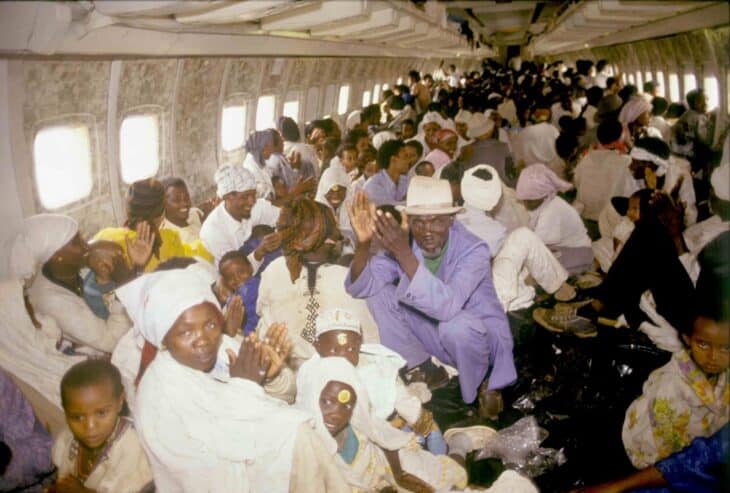

Guinness put the number at 1,088, including two babies born during the flight. Contemporary reports ran from 1,078 to 1,122. Either way, it was nearly double the 747-8’s certified maximum.
The earlier record came from Australia. After Cyclone Tracy hit Darwin in 1974, a Qantas 747-200 carried 674 evacuees in one flight, according to Wikipedia’s 747 history, though some accounts give 673.
A longer jet, fewer seats
Lufthansa’s 747-8 is longer than its 747-400 but carries seven fewer seats in total, because it carries far more premium seats: 88 first and business seats on the 747-8 against 67 on the 747-400.
The bigger rival is the Airbus A380, which carries passengers on two full-length decks. Our 747-8 vs A380 comparison sets the two side by side.
Seats are only half the load. A full 747 also carries a fuel load that weighs almost as much as the empty plane.
FAQ
Sources and references used for research and fact-checking.
- Boeing, 747-8 Airplane Characteristics for Airport Planning (D6-58326-3, Rev E)
- Boeing, 747-400 Airplane Characteristics for Airport Planning (D6-58326-1, Rev F)
- Federal Register (FAA), Special Conditions: Boeing Model 747-8; Upper Deck Occupancy
- Wikipedia, Boeing 747
- Wikipedia, Boeing 747-400
- Wikipedia, Boeing 747-8
- Wikipedia, Boeing 747SP
- Wikipedia, Operation Solomon
- Wikipedia, Lufthansa fleet
- AeroLOPA, Lufthansa Boeing 747-400 seat map
- AeroLOPA, Lufthansa Boeing 747-8 seat map
- AeroLOPA, Lufthansa Boeing 747-8 Allegris seat map
- AeroLOPA, Korean Air Boeing 747-8 seat map
- AeroLOPA, Air China Boeing 747-8 seat map
Get the Newsletter
The latest aviation news and stories sent to your inbox.
About the Author

Tim is the owner and lead editor of AeroCorner since 2019, overseeing aviation content covering aircraft, airlines, airports, and the broader aviation industry. Through years of researching, writing, editing, and publishing aviation-focused content, he has developed extensive practical knowledge of commercial aviation and air travel. Based in Asia and a frequent traveler himself, Tim also brings firsthand passenger experience to AeroCorner’s coverage. Outside of publishing, he has also explored aviation firsthand through hands-on flight training in New Zealand.