

Table of Contents
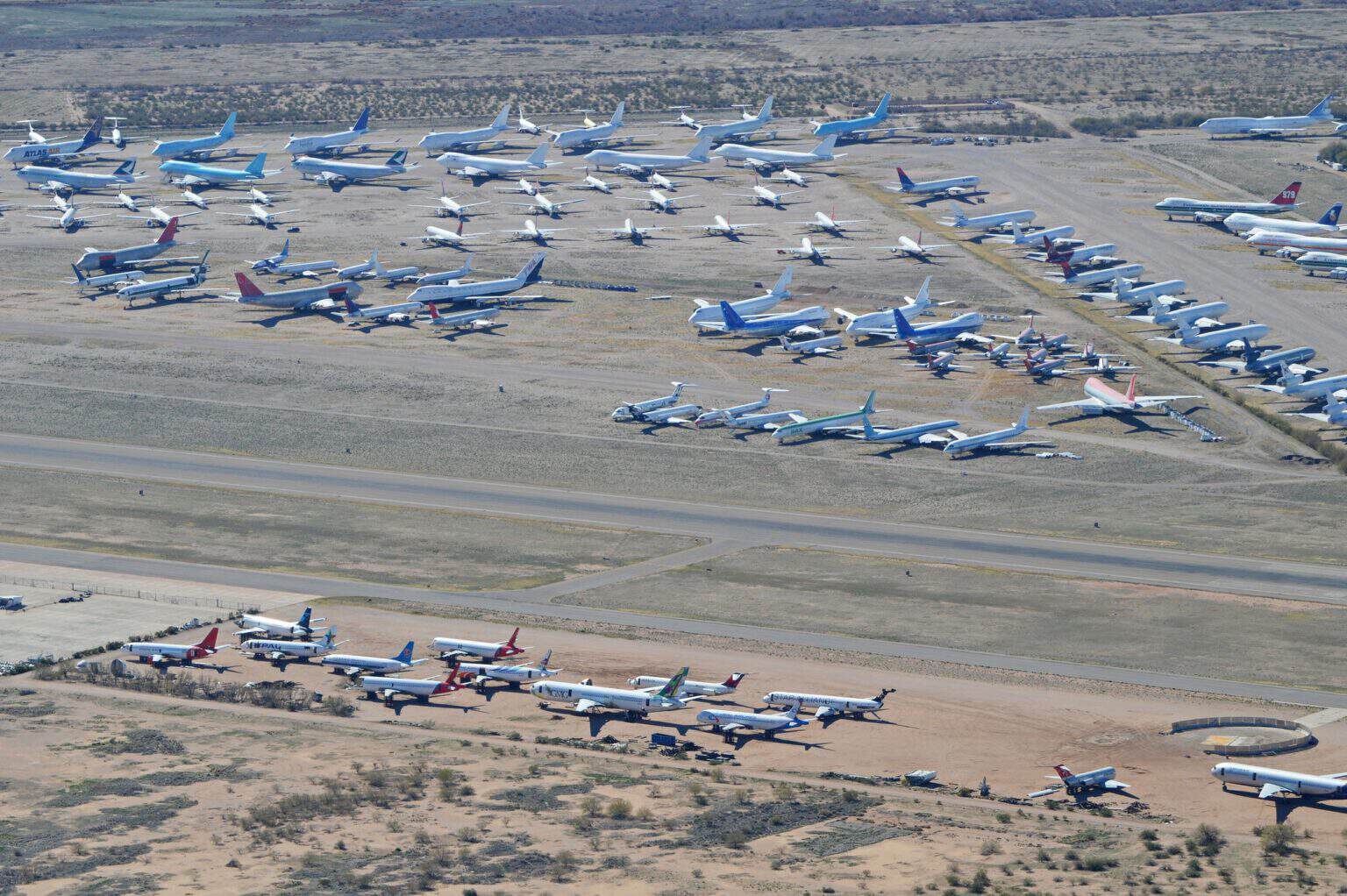
Airlines say they cannot get enough new planes. Boeing and Airbus are sold out for years. Yet while that shortage runs, thousands of airliners sit in desert storage yards doing nothing.
The world’s commercial fleet stood at 35,550 aircraft in June 2025, according to IATA’s fleet report built on Cirium data. Of those, 30,300 were in active service and 5,250, about 15%, were held in storage.
How Many Commercial Planes Are There in the World?
The best count is 35,550. That is every aircraft Cirium classes as commercial: passenger jets, freighters, combis and convertibles, from widebodies down to regional turboprops.
It leaves out private jets, military aircraft and small general aviation planes. It also leaves out retired airframes: Cirium retires an aircraft once filings, a part-out or about five years of inactivity show it is not coming back.
The count at a glance
35,550 commercial aircraft worldwide as of June 2025. 30,300 active, 5,250 in storage. 152 master series from 26 manufacturers. Boeing and Airbus built 80% of the active fleet. Source: IATA, The Global Commercial Aircraft Fleet, August 2025 (Cirium Fleets Analyzer data).
The Active Fleet by Type of Aircraft
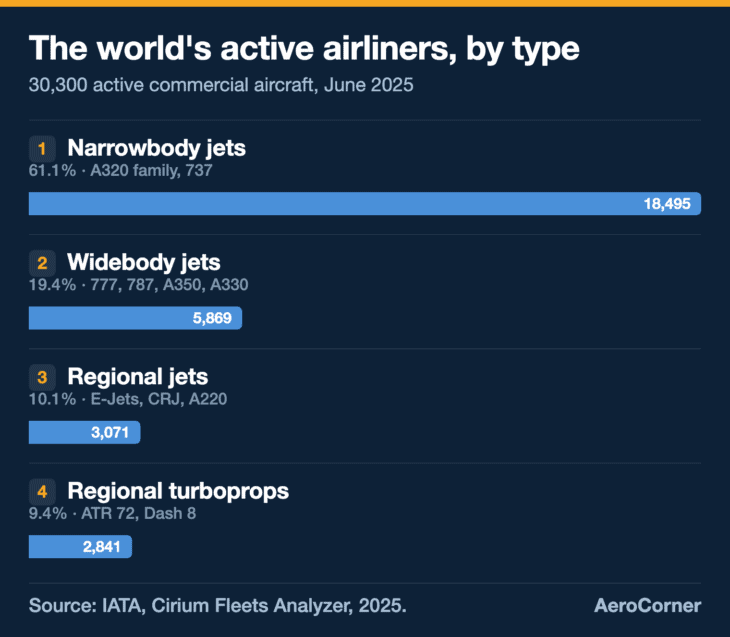
IATA splits the 30,300 active aircraft into four market classes. The parts below add to 30,276; IATA rounds the total to the nearest hundred.
| Market class | Active aircraft | Share | Typical types |
|---|---|---|---|
| Narrowbody jets | 18,495 | 61.1% | A320 family, 737 |
| Widebody jets | 5,869 | 19.4% | 777, 787, A350, A330 |
| Regional jets | 3,071 | 10.1% | Embraer E-Jets, CRJ, A220 |
| Regional turboprops | 2,841 | 9.4% | ATR 72, Dash 8, Beech 1900 |
| Total active | 30,276 | 100% |
The narrowbody is the workhorse. Two families, the A320 (including the neo) and the 737 (including the MAX), make up more than 90% of that segment, and narrowbodies fly close to 60% of the world’s available seat kilometers.
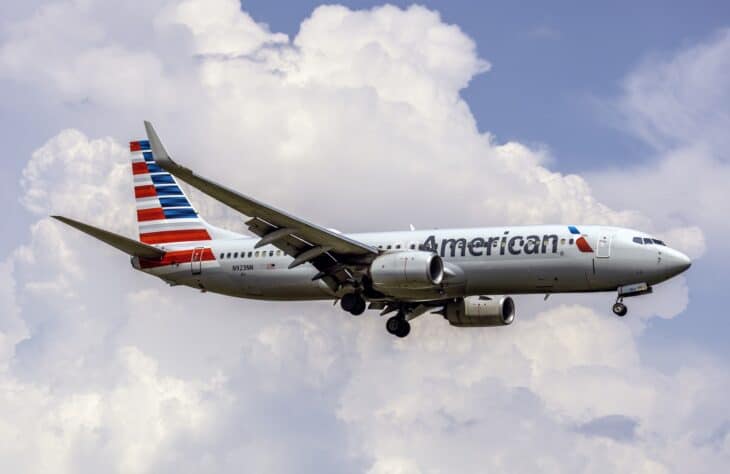
The Boeing 737-800 is the single biggest group in IATA’s narrowbody chart, ahead of the classic A320. The newer Airbus A320neo family has a stranger distinction: it has more aircraft in storage than any other type, for a reason covered below.

Widebodies punch far above their numbers. They are under a fifth of the fleet but fly almost 40% of seat kilometers, because they carry an average of 274 seats per flight and log the highest utilization of any class.
Regional jets and turboprops are the opposite. Together they are about one plane in five, yet they produce only around 3% of seat kilometers on short hops with about 63 seats per flight.
Why 5,250 Airliners Are Sitting in Storage
A 15% storage share sounds wrong during a plane shortage, and it is well above the 2010 to 2018 average of 11.8%. IATA gives three reasons.
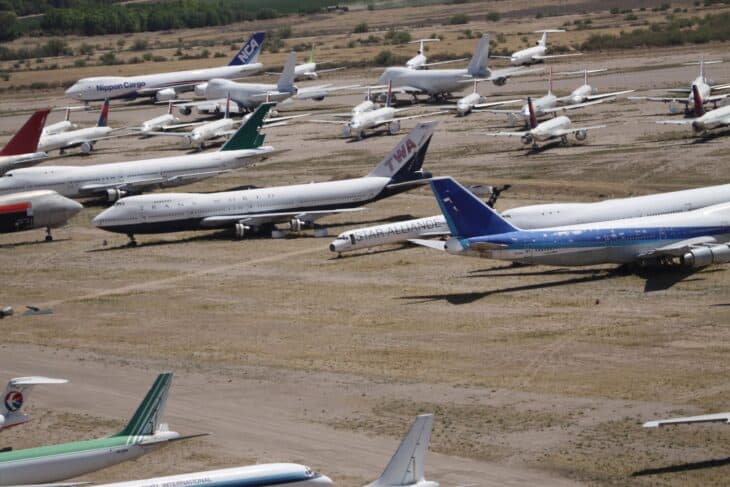

First, engines. The A320neo family has 692 aircraft in storage, the most of any type, and IATA ties the high storage level to engine issues, particularly Pratt & Whitney’s PW1000G geared turbofan. A further 2% of the global fleet is grounded for engine-related reasons.

Second, regional aircraft. The CRJ and ATR families show unusually high parked shares, as pilot shortages, cost pressure and airport limits push airlines toward bigger planes. Many of those stored regionals are old and may never fly again.
Third, the definition. Cirium counts a narrowbody as stored after 60 days without flying and a widebody after 90 days, and that includes planes in unplanned maintenance, in conversion to freighters, and brand-new aircraft still being fitted out.
The missing fleet
IATA estimates the industry is short at least 5,300 aircraft that would have been delivered if pre-pandemic production had continued. The order backlog has passed 17,000 aircraft, almost 60% of the active fleet and nearly 12 years of current production, and IATA does not expect it to normalize before 2031 to 2034.
Why the Numbers Differ
Search for this question and you will see 24,000, 28,000, 30,000 and 35,000. None of them is a typo. Each counts a different set of aircraft.
| Source | Count | What it includes |
|---|---|---|
| IATA / Cirium, June 2025 | 35,550 | All commercial aircraft, active and stored, jets and turboprops |
| IATA / Cirium, June 2025 | 30,300 | The same fleet, active aircraft only |
| Boeing Commercial Market Outlook 2026 | 28,000 (2025) | Jets only: regional jets, single-aisles, widebodies, freighters |
| Airbus Global Market Forecast 2026 | About half of 45,550 | Passenger jets over 100 seats and freighters over 10 tonnes |
Boeing’s figure comes from its widely covered annual forecast. Its outlook puts the 2025 fleet at 28,000 airplanes, and every segment it forecasts is a jet, so the 2,841 active turboprops fall outside it.
Airbus draws the line higher still. Its forecasts count passenger jets with more than 100 seats plus freighters over 10 tonnes, which drops turboprops and the smaller regional jets as well. Airbus says that fleet will double to more than 45,550 by 2045, so today’s version is roughly half that size.
The most repeated wrong number
Pages that say the world has about 24,000 commercial planes are quoting a manufacturer-style count of larger jets as if it covered every airliner. Add regional aircraft, turboprops and stored planes and the real total is close to 35,550.
Then there is the date. IATA expects about 2,100 deliveries a year over the next five years, minus retirements, so a count from 2019 or 2023 is simply stale.
Where the Number Is Going
Every forecaster expects the fleet to nearly double in 20 years. Boeing’s 2026 outlook sees its jet fleet growing from 28,000 to 50,095 airplanes by 2045, about 3% a year, as passenger traffic doubles.
Boeing expects 43,625 new deliveries over that span: 33,545 single-aisles, 7,715 widebodies, 1,435 regional jets and 930 freighters. About half replace older aircraft rather than add to the fleet.
The fleet is also getting older while it waits. IATA puts the average age at about 15 years, up from 13 before the pandemic, the highest in aviation history. Retirements are near record lows because airlines are holding on to anything that still flies.
How That Compares
The biggest single airline fleets are a small slice of the total. United flies 1,143 mainline jets, under 4% of the world’s active commercial fleet. Even the largest airlines in the world each fly only a few percent of it.
Those planes belong to the 1,138 airlines in the world, and only a fraction of them are airborne at once. On record days, trackers have counted more than 24,000 aircraft of all kinds airborne at once, as our guide to how many planes are in the sky right now explains.
FAQ
Sources and references used for research and fact-checking.
- IATA Sustainability and Economics, The global commercial aircraft fleet: Shortages cap growth (August 2025)
- IATA, Airlines constrained by aerospace supply chain bottlenecks (press release, December 9, 2025)
- Boeing, Boeing: Global Commercial Fleet Will Top 50,000 Airplanes in 20 Years as Passenger Traffic Doubles
- Boeing, Commercial Market Outlook 2026-2045: Executive Summary
- Boeing, Commercial Market Outlook 2026 presentation
- Airbus, Airbus forecasts growing services market to double by 2045
Get the Newsletter
The latest aviation news and stories sent to your inbox.
About the Author

Tim is the owner and lead editor of AeroCorner since 2019, overseeing aviation content covering aircraft, airlines, airports, and the broader aviation industry. Through years of researching, writing, editing, and publishing aviation-focused content, he has developed extensive practical knowledge of commercial aviation and air travel. Based in Asia and a frequent traveler himself, Tim also brings firsthand passenger experience to AeroCorner’s coverage. Outside of publishing, he has also explored aviation firsthand through hands-on flight training in New Zealand.