

Table of Contents
The world has 1,138 airlines. That is the count from the Air Transport Action Group (ATAG), the industry coalition that publishes the standard global snapshot of aviation, in its 2024 report built on 2023 data.
Between them, those 1,138 airlines flew a fleet of 29,039 commercial aircraft and carried 4.4 billion passengers in 2023. The number is smaller than it was before the pandemic, and it is not spread out the way most people would guess.
How Many Airlines Are There in the World?
1,138 commercial airlines, according to ATAG’s Aviation: Benefits Beyond Borders, released in December 2024. It is the newest published world total, and its figures describe the industry in 2023.
ATAG counts commercial airlines, the carriers behind the world’s passenger and cargo network. It is not a register of every aircraft operator, and that difference is where the much bigger numbers you may have seen come from.
The count at a glance
1,138 commercial airlines in 2023, per ATAG. 381 of them belong to IATA, the airline trade body. 1,315 airlines report to IATA’s annual statistics. Over 6,200 three-letter operator codes sit in ICAO’s register, and most of those are not airlines.
How Many Airlines Each Region Has
ATAG’s regional reports split the 1,138 into six regions, and the six add up to the world total exactly. Asia-Pacific and Europe lead, with just over 300 airlines each.
| Region | Airlines | Share of airlines | Share of passenger traffic |
|---|---|---|---|
| Asia-Pacific | 316 | 27.8% | 34.7% |
| Europe | 309 | 27.2% | 25.9% |
| Africa | 196 | 17.2% | 2.9% |
| Latin America and Caribbean | 135 | 11.9% | 8.7% |
| North America | 124 | 10.9% | 23.1% |
| Middle East | 58 | 5.1% | 4.6% |
| World | 1,138 | 100% | 100% |
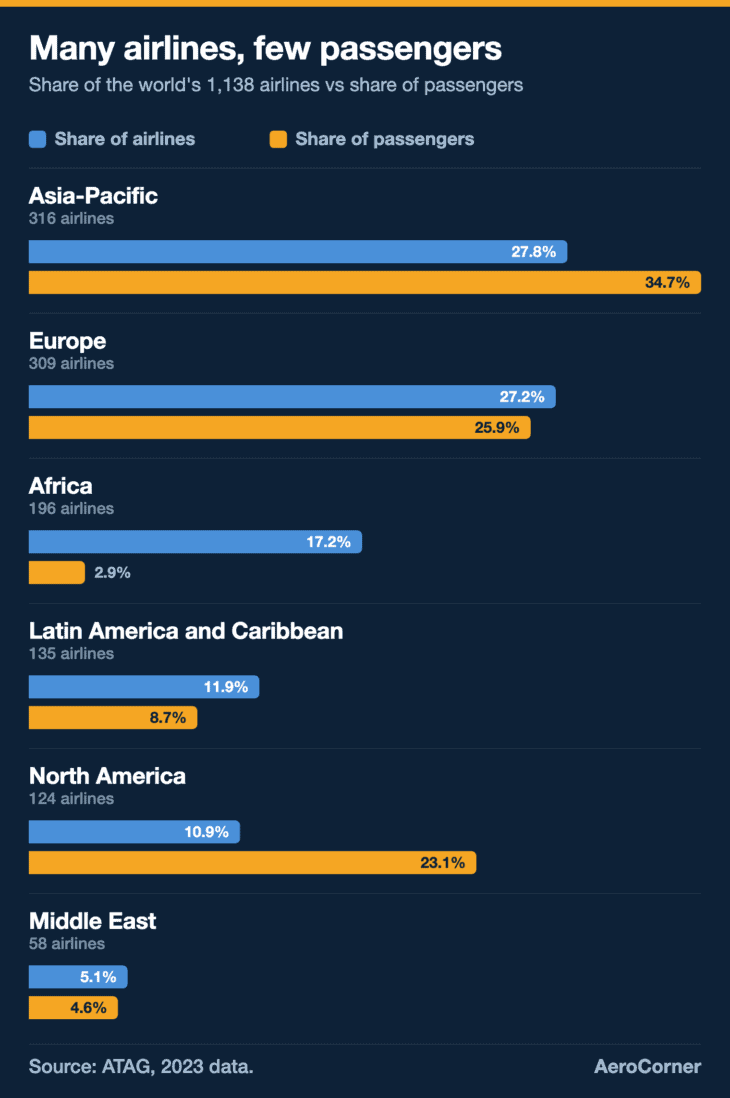
The surprise is Africa. Its 196 airlines outnumber North America’s 124, yet Africa carries 2.9% of the world’s passengers and North America carries 23.1%. African aviation is spread across many small carriers, while North American traffic runs through a handful of very large ones.
Our ranking of the biggest airlines in the US shows how concentrated that market is, with a few carriers taking most of the passengers.
The Middle East is the opposite surprise. It has only 58 airlines, the fewest of any region, but it also has only 128 commercial airports in ATAG’s count. A small number of airlines and airports carry the region’s 4.6% share of world traffic.
Why Other Sites Give Different Numbers
Search this question and you will see answers from about 380 to more than 6,000. Most of them are real numbers. They just count different things, and a few of them count things that are not airlines at all.
| What is counted | Number | Source and date |
|---|---|---|
| Operator codes in ICAO’s three-letter register | Over 6,200 | ICAO, May 2024 |
| IATA airline codes | About 3,000 | IATA, September 2025 |
| Airlines in IATA’s annual statistics | 1,315 | IATA, 2025 data |
| Commercial airlines | 1,138 | ATAG, 2023 data |
| IATA member airlines | 381 | IATA member list, November 2026 |
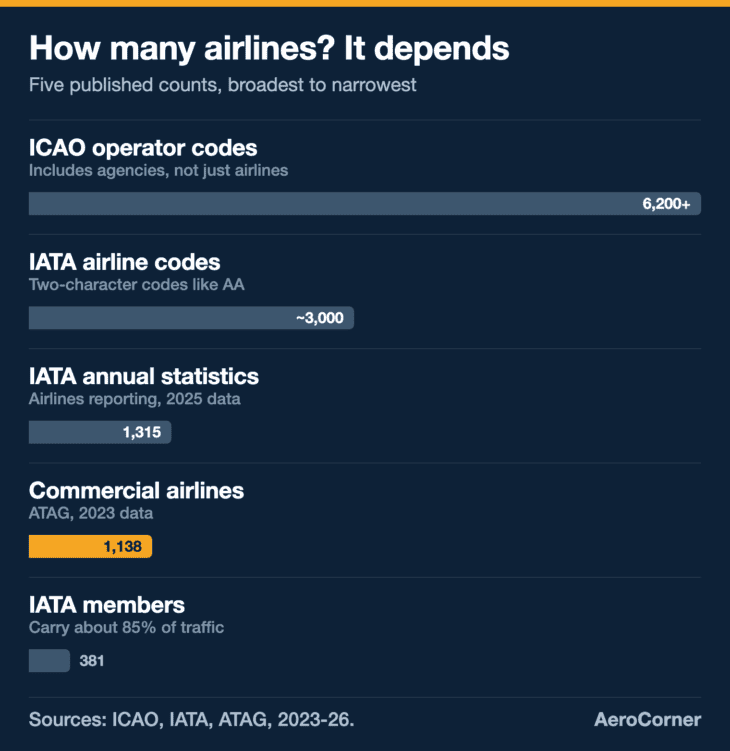
381 is a club, not a census. That is the number of airlines in the International Air Transport Association, the trade body, across five regions on its member list. IATA says its members carry about 85% of global air traffic, which is why the figure gets quoted, but hundreds of working airlines never join.
1,315 is a reporting list. IATA’s World Air Transport Statistics, released in July 2026, draws on the 1,315 airlines in its annual statistics collection. It is close to ATAG’s figure but measured a different way, two years later.
About 3,000 is a code list. IATA says it manages about 3,000 airline codes, the two-character tags like AA or BA on your ticket. A code is not the same as a flying airline, because IATA can reissue a delisted airline’s code after six months and gives some regional carriers a shared “controlled duplicate.”
The 6,000-plus number is not airlines
ICAO lists over 6,200 three-letter designators, the codes like AAL and BAW that air traffic control uses. The register is for aircraft operating agencies, aeronautical authorities and services, and codes starting with Y and Z are reserved for government organizations. It counts operators of every kind, not airlines you can book.
Then there are the lists. Wiki pages and directories that name every airline ever founded mix in carriers that shut down decades ago, so a long list is a history book, not a head count. Our guide to the oldest airlines in the world still flying shows how few of the early names survive.
The World Has Fewer Airlines Than It Did in 2019
ATAG’s earlier reports show the total falling. Its 2012 figures counted 1,568 airlines, and its 2020 report counted 1,478 airlines for 2019. The 2023 figure of 1,138 is 340 fewer than in 2019.
| ATAG figures | Airlines | Commercial aircraft | Airports with scheduled flights |
|---|---|---|---|
| 2012 edition | 1,568 | 23,844 | 3,846 |
| 2019 data | 1,478 | 33,299 | 3,780 |
| 2023 data | 1,138 | 29,039 | 4,072 |
ATAG does not list which airlines dropped out, so treat the drop as a direction, not a precise toll. The 2023 snapshot came right after the pandemic grounded most of the world’s fleets, and the aircraft count also sat below its 2019 level.
The airport count went the other way. 4,072 airports had scheduled flights in 2023, up from 3,780 in 2019, so fewer airlines now serve more places. Our count of how many airports are in the world explains why that figure is a small slice of all airfields.
A Few Hundred Airlines Carry Almost Everyone
The 1,138 airlines are wildly unequal. IATA’s 381 members, a third of ATAG’s total, carry about 85% of the world’s air traffic, which leaves several hundred airlines sharing the rest.
That is why a list of the largest airlines in the world looks so short. A few groups in the US, China and Europe fly hundreds of aircraft each, while many national and regional carriers fly a handful.
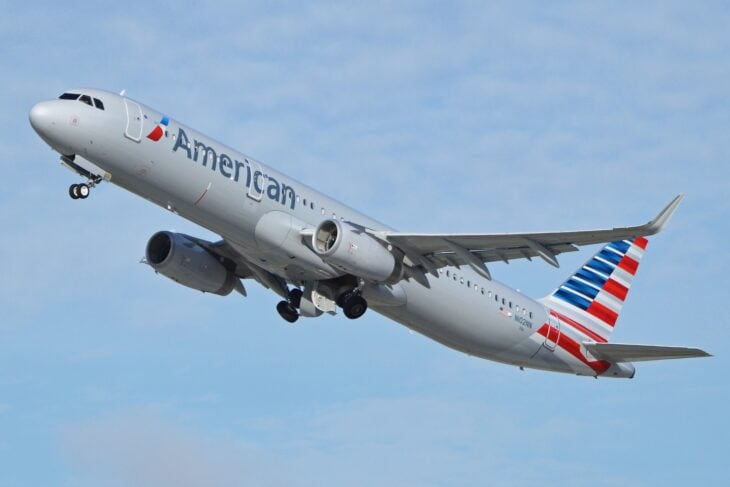
Spread the 29,039 aircraft evenly and each airline would fly about 25 planes. In reality American Airlines alone reported 1,609 planes on June 30, 2026, which our count of how many planes American Airlines has breaks down by type.

FAQ
Sources and references used for research and fact-checking.
- Air Transport Action Group (ATAG), Facts and figures
- Air Transport Action Group (ATAG), Aviation: Benefits Beyond Borders 2024, regional analyses
- Air Transport Action Group (ATAG), Aviation: Benefits Beyond Borders 2020
- Air Transport Action Group (ATAG), via JTTRI, Aviation: Benefits Beyond Borders presentation, scope of our industry
- IATA, Current Airline Members
- IATA, About us
- IATA, IATA releases 2025 World Air Transport Statistics report
- IATA, IATA codes: air travel's invisible but essential connector
- ICAO Uniting Aviation, Did you ever wonder where those three-letter codes that identify aircraft operators come from?
- Wikipedia, Airline codes
- Wikipedia, KLM
Get the Newsletter
The latest aviation news and stories sent to your inbox.
About the Author

Tim is the owner and lead editor of AeroCorner since 2019, overseeing aviation content covering aircraft, airlines, airports, and the broader aviation industry. Through years of researching, writing, editing, and publishing aviation-focused content, he has developed extensive practical knowledge of commercial aviation and air travel. Based in Asia and a frequent traveler himself, Tim also brings firsthand passenger experience to AeroCorner’s coverage. Outside of publishing, he has also explored aviation firsthand through hands-on flight training in New Zealand.