


Table of Contents
Twenty-five years on, the airline map of September 2001 is half gone. What replaced it is a market run by four carriers.
The Air Transport Association ranked America’s 10 largest airlines of 2001 by revenue passenger miles, meaning one paying passenger flown one mile. Five of them no longer exist: Northwest, Continental, US Airways, America West and ATA.
Four of the five did not simply fail. They were folded into Delta, United and American, and each of those three buyers went through Chapter 11 bankruptcy before it bought. The fifth, ATA, shut down in 2008.
Of the 10, only American, United, Delta, Southwest and Alaska still fly under the names they carried in 2001. These are the airlines that did not survive the decade that began on September 11, and the survivors that swallowed them.
The grounding turned a weak year into a $19.6 billion hole
Traffic was already soft in 2001. A recession had hit business travel, and second-quarter traffic showed no growth at all. Then the attacks broke it: fourth-quarter traffic fell 19 percent, and airlines cut their schedules by a fifth in the immediate aftermath.
Airlines initially announced about 100,000 layoffs and furloughs. Voluntary programs and work-sharing brought that down to about 80,000 people, roughly 11 percent of the industry’s workforce.
One airline did not make it past the next day. Midway Airlines of Raleigh-Durham, already in bankruptcy since August 13, did not restart when the airspace reopened. It ceased operations on September 12, 2001, laying off 1,700 employees, and after a brief comeback it was gone for good by October 2003.
Congress moved fast. The Air Transportation Safety and System Stabilization Act, signed on September 22, 2001, gave carriers $5 billion in direct compensation and authorized up to $10 billion in federal loan guarantees. The ATA wrote that it “prevented almost certain bankruptcy for many airlines.”
It only delayed the reckoning. Revenue passenger miles fell 5.9 percent for 2001, which the ATA called “the largest drop in U.S. history.” US scheduled airlines lost $8.3 billion that year and $11.3 billion in 2002, by the ATA’s restated figures: $19.6 billion in two years.

US Airways broke first. Reagan National Airport stayed shut until October 4, three weeks after every other US airport reopened, and the closure hit US Airways disproportionately. It filed for Chapter 11 on August 11, 2002, and United followed on December 9.
American and United, the two airlines whose aircraft were hijacked that morning, both survived as brands. Both later passed through bankruptcy court.
The 2001 top 10, and what happened to each
The ranking below comes from the ATA’s 2002 Economic Report. Together these 10 airlines flew about 603 billion of the industry’s 652 billion revenue passenger miles in 2001, or 92 percent of the market.
| 2001 rank | Airline | 2001 revenue passenger miles | What happened |
|---|---|---|---|
| 1 | American (incl. TWA) | 126.9 billion | Still flying. Chapter 11 in 2011, merged with US Airways in 2013 |
| 2 | United | 116.6 billion | Still flying. Chapter 11 from 2002 to 2006, merged with Continental in 2010 |
| 3 | Delta | 97.6 billion | Still flying. Chapter 11 from 2005 to 2007, merged with Northwest in 2008 |
| 4 | Northwest | 73.1 billion | Gone. Chapter 11 in 2005, absorbed by Delta, name retired in January 2010 |
| 5 | Continental | 58.7 billion | Gone. Absorbed by United, last flight in March 2012 |
| 6 | US Airways | 45.9 billion | Gone. Chapter 11 in 2002 and 2004, absorbed by American, last flight in October 2015 |
| 7 | Southwest | 44.5 billion | Still flying |
| 8 | America West | 19.1 billion | Gone. Merged with US Airways in 2005 and took its name |
| 9 | Alaska | 12.2 billion | Still flying. Bought Hawaiian in 2024 |
| 10 | ATA (American Trans Air) | 8.3 billion | Gone. Shut down on April 3, 2008 |
The list hides a sixth loss. American’s 2001 figure includes Trans World Airlines, which it bought in April 2001. TWA’s 71-year run ended on December 1, 2001, when a McDonnell Douglas MD-83 flew the last TWA flight from Kansas City to St. Louis.


The low point came on September 14, 2005, when Delta and Northwest filed for bankruptcy on the same day. Until US Airways emerged on September 27, four of the country’s largest airlines, Delta, Northwest, United and US Airways, were all flying under court protection, and together they carried half of America’s passengers.
9/11 was not the only cause. Rising fuel costs and pension obligations did much of the later damage, and fuel is what Delta blamed. Continental never filed after 2001 and merged with United on its own terms. ATA collapsed after losing a military charter contract as fuel prices climbed.
Four airlines now sell two thirds of America’s seats
The mergers built the market every American flyer now books into. In September 2026, OAG’s schedule data shows American with 21.07 million seats, Delta with 18.99 million, Southwest with 17.95 million and United with 17.55 million.
That is 75.6 million of the 111.6 million seats scheduled in the US market that month, domestic and international combined, or about 68 percent. Alaska, in fifth place, schedules 6.18 million, around a third of United’s total.
The two eras are measured differently, passenger miles then and scheduled seats now, but the direction is plain. In 2001 it took 10 airlines to fly 92 percent of the traffic. Today the biggest survivor, American, is the largest airline in the world by passengers carried and daily flights.

The vanished airlines did not leave all at once. Their aircraft flew on in new paint. In the mid-1990s, Northwest had the world’s largest fleet of McDonnell Douglas DC-9s, 180 of them, and Delta kept the type flying until January 6, 2014.
That last DC-9 commercial flight, DL2014, left Minneapolis/St. Paul, Northwest’s original hub, for Atlanta. It retired a design that had first flown in 1965.
Fewer airlines also means fewer rivals on the same routes. The revenue systems behind every ticket price now compete against a far shorter list of opponents than they did in 2001.
Spirit and Hawaiian show the shakeout is still running
The consolidation did not end with the last US Airways flight in 2015. In the last two years, two more airlines from the 2001 rankings have lost their independence or vanished outright.
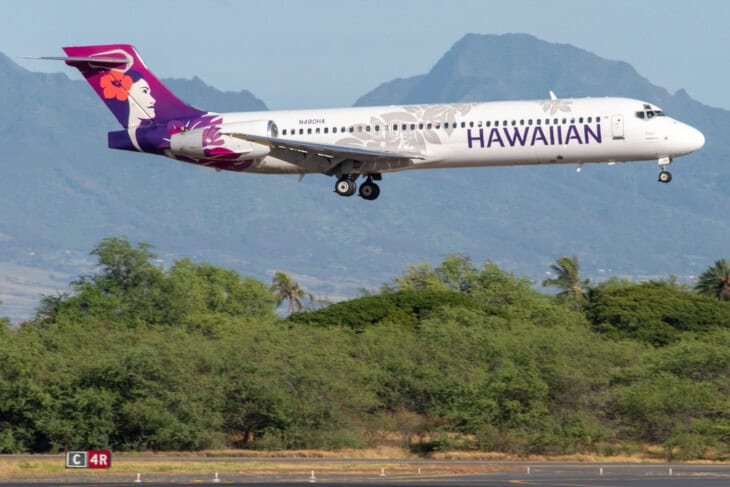
Hawaiian, 12th by passenger miles in 2001, was bought by Alaska Air Group on September 18, 2024. It moved onto Alaska’s operating certificate in October 2025 and onto Alaska’s AS flight code in April 2026, keeping the Hawaiian brand for flights to, from and within Hawaii.
Spirit, 14th in 2001, is gone entirely. A federal judge blocked JetBlue’s attempt to buy it on January 16, 2024, calling the deal anticompetitive. Spirit then filed for Chapter 11 twice and ceased operations on May 2, 2026.
What is left is an estate selling off parts, which is why nobody really owns Spirit Airlines now. JetBlue won Spirit’s 22 LaGuardia slots at the bankruptcy auction, and on August 31, 2026, the FAA said it tentatively intends to let JetBlue buy the slots.
That is the pattern of the past 25 years in one transaction. An American airline disappears, and what it owned passes to the airlines that are left.
Sources and references used for research and fact-checking.
- Air Transport Association, 2002 Economic Report: Top 25 Airlines 2001, Traffic and Financial Results
- Air Transport Association, 2003 Economic Report
- US Government Accountability Office, Aviation Assistance: Compensation Criteria and Payment Equity under the Air Transportation Safety and System Stabilization Act (GAO-04-725R)
- Wikipedia, Air Transportation Stabilization Board
- The White House (archived), Opening Reagan National Airport Fact Sheet
- WNYC, The Near Death of Reagan National Airport After 9/11
- Wikipedia, US Airways
- AeroTime, The Day That 4 American Legacy Carriers Went Bankrupt
- Wikipedia, Delta Air Lines
- Wikipedia, Northwest Airlines
- Wikipedia, Continental Airlines
- Wikipedia, AMR Corporation
- Wikipedia, American Airlines
- Wikipedia, United Airlines
- Wikipedia, Trans World Airlines
- Wikipedia, ATA Airlines
- Wikipedia, Midway Airlines (1993-2003)
- Wikipedia, McDonnell Douglas DC-9
- Wikipedia, Hawaiian Airlines
- Wikipedia, Spirit Airlines
- OAG, US Aviation Market Insights, September 2026
- Federal Register (FAA), Petition for Exemption and Other Relief, Docket No. FAA-2026-9043
Get the Newsletter
The latest aviation news and stories sent to your inbox.
About the Author

Tim is the owner and lead editor of AeroCorner since 2019, overseeing aviation content covering aircraft, airlines, airports, and the broader aviation industry. Through years of researching, writing, editing, and publishing aviation-focused content, he has developed extensive practical knowledge of commercial aviation and air travel. Based in Asia and a frequent traveler himself, Tim also brings firsthand passenger experience to AeroCorner’s coverage. Outside of publishing, he has also explored aviation firsthand through hands-on flight training in New Zealand.