


The FAA’s own recruiting page carries two numbers a few inches apart. New trainees start at $22.61 an hour. Certified controllers, the same page says, average more than $155,000 a year within three years of leaving the academy.
Both numbers describe the same person. The distance between them is about the length of a college degree, and a large share of the people who start that journey never reach the second figure.
Air traffic control is one of the very few jobs in America that pays a six-figure median without asking for a bachelor’s degree. It is also one of the only ones that legally removes you on your 56th birthday, and will not let you through the door after 31. Those two ages explain almost everything else about the money.
How Much Do Air Traffic Controllers Make?
The median annual wage for air traffic controllers was $148,080 in May 2025, according to the Bureau of Labor Statistics. The median for all US workers in the same period was $50,980, so the typical controller earns close to three times what the typical American does.
The spread around that median is enormous. The lowest-paid 10 percent of controllers earned under $78,420, while the highest-paid 10 percent cleared $215,610. That is a gap of roughly $137,000 inside a single occupation of about 24,000 people.
In most careers a spread that wide is seniority. In this one it mostly is not. A controller’s pay is set first and foremost by which building they report to.
The answer in short
Median pay was $148,080 in May 2025 (BLS), ranging from under $78,420 to over $215,610. Base pay is set by the complexity level of your facility, not by negotiation or years served. Locality pay and overtime are stacked on top. Trainees start at $22.61 an hour, certification takes years, and the career ends by law at 56.
Your Pay Band Is Set by the Building, Not by You
The FAA scores every control tower, radar approach control and en route center in the country on a complexity scale that runs from Level 4 to Level 12. The score reflects how much traffic the facility handles and how difficult that traffic is to work.
Each level carries its own pay band, and a fully certified controller sits inside the band for the facility they are certified at. A quiet Level 4 tower and a Level 12 en route center are, in pay terms, two different jobs with the same job title. It is the part of the controller’s job that surprises people most.
| Facility level | Certified controller base pay band |
|---|---|
| Level 4 | $60,547 to $81,736 |
| Level 5 | $68,721 to $92,772 |
| Level 6 | $75,939 to $102,516 |
| Level 7 | $83,912 to $113,280 |
| Level 8 | $92,723 to $125,176 |
| Level 9 | $102,456 to $138,315 |
| Level 10 | $117,827 to $159,065 |
| Level 11 | $124,007 to $167,412 |
| Level 12 | $130,212 to $175,785 |
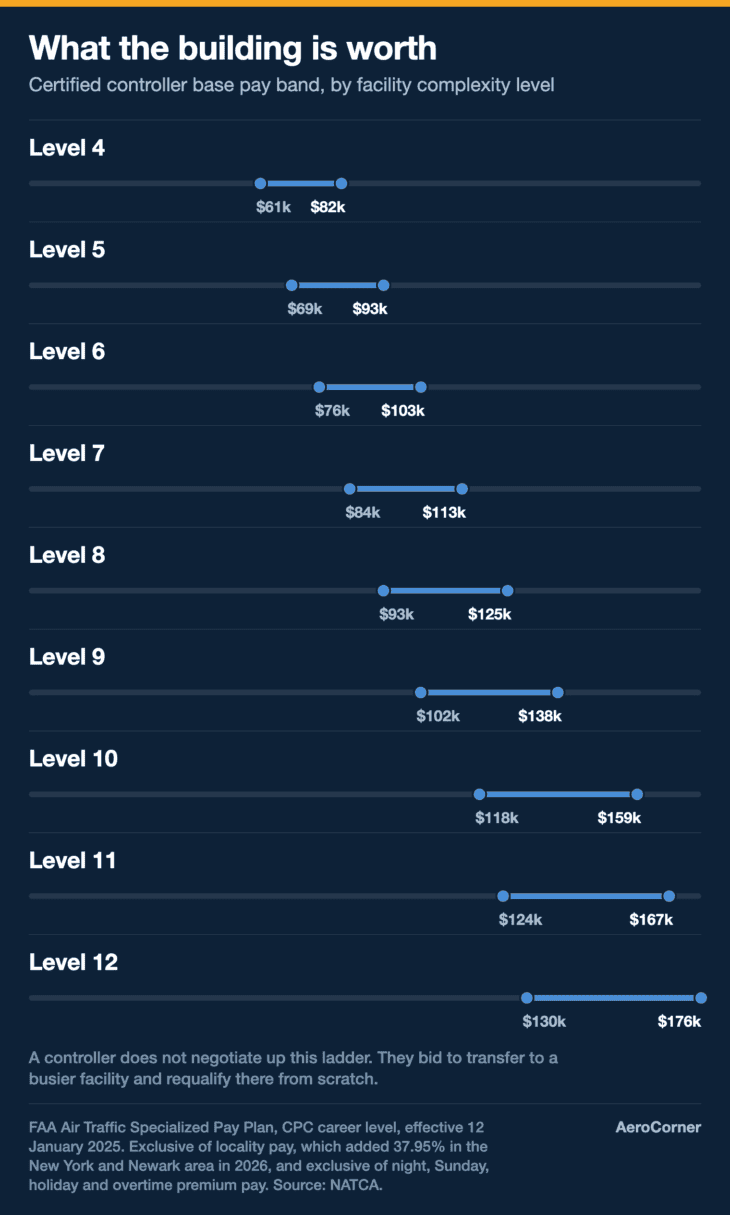
The practical consequence is that a controller who wants a raise does not ask for one. They bid to transfer to a busier facility and then requalify there, which means months or years of training all over again in unfamiliar airspace.
That churn is visible in the FAA’s own numbers. Of the roughly 4,000 controllers in the training pipeline in April 2026, about 1,000 were already fully certified somewhere else and were retraining at a new facility.
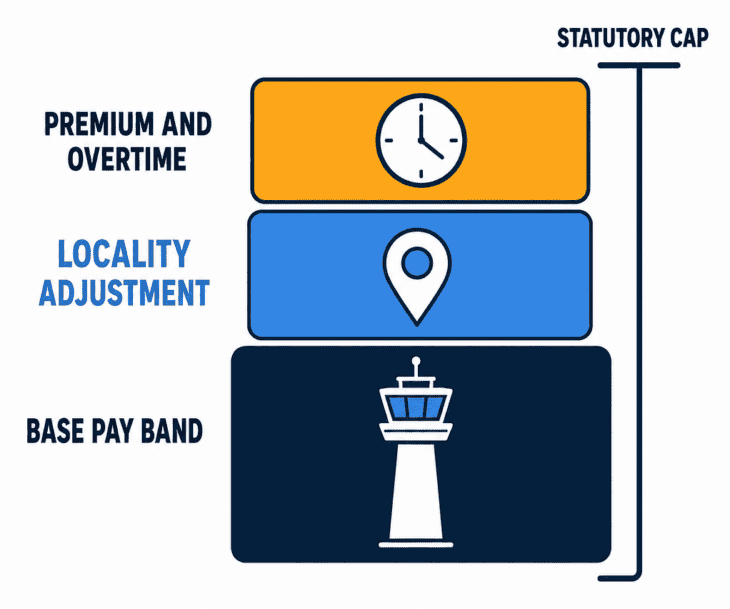
Base Pay Is Only One of Three Layers
The band figures above exclude locality pay, the federal adjustment for local labor costs. In 2026 that adjustment was 37.95 percent in the New York and Newark area, so the same job description pays very differently in Queens than it does in Kansas.
Premium pay sits on top of that: night differentials, Sunday and holiday work, and overtime, all of which a 24-hour operation generates in volume. For a lot of controllers this third layer is the difference between a good salary and the headline number.
There is a ceiling. FAA pay including locality is capped by law at the rate for Level II of the Executive Schedule, listed as $225,700 on the 2025 pay tables.
Add New York locality to the top of the Level 12 band and the arithmetic clears $242,000. At the busiest facilities in the most expensive cities, it is the statutory ceiling rather than the pay band that actually stops the money.
The Years Before the Six Figures
None of the above applies until you are certified, and getting there is where most of the attrition happens. Trainees at the FAA Academy in Oklahoma City earn $22.61 an hour, which annualises to roughly $47,000 before locality.
That rate is itself the result of a recruiting problem. The FAA raised the academy starting salary by 30 percent in March 2025 as part of a campaign to widen the applicant pool.
The academy is not a formality. By the FAA’s own accounting, on average 57 to 73 percent of trainees graduate, depending on which training path they are on. Somewhere between a quarter and two-fifths of the people who make it that far do not make it through.
Graduation is the halfway point, not the finish line
An academy graduate is not yet a controller. They are assigned to one of the FAA’s 313 facilities and work under supervision until they certify on every position there, which the FAA says can take more than two years at a complex facility. Wash out during that on-the-job phase and the years already invested do not convert into a certification anywhere.
To keep people moving through that gauntlet the FAA and the controllers’ union agreed a set of cash awards in May 2025. Academy graduates who complete initial qualification training get $5,000, new hires who complete it get $5,000, and graduates posted to one of 13 hard-to-staff facilities get $10,000.
Why the Career Ends at 56
Federal law, at 5 U.S.C. 8335(a), separates an air traffic controller on the last day of the month in which they turn 56. The Secretary of Transportation can exempt a controller of exceptional skill and experience, but only as far as 61.
A separate provision, 5 U.S.C. 3307(b), lets the Secretary set a maximum age for entering the job at all. The FAA has fixed that at under 31 years old on the day you apply.
Those two rules are not independent. The window between them is 25 years, which is exactly the service a controller needs to retire under the enhanced federal rules that apply to the job.
Under those rules a controller can retire at 50 with 20 years of covered service, or at any age with 25 years. The annuity is calculated at 1.7 percent of their highest three-year average salary for the first 20 years, then 1 percent for each year after.
Run that on a controller whose high-three average is $150,000 and who leaves with 25 years in. The formula returns 39 percent of that average, or about $58,500 a year, beginning in their early fifties.
Before 31
The door closes. You must be under 31 on the day you apply, then pass the Air Traffic Skills Assessment, a medical, a psychological evaluation and a security clearance.
Months 1 to 6
FAA Academy, Oklahoma City. Paid at $22.61 an hour. Between 57 and 73 percent of trainees graduate.
Years 1 to 3
On-the-job training. Assigned to one of 313 facilities and certified position by position. The FAA says full certification can take more than two years at a complex facility.
Age 50, or 25 years in
Retirement eligibility. Age 50 with 20 years of service, or any age with 25 years, under the enhanced federal retirement rules for controllers.
Age 56
Mandatory separation. Required by 5 U.S.C. 8335(a) on the last day of that month, with a discretionary exemption available only to 61.
Then comes the twist. Because the agency is short of people, it now pays certified controllers who are eligible to retire but not yet 56 a lump sum worth 20 percent of their basic pay for every additional year they stay.
The FAA built a career designed to eject people at 56 and is now paying a premium to stop them leaving at 51.
The Myth: Six Figures Means the FAA Pays Generously
The myth
A $148,080 median must mean air traffic control is one of the best-compensated jobs in the federal government. What that number actually reflects is a workforce running thousands of people short and covering the gap with overtime it cannot refuse.
As of April 2026 the FAA had roughly 11,000 certified professional controllers deployed across more than 300 facilities, against a full staffing target of 12,563 set in its 2026 workforce plan. That target was itself revised in the same document, which leans on new staffing models and scheduling software as much as on headcount.
The gap is closed with mandatory overtime. The controllers’ union reported that in 2022 controllers at 40 percent of FAA facilities worked a six-day week at least once a month, and six-day weeks have remained routine since. A meaningful part of the median salary is time the agency compels people to work.
The base rate is contested too. In April 2026 Congress appropriated $140 million for a 3.8 percent controller pay increase, but released only the 1 percent that every federal civilian employee received, leaving the remaining 2.8 percent to the FAA Administrator’s discretion.
As of early September 2026 that 2.8 percent had still not been paid, and two senators had written to the Administrator accusing him of holding it back to extract scheduling concessions. The staffing arithmetic behind all of this is the subject of the controller staffing crisis, which is the reason the overtime exists in the first place.
It is worth setting the number against the other side of the radio. Airline pilots reach comparable money, but only after six figures of training debt and years of regional wages, and they can keep flying to 65. Controllers start earning federal pay from their first day at the academy and are done nine years earlier.
Neither route is obviously the better deal. They are just priced very differently, and the controller’s price is paid in the shape of the career rather than in tuition.
Which brings it back to the two numbers on the FAA’s recruiting page. What sits between $22.61 an hour and $155,000 a year is not a promotion ladder you climb by being good at the job.
It is a facility assignment you bid for, a certification that takes years and washes out a large minority of the people who attempt it, and a clock that will not start after your 31st birthday and stops dead on your 56th.
Sources and references used for research and fact-checking.
- U.S. Bureau of Labor Statistics, Air Traffic Controllers, Occupational Outlook Handbook
- Federal Aviation Administration, Safe Skies. Strong Careers. We're Hiring Air Traffic Controllers.
- National Air Traffic Controllers Association, ATSPP Pay Bands, effective January 12, 2025
- Federal Aviation Administration, FAA Releases Bold, New Air Traffic Controller Hiring Plan
- Federal Aviation Administration, U.S. Transportation Secretary Sean P. Duffy Unveils New Package to Boost Air Traffic Controller Workforce
- Cornell Law School Legal Information Institute, 5 U.S. Code 8335, Mandatory separation
- Cornell Law School Legal Information Institute, 5 U.S. Code 3307, Competitive service; maximum-age entrance requirements; exceptions
- U.S. Office of Personnel Management, Salary Table 2026-NY
- FEDweek, FERS Air Traffic Controller Retirement
- CBS News, Illinois senators blast FAA administrator for holding air traffic controller raises hostage
- National Air Traffic Controllers Association, NATCA Calls on FAA to Collaborate on Air Traffic Controller Fatigue
Get the Newsletter
The latest aviation news and stories sent to your inbox.
About the Author

Tim is the owner and lead editor of AeroCorner since 2019, overseeing aviation content covering aircraft, airlines, airports, and the broader aviation industry. Through years of researching, writing, editing, and publishing aviation-focused content, he has developed extensive practical knowledge of commercial aviation and air travel. Based in Asia and a frequent traveler himself, Tim also brings firsthand passenger experience to AeroCorner’s coverage. Outside of publishing, he has also explored aviation firsthand through hands-on flight training in New Zealand.