

Table of Contents
On August 5, 1981, the Reagan administration fired 11,345 striking air traffic controllers. That is more people than the FAA’s entire certified controller force today.
The FAA counted 11,027 certified professional controllers on September 30, 2026, the highest level in a decade. Add the trainees and the agency employs about 15,000. Add the contract towers and the US civilian total reaches about 16,500.
How Many Air Traffic Controllers Are There?
It depends on who you count, and the difference is thousands of people. A certified professional controller, or CPC, has finished certification at their facility. Those are the 11,027, working across more than 300 FAA facilities.
In April 2026, the FAA also had about 4,000 controllers in its training pipeline. Roughly 1,000 of those were already certified somewhere else and were requalifying after moving to a new facility.
The count at a glance
11,027 fully certified FAA controllers on September 30, 2026. About 15,000 FAA controllers including trainees. More than 1,500 more at 266 privately run contract towers. Those figures leave out military controllers, for whom we could find no published total.


Who counts as a controller
The FAA’s 2026 to 2028 workforce plan splits the workforce into four groups. The table shows the last actual headcount it published, next to what it planned for September 2026.
| Group | Actual, Sept. 2025 | Planned, Sept. 2026 |
|---|---|---|
| Certified professional controllers | 10,694 | 10,968 (actual: 11,027) |
| CPCs in training (certified elsewhere, requalifying) | 1,001 | 1,028 |
| Developmental controllers | 2,529 | 2,753 |
| FAA Academy students | 608 | 571 |
| Total FAA controller workforce | 14,832 | 15,321 |
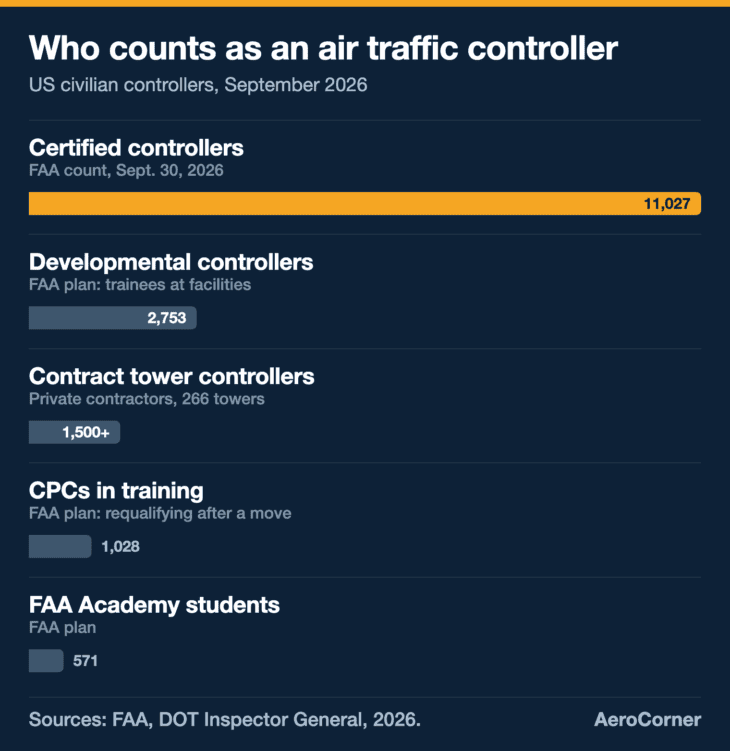
Developmental controllers are trainees working toward certification at a facility. The FAA says it can take more than two years to certify a new hire, depending on the facility’s complexity.
That lag explains the surprise in the numbers. The FAA hired a record 2,235 trainees in fiscal 2026, yet its certified force grew by 333. The plan also expects to lose 743 Academy students in fiscal 2026, the largest single source of controller losses.
The contract towers sit outside all of this. A March 2026 audit by the Transportation Department’s inspector general counted 266 of them, staffed by more than 1,500 controllers who work for private contractors. They were about 18 percent understaffed in April 2025.
Why the numbers differ
Search this question and you will see at least five answers, three of them from the federal government. None is exactly wrong. Each one measures something different.
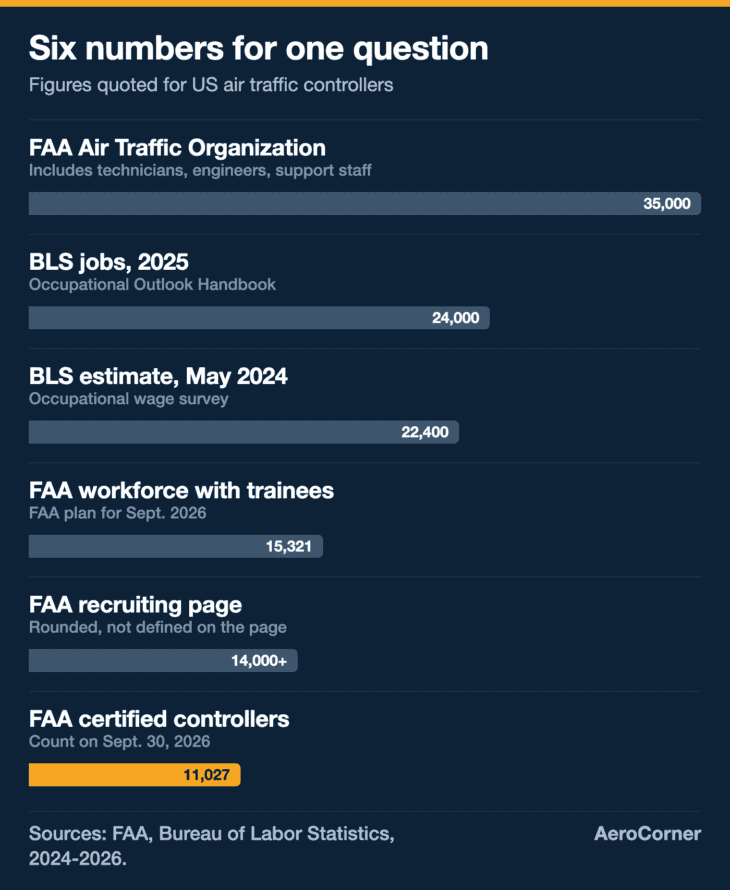
Myth: the FAA has 35,000 controllers
The figure comes from the FAA’s Air Traffic Organization page, which describes 35,000 controllers, technicians, engineers and support personnel. Read quickly, it looks like a controller count. Controllers are less than half of it.
The FAA’s recruiting page says “more than 14,000.” It does not define the figure, but it matches a rounded headcount with trainees included, close to the agency’s September 2024 total of 14,264.
The largest genuine controller figures come from the Bureau of Labor Statistics. Its Occupational Outlook Handbook says controllers held about 24,000 jobs in 2025, while its wage survey counted 22,400 in May 2024. That is also where the $148,080 median controller salary comes from.
Those totals run thousands above the FAA’s, and BLS does not publish a reconciliation. It counts an occupation across every employer rather than one agency’s payroll. It says 92 percent work for the federal government, which is not the same thing as the FAA.
How the shortage shrank without many new controllers
As recently as 2024, the shortage was framed as roughly 4,000 controllers. In September 2024 the FAA had 10,730 certified controllers at its facilities against a target of 14,633, a gap of 3,903.
Today the gap is 1,536. The target is now 12,563, set in the workforce plan the FAA released in May 2026.
The math behind the smaller shortage
The gap fell by 2,367 between September 2024 and September 2026. Cutting the target accounts for 2,070 of that. Added certified controllers account for 297. By that measure, about 87 percent of the improvement came from the target moving.
The FAA has a real argument for the change. It says the old model misjudged how much time controllers are available for traffic, cutting its availability factor from 2.14 to 1.87 after a review by the National Academies’ Transportation Research Board.
It also says better scheduling could raise time on position from about four hours to more than five in an eight-hour shift. And it will adopt a measure that gives trainees partial credit for the work they already do on position.
The plan’s bluntest line is about that scheduling. “The FAA does not use any automated scheduling optimization tools,” it says, because local managers still build the schedules by hand.
Critics have reasons for caution. The old target was set with the National Air Traffic Controllers Association in 2023, and the union told FLYING it “was not involved” in the new plan. The FAA’s own forecast reaches only 11,312 certified controllers by the end of fiscal 2028, still 1,251 under today’s target.
Controllers worked 2.2 million overtime hours in 2024, at a cost of $200 million, according to a National Academies report. Our piece on why there aren’t enough air traffic controllers covers how that shortage plays out on a working day.
Where the cuts landed
Controllers split between terminal facilities, meaning towers and approach control, and the en route centers that handle aircraft at cruise. The jobs are different, and the new target did not treat them equally.

| Facility type | Old target | New target | Certified, Sept. 2025 | All controllers, Sept. 2025 |
|---|---|---|---|---|
| Terminal (towers, approach) | 8,966 | 7,495 | 6,331 | 8,387 |
| En route centers | 5,667 | 5,068 | 4,362 | 5,836 |
| Total at facilities | 14,633 | 12,563 | 10,693 | 14,223 |
Terminal facilities absorbed 1,471 of the 2,070 positions cut. Count every controller, trainees included, and both types already sit above their new targets, which is why the FAA’s partial-credit measure matters so much.
Count only certified controllers, as the FAA’s old targets did, and both still fall short. That is the whole staffing debate in one table.
How the number got here
Today’s workforce still carries the shape of 1981. Rebuilding after the strike took close to 10 years, and the controllers hired in that wave drove a retirement peak in fiscal 2007.
August 1981
11,345 strikers fired. Staffing takes close to 10 years to return to normal.
Fiscal 2007
Retirements peak. The controllers hired in the early 1980s reach the end of their careers.
2023
The 14,633 target. The FAA and the controllers union agree on the staffing goal.
September 2024
10,730 certified at facilities. The gap to the target stands at 3,903.
May 2026
The target falls to 12,563. The new workforce plan lowers the goal by 2,070.
September 2026
11,027 certified. The FAA also reports a record 2,235 trainee hires for the fiscal year.
The next change is on the calendar. The FAA plans to hire 2,300 trainees in fiscal 2027 and 2,400 in fiscal 2028, and it forecasts 11,134 certified controllers at the end of fiscal 2027.
The controllers outside the FAA
The military runs its own air traffic control, and we could find no published total. A July 2026 Pentagon inspector general report said the Air Force has 913 authorized controller positions, about a fifth of them vacant, but figures for the other services were kept out of the public version.
The same report said more than a third of the department’s departing controllers leave for the FAA. Federal agencies are, in effect, competing for the same scarce people.
For scale, EUROCONTROL’s preliminary 2025 data shows 17,840 full-time-equivalent controllers on operational duty across 38 European air navigation providers. The two counts are not defined the same way, so treat that as a rough comparison and not a ranking.
FAQ
Sources and references used for research and fact-checking.
- Federal Aviation Administration, The Air Traffic Controller Workforce Plan 2026-2028
- Federal Aviation Administration, The Air Traffic Controller Workforce Plan 2025-2028
- Federal Aviation Administration, FAA Releases Bold, New Air Traffic Controller Hiring Plan
- Federal Aviation Administration, FAA Breaks All-Time Record for Air Traffic Controller Trainee Hiring
- The National News Desk, FAA adds record number of controller trainees as it races to rebuild workforce
- Fox News, FAA breaks all-time record for air traffic controller hiring in 2026
- AIN, FAA Cuts 2,000 from Certified Controller Goal in 2026 Hiring Plan
- FLYING / AVweb, FAA Lowers Controller Staffing Target
- CNN via ABC 17 News, FAA slashes hiring target, saying it can keep the skies safe with fewer air traffic controllers than it thought
- US Department of Transportation Office of Inspector General, FAA Took Action To Improve Monitoring and Increase Staffing Levels at Contract Towers, but Staffing Shortages Remain
- US Bureau of Labor Statistics, Air Traffic Controllers, Occupational Outlook Handbook
- US Bureau of Labor Statistics, National Aviation Day 2025
- Federal Aviation Administration, Air Traffic Organization
- Federal Aviation Administration, Aviation Careers
- Federal Aviation Administration, Air Traffic Controller Hiring
- Stars and Stripes, Military air traffic controller shortages hinder homeland defense, IG says
- FEDweek, Shortage of Civilian Air Traffic Controllers Hampering Mission at DoD/DoW, Says Report
- EUROCONTROL, First look at ANSPs' ACE 2025 data
- Wikipedia, Professional Air Traffic Controllers Organization (1968)
Get the Newsletter
The latest aviation news and stories sent to your inbox.
About the Author

Tim is the owner and lead editor of AeroCorner since 2019, overseeing aviation content covering aircraft, airlines, airports, and the broader aviation industry. Through years of researching, writing, editing, and publishing aviation-focused content, he has developed extensive practical knowledge of commercial aviation and air travel. Based in Asia and a frequent traveler himself, Tim also brings firsthand passenger experience to AeroCorner’s coverage. Outside of publishing, he has also explored aviation firsthand through hands-on flight training in New Zealand.