

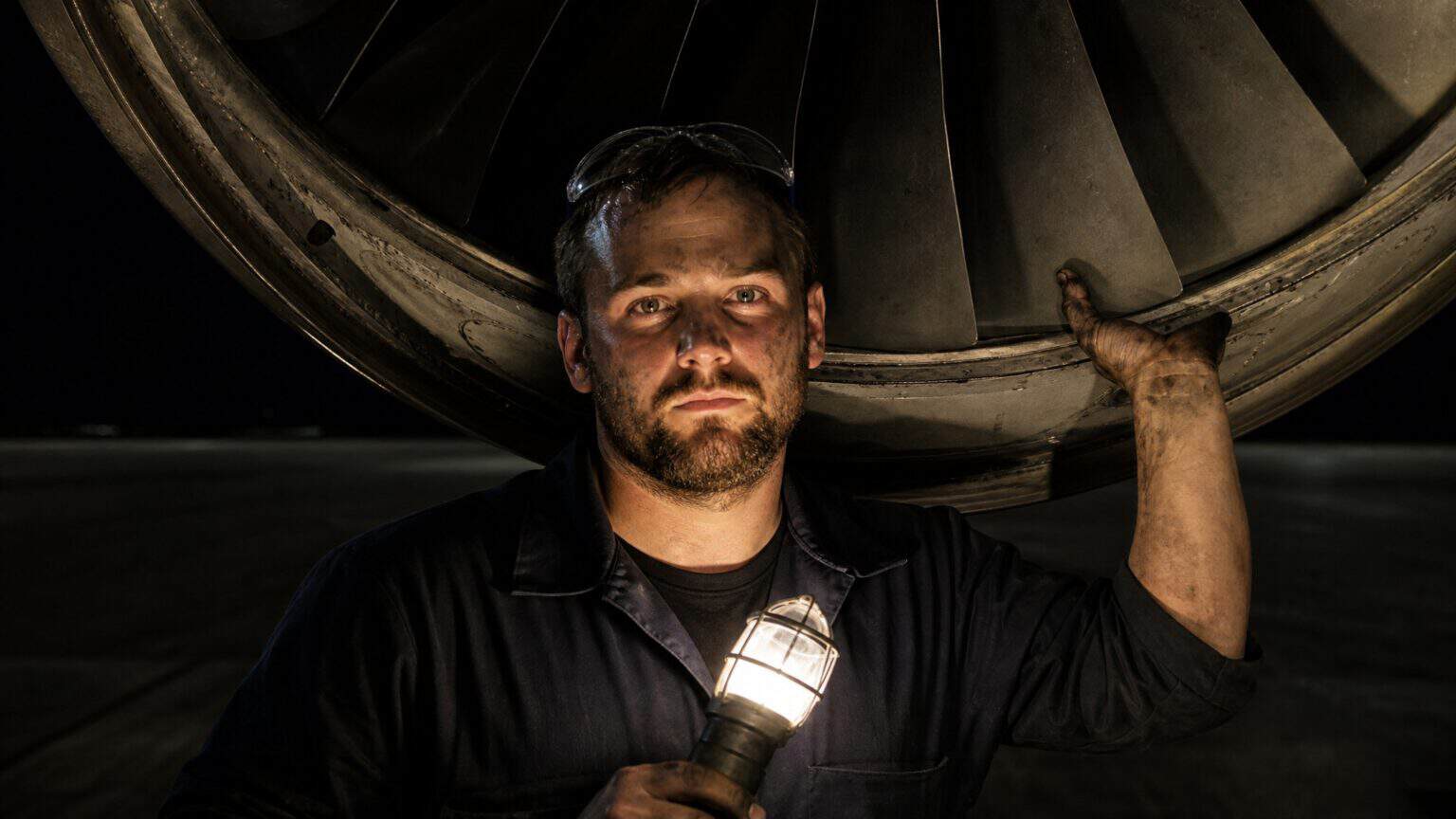
Somewhere in the hour before your flight pushed back, a person you never saw wrote a short entry in a maintenance record and signed their name against it. Until that signature existed, the aircraft was not legally allowed to carry you anywhere.
That signature is not a formality or an internal sign-off sheet. It is a federal certification act, made by an individual holding a federal license, and it is the reason the jet is permitted to fly.
The two pilots who then flew you across the country earn, at the median, roughly three times what that person does. Here is what aircraft mechanics actually make, what their signature legally commits them to, and why the gap between the two numbers has almost nothing to do with the difficulty of the work.
How Much Do Aircraft Mechanics Make?
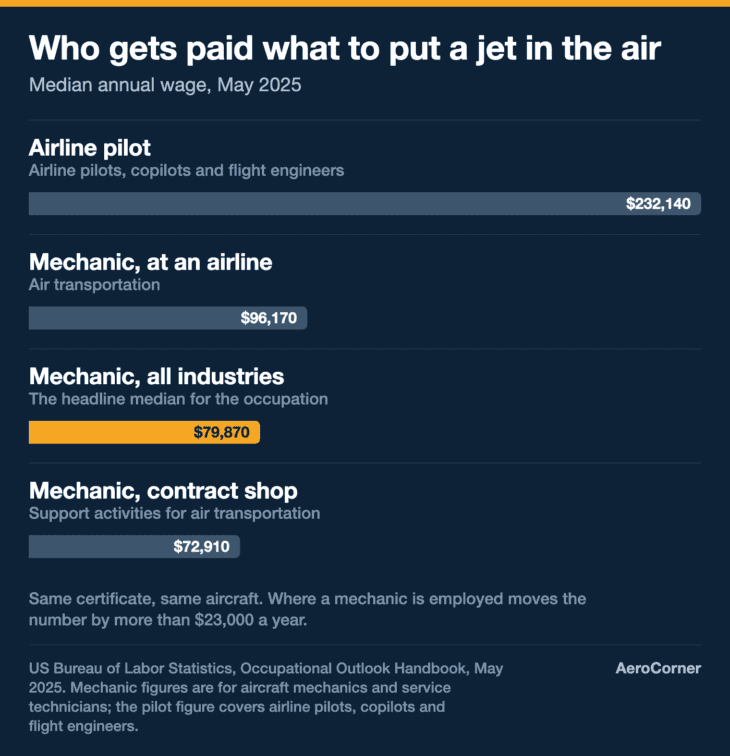
The median aircraft mechanic salary in the United States was $79,870 a year as of May 2025, according to the Bureau of Labor Statistics. The bottom 10 percent earned less than $48,780, and the top 10 percent earned more than $128,890.
Over the same period, the median for airline pilots, copilots and flight engineers was $232,140. The mechanic who releases the aircraft earns about 34 cents for every dollar earned by the person who then flies it.
That single median hides a spread that matters more than the headline. Where a mechanic works changes the number by tens of thousands of dollars, with the same certificate in their pocket.
| Where the mechanic works | Median annual wage |
|---|---|
| Air transportation (the airlines themselves) | $96,170 |
| Couriers and express delivery (FedEx, UPS) | $90,190 |
| Aerospace product and parts manufacturing | $82,720 |
| Federal government | $76,210 |
| Support activities for air transportation (contract MRO) | $72,910 |
A mechanic on an airline’s own payroll makes about $23,000 a year more than one doing similar work for a contract maintenance shop. Getting hired directly by a carrier is the single biggest financial decision in the career.
The short version
Median pay for a US aircraft mechanic was $79,870 in May 2025, against $232,140 for an airline pilot. Working directly for an airline lifts the mechanic median to $96,170. The certificate takes 18 to 24 months and costs a fraction of flight training, which is most of the reason the pay is lower.
What That Signature Actually Commits Them To
Federal aviation regulations are unusually blunt about who may declare an aircraft fit to fly. Under 14 CFR 43.7, only a short list of parties can approve an aircraft for return to service after maintenance, and a mechanic holding an Airframe and Powerplant certificate is on it.
The certificate, universally called an A&P, is issued to a person, not to a company. When a mechanic signs a maintenance record, they are exercising their own federal authority, and it is their own certificate that is on the line if the work was wrong.
This is what separates the job from almost every other trade. A car mechanic who does poor work faces a lawsuit or a lost customer. An A&P who signs off work that was not done properly faces enforcement action against the license the entire career depends on.
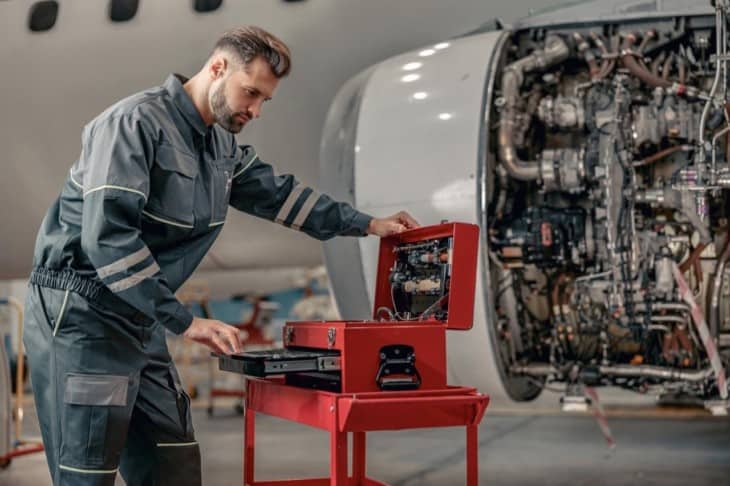
Much of that authority is exercised overnight, when the aircraft is on the ground and there is time to open panels. The overnight maintenance shift is where the majority of scheduled airline work happens, and where most of those signatures get written.
It is also the authority behind the deferral system passengers occasionally hear about. When a component fails and the flight departs anyway under the minimum equipment list, a mechanic has made and signed a documented engineering judgment that the aircraft is safe to fly without it.
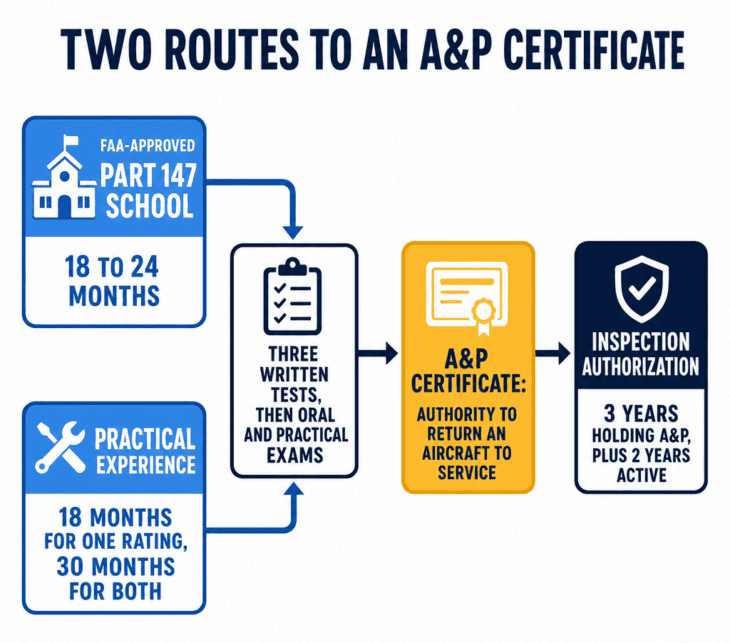
Above the A&P sits one more rung. An Inspection Authorization, granted under 14 CFR 65.91, lets a mechanic approve major repairs and major alterations and sign off annual inspections.
To hold one you need three years with both the airframe and powerplant ratings, two years of continuous recent work, a fixed base of operations, access to the right equipment and data, and a passing grade on a further written examination. It is a licence to make the calls nobody else in the hangar is permitted to make.
Why the Pay Gap Is Structural, Not a Verdict on the Work
The honest explanation for the gap is not that flying is harder than fixing. It is that the two professions have wildly different barriers to entry, and pay tracks the barrier far more closely than it tracks the difficulty.
There are two legal routes to an A&P. You can graduate from an FAA-approved Part 147 aviation maintenance technician school, or you can document real practical experience: 18 months for a single rating, or 30 months working on both airframes and powerplants at once, under 14 CFR 65.77.
Either route ends at the same three written tests, followed by oral and practical examinations. Military maintenance experience counts toward the second route, which is why so many A&Ps are veterans.
The school route typically runs 18 to 24 months. A community college program can cost as little as $5,000 to $15,000 in tuition for a state resident, while a private aviation maintenance academy generally charges $30,000 to $50,000 for the full airframe and powerplant course.
Compare that to the other side of the wall. Becoming an airline pilot commonly means $80,000 to $130,000 in training costs before the first paycheck, then years of building flight hours toward the 1,500 an airline requires.
| Aircraft mechanic (A&P) | Airline pilot | |
|---|---|---|
| Typical cost to qualify | $5,000 to $50,000 | $80,000 to $130,000 |
| Time to the certificate | 18 to 24 months of school, or 30 months of documented experience | Commonly 2 to 4 years to reach 1,500 flight hours |
| Medical certificate required | None | First class medical, renewed regularly |
| Mandatory retirement age | None | 65 for airline flying |
| Median annual wage | $79,870 | $232,140 |
Three of those rows do most of the work. Pilots are squeezed by a medical certificate they can lose overnight, a hard retirement age of 65, and an hours requirement that keeps the supply of qualified candidates permanently tight.
Mechanics face none of the three. No medical, no age ceiling, and a certificate that a determined person can reach in under two years, so the pool of people who can legally do the job is simply larger.
The training itself also got more flexible recently. In 2022 the FAA rewrote Part 147 for the first time in more than half a century, scrapping the rigid 1,900-hour curriculum in favour of a competency-based standard tied to the Airman Certification Standards.
The Shortage That Is Quietly Worse Than the Pilot One
The pilot shortage has been front page news for a decade. The mechanic shortage is larger in absolute terms and gets almost no coverage at all.
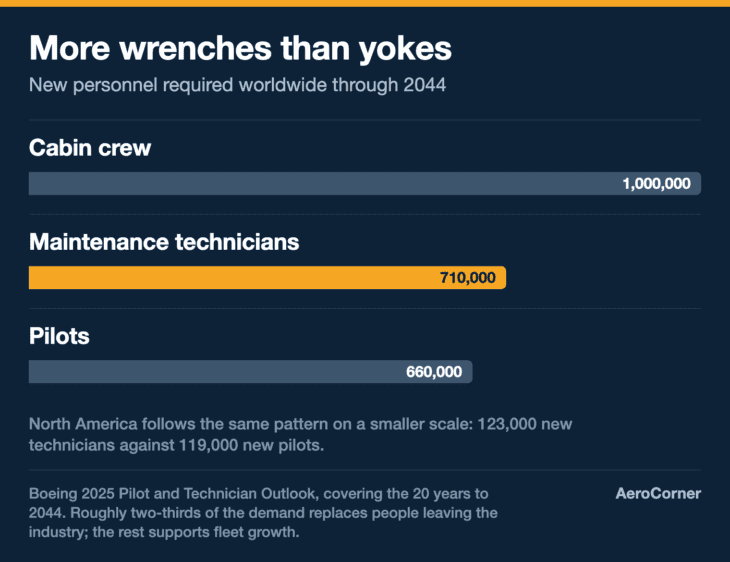
Boeing’s 2025 Pilot and Technician Outlook projects that the world will need 710,000 new maintenance technicians through 2044, against 660,000 new pilots. In North America the split is 123,000 technicians against 119,000 pilots.
More wrenches than yokes
Boeing’s 20-year forecast calls for more new maintenance technicians than new pilots, both worldwide and in North America. Roughly two-thirds of that demand is replacing people who leave the industry rather than staffing fleet growth.
The supply side is not keeping up. The Aviation Technician Education Council’s 2025 Pipeline Report projects a 10 percent shortfall in certificated mechanics for 2025, narrowing to 7 percent by 2035 but still leaving a gap of around 10,000 people.
The FAA issued slightly more than 9,000 new mechanic certificates in 2024, just short of the record 9,401 in 2023. That is a healthy number by historical standards and it is still not enough.
The most telling figure in the report is not about demand at all. About one third of the seats in America’s aviation maintenance schools sit empty, largely because almost nobody leaving high school knows the career exists.
Meanwhile the existing workforce is ageing out. CAE’s 2025 Aviation Talent Forecast puts the average age of an FAA-registered mechanic at 54, and expects 83 percent of today’s technicians to retire or put their tools down within ten years.
Put those together and the wage picture starts to look less settled than the median suggests. BLS expects about 13,100 openings a year across the occupation through 2035, most of them replacing people who leave.
The Myth: It Is a Fallback Trade for People Who Could Not Fly
The assumption
That aircraft maintenance is a low-ceiling manual trade you fall into, with a hard pay cap and no route upward for anyone without a degree.
The top 10 percent of aircraft mechanics earn more than $128,890 a year. That is achieved with no bachelor’s degree required and, on the community college route, with training debt an order of magnitude below a pilot’s.
Measured as return on money spent to qualify, the A&P is one of the strongest deals in the whole of aviation employment, and it is available to someone who never sets foot in a university.
The other half of the myth is about the work itself. Modern airline maintenance is a documentation-heavy technical discipline built around scheduled inspection intervals, not a matter of listening for odd noises.
Every airframe moves through a defined ladder of inspections, from overnight line checks up to heavy checks that strip an aircraft down over weeks. The mechanic’s job is as much about reading manuals correctly and recording what was done as it is about turning a wrench.
There is one more reason the headline median reads low. The BLS occupation covers everyone from a general aviation shop in a small town to a wide-body line technician at a major hub, and the range of jobs on an airport is wide enough that a single median number flattens most of what is interesting about it.
The person maintaining a training aircraft at a country airfield and the person releasing a 787 for a transpacific sector hold the same certificate and appear in the same statistic. Only one of them is being paid what the airlines pay.
So the next time you are stuck at the gate watching someone in a high-visibility vest disappear into an open panel, you are watching a federal licence holder decide whether your aircraft flies. Nobody on board that jet, including both pilots, can overrule that decision.
They just get paid about a third as much for making it.
Sources and references used for research and fact-checking.
- US Bureau of Labor Statistics, Aircraft and Avionics Equipment Mechanics and Technicians, Occupational Outlook Handbook
- US Bureau of Labor Statistics, Airline and Commercial Pilots, Occupational Outlook Handbook
- Legal Information Institute, Cornell Law School, 14 CFR 43.7, Persons authorized to approve aircraft, airframes, aircraft engines, propellers, appliances, or component parts for return to service
- Electronic Code of Federal Regulations, 14 CFR 65.77, Experience requirements
- Legal Information Institute, Cornell Law School, 14 CFR 65.91, Inspection authorization
- Federal Register, Federal Aviation Administration, Aviation Maintenance Technician Schools, interim final rule
- Aviation Technician Education Council, 2025 Pipeline Report
- Boeing, Boeing Forecasts 20-Year Global Demand for Nearly 2.4 Million New Commercial Pilots, Technicians, Cabin Crew
- CAE, 2025 Aviation Talent Forecast: Aircraft Maintenance Technician
Get the Newsletter
The latest aviation news and stories sent to your inbox.
About the Author

Tim is the owner and lead editor of AeroCorner since 2019, overseeing aviation content covering aircraft, airlines, airports, and the broader aviation industry. Through years of researching, writing, editing, and publishing aviation-focused content, he has developed extensive practical knowledge of commercial aviation and air travel. Based in Asia and a frequent traveler himself, Tim also brings firsthand passenger experience to AeroCorner’s coverage. Outside of publishing, he has also explored aviation firsthand through hands-on flight training in New Zealand.