


Table of Contents
Open a live flight tracker and zoom all the way out. The planet disappears under a swarm of little yellow aircraft icons, packed so tightly over Europe and the eastern United States that the coastlines vanish underneath them.
Somewhere in that swarm is a number. It is not a small one, and it is not a stable one. Watch the same map twelve hours later and a large share of those icons will simply be gone.
Nobody runs an official global census of airborne aircraft. What exists instead is a count assembled from radio signals, volunteer rooftop antennas, and a ring of satellites, and it has some very specific blind spots. This is what that count actually says, and what it quietly leaves out.
How Many Planes Are in the Sky Right Now?
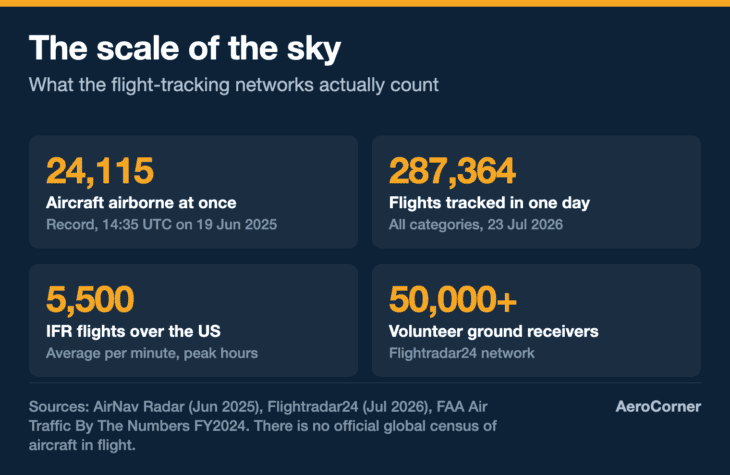
Through most of a normal day the flight-tracking networks show somewhere in the region of 10,000 to 15,000 aircraft in the air worldwide. That is an approximate working figure, not an audited one, and it moves constantly.
The peak is precise, because the trackers log it. On June 19, 2025, at 14:35 UTC, AirNav Radar recorded 24,115 aircraft airborne simultaneously, a record for its network. Roughly half a day later, the same map is a fraction of that.
The answer at a glance
There is no official count of aircraft in flight. Commercial flight trackers, which piece the number together from aircraft radio broadcasts, typically show 10,000 to 15,000 airborne worldwide at a given moment, peaking above 24,000 in the busiest hours. The figure swings by more than double across a single day, and roughly half of what is flying is not a scheduled airliner.
Nobody counts planes. They count radio broadcasts.
The reason a live map exists at all is a technology called ADS-B, short for Automatic Dependent Surveillance-Broadcast. It is doing something almost aggressively simple.
An ADS-B-equipped aircraft works out where it is using GPS, then shouts that position over the radio roughly once a second on 1090 MHz. No request, no handshake, no pilot input. Anyone with the right receiver can hear it.
That last part is why the public flight trackers exist. The signal is unencrypted, so hobbyists can pick it up with a small antenna and a cheap receiver box, and the tracking companies simply pool those feeds. Flightradar24 alone says its network runs to more than 50,000 ground receivers.
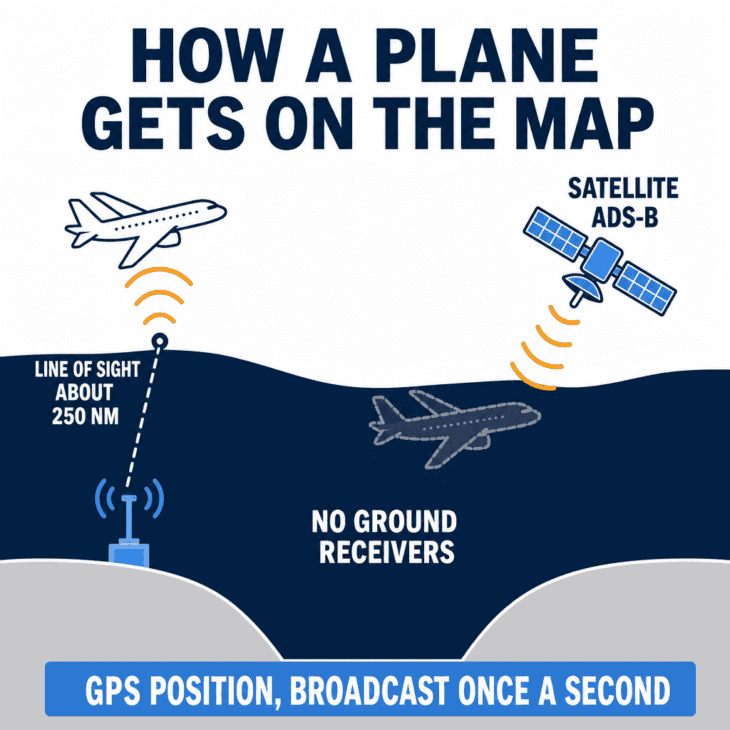
The catch is that 1090 MHz travels in a straight line. A well-sited antenna hears an airliner at cruise altitude out to roughly 250 nautical miles before the curvature of the Earth puts the aircraft below the horizon.
Which means the map is really a map of where people live. Dense receiver coverage over Europe, North America, and East Asia; thinning coverage over the Sahara, Siberia, and the Amazon; and until recently, a hole in the middle of every ocean.
That hole is the same one that shaped how controllers manage traffic over the ocean without radar, and it has now largely closed. Aireon put ADS-B receivers on all 66 satellites of the Iridium NEXT constellation, and in February 2026 Flightradar24 began folding that satellite feed into its public map. The mid-Atlantic is no longer a blank.
The peak chases the sun around the planet
The record-setting moment for airborne aircraft was 14:35 UTC. That timing is not a coincidence, and it explains why the global figure swings so hard.
Mid-afternoon UTC is the one window where the world’s three big traffic blocks overlap. Europe is deep into its afternoon banks, North America is well into its morning departures, and East Asia has not yet shut down for the night. Every major system is running at once.
The FAA’s own numbers fit neatly inside that window. Using traffic data from July 25, 2024, the agency found peak operations in US airspace run between 1500 and 2200 GMT, and that during those hours an average of 5,500 IFR flights were enroute over the United States every single minute, topping out at 5,700.
5,500 aircraft, every minute, over one country
During peak hours the FAA has an average of 5,500 instrument flights enroute across US airspace at any given minute, with a maximum of 5,700. That is one country’s share of a global snapshot that topped out at 24,115 aircraft. The Air Traffic Organization handles more than 44,000 flights and 3 million passengers a day across 29 million square miles of airspace.
Then the wave moves west. As Europe closes down for the night the number falls away, and the low point of the global day comes when the Atlantic and most of Asia are dark and the traffic is concentrated over the Americas alone.
This is also why the busiest airports are where they are. Atlanta runs 1,231 flights a day to 244 destinations, and it holds the title because of connecting banks rather than local demand, which means its contribution to the count arrives in tight, deliberate pulses rather than a steady trickle.
About half of what is flying is not an airliner
Here is the part most people get wrong. Picture the sky and you picture airliners, because those are the aircraft you personally fly on.
On July 23, 2026, Flightradar24 tracked 287,364 flights of all kinds. Of those, 153,359 were commercial flights. Everything else, roughly 47 percent of the total, was something other than a scheduled passenger or cargo service.
That remainder is business jets, air taxis, flight training circuits, crop dusters, air ambulances, police and news helicopters, gliders, survey aircraft, and ferry flights. Most of it is short, most of it is low, and almost none of it appears in the statistics people quote about air travel.
It also means the sky over a given point is far less exotic than a live map suggests. Some of the densest traffic on Earth sits over water: the corridor between Florida and the Caribbean is so busy that the Bermuda Triangle is one of the most heavily flown patches of sky anywhere.
How many kinds of plane are up there? About 487.
There is a second way to ask the question, and it produces a more useful answer. Not how many aircraft are flying, but how many different kinds.
We track that one directly. AeroCorner’s active aircraft index receives live flight data from 487 aircraft types, where a type counts as active if at least one example of it has been observed airborne in the past 365 days.
Sorting those types by how much activity each one generates makes the point the headline number hides.
| Aircraft type | ICAO code | Airborne detections |
|---|---|---|
| Boeing 737-800 | B738 | 1,085 |
| Cessna 172 Skyhawk | C172 | 836 |
| Airbus A320-200 | A320 | 698 |
| Boeing 737 MAX 8 | B38M | 576 |
| Airbus A321neo | A21N | 525 |
The Cessna 172 sits second, ahead of the A320. A single-engine trainer certified in 1956 puts more activity into the sky on a given day than most of the world’s airliner types do.

The far end of the list is where the shape really shows. Dozens of types register a handful of detections in a day: three ATR 42-500s, three Gulfstream G200s, three Apache gunships. The list is long, thin, and the thin part is most of it.
The number keeps setting records
Whatever the count is when you read this, it is very probably higher than the equivalent moment a year ago. Global air traffic did not merely recover from the pandemic collapse, it went straight through the old ceiling.
Flightradar24’s single-day records tell the story cleanly, because they measure the same thing the same way over seven years.
| Date | Commercial flights tracked | What it marked |
|---|---|---|
| July 23, 2026 | 153,359 | Current record |
| July 24, 2025 | 144,806 | Previous summer peak |
| July 13, 2023 | 137,225 | First post-pandemic record |
| June 21, 2019 | 126,753 | Pre-pandemic benchmark |
| April 12, 2020 | 23,923 | Pandemic low |
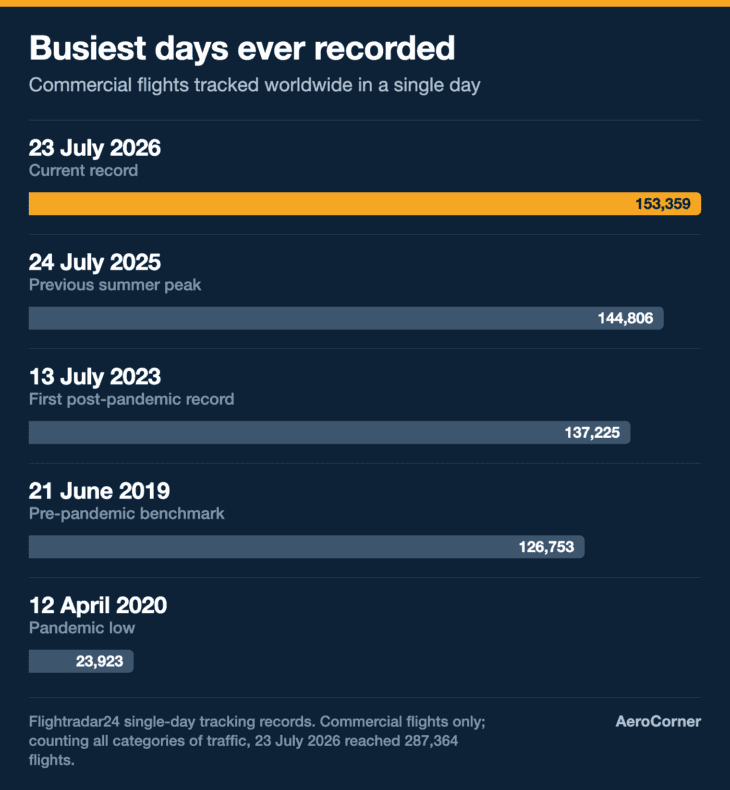
The April 2020 figure is worth sitting with. On that day the entire world’s commercial aviation system produced fewer flights than a single ordinary summer afternoon does now.
Some of the growth since is genuine new demand. Some of it is better tracking: every year more aircraft carry ADS-B, more receivers come online, and more of the previously invisible sky becomes visible. The line goes up for both reasons at once.
The myth: the map shows every plane
What a live flight tracker is not
A public flight map is not a picture of the sky. It is a picture of the aircraft that are broadcasting, in places where somebody is listening, that the tracking company has chosen to display. Every one of those three conditions has exceptions, and the gaps are largest exactly where people assume the map is complete.
Start with the aircraft that do not broadcast. The FAA’s ADS-B Out mandate took effect on January 1, 2020, and it covers most controlled airspace, but it is not universal. Aircraft without electrical systems, including many vintage types and gliders, are exempt and can legally fly in plenty of airspace without ever appearing.
Then there is military traffic. Combat aircraft, tankers, and surveillance platforms routinely operate with their transponders configured so they do not show up on a public map, and the tracking companies filter out a good deal of what they do receive.
Private owners can also apply to have their registration suppressed from public display. The aircraft is still broadcasting, still visible to the controllers running the airspace, just absent from the consumer app.
And finally there is the definition problem. Different trackers count different things: some include aircraft still taxiing, some count only airborne flights, some fold in gliders and drones and some do not. Two services can look at the same instant and honestly report numbers thousands apart.
That is the real reason no single authoritative answer exists. It is not that the count is hard to measure. It is that “a plane in the sky” turns out to be a surprisingly slippery thing to define.
So the next time you open a flight tracker and watch the swarm, remember what you are actually looking at. Not the sky, but everything in it that is talking, within earshot of somebody who is listening.
On a summer afternoon that is more than 20,000 aircraft at once. By the time you wake up tomorrow it will be a fraction of that, and climbing again.
The number above your head right now is unknowable to the last aircraft. The shape of it, though, is completely predictable: it follows the sun, it peaks in the northern summer, and every year it ends up a little higher than the last.
Sources and references used for research and fact-checking.
- Federal Aviation Administration, Air Traffic By The Numbers (FY2024)
- AirNav Radar, Record Day in the Skies: Over 24,000 Flights Tracked Simultaneously
- Airways Magazine, Flightradar24 Tracks Record 153,359 Commercial Flights in One Day
- FAA Safety Briefing, ADS-B 101: What It Is, and What It Means to You
- Flightradar24, Flightradar24 expands global coverage with Aireon space-based ADS-B data
- Aireon, Space-Based ADS-B Global Air Traffic Surveillance
Get the Newsletter
The latest aviation news and stories sent to your inbox.
About the Author

Tim is the owner and lead editor of AeroCorner since 2019, overseeing aviation content covering aircraft, airlines, airports, and the broader aviation industry. Through years of researching, writing, editing, and publishing aviation-focused content, he has developed extensive practical knowledge of commercial aviation and air travel. Based in Asia and a frequent traveler himself, Tim also brings firsthand passenger experience to AeroCorner’s coverage. Outside of publishing, he has also explored aviation firsthand through hands-on flight training in New Zealand.