

Table of Contents
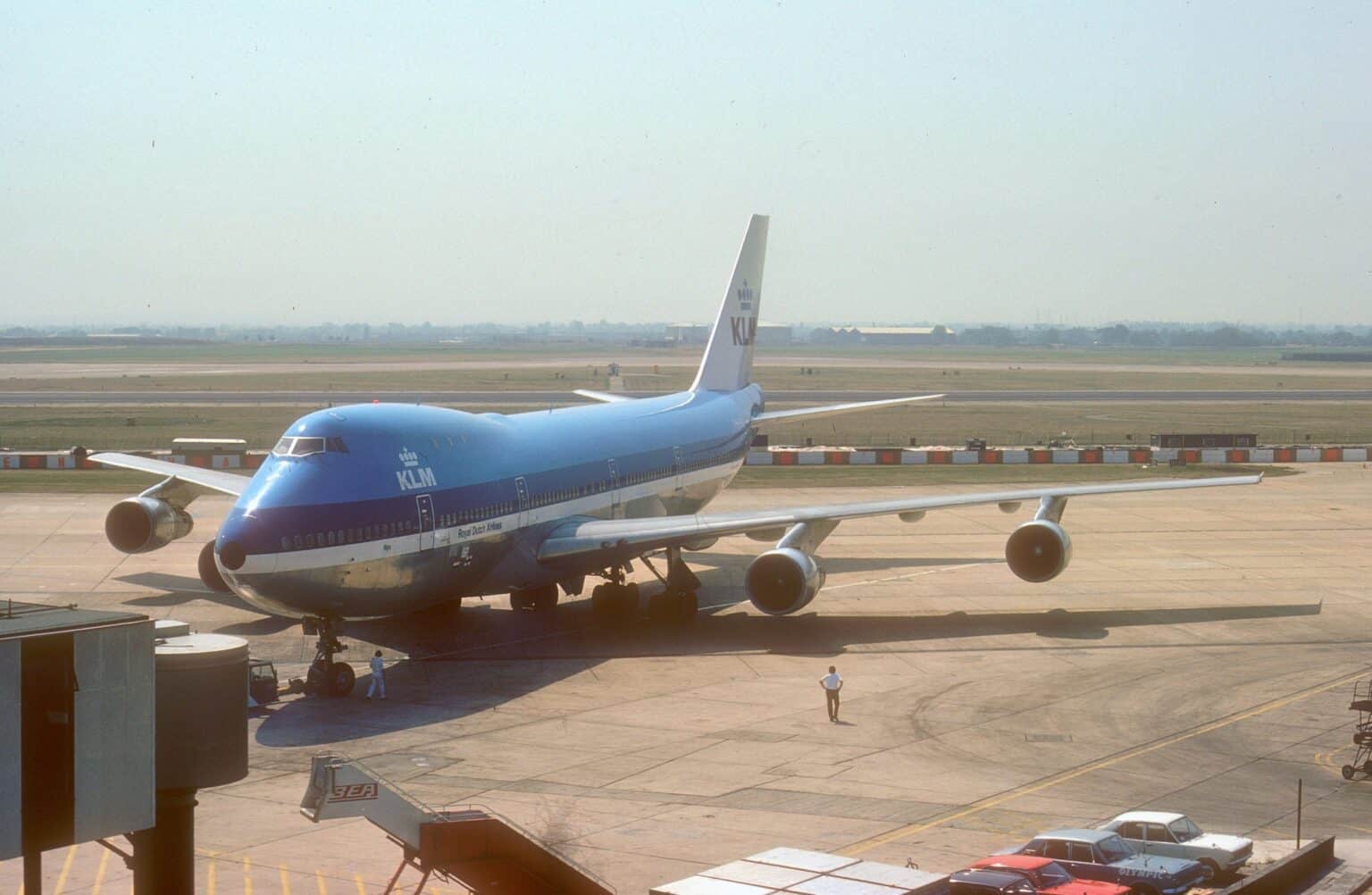
The worst collision between two aircraft on the ground is also the deadliest accident in aviation history. On March 27, 1977, a KLM Boeing 747 began its takeoff in fog at Los Rodeos Airport on Tenerife and struck a Pan Am 747 still on the runway, killing 583 people.
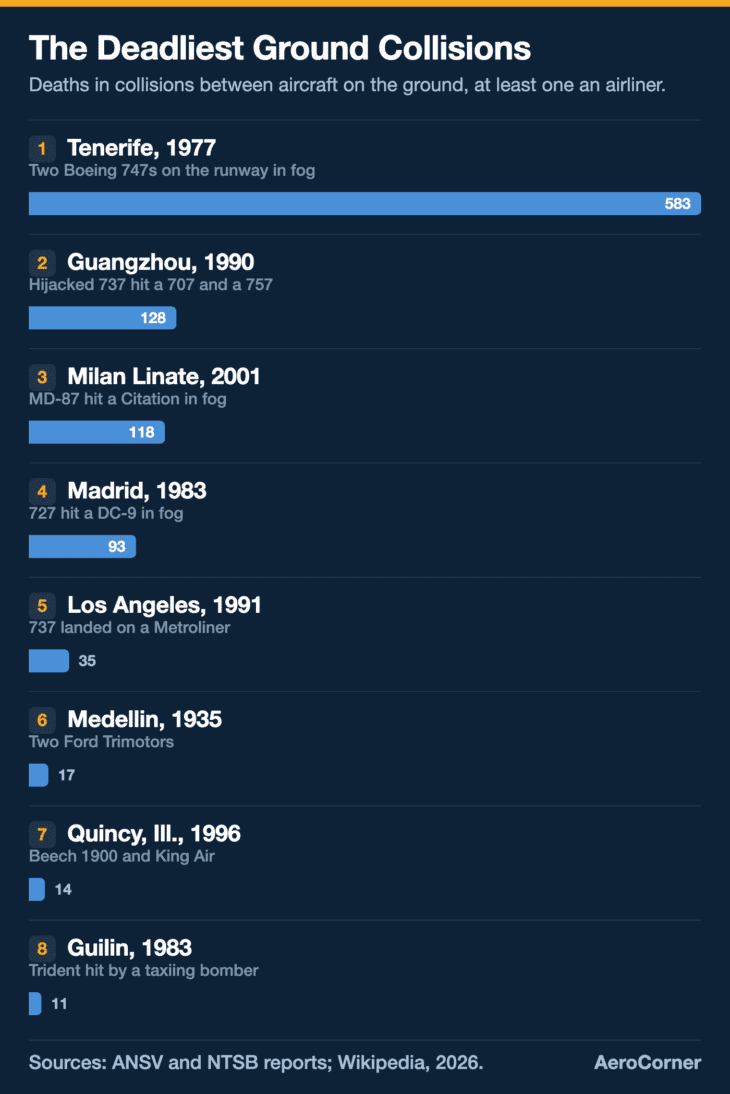
This list ranks every fatal ground collision we could document between two aircraft, at least one of them an airliner, by the number of people killed. Deaths on the ground and later deaths from injuries are counted, as the investigators counted them.
The list is current as of November 2026, the day after a Copa 737-800 clipped a UPS 767 on a taxiway at Miami. That collision hurt two people, and the history below shows why a wingtip strike on a taxiway is taken so seriously.
| Rank | Collision | Aircraft | Deaths |
|---|---|---|---|
| 1 | Tenerife, Spain, March 27, 1977 | KLM 747 and Pan Am 747 | 583 |
| 2 | Guangzhou, China, Oct. 2, 1990 | Hijacked Xiamen 737, a 707 and a CAAC 757 | 128 |
| 3 | Milan Linate, Italy, Oct. 8, 2001 | SAS MD-87 and Cessna Citation CJ2 | 118 |
| 4 | Madrid, Spain, Dec. 7, 1983 | Iberia 727 and Aviaco DC-9 | 93 |
| 5 | Los Angeles, Feb. 1, 1991 | USAir 737-300 and SkyWest Metroliner | 35 |
| 6 | Medellín, Colombia, June 24, 1935 | Two Ford Trimotors | 17 |
| 7 | Quincy, Illinois, Nov. 19, 1996 | United Express Beech 1900C and King Air | 14 |
| 8 | Guilin, China, Sept. 1983 | CAAC Trident and military H-5 bomber | 11 |
| 9 | Chicago O’Hare, Dec. 20, 1972 | North Central DC-9 and Delta Convair 880 | 10 |
| 10 | Detroit, Dec. 3, 1990 | Northwest DC-9 and Northwest 727 | 8 |
| 11 | Tokyo Haneda, Jan. 2, 2024 | JAL A350 and Coast Guard Dash 8 | 5 |
| 12 | St. Louis, Nov. 22, 1994 | TWA MD-82 and Cessna 441 | 2 |
| 13 (tie) | Paris CDG, May 25, 2000 | Air Liberté MD-83 and Shorts 330 | 1 |
| 13 (tie) | London Luton, April 18, 1974 | Court Line One-Eleven and Piper Aztec | 1 |
How this ranking works
The measure is total deaths, as reported by the investigating authority or the standard record of the event. In scope: a collision between two or more aircraft on a runway, taxiway or apron, with at least one airliner involved. Out of scope: mid-air collisions, and airliners that hit ground vehicles or equipment (those get their own section at the end). Ties are listed by date.
1. Tenerife, 1977: 583 Killed

Neither 747 was meant to be at Los Rodeos. A bomb at Gran Canaria Airport had sent a stream of diversions to the small airport on Tenerife, and parked aircraft blocked the only taxiway, so departing jets had to taxi down the runway itself.
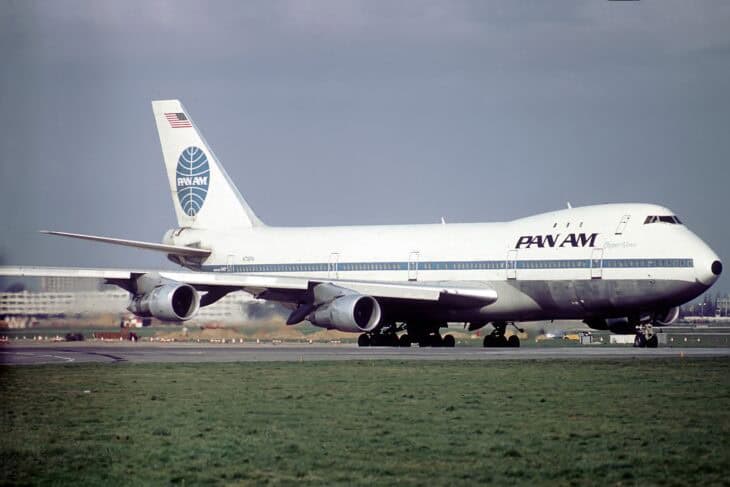
In drifting fog, the Boeing 747-206B operating KLM Flight 4805 began its takeoff roll while Pan Am Flight 1736, a 747-121, was still on the runway. The collision and fire killed all 248 people on the KLM jet and 335 of the 396 aboard the Pan Am jet.
Spain’s investigators concluded that the KLM captain took off believing he had clearance and that the runway was clear, despite Pan Am’s radio call that it would “report when clear.” Dutch investigators put more weight on mutual misunderstanding of the radio calls. Our full account of the Tenerife disaster walks through the last minutes.
Every survivor was on one aircraft
All 61 people who survived Tenerife were aboard the Pan Am 747, in the front section of the aircraft. Nobody on the KLM jet survived.
The legacy is in every cockpit today: standard radio phraseology, and the crew resource management training that made it normal for a first officer to challenge a captain.
2. Guangzhou, 1990: 128 Killed
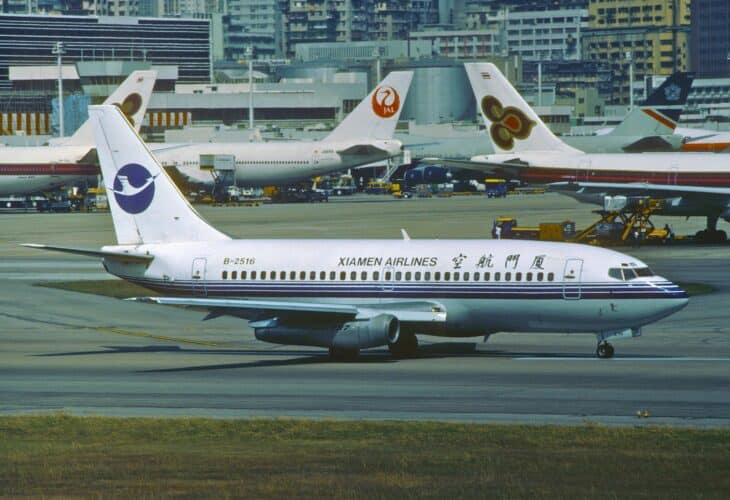
This is the one entry that was not an accident in the usual sense. On October 2, 1990, a passenger hijacked Xiamen Airlines Flight 8301, a Boeing 737-247, and demanded to be flown to Taiwan.
Low on fuel, the captain landed at Guangzhou Baiyun. During the landing roll the hijacker fought him for the controls, and the 737 veered off the runway onto the apron. It struck a parked China Southwest Boeing 707, then a CAAC Boeing 757 waiting to depart for Shanghai.
Eighty-two people died on the 737, including the hijacker, and 46 died on the 757. The 707 had only a cleaner aboard, who survived. It was the deadliest hijacking in history until the September 11 attacks.
3. Milan Linate, 2001: 118 Killed
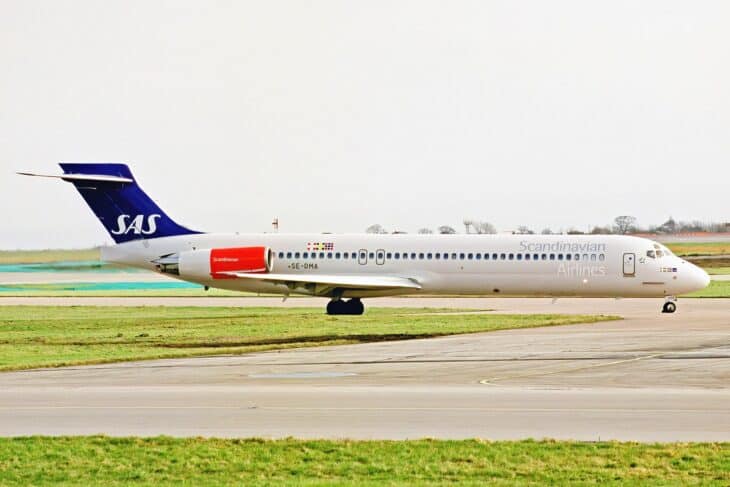

On October 8, 2001, in fog with visibility under 650 feet (200 m), a Cessna Citation business jet taxiing for a flight to Paris took the wrong path and ended up on the active runway. SAS Flight 686, a McDonnell Douglas MD-87 bound for Copenhagen, was taking off.
The MD-87 hit the Citation at about 150 knots, then left the runway and struck a luggage hangar at about 136 knots. All 110 people on the airliner, all four on the Citation and four ground workers in the hangar were killed. It remains the deadliest accident in Italian aviation history.
Italy’s investigation agency, ANSV, named the Citation’s runway incursion as the immediate cause in its final report A/1/04, and found failures in the airport’s safety systems behind it. Linate had no working ground radar: the old system was shut down in 1999 and the replacement was never fully installed.
4. Madrid, 1983: 93 Killed
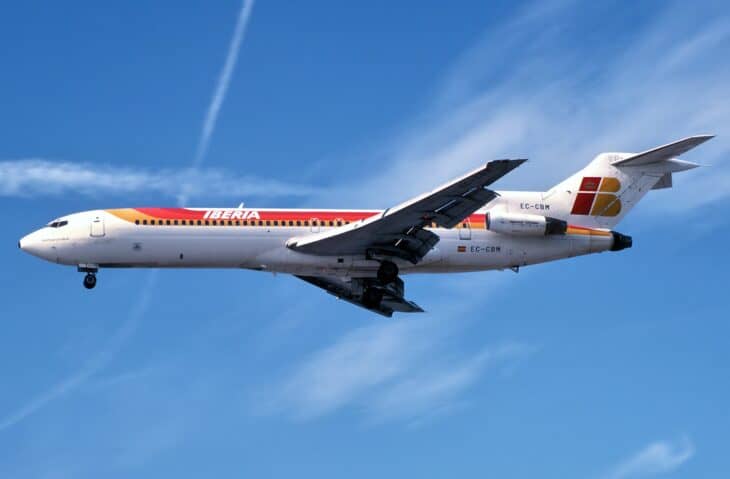
On December 7, 1983, Iberia Flight 350, a Boeing 727-256 bound for Rome, was cleared to take off from Madrid-Barajas in thick fog. At the same time, Aviaco Flight 134, a DC-9-32 heading for Santander, was taxiing to the same runway.
The DC-9 crew made a wrong turn in the fog and rolled onto the active runway. The 727 crew saw it and pulled up, but the jet was not yet at flying speed, and its rear fuselage struck the DC-9.
All 42 people on the DC-9 died, along with 51 of the 93 on the 727. The investigation blamed inadequate signs and taxiway markings, the same weakness Linate would show 18 years later.
5. Los Angeles, 1991: 35 Killed
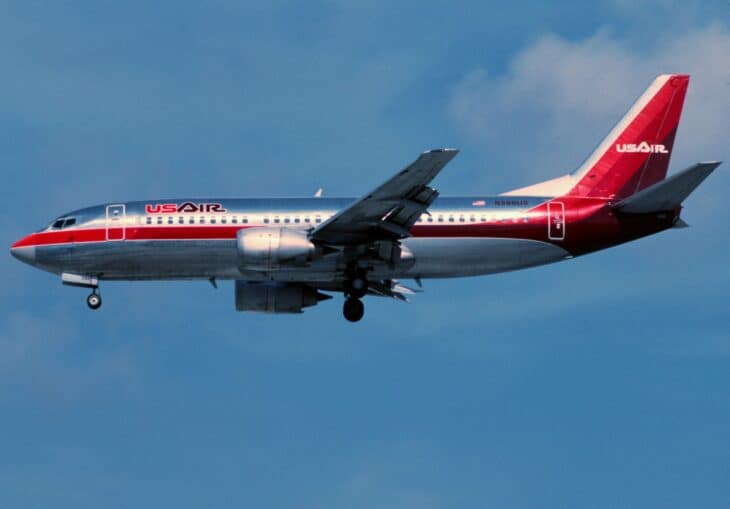

LAX on the evening of February 1, 1991, was not busy and not foggy. The tower’s local controller cleared SkyWest Flight 5569, a Fairchild Metroliner turboprop, onto the runway to wait for takeoff, then cleared USAir Flight 1493, a Boeing 737-300, to land on the same runway.
The 737 landed on top of the Metroliner, crushed it, and veered into an airport fire station. All 12 people on the Metroliner died, and 23 of the 89 on the 737, two of them from burns days later.
The NTSB (report AAR-91/08) blamed tower procedures that gave the controller no backup, and weak FAA oversight. The controller had been distracted by a misplaced flight progress strip and an aircraft that had switched off the tower frequency, and lost track of the Metroliner. The crash led to the recommendation that LAX separate its takeoff and landing runways.
6. Medellín, 1935: 17 Killed
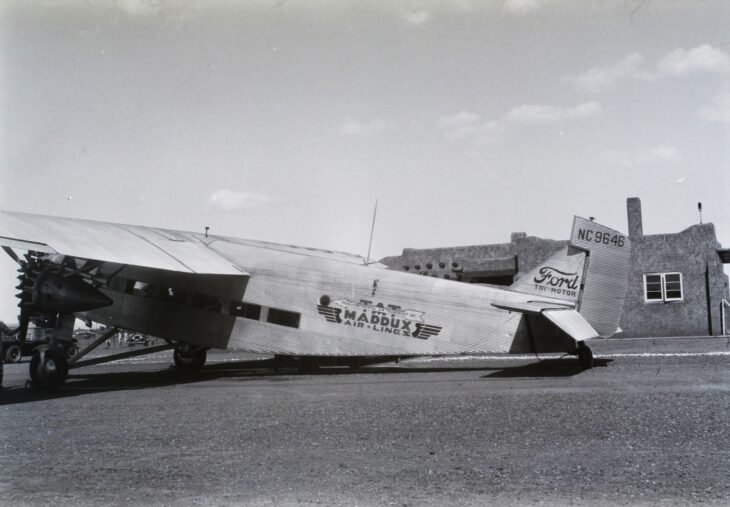

The oldest entry is also the most famous in Latin America. On June 24, 1935, a SACO Ford 5-AT-B Trimotor swerved during its takeoff run at Medellín’s Olaya Herrera Airport and hit a SCADTA Trimotor that was taxiing.
Seventeen of the 20 people aboard died, including the Argentine tango singer Carlos Gardel, his songwriter Alfredo Le Pera and his guitarist Guillermo Barbieri. The investigation pointed to strong crosswinds and an uneven runway.
7. Quincy, Illinois, 1996: 14 Killed
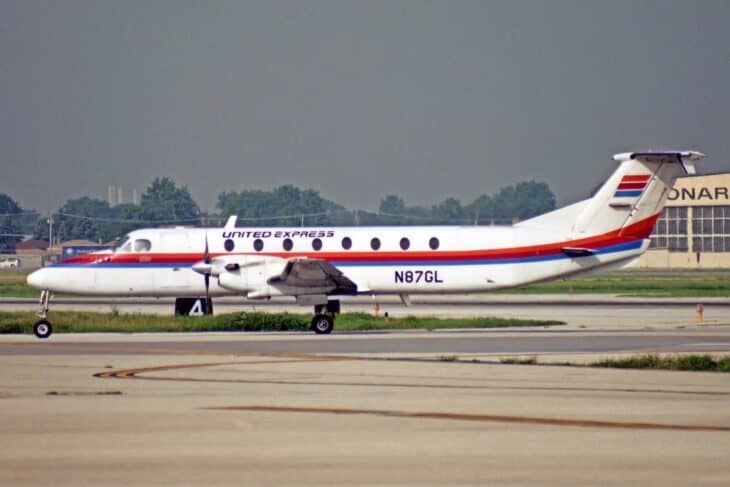

Quincy had no control tower, so pilots announced their own moves on a shared radio frequency. On November 19, 1996, United Express Flight 5925, a Beechcraft 1900C flown by Great Lakes Airlines, was landing on Runway 13 while a private King Air began its takeoff on intersecting Runway 4.
They met at the intersection. All 12 on the 1900 and both people on the King Air died.
The NTSB’s probable cause (AAR-97/04) was the King Air pilots’ failure to monitor the frequency or scan for traffic. A third pilot’s radio reply, cut off by a cockpit warning, was taken by the 1900 crew to mean both aircraft were holding short.
8. Guilin, 1983: 11 Killed
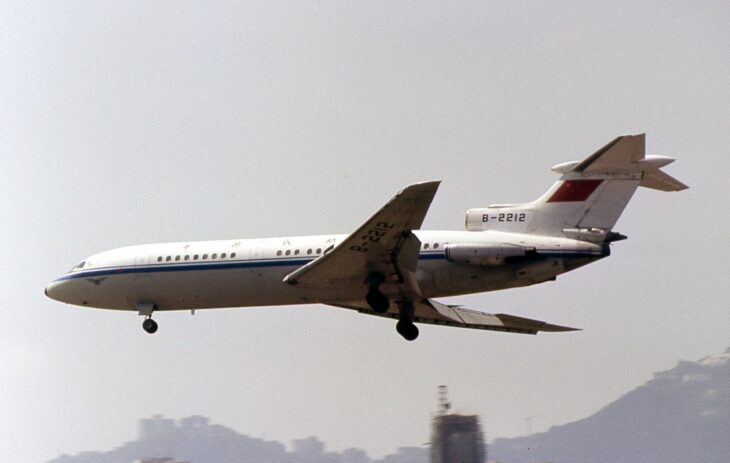

Guilin Qifengling was a shared military and civil airport in September 1983. A People’s Liberation Army Air Force Harbin H-5 bomber struck CAAC Flight 264, a Hawker Siddeley Trident 2E taxiing for a flight to Beijing, and tore a hole in its forward fuselage.
Eleven of the 106 people on the Trident died. Records of this accident are thin: the published accounts disagree on the exact date and say nothing of the bomber crew’s fate.
9. Chicago O’Hare, 1972: 10 Killed
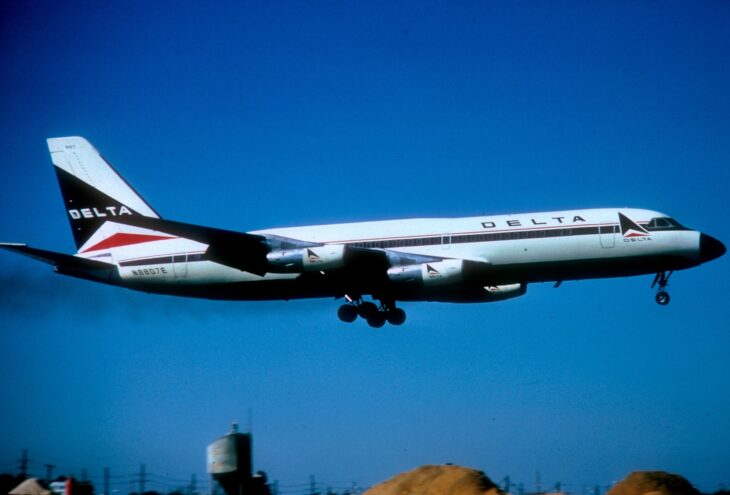
On December 20, 1972, with visibility about a quarter mile (400 m), a Delta Convair 880 that had just landed told ground control it was “inside the bridge.” The controller missed those words and told it to hold at a run-up pad on the opposite side of the terminal from where the crew believed it was going.
The Delta crew taxied across Runway 27L, which nobody had told them was in use for departures. North Central Flight 575, a DC-9-31, was rolling at about 140 knots when its captain saw the Convair in the fog and pulled up too late.
The DC-9 came back down, its landing gear collapsed, and it burned. All 10 deaths were on the North Central jet; everyone on the Delta aircraft got out. The NTSB report is AAR-73-15.
10. Detroit, 1990: 8 Killed
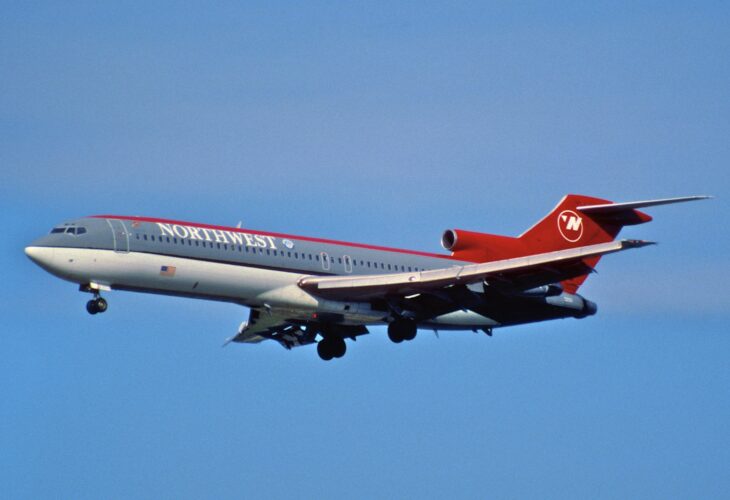

On December 3, 1990, in dense fog at Detroit Metropolitan, Northwest Flight 1482, a DC-9-14, missed its taxiway turn, got lost, and rolled onto active Runway 3C. Northwest Flight 299, a 727 bound for Memphis, was taking off.
The 727’s wing cut through the side of the DC-9 and tore off its right engine. One flight attendant and seven passengers on the DC-9 died. The flight attendant and one passenger died of smoke inhalation after the tail cone exit’s internal release failed to open it.
The NTSB (AAR-91/05) found that the DC-9 pilots had virtually reversed roles and failed to stop and tell the controller they were lost. It also faulted the tower, the airport’s markings and signs, and Northwest’s crew resource management training.
11. Tokyo Haneda, 2024: 5 Killed
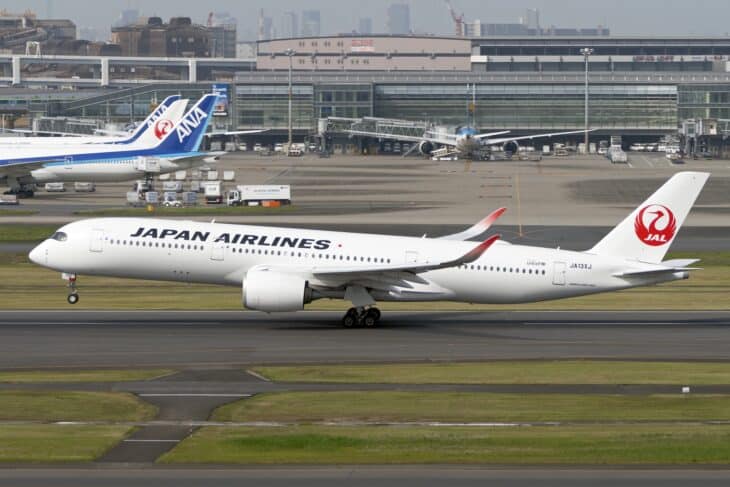

On January 2, 2024, Japan Airlines Flight 516, an Airbus A350-941, landed on Runway 34R and hit a Japan Coast Guard Dash 8 that was stopped on the runway. The Coast Guard crew were about to fly relief supplies to the area hit by the Noto earthquake the day before.
Five of the six Coast Guard crew died; only the captain survived. All 379 people on the A350 got out before fire destroyed it, which made this the first hull loss of an A350.
The Japan Transport Safety Board’s interim report found the tower had told the Dash 8 “Number one, taxi to holding point C5,” meaning first in line. The Coast Guard captain took it to mean he was cleared, and entered the runway believing he could take off. As of November 2026 the JTSB has issued interim reports, not a final one.
Five of the ten deadliest happened in fog
Tenerife, Linate, Madrid, O’Hare and Detroit all happened in fog. In each one, a crew either could not see the other aircraft or did not know where on the airport they were.
12. St. Louis, 1994: 2 Killed
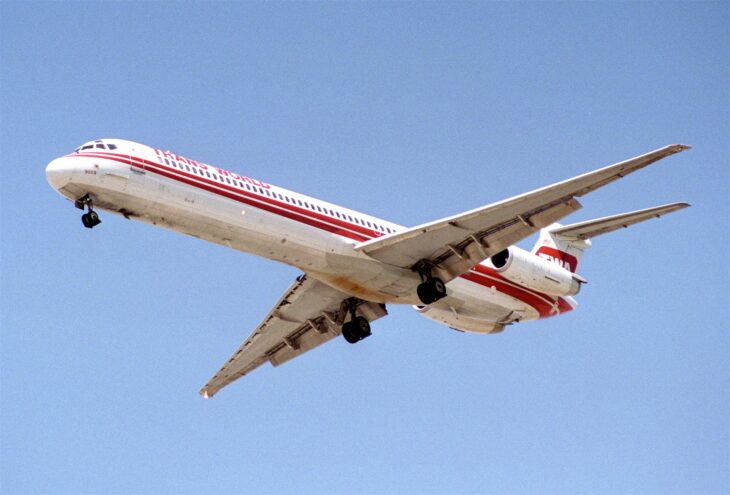

On November 22, 1994, the pilot of a Cessna 441 charter plane was cleared to back-taxi on Runway 31 at St. Louis Lambert. He taxied onto Runway 30R instead, where TWA Flight 427, a McDonnell Douglas MD-82 with 140 people aboard, had just started its takeoff roll.
The MD-82’s right wing sheared the top off the Cessna, killing both people aboard. Nobody on the TWA jet died. The NTSB (AAR-95/05) named the Cessna pilot’s mistaken belief that his runway was 30R as the probable cause.
13 (tie). Paris Charles de Gaulle, 2000: 1 Killed
On May 25, 2000, the tower controller at Charles de Gaulle cleared a Streamline Aviation Shorts 330 freighter to “line up and wait, number two,” believing it was behind an Air Liberté MD-83. It was actually entering the runway in front of it.
The MD-83, carrying 157 people, hit the Shorts’ cockpit with its left wing at about 155 knots during takeoff. The Shorts’ first officer was killed. France’s BEA also cited radio traffic split between French and English, and recommended English-only control at the airport.
13 (tie). London Luton, 1974: 1 Killed
On April 18, 1974, a Court Line BAC One-Eleven was taking off from Luton for Munich when a Piper Aztec entered the runway without permission. The Aztec’s pilot was killed and his passenger injured; the One-Eleven aborted its takeoff and everyone aboard got out on the slides.
The UK investigators named the controller’s non-standard phrase, “Cleared to Alpha Two Six,” as a causal factor. Three years later, Tenerife made the same lesson about radio language far more costly.
What About Airliners That Hit Vehicles?
Some of the deadliest ground accidents involve only one aircraft, which is why they are not ranked above. On October 11, 1984, Aeroflot Flight 3352, a Tu-154, landed at Omsk and hit maintenance vehicles on the runway; 178 people died, which would put it second on this list.
Singapore Airlines Flight 006, a 747-400, tried to take off from a closed runway at Taoyuan International, near Taipei, on October 31, 2000, and hit construction equipment, killing 83. In Lima on November 18, 2022, a LATAM A320neo hit a fire truck on its takeoff roll, and three firefighters died.
The most recent fatal one was in New York. On March 22, 2026, Air Canada Express Flight 8646, a CRJ900, landed at LaGuardia and hit an airport fire truck crossing the runway, killing both pilots.
Ground collisions are not just fender benders
A taxiway wingtip strike like Miami’s on November 14, 2026, which caused two minor injuries, is easy to dismiss. But the deadliest accident in aviation history happened on a runway, at taxi and takeoff speed, between two aircraft that never left the ground together.
The Collisions Nobody Died In
For every fatal ground collision there are many more that end with bent metal. On December 23, 1983, a Korean Air DC-10 on its takeoff roll in fog at Anchorage hit a Piper Navajo, and all 12 people involved survived. In Jakarta in 2016, a Batik Air 737-800 and a TransNusa ATR 42 collided with 60 people aboard and no deaths.
The latest came on November 14, 2026, when the wingtip of a Copa 737-800 struck the nose of a UPS 767 freighter as both taxied at Miami International. The FAA said controllers had told the UPS crew to give way, and two people had minor injuries. Our report on the Miami taxiway collision has the radio calls.
What every entry above shares is a picture of the airport that turned out to be wrong: a crew that thought it was cleared, a controller who thought an aircraft was elsewhere, a pilot who thought he was on another runway. The runway markings and signs and stop-bar lights at modern airports exist to correct that picture before it costs lives.
FAQ
Sources and references used for research and fact-checking.
- Wikipedia, Tenerife airport disaster
- Wikipedia, 1990 Guangzhou Baiyun airport collisions
- ANSV, Final Report A/1/04: Milano Linate, Boeing MD-87 SE-DMA and Cessna 525-A D-IEVX, 8 October 2001
- Wikipedia, 2001 Linate Airport runway collision
- Wikipedia, 1983 Madrid Airport runway collision
- Wikipedia, 1991 Los Angeles runway collision
- NTSB, Aircraft Accident Report AAR-91/08: USAir Flight 1493 and SkyWest Flight 5569, Los Angeles
- Wikipedia, 1935 Medellín Airport runway collision
- NTSB, Aircraft Accident Report AAR-97/04: United Express Flight 5925, Quincy, Illinois
- Wikipedia, United Express Flight 5925
- Wikipedia, 1983 Guilin Airport collision
- Wikipedia, 1972 Chicago-O'Hare runway collision
- NTSB, Aircraft Accident Report AAR-73-15: North Central Airlines and Delta Air Lines, O'Hare
- Wikipedia, 1990 Detroit Metropolitan Airport runway collision
- NTSB, Aircraft Accident Report AAR-91/05: Northwest Flights 1482 and 299, Detroit
- Japan Transport Safety Board, Interim Report: Collision between JA722A and JA13XJ at Tokyo International Airport
- Wikipedia, 2024 Haneda Airport runway collision
- NTSB, Aircraft Accident Report AAR-95/05: TWA Flight 427 and Cessna 441, St. Louis
- Wikipedia, TWA Flight 427
- Wikipedia, 2000 Charles de Gaulle runway collision
- Wikipedia, Court Line Flight 95
- Wikipedia, Aeroflot Flight 3352
- Wikipedia, Singapore Airlines Flight 006
- Wikipedia, LATAM Airlines Peru Flight 2213
- Wikipedia, Air Canada Express Flight 8646
- Wikipedia, 1983 Anchorage runway collision
- Wikipedia, 2016 Halim Airport runway collision
- Wikipedia, Runway incursion
- AeroCorner, Copa CM427 and UPS 358 taxiway collision at Miami
Get the Newsletter
The latest aviation news and stories sent to your inbox.
About the Author

Tim is the owner and lead editor of AeroCorner since 2019, overseeing aviation content covering aircraft, airlines, airports, and the broader aviation industry. Through years of researching, writing, editing, and publishing aviation-focused content, he has developed extensive practical knowledge of commercial aviation and air travel. Based in Asia and a frequent traveler himself, Tim also brings firsthand passenger experience to AeroCorner’s coverage. Outside of publishing, he has also explored aviation firsthand through hands-on flight training in New Zealand.