

Table of Contents
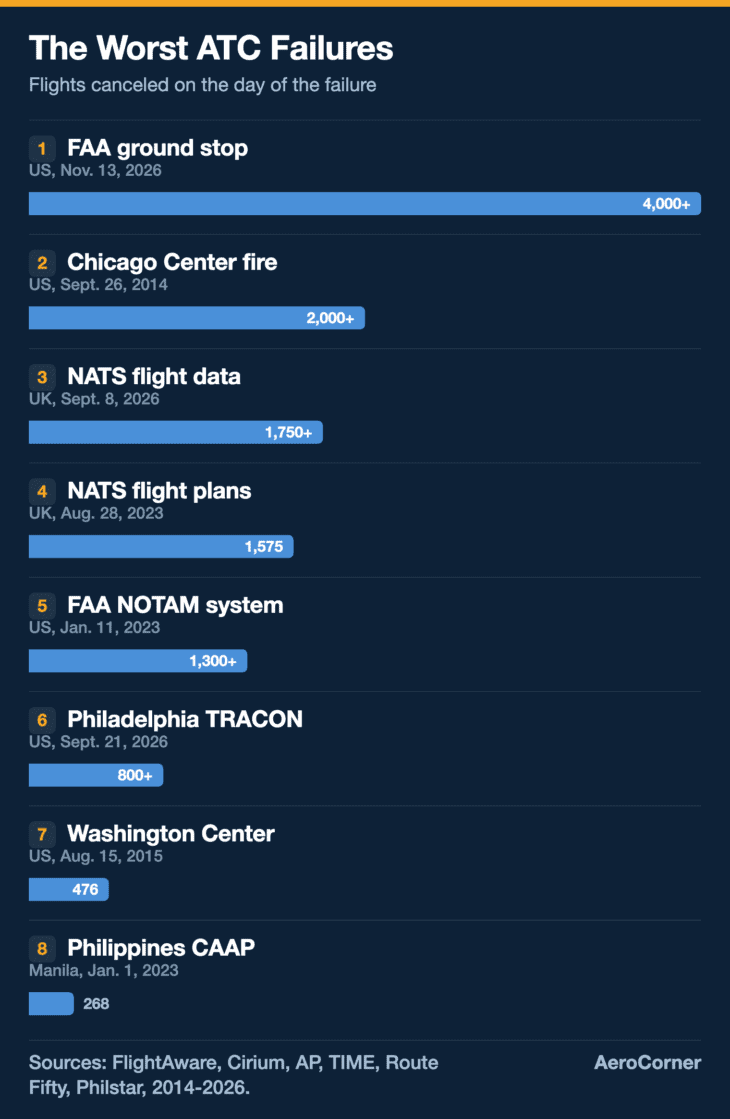
The worst air traffic control failure in history, measured by flights canceled, is the FAA’s nationwide ground stop of Nov. 13, 2026. A telecommunications outage at the centers that run America’s high-altitude traffic stopped every departure in the country for more than four hours, and FlightAware counted more than 4,000 cancellations that day.
It beat a record that had stood since 2014, when a contractor set fire to the Chicago Center and wiped out more than 2,000 flights at O’Hare and Midway in a single day. Two British failures, in 2023 and 2026, are the only others to pass 1,500.
This list ranks 12 technical failures of air traffic control systems, worldwide, by the number of flights canceled on the day they happened. Every count names the tracker or report it comes from, because no air navigation provider publishes an official cancellation total. Figures are as of November 2026.
| Rank | Failure | Date | Flights canceled (day 1) | Counted by |
|---|---|---|---|---|
| 1 | FAA nationwide ground stop | Nov. 13, 2026 | 4,000+ | FlightAware |
| 2 | Chicago Center fire | Sept. 26, 2014 | 2,000+ | O’Hare and Midway, via TIME |
| 3 | NATS flight data failure, UK | Sept. 8, 2026 | 1,750+ | Cirium |
| 4 | NATS flight plan failure, UK | Aug. 28, 2023 | 1,575 | Cirium |
| 5 | FAA NOTAM system failure | Jan. 11, 2023 | 1,300+ | FlightAware |
| 6 | Philadelphia TRACON circuit failure | Sept. 21, 2026 | 800+ | Newark and Philadelphia, via AP |
| 7 | Washington Center ERAM failure | Aug. 15, 2015 | 476 | DC-area airports, via Route Fifty |
| 8 | Philippines airspace closure | Jan. 1, 2023 | 268 | Manila NAIA, via Philstar |
| 9 | ENAV data network fault, Italy | Oct. 16, 2026 | 192+ (by noon) | Cirium |
| 10 | Japan flight data system failure | March 1, 2003 | 192 | Japanese media, via Computerworld |
| 11 | NATS radar fault, UK | July 30, 2025 | 155 | Cirium |
| 12 | NATS Swanwick server failure, UK | Dec. 12, 2014 | About 150 | NATS, in the independent enquiry |
How this ranking works
We rank technical failures of air traffic control: equipment, software, power and communications outages that forced controllers to cut or stop traffic. Strikes, weather, staffing shortages and controller errors are excluded. The measure is flights canceled on the day of the failure, because it is the one number counted for almost every event. Each count is the tracker or report named in the table, taken from the latest figure published for that day. Delays, passengers and cost are given where a source counted them, but they do not change the order.
1. FAA Nationwide Ground Stop, Nov. 13, 2026

At 3:54 p.m. ET on a Friday, the FAA stopped every departure in the United States after a telecommunications outage hit its Air Route Traffic Control Centers. Transportation Secretary Sean Duffy said the airspace reopened at 8:15 p.m. ET, more than four hours later.
FlightAware data cited by CBS News showed more than 10,000 delays and more than 4,000 cancellations. NBC News put US-related cancellations above 5,300 for the whole day by 8:20 p.m. ET, against about 1,024 the day before, so most of that day’s cancellations trace to the outage.
Cirium counted about 600 flights diverted. The damage ran into Saturday, when ABC News reported nearly 800 more cancellations. Our full account of the Nov. 13 ground stop covers the timeline and the network at the center of it.
Duffy said routers “got overloaded with data,” but the FAA has not published a final cause. What puts it first is scale: every other failure on this list closed one region or one country’s busiest airports, and this one closed every airport in the US at once.
2. Chicago Center Fire, Sept. 26, 2014

Measured by how long it lasted, this is the worst failure on the list by a distance. A contract employee set fire to the basement telecommunications room of the Chicago Air Route Traffic Control Center in Aurora, Illinois, and cut cables, taking down the center that runs high-altitude traffic over the Chicago region.
More than 2,000 flights were canceled at O’Hare and Midway that Friday, TIME reported. By 11 a.m. on Saturday, another 630-plus O’Hare and 70-plus Midway flights had been scrubbed, and Flying magazine put the total above 3,500 by Sept. 30.
The center did not take its airspace back until Oct. 13, 2014. Technicians replaced more than 20 racks of equipment, 835 telecommunications circuits and more than 10 miles (16 km) of cable, the FAA said.
18 days at the busiest airport in the country
The FAA’s 30-day review found Chicago Center was out of service for 18 days, and O’Hare was still the busiest airport in the US on 11 of them, because neighboring centers took over its airspace. The review’s lesson was that recovery from a center outage should take hours, instead of days.
3. NATS Flight Data Failure, UK, Sept. 8, 2026
Britain’s air traffic provider, NATS, lost the link between its London Area Control center and its flight data system at 12:32 on a Tuesday afternoon. Airspace restrictions were not fully lifted until 19:30.
Cirium counted more than 1,750 UK arrivals and departures canceled that day: 902 departures and 860 arrivals, out of 5,800 scheduled. NATS’s own preliminary report says it handled 6,094 flights against about 8,000 forecast.
The cause, per that report, was “a legacy and previously unknown defect” in a software module that assigns squawk codes, the four-digit transponder codes controllers give each flight. A UK regulator’s independent review is due to report by March 8, 2027. We cover the background in why Britain’s air traffic control keeps failing.
A one-millisecond window
NATS estimated the window in which the 2026 software defect could be triggered at about one millisecond: a valid manual squawk code request had to be interrupted by a higher-priority message at exactly the wrong instant. Hitting it cost the UK more than 1,750 flights.
NATS failed again 13 days later. A technical issue at its Prestwick center on Sept. 21, 2026 canceled 227 UK flights by late afternoon, according to Cirium, and the CAA review covers both events.
4. NATS Flight Plan Failure, UK, Aug. 28, 2023
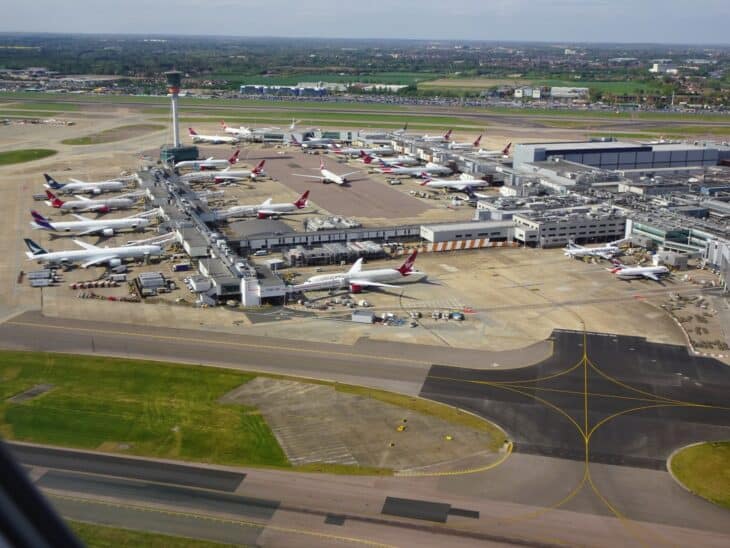

On a bank holiday Monday, the NATS system that processes incoming flight plans, called FPRSA-R, met a single plan containing two waypoints with duplicate names. The primary system threw a critical exception and shut down, and its backup did the same with the same plan.
Automatic processing stopped at 08:32 and was fully restored at 14:32. Controllers entered plans by hand in between, so NATS cut traffic hard: Cirium counted 790 UK departures and 785 arrivals canceled that day.
It ranks below 2026 on the day’s count, but it has the biggest measured human cost of any failure here. The UK Civil Aviation Authority’s independent review found more than 700,000 passengers were affected, about 300,000 of them by cancellations, at a total cost of roughly £75 million to £100 million.
5. FAA NOTAM System Failure, Jan. 11, 2023
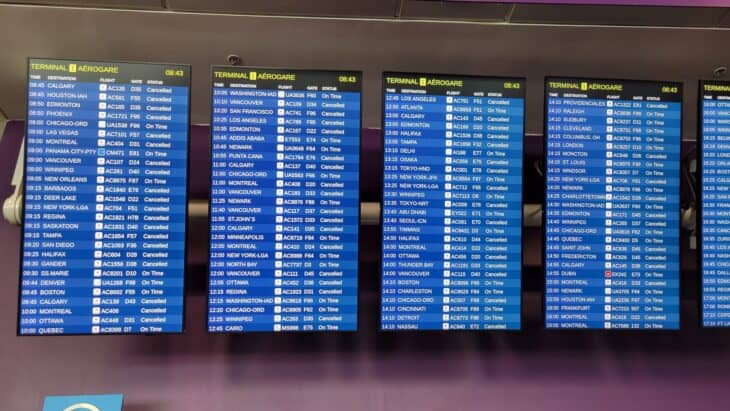

The Notice to Air Missions system, which sends pilots safety alerts about runways, airspace and equipment, stopped processing updates at 3:28 p.m. ET the day before. At 7:30 a.m. ET on Jan. 11, the FAA paused all domestic departures, and flights were moving again by about 9 a.m.
That short stop still knocked out more than 1,300 flights and delayed nearly 10,000 more, FlightAware data reported by NPR showed. The FAA later said contract personnel “unintentionally deleted files” while correcting a synchronization problem between the live database and its backup.
6. Philadelphia TRACON Circuit Failure, Sept. 21, 2026
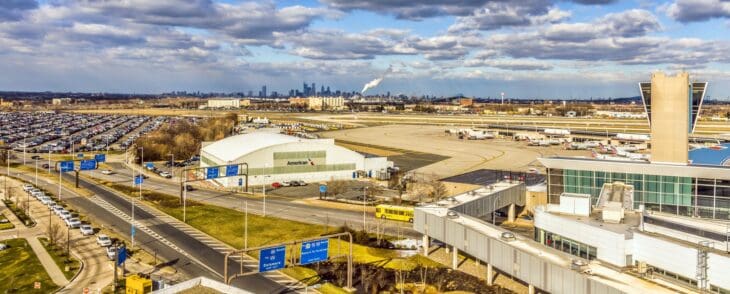

A primary circuit serving the Philadelphia approach control facility failed on a Monday morning, and its backup fiber between New Brunswick and Newark, New Jersey, had been severed by unrelated construction. FAA Administrator Bryan Bedford called it “one of the old L3 Verizon circuits.”
No commercial flight landed at Newark from about 9:40 a.m. to just after 5:20 p.m., the Associated Press reported from Flightradar24 data. AP counted more than 600 cancellations into and out of Newark and more than 200 at Philadelphia, with stops also hitting Teterboro, JFK and LaGuardia, as covered in our report on the Philadelphia TRACON outage.
7. Washington Center ERAM Failure, Aug. 15, 2015
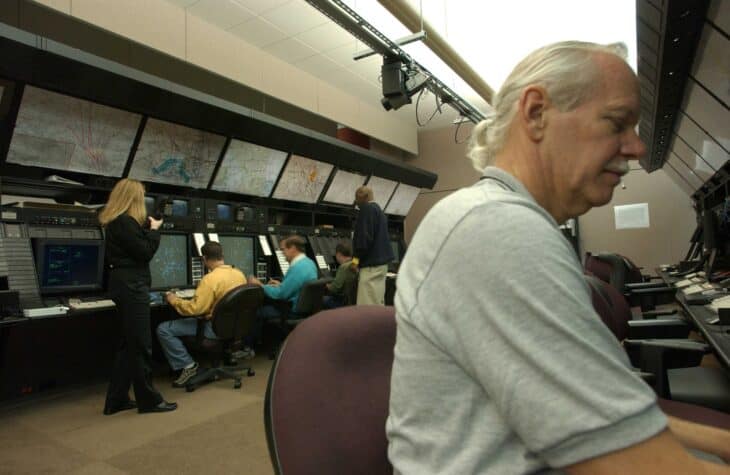

The FAA’s En Route Automation Modernization system at the Washington Center in Leesburg, Virginia, failed on a Saturday after a recent software upgrade. According to Route Fifty, data stayed in memory until storage filled up.
Route Fifty counted 476 flights canceled and 492 delayed at Washington-area airports. It is the clearest case on this list of a new system upgrade, rather than old equipment, causing the outage.
8. Philippines Airspace Closure, Jan. 1, 2023
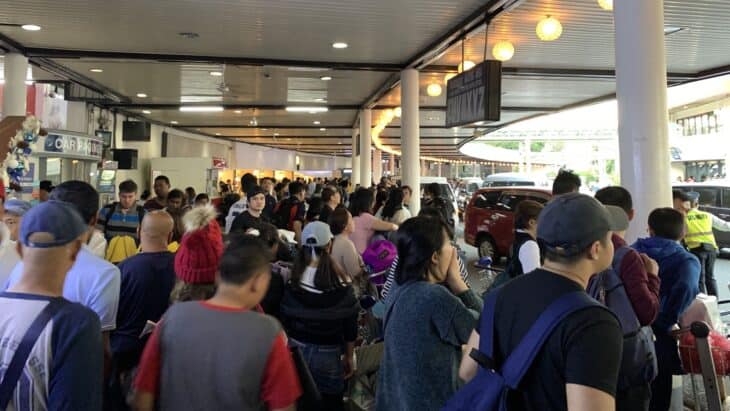

At 9:49 a.m. on New Year’s Day, the Civil Aviation Authority of the Philippines’ Air Traffic Management Center in Manila lost power, and with it communications, radio, radar and internet. From 10 a.m. to 4 p.m., no flight entered or left Philippine airspace.
CAAP director general Manuel Tamayo said one uninterruptible power supply failed, and when it was reconnected, 380 volts came in instead of 220. He also admitted the system was “quite old.”
Manila’s Ninoy Aquino International Airport counted 268 cancellations, plus seven diversions and seven delays, according to Philstar figures compiled on Wikipedia. About 56,000 passengers were affected, and Cebu Pacific alone canceled 258 flights that day.
9. ENAV Data Network Fault, Italy, Oct. 16, 2026
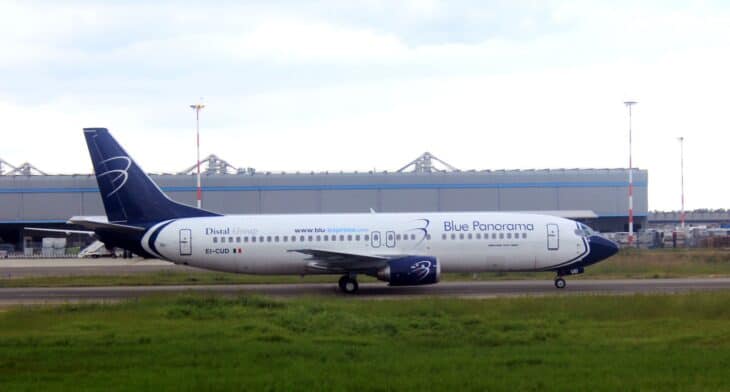

Faults in the data network serving Italian air traffic control forced ENAV to cut national capacity from 6 a.m. local time, to about half of normal at first. ENAV ruled out malicious activity, and traffic was fully restored the same day.
Cirium counted 192 cancellations across Italy by noon, so the full-day total was higher, and only about 31% of departures left on time, according to AeroTime. Our report on the ENAV network fault has the airport-by-airport picture.
10. Japan Flight Data System Failure, March 1, 2003
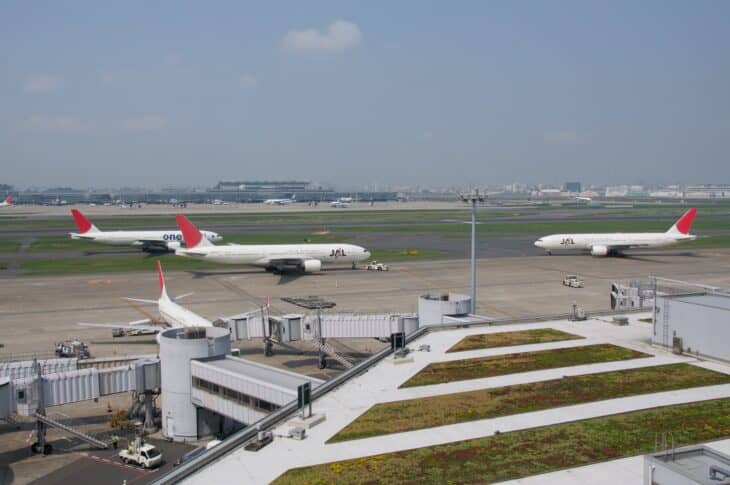

Japan’s national Flight Data Processing system at the Tokyo Air Traffic Control Center failed at 7 a.m. on a Saturday, after a software bug in a newly loaded program. One half came back at 7:40 a.m. and the other not until 10:58 a.m.
Local media counted 192 flights canceled and 1,342 delayed by 30 minutes or more, Computerworld reported. An estimated 270,000 people were affected, and the transport ministry set up a committee of outside experts to investigate.
11. NATS Radar Fault, UK, July 30, 2025

NATS called it a “radar related issue” fixed by switching to the backup system, and the technical problem itself lasted about 20 minutes. Departures and arrivals in London were still held for about an hour.
Cirium counted 84 departures and 71 arrivals canceled by 10 p.m., 155 flights in all. That is the measure of how fragile a busy system is: a 20-minute fault on a summer afternoon cost as many flights as the whole 2014 server failure below.
12. NATS Swanwick Server Failure, UK, Dec. 12, 2014
At 14:44, both the primary and backup System Flight Servers at NATS’s Swanwick center shut down. The independent enquiry found the software checked against a limit of 151 when it should have used 193, and the table it was checking held 153 entries.
Departures from London airports were stopped at 14:55, and the system was back with controllers at 15:49. NATS estimated about 150 cancellations and 353 delayed flights, and the enquiry found up to 230,000 passengers may have been affected that afternoon and evening.
The Failures a Cancellation Count Misses
Some of the most serious failures never produced a big cancellation number, either because nobody counted or because the damage was to safety rather than schedules. Four belong in any honest history.
Los Angeles Center radio failure, Sept. 14, 2004
This was the most dangerous failure here. Controllers at the Los Angeles Center in Palmdale lost voice contact with about 400 airplanes for roughly three and a half hours, and at least five losses of separation followed, IEEE Spectrum reported.
The cause was a countdown timer in the voice switch control system that ran out after about 49.7 days. The FAA’s workaround was a reboot every 30 days, and that maintenance check had not been done. About 800 flights were disrupted, but no cancellation count was ever published.
Newark’s radar and radio blackouts, 2025
On April 28, 2025, controllers at Philadelphia TRACON working Newark traffic lost radar and communications for about 90 seconds, according to the controllers’ union, NATCA. More outages followed on May 9 and May 11.
The damage was slow rather than sudden. Cirium data showed Newark averaging 39 canceled departures a day after April 26, against about four before, with 183 flights called off on May 1, and United cut 35 round trips a day from its Newark schedule.
Minneapolis Center, Aug. 6, 2026
A telecommunications failure put the Minneapolis Center into ATC zero at about 2 p.m., stopping flights across nine states for roughly two hours, as covered in our report on the Minneapolis Center outage. Affected flights averaged a 205-minute delay, but storms in the Northeast that day make any cancellation count impossible to separate.
Eurocontrol flow management outage, April 3, 2018
Europe’s central flow management system failed at 10:26 UTC after a script meant for test databases deleted live flight data. It was back by 18:00, and Eurocontrol said “only a few flights were cancelled.” The widely repeated figure of 15,000 flights was a same-day forecast of how many might be delayed, not a count.
What about 9/11, Überlingen or the DCA midair?
None of them is a technical failure of air traffic control systems, so none is ranked here. On Sept. 11, 2001, the FAA grounded the country by choice, and the 9/11 Commission found the system handled it with great skill as about 4,500 aircraft landed without incident. Midair collisions involving controllers are accidents, investigated by safety boards, and they belong on a list of crashes rather than outages.
For that list, see our ranking of the worst airplane crashes in history. For how the collision-avoidance safety net works when controllers and pilots lose track of each other, read how TCAS prevents midair collisions.
Why Air Traffic Control Failures Are Getting Bigger
Five of the 12 failures on this list happened in 2025 or 2026. The pattern behind them is consistent: the radars and controllers keep working, and the thing that breaks is a circuit, a network or a piece of software that every position depends on.
When that link fails, controllers do not lose the airplanes already flying. The safe response is to stop sending more, with a ground stop or a capacity cap, which is why a failure in one building shows up as cancellations hundreds of miles away. Our guide to how ground stops and flow control work explains the mechanics.
The size of the failure is set by how much traffic depends on the broken part. A cut line at Raleigh-Durham on Oct. 12, 2026 caused just nine cancellations at that airport by the afternoon, as our report on the RDU outage shows. A network fault that touches every center at once, as on Nov. 13, takes the whole country with it.
FAQ
Sources and references used for research and fact-checking.
- CBS News, FAA issues nationwide ground stop
- NBC News, Live updates: FAA grounds flights nationwide because of communication issue
- CNBC, FAA grounds departing flights nationwide, citing air traffic communication system outage
- ABC News, FAA ground stop live updates
- Wikipedia, 2026 United States ground stop
- TIME, Chicago O'Hare and Midway flights canceled after fire
- CBS Chicago, Airports trying to get back to normal after fire at FAA facility
- Flying, Michael Huerta orders security review after Chicago fire
- FAA, via AviationPros, Air traffic service restored at Chicago Center
- FAA, via AviationPros, FAA 30-Day Review of Chicago Center Fire Underscores Need for Funding, Flexibility and NextGen
- International Airport Review, NATS system fault triggers mass flight cancellations across UK airports
- NATS, NATS Preliminary Investigation Report into NAS Incident on 08 Sept 2026
- UK Civil Aviation Authority, UK aviation regulator announces scope of independent review into NATS technical incident on 8 September 2026
- AP, via WCAX, Second technical issue in 2 weeks afflicts UK's air traffic controller
- UK Civil Aviation Authority, NATS Major Incident Investigation Final Report (CAP2993C)
- UK Civil Aviation Authority, Independent Review of NATS (En Route) Plc's Flight Planning System Failure (CAP2993)
- Airport Technology, UK flight delays: air traffic control failure
- NPR, via Vermont Public, Here's the latest on the NOTAM outage that caused flight delays and cancellations
- Wikipedia, 2023 FAA system outage
- AVweb, Telecom failure disrupts Northeast air traffic
- AP, via WAFB, New York airport operations resume after disruptions across US Northeast
- Route Fifty, What went wrong with the FAA's software over the weekend
- PortCalls Asia, Airlines work toward normalizing flight operations
- GMA News, Officials cite outdated system for glitch that closed Philippine airspace
- Wikipedia, 2023 Philippine airspace closure
- Philstar, Data: Airspace outage left thousands stranded, hundreds of flights canceled
- AeroTime, Italy air traffic network failure flight disruption
- Computerworld, Computer trouble grounds all Japan flights
- International Airport Review, Second major air traffic control technical outage in two years disrupts UK airports
- UK Civil Aviation Authority, NATS System Failure 12/12/14 Independent Enquiry Final Report
- IEEE Spectrum, Lost radio contact leaves pilots on their own
- The Herald (Everett), Air traffic control blackout causes close calls in skies
- The Vindicator, via Los Angeles Times, California radio, radar failures prompt diverted flights
- Airways Magazine, Newark Liberty's severe disruption
- AirlineGeeks, Cancelations at Newark spike again
- CBS News, Newark airport delays and air traffic control
- Insurance Journal, Insurance Journal: Newark outage May 11, 2025
- Simple Flying, Minneapolis-St. Paul operations resume after ATC outage grounds flights across the Midwest
- EUROCONTROL, Explaining the EUROCONTROL Network Manager systems outage of 3 April 2018
- National Commission on Terrorist Attacks Upon the United States, The 9/11 Commission Report, Chapter 1
Get the Newsletter
The latest aviation news and stories sent to your inbox.
About the Author

Tim is the owner and lead editor of AeroCorner since 2019, overseeing aviation content covering aircraft, airlines, airports, and the broader aviation industry. Through years of researching, writing, editing, and publishing aviation-focused content, he has developed extensive practical knowledge of commercial aviation and air travel. Based in Asia and a frequent traveler himself, Tim also brings firsthand passenger experience to AeroCorner’s coverage. Outside of publishing, he has also explored aviation firsthand through hands-on flight training in New Zealand.