

Table of Contents
A communications failure at the centers that run America’s high-altitude traffic left the FAA with one safe move on a busy Friday afternoon: keep every departing airplane on the ground.
The FAA nationwide ground stop on Friday, Nov. 13, 2026 halted departures at every US airport from about 3:54 p.m. ET. Transportation Secretary Sean Duffy said it followed “a communication issue impacting all Air Route Traffic Control Centers.” The FAA later called it “a temporary telecommunications outage.”
The two orders before it were very different days. On Sept. 11, 2001, the FAA’s Command Center ordered a nationwide ground stop at 9:25 a.m. as the hijackings unfolded. On Jan. 11, 2023, a failure of the NOTAM pilot-alert system held departures nationwide from 7:30 a.m. until about 9 a.m. ET.
ABC News called Friday’s order the second nationwide ground stop since 9/11, and Wikipedia’s running account calls it the third in US history. Accounts of the 2023 outage described it as the first nationwide ground stop since 9/11, and we found no official FAA count of these orders.
Why a Network Failure Grounds the Whole Country
The US has 22 Air Route Traffic Control Centers, and they handle every flight above 18,000 feet. An Embraer 175 on a short regional hop and a Boeing 777-300ER bound for Asia both climb into and cruise through airspace run by those centers.
Controllers cannot work without that link to pilots. When it fails, the FAA does not add more aircraft to a system that may not be able to reach them. It stops the flow at the source with a ground stop and lets the airplanes already flying land.
That is what the Command Center’s advisory did. It said “all airports are ground stopped,” kept “all departing traffic” on the ground “until further notice,” and said inbound international flights would be handled case by case. Flights already in the air continued to their destinations.
Chicago O’Hare and Midway had been placed under their own ground stop for an equipment outage shortly before the national order, CBS News reported. An internal Alaska Airlines message seen by CNBC pointed to communications and radar problems.
The most specific account came from sources who spoke to CBS News. They said an update to the private communications network linking the air traffic control system caused it to reboot, and the reboot crashed it. CBS said the network is operated by L3Harris, which did not immediately comment.
Homeland Security Secretary Markwayne Mullin told reporters there was no indication of “a nefarious attack.” “It’s just a telecommunications outage as of now,” he said, adding: “This isn’t another 9/11.”
Officials told NBC News there was no sign of a cyberattack and no link to the Microsoft outage that had disrupted email services since the day before. Air Space Intelligence, the vendor behind the FAA’s new SMART traffic management system, said its products played no role.
3,100 Airplanes in the Air and 11,000 Waiting to Leave
The timing could hardly have been worse. Flight data firm Cirium told CNBC that about 11,000 flights were scheduled to leave US airports after 4 p.m. ET that Friday.
Flightradar24 counted about 3,100 aircraft in the air and bound for US airports when the stop began, CBS News reported. Shortly after the order, FlightAware listed more than 10,000 delays and over 2,000 cancellations.
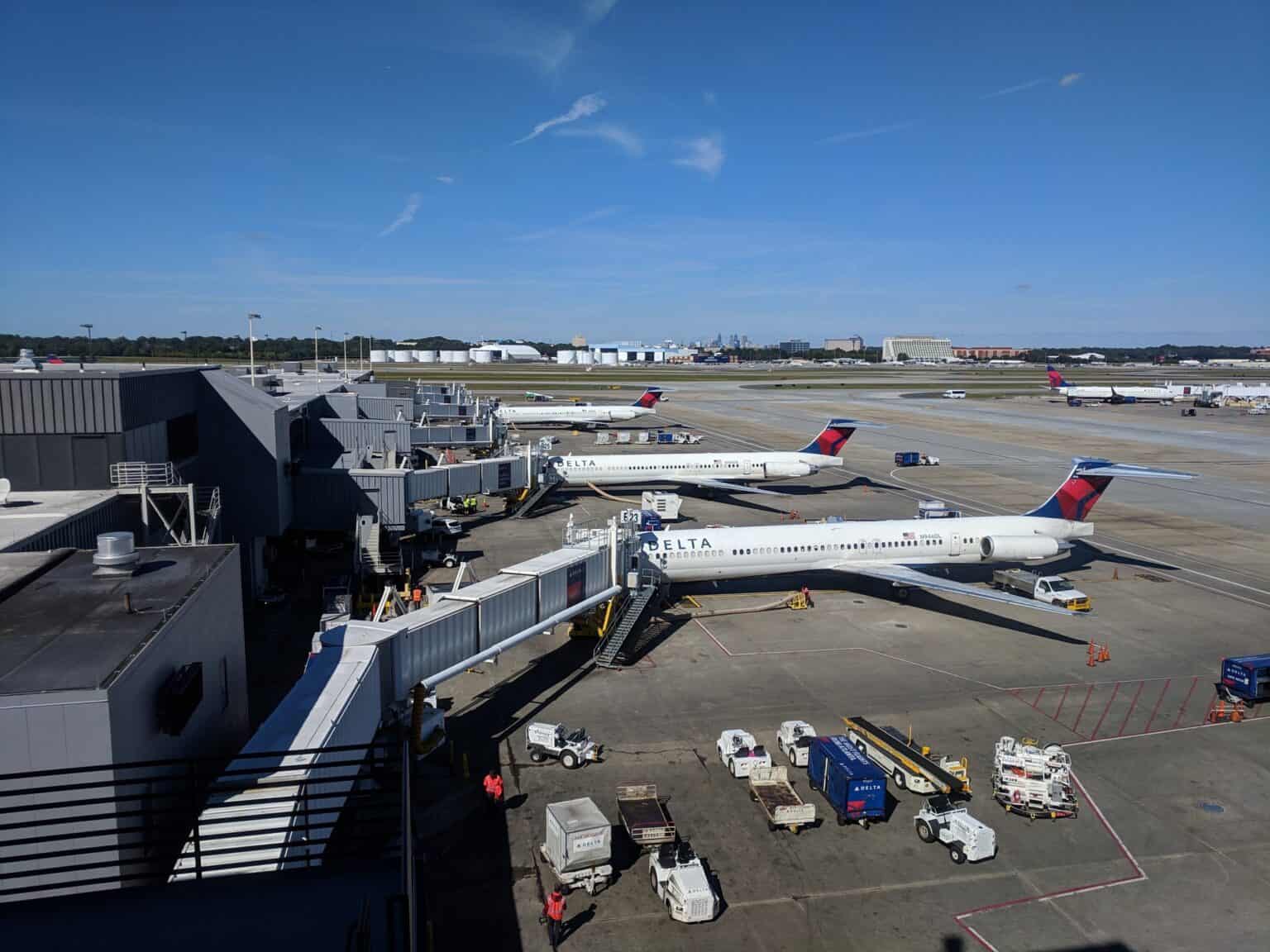
Arrivals kept landing while nothing left, so ramps filled up. By about 5:30 p.m. ET, Reagan Washington National was at capacity and O’Hare was close to it, according to a source cited by NBC News.
The two earlier orders set the scale. In January 2023, more than 10,000 US flights were delayed after the NOTAM failure, though departures were moving again within about 90 minutes.
On Sept. 11, 2001, the FAA went further than a ground stop. At 9:42 a.m., after the Pentagon was hit, national operations manager Ben Sliney ordered every aircraft to land at the nearest airport. About 4,500 commercial and general aviation aircraft landed without incident, according to the 9/11 Commission.
Three orders, three causes
Sept. 11, 2001: a terrorist attack. Jan. 11, 2023: damaged files in the NOTAM database. Nov. 13, 2026: a telecommunications outage across the en route centers.
The Network Under Air Traffic Control Is the Weak Point
The 2023 stop began with a contractor who unintentionally deleted files while correcting a sync problem between a live database and its backup, the FAA later said. Friday’s appears to have begun in the network itself.
That network matters more than most travelers realize. The Register reported that the FAA Telecommunications Infrastructure, managed by L3Harris, carries secure communication between more than 4,400 FAA facilities.
It is already being replaced. In August 2026, the FAA gave AT&T a $74.3 million initial task order to lead the rebuild of its air traffic network, part of an overhaul the agency wants finished by the end of 2028.
Friday’s failure is also the largest in a run of outages that started on the communications side. In the months before it, failed circuits and cut lines halted traffic at individual facilities, including an August failure at the Minneapolis center that grounded flights across nine states.
The difference on Nov. 13 was reach. One center going dark slows a region. A fault that touches every center at once leaves the FAA no region to route around, which is why the order covered every airport in the country.
How the Restart Went, and What Is Still Unanswered
The restart came in pieces. A Lufthansa flight from Boston to Frankfurt left at 5:21 p.m. ET, according to Flightradar24 data cited by CNBC, and Pacific-bound flights at San Francisco were cleared at 3 p.m. local time.
Around 6 p.m. ET, the FAA said flights would be allowed to depart as the en route facilities recovered. By 6:50 p.m. ET, cargo and passenger flights were leaving the West Coast for Asia and Hawaii, CNBC reported.
The reports available by the morning of Nov. 14 gave no single time for a full lift and no final cancellation count. The FAA had also not named the failed equipment or confirmed the update-and-reboot account.
That account will decide what the story becomes. A bad software update is a process problem, and a process can be fixed by the next maintenance window. A network that one update can take down nationwide is a design problem, and that is the question the FAA’s rebuild now has to answer.
Sources and references used for research and fact-checking.
- CBS News, FAA issues nationwide ground stop due to "extraordinary circumstances," White House says no indication of "nefarious act"
- CNBC, FAA grounds departing flights nationwide, citing air traffic communication system outage
- ABC News, FAA issues rare nationwide ground stop; no indication of 'nefarious attack'
- NBC News, Live updates: FAA grounds flights nationwide because of communication issue
- The Register, All US flights grounded by FAA
- Wikipedia, 2026 FAA communication outage
- Wikipedia, 2023 FAA system outage
- National Commission on Terrorist Attacks Upon the United States, The 9/11 Commission Report, Chapter 1: We Have Some Planes
Get the Newsletter
The latest aviation news and stories sent to your inbox.
About the Author

Tim is the owner and lead editor of AeroCorner since 2019, overseeing aviation content covering aircraft, airlines, airports, and the broader aviation industry. Through years of researching, writing, editing, and publishing aviation-focused content, he has developed extensive practical knowledge of commercial aviation and air travel. Based in Asia and a frequent traveler himself, Tim also brings firsthand passenger experience to AeroCorner’s coverage. Outside of publishing, he has also explored aviation firsthand through hands-on flight training in New Zealand.