

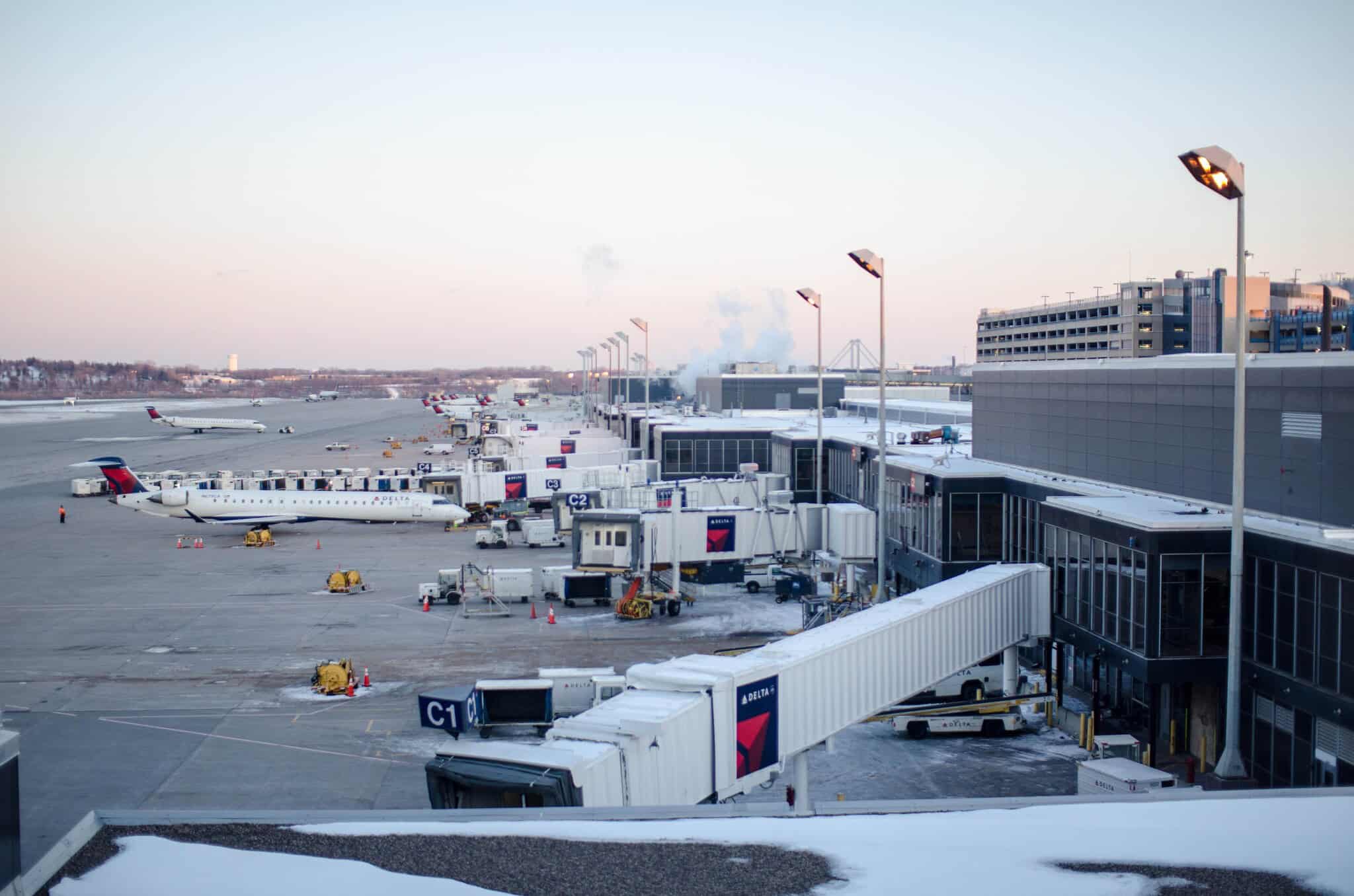
On August 6, 2026, an equipment failure at the Minneapolis Air Route Traffic Control Center knocked out radar and voice communications there for roughly two hours. The outage triggered a ground stop at Minneapolis-St. Paul International and cascading delays across the nine-state region the facility controls.
The ground stop began around 2:00 p.m. local time and lifted by 4:15 p.m., according to CBS Minnesota. The Metropolitan Airports Commission advised travelers to expect flight impacts to continue through the evening as airlines recovered.
By late afternoon, 87 departures had been delayed at MSP, with average waits of about 90 minutes. Flights bound for Iowa, Michigan, Kansas, Missouri, North and South Dakota, and Wisconsin were also affected, since Minneapolis Center controls high-altitude traffic across all of those states, not just Minnesota.
What actually failed, and why one center matters so much
The FAA confirmed to local outlets that technical teams responded immediately to restore the system, but as of publication it has not disclosed the precise cause. TAMPAcrit reported a dual failure in the facility’s redundant processing arrays, affecting both radar data and voice communications.
Other outlets tied the outage to a broader telecommunications disruption in the Twin Cities area that also knocked out some local internet, 911, and government services around the same time. A Minnesota IT Services spokesperson said there was no indication of a cybersecurity breach.
Minneapolis Center, identified by the FAA as ZMP, is one of 21 air route traffic control centers that carve up the continental United States into high-altitude sectors. Each center is the only facility handling en route traffic, the cruise portion of a flight, across its slice of airspace.
There is no adjacent center that can simply absorb another center’s full workload on short notice.
When a center loses both radar and radio at once, a condition controllers informally call “ATC Zero,” it cannot provide separation services to aircraft already in its airspace, let alone accept new ones.
Aircraft already airborne fall back on onboard collision-avoidance systems and, where available, relay communications through other centers or the airline’s own operations center, while the facility works to restore service.
A rare failure mode, not a routine one
Full facility outages like this are uncommon precisely because en route centers carry redundant processing and power systems designed to prevent exactly this kind of dual failure. When redundancy itself fails, as reported here, investigators typically look hardest at the layer that was supposed to keep the two systems independent.
A rough week for the national airspace system
The Minneapolis outage landed in the middle of a broader stretch of disruption. The same day, severe weather forced service cuts at nine major airports nationwide, and the following day brought a wave of controller call-outs that cancelled nearly 2,000 flights across the Northeast, a story AeroCorner covered separately. The two events share a week but not a cause.
Cause still under investigation
The FAA has said only that it is investigating what caused the equipment failure. Descriptions of the root cause vary between outlets, from a processing-array fault to a wider regional telecom problem, and none has been confirmed as final. Treat the technical explanation as preliminary until the FAA publishes its own findings.
Get the Newsletter
The latest aviation news and stories sent to your inbox.
About the Author

Tim is the owner and lead editor of AeroCorner since 2019, overseeing aviation content covering aircraft, airlines, airports, and the broader aviation industry. Through years of researching, writing, editing, and publishing aviation-focused content, he has developed extensive practical knowledge of commercial aviation and air travel. Based in Asia and a frequent traveler himself, Tim also brings firsthand passenger experience to AeroCorner’s coverage. Outside of publishing, he has also explored aviation firsthand through hands-on flight training in New Zealand.