

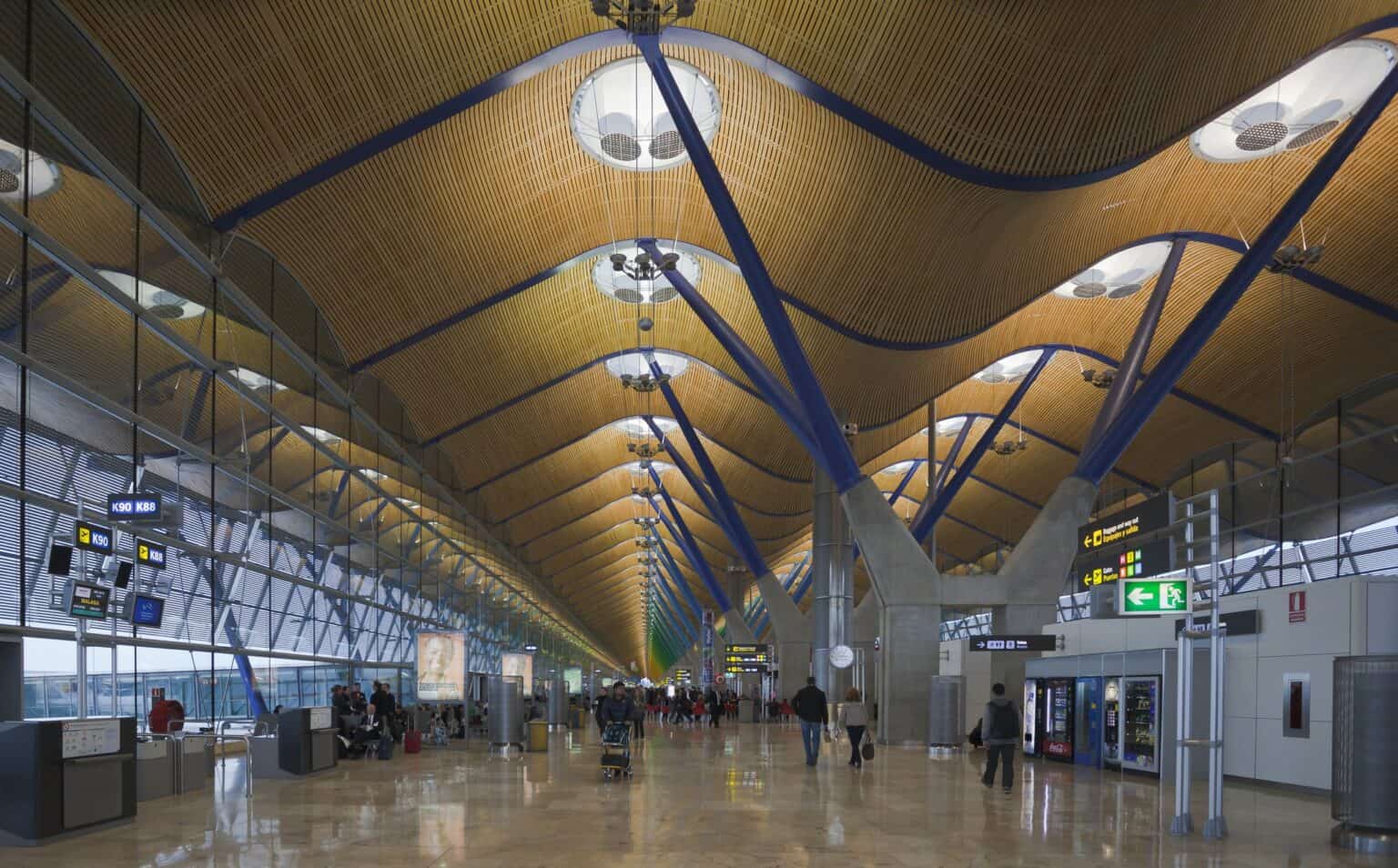
Spain’s Transport Ministry has set the minimum air services for the 24-hour general strike on Wednesday, November 11, 2026. At Madrid-Barajas, 78% of flights to the islands and other protected routes, 57% of international and long domestic flights and 32% of short mainland hops must be kept.
The 52-page resolution was signed on November 6 by José Antonio Santano, the Secretary of State for Transport, and is now posted on the ministry’s strike page. It was still missing on November 7, when AeroCorner first looked at the strike.
What the order protects at the big airports
The order does not set one national figure. It sets a share of each airline’s scheduled flights on each route, airport by airport, in three bands, with the result rounded up to a whole flight.
The first band covers domestic flights to and from the Balearic and Canary Islands, Ceuta and Melilla, plus routes under public service obligations. The second covers every international flight and mainland routes where public transport would take 5 hours or more. The third covers mainland routes with a faster ground alternative.
| Airport | Islands, Ceuta, Melilla and public-service routes | International and long domestic | Short domestic |
|---|---|---|---|
| Madrid-Barajas | 78% | 57% | 32% |
| Barcelona-El Prat | 79% | 56% | 34% |
| Málaga | 75% | 57% | 32% |
| Palma de Mallorca | 75% | 53% | n/a |
| Alicante | 74% | 54% | 31% |
| Valencia | 75% | 59% | 32% |
| Seville | 76% | 57% | 35% |
| Ibiza | 68% | 42% | n/a |
| Gran Canaria | 72% | 56% | n/a |
| Tenerife South | 71% | 58% | n/a |
Across all the airports listed, the island band runs from 52% at Almería to 85% at Santiago de Compostela. International protection runs from 39% at Menorca to 64% at Valladolid, and the short domestic band from 18% at Logroño to 37% at Pamplona.
When a route links two airports on the list, the higher of their two percentages applies. Overflights, emergency and state flights, and Interior Ministry flights moving foreign nationals in police custody are protected in full. So are flights that took off before the strike began and land during it.
How the ministry got to these numbers
The percentages come from a formula. The ministry estimates how many booked passengers it must still move, 90% on island routes, 65% on international and long domestic routes and 40% on short ones, then multiplies that by each airport’s expected November load factor.
The rest, it assumes, will cancel, fly another day or find another way to travel. That is why the short domestic band is the lowest: on those routes, the ministry judges that a train or bus can do the trip in under 5 hours.
The ministry counts more than 4,600 takeoffs and landings scheduled at Spanish airports that day, with close to 780,000 seats. Based on expected load factors, it says more than 663,000 passengers could be affected.
Compared with the order for the October 15, 2025 general strike, island protection is higher at all four of the busiest airports: Madrid rose from 76% to 78%, Barcelona-El Prat from 72% to 79%, Málaga from 67% to 75% and Palma de Mallorca from 70% to 75%. International shares held steady or slipped, by at most 3 points at Palma.
A floor, not a forecast
These percentages are the minimum each airline must be able to fly if its staff strike. They are not a cancellation list. How many flights actually go ahead depends on how many workers walk out and on how each airline plans its schedule, and airlines can still choose to cancel more.
Inside the terminal
The order also covers the airport itself. Assistance for passengers with reduced mobility keeps 75% of its scheduled staff, airside restaurants 30%, and terminal toilet cleaning 50%.
Passport control must be staffed so the average wait stays under 30 minutes per passenger. Security assistants follow whatever minimums apply to private security staff, which Infobae reported the Interior Ministry has set at 90% for airports.

For workplaces that run shifts, the strike starts with the last shift beginning before midnight on November 10 and ends when the last shift begun on November 11 finishes, even if that runs into Thursday. The separate, indefinite SAERCO controllers’ strike at nine smaller airports keeps its own September 28 order.
The order also sets minimum pilot and cabin crew numbers by pointing to the applicable aviation rules. It says that follows a September 22, 2026 Constitutional Court ruling that found an earlier order’s crew criteria too vague.
What airlines have said
As of November 8, AeroCorner found no published cancellation list or strike waiver for November 11 from Iberia, Vueling, Air Europa or Ryanair, and no statement on the day from airport operator Aena. In the last full-day general strike, in 2012, Iberia, Vueling and Air Nostrum canceled hundreds of flights between them.
If a flight is canceled, EU Regulation 261/2004 still requires the airline to offer a refund or rerouting and care at the airport. Whether cash compensation is also owed depends on who actually walked out, as AeroCorner’s earlier explainer on the strike sets out.
Sources and references used for research and fact-checking.
- Ministerio de Transportes y Movilidad Sostenible, Resolución de servicios mínimos, transporte aéreo, huelga general del 11 de noviembre de 2026
- Ministerio de Transportes y Movilidad Sostenible, Resoluciones de servicios mínimos (transporte aéreo)
- Ministerio de Transportes y Movilidad Sostenible, Resolución de servicios mínimos en el transporte aéreo, huelga general del 15 de octubre de 2025
Get the Newsletter
The latest aviation news and stories sent to your inbox.
About the Author

AeroCorner News is the aviation news desk of AeroCorner.com. It covers accidents and incidents, safety rulings, airline and airport disruption, and new aircraft. It works from primary sources such as the NTSB, FAA, EASA and the manufacturers' own announcements.