

Table of Contents
At about 2:20 a.m. on July 23, 1982, a Bell UH-1B helicopter lost its tail rotor over a movie set at Indian Dunes, Valencia, California, and crashed at the edge of a shallow river. Actor Vic Morrow, 53, and child actors Myca Dinh Le, 7, and Renee Shin-Yi Chen, 6, were killed. The six people aboard had minor injuries.
The usual telling says the metal lid of an exploding mortar flew up and struck the tail rotor. The National Transportation Safety Board examined that lid and reached the opposite conclusion: it hit the blade after the tail rotor assembly had already come off. Heat and debris from two special effects blasts did the damage, and nobody had arranged for the pilot and the blasts to be coordinated.
This article is built from the NTSB’s Aircraft Accident Report NTSB/AAR-84/14, adopted October 30, 1984. It replaced an earlier version, AAR-84/02, which the board revised after director John Landis petitioned it to reconsider the probable cause.
July 21, 1982
A new certificate. The FAA office in Riverside issues the helicopter a temporary experimental airworthiness certificate, because it has been modified for filming.
About 21:00, July 22
First session. The helicopter flies about 600 feet east to the set and hovers as a camera platform while charges are fired.
About 23:30
Second session. A charge in the water sends up a geyser that blinds the pilot’s windscreen for several seconds. Two cameramen and a stuntman aboard later say they worried about the heat.
23:45
The break. The pilot raises the debris hazard with the unit production manager, who later assures him the helicopter will stay over the water.
About 02:00, July 23
Rehearsal. The helicopter hovers about 40 feet above the river. No charges are fired.
About 02:18
The take. Six people board: the pilot, the unit production manager, two cameramen and two stuntmen.
About 02:20
The fifth charge. A fireball engulfs the tail during a left hovering turn. The tail rotor assembly separates and the helicopter descends out of control.
March 6, 1984
First report. The NTSB adopts AAR-84/02.
March 16, 1984
The petition. Lawyers for John Landis ask the board to reconsider its probable cause.
Oct. 30, 1984
Revised report. The NTSB adopts AAR-84/14, with a revised probable cause.
What happened
The scene was for John Landis’s segment of Twilight Zone: The Movie. The NTSB describes the set as 11 bamboo huts beside a shallow manmade river, dressed as a Vietnamese village under heavy bombardment. Special effects crews had placed mortars, steel pots loaded with black powder and a gasoline and sawdust mixture, to make the explosions.
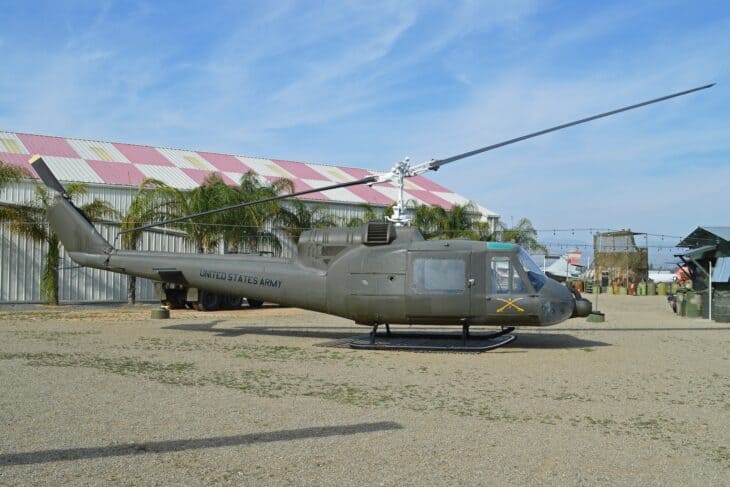
The aircraft was a Bell UH-1B Huey, registration N87701, serial 64-14038. It was owned by Rocky Mountain Helicopter of Provo, Utah, and flown by its subsidiary, Western Helicopters of Rialto, California. It served as both a prop in the scene and a camera platform.
The pilot was Dorcey A. Wingo, 35, a former Army helicopter pilot who had flown in Vietnam. The report credits him with 4,514 hours, 4,408 of them in rotorcraft. It was his fourth film job, but his first flying near special effects explosions.
The final take called for Morrow to carry the two children out of the village and across the river while the huts were blown up. The helicopter was to hover over the river and make a 180-degree left turn so a cameraman on the left skid could film them.
It did not fly that plan. The cameraman on the skid told investigators the helicopter was much lower than in rehearsal and over the village on the south shore, not the middle of the river. Wingo said he settled at about 35 feet, then heard radio calls to go lower.
A cameraman on the north shore said Landis shouted through a megaphone for the helicopter to “get lower.” The NTSB records that Landis later said he did not recall giving that command, while the assistant director beside him said Landis did ask for it.
After three explosions, the helicopter began its left turn. The fourth and fifth charges went off less than 0.1 second apart, and the fifth raised a column of burning fuel that engulfed the tail. The helicopter swung back to the right, lost its tail rotor and came down on the river’s north side, where its main rotor struck the three actors as they crossed.
The report adds a detail that explains why no one could stop it. Only the technician firing the first charge had a radio link to the special effects coordinator. The others were told to fire when they heard the machine guns on the helicopter, and the technician whose charges were nearest said no one had told him its flight path.
What the NTSB found
The board found nothing wrong with the helicopter or the pilot’s paperwork. It was properly maintained, with no sign of a pre-existing failure, and Wingo was certificated and qualified for the flight.
The revised probable cause reads: “the detonation of debris-laden high temperature special effects explosions too near to a low flying helicopter leading to foreign object damage to one rotor blade and delamination due to heat to the other rotor blade, the separation of the helicopter’s tail rotor assembly, and the uncontrolled descent of the helicopter.”
It continues: “The proximity of the helicopter to the special effects explosions was due to the failure to establish direct communications and coordination between the pilot, who was in command of the helicopter operation, and the film director, who was in charge of the filming operation.”
The FBI measured the camera film frame by frame for the board. At the fifth explosion, the center of the tail rotor was about 34 feet above the charge and only 13 feet to one side of it.
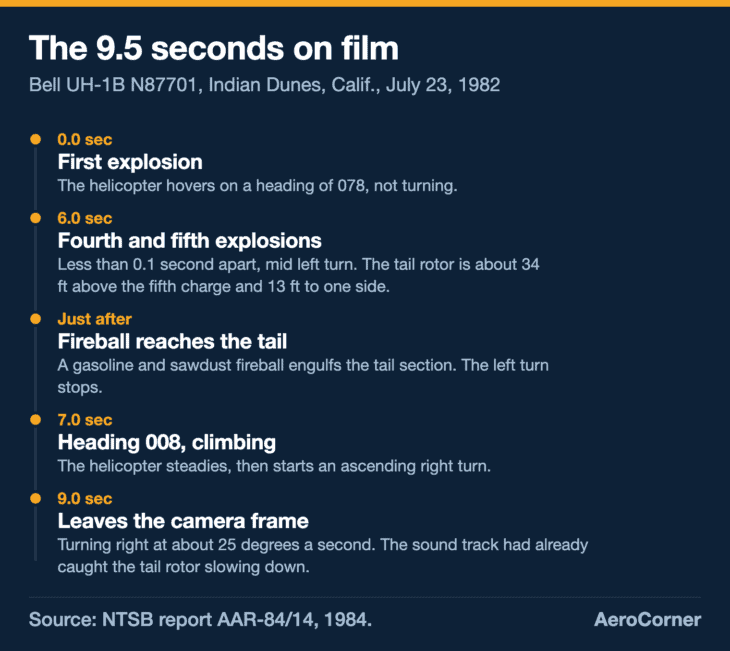
The board could not name the single failure that brought the tail rotor down. One blade had a semicircular dent about 3.5 inches across on its trailing edge, where it broke. The other had lost about 33 inches of its skin, peeled off because the heat had weakened the bond.
Either one, or both together, could have thrown the tail rotor out of balance hard enough to snap the gearbox mount, the board found. Its finding is that “regardless of the specific damage,” the evidence was “clear and convincing” that the blasts caused it.
Blame was shared. The board said the pilot, the one person who understood how vulnerable a helicopter was to heat and debris, should have insisted on a joint briefing and on a direct radio link to the technicians. It also found that the director “failed to fulfill his responsibility of insuring safety on the film set,” holding no preproduction meeting and taking no action after the pilot raised the hazard.
What most accounts get wrong
The crash is almost always told as a mortar lid flying up into the tail rotor, a version repeated in Wikipedia’s account. The NTSB did find two punctures on the broken blade that matched the sharp tangs on the steel lid of a 5-gallon glue pot. But because the punctures were not elongated, the board concluded the blade was barely turning when they were made: the lid struck it after the tail rotor assembly had already separated. The board called those punctures not significant. What it blamed was a dent from an object it could not identify, heat that peeled the skin off the other blade, or both.
The cause itself was rewritten once. The March 1984 report blamed a single debris strike and said the peeled skin was “not a significant factor.” Landis’s lawyers petitioned, arguing that heat delamination alone caused the crash and that the licensed pyrotechnics operator, not the director, controlled the charges.
They also produced tests by Landis’s consultant showing that the residue on the dented blade, which the board’s consultant had found similar to an adhesive used on the huts, was the helicopter’s own olive drab paint. The board added those results to the report.
On October 30, 1984, the NTSB granted the petition “in part.” It added heat delamination to the probable cause, revised two findings and deleted one. It rejected the argument that the pyrotechnics operator alone was responsible, and kept the finding that the director failed in his duty of safety on the set.
Why a helicopter cannot survive losing its tail rotor at 25 feet
A single main rotor turning one way pushes the fuselage the other way. On the Huey, the main rotor’s torque tries to swing the nose right, and the tail rotor pushes sideways to hold it straight.
A left hovering turn asks even more of it. The NTSB notes the tail rotor blades were near full deflection and near their highest aerodynamic load at the moment the fireball reached them, which is why damage to one blade could tear the whole assembly loose.
With altitude, a pilot who loses tail rotor thrust can enter autorotation: the engine stops driving the rotor, the torque largely disappears and the helicopter can be landed upright. The report says the helicopter was hovering about 25 feet above the village, and Wingo “had neither the time nor the altitude” to do that. Once the tail rotor separated, the crash was inevitable.
That is also why the rules treated helicopters differently. Under what is now 14 CFR 91.119(d), a helicopter may fly below the normal minimum altitudes if it does so “without hazard to persons or property on the surface.” Airplanes need an express FAA waiver to do the same.
What changed
The NTSB found a gap in the rules. Since March 1982, airplanes flying low for film and television work had needed an FAA-approved Motion Picture and Television Flight Operations Manual. Helicopters did not, and Western Helicopters had never been asked for one.
Its one safety recommendation, A-84-16, asked the FAA to require that manual “for all types of aircraft.” The board said it should cover pilot qualifications, mandatory briefings for the film crew, a communications plan for everyone involved and the pilot in command’s final authority over the flight.
Wikipedia’s account says the FAA responded by amending its inspector guidance to make clear that low-level helicopter filming needs a certificate of waiver, language it says was formally adopted in 1986.
The courts reached no verdict against anyone. Landis, Wingo, associate producer George Folsey Jr., unit production manager Dan Allingham and explosives specialist Paul Stewart were tried for involuntary manslaughter and acquitted after a trial that ran through 1986 and 1987, according to Wikipedia. It also records that the children had been hired without the permits California requires and paid off the books, so they could work at night.
Hollywood changed its own practice. Wikipedia credits the accident with new studio safety committees and bulletins, a Directors Guild safety hotline and a Screen Actors Guild push for performers to refuse a scene they believe is unsafe. Steven Spielberg, who produced the film with Landis, said afterward that “no movie is worth dying for.”
Two other famous helicopter crashes turned on the margins a pilot flies with rather than a mechanical surprise: the Stevie Ray Vaughan helicopter crash, a VFR night departure in 1990, and the Kobe Bryant helicopter crash in cloud in 2020.
FAQ
Sources and references used for research and fact-checking.
- National Transportation Safety Board, Aircraft Accident Report NTSB/AAR-84/14, Western Helicopters Bell UH-1B, N87701, Valencia, California, July 23, 1982 (supersedes NTSB/AAR-84/02)
- National Transportation Safety Board, CAROL case LAX82AA274, Bell UH-1B N87701, Valencia, California
- Cornell Legal Information Institute, 14 CFR 91.119, Minimum safe altitudes: General
- Wikipedia, Twilight Zone accident
- Wikipedia, Vic Morrow
- Wikipedia, Twilight Zone: The Movie
Get the Newsletter
The latest aviation news and stories sent to your inbox.
About the Author

Tim is the owner and lead editor of AeroCorner since 2019, overseeing aviation content covering aircraft, airlines, airports, and the broader aviation industry. Through years of researching, writing, editing, and publishing aviation-focused content, he has developed extensive practical knowledge of commercial aviation and air travel. Based in Asia and a frequent traveler himself, Tim also brings firsthand passenger experience to AeroCorner’s coverage. Outside of publishing, he has also explored aviation firsthand through hands-on flight training in New Zealand.