

Table of Contents
On the morning of March 19, 1982, a Beech F35 Bonanza clipped Ozzy Osbourne’s tour bus during a low pass over a private airstrip near Leesburg, Florida. It then struck a tree and a house and caught fire. Guitarist Randy Rhoads, 25, died with seamstress and makeup artist Rachel Youngblood, 58, and the pilot, tour bus driver Andrew Aycock.
Two details in most retellings are wrong. Aycock was not an unlicensed pilot: he held a private pilot certificate with an instrument rating, and what had lapsed was his medical certificate. And the federal investigators never cited drugs. Their causes were poor judgment, buzzing and a misjudged clearance.
This article is built from the National Transportation Safety Board’s Brief of Accident MIA82FA078 (file 2450, adopted March 19, 1983), the coded fields behind it in the NTSB’s accident database, and the FAA’s registration record for the airplane, N567LT. Facts from other sources are named as they come.
November 16, 1979
The last medical. Andrew Aycock passes what the NTSB file records as his last FAA medical examination, a second-class certificate.
End of November 1981
The medical runs out. Under the rules of the time, a second-class medical covered private flying for 24 months. Aycock does not renew it.
March 18, 1982
Knoxville. Ozzy Osbourne’s band plays Knoxville, Tennessee, on the Diary of a Madman tour, then sets off overnight by bus for the Rock Super Bowl festival in Orlando.
Morning, March 19
A stop at Leesburg. The bus pulls in at Flying Baron Estates, a property with its own airstrip northwest of Orlando, to have its air conditioning fixed.
First flight
A joy ride. Aycock takes the Bonanza from the hangar without permission and flies keyboardist Don Airey and tour manager Jake Duncan.
9:55 a.m.
The second flight. The NTSB file logs the departure. Rhoads and Youngblood are aboard with Aycock.
About 10:00 a.m.
The accident. On one of several low passes, a wing strikes the bus. The airplane hits a tree and a residence, and a fire follows.
March 19, 1983
The finding. One year to the day later, the NTSB adopts its brief: poor judgment, buzzing and misjudged clearance by the pilot in command.
What happened
In March 1982, Rhoads was 25 and the lead guitarist on Ozzy Osbourne’s first two solo albums, Blizzard of Ozz (1980) and Diary of a Madman (1981). Before that, he had co-founded Quiet Riot. The band was touring the US by bus.
After a show in Knoxville, the bus drove through the night toward Orlando. On the way, it stopped at Flying Baron Estates near Leesburg, a property with a house, a hangar and a private airstrip, so the air conditioning could be repaired. Ultimate Classic Rock reports that Aycock lived nearby.
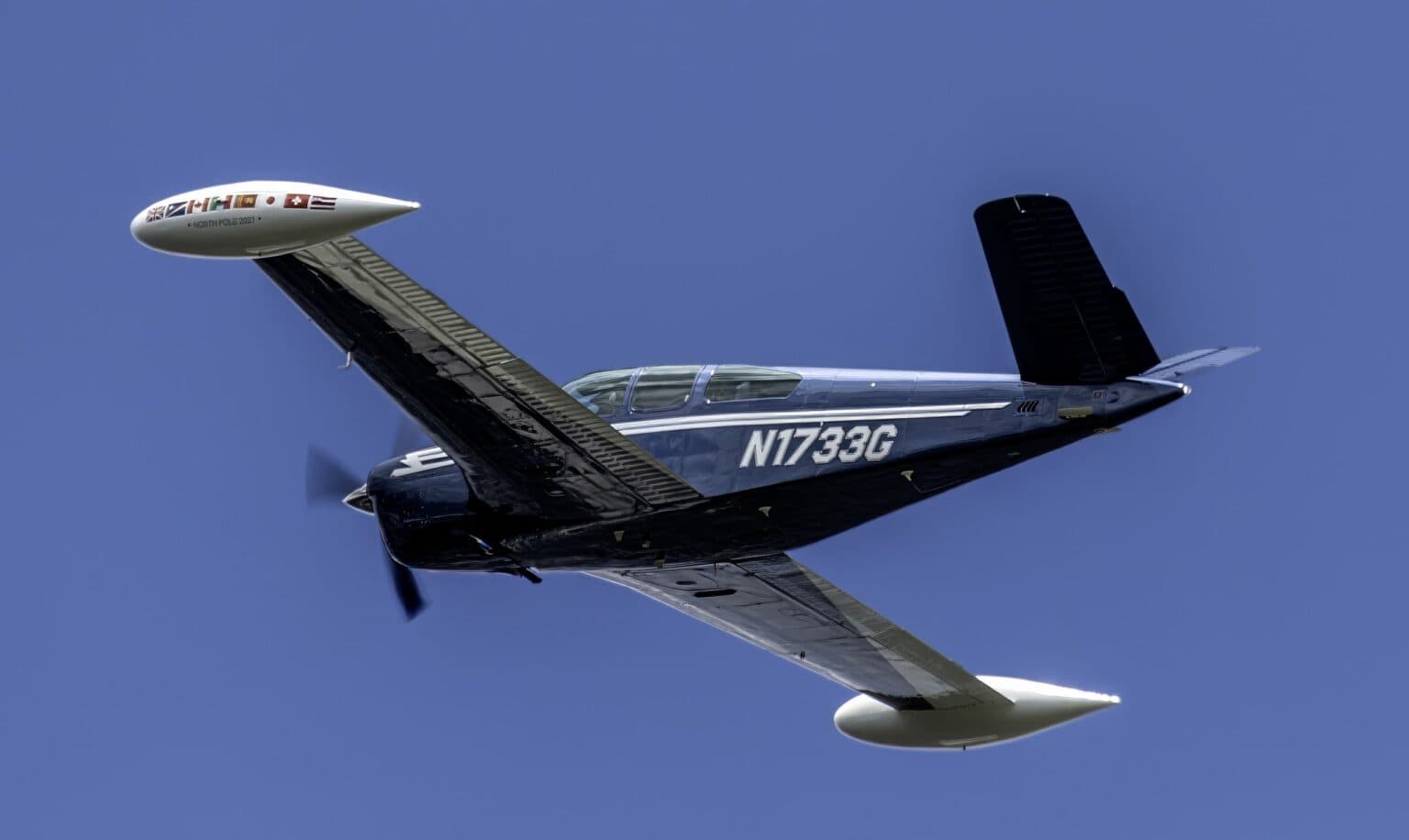
In the hangar was a single-engine Beech F35 Bonanza, N567LT, serial D-4144. The F35 is a mid-1950s version of the V-tail Bonanza, a four-seat retractable-gear airplane; its modern straight-tail descendant is the Beechcraft Bonanza G36. The NTSB file lists a Continental E225-8 engine of 225 horsepower and a maximum weight of 2,750 pounds (1,247 kg).


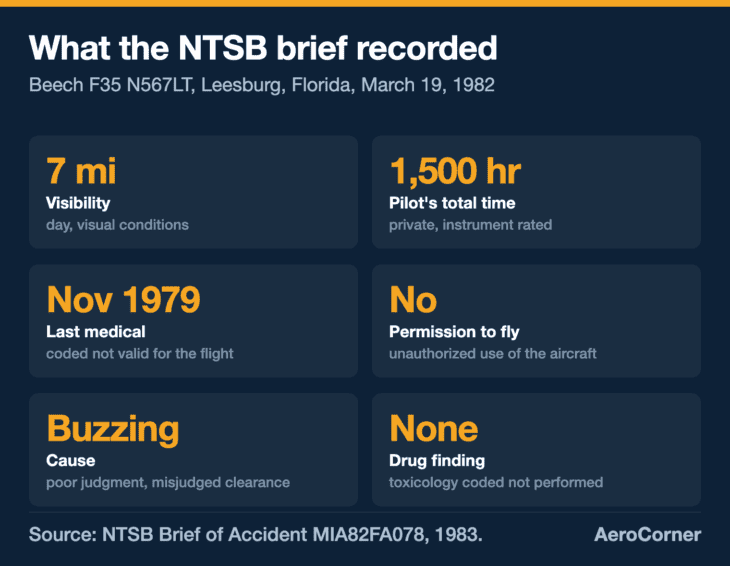
The NTSB states it plainly: the pilot, “a rock group driver,” took the airplane from the hangar without permission to give members of the group a ride. Its database codes the first finding as unauthorized use of the aircraft. No flight plan was filed, and the file holds no record of a weather briefing.
According to band members’ accounts summarized on Wikipedia, the first flight carried keyboardist Don Airey and tour manager Jake Duncan and landed safely. The second carried Rhoads and Youngblood. The NTSB file logs a departure at 9:55 a.m. local time.
The weather was not a factor. The file records daylight, visual conditions, 7 miles (11 km) of visibility and a light southerly wind of 7 knots. This was a clear-weather accident from start to finish.
During the second flight, the Bonanza made several low passes over the area. On one of them, a wing hit the parked bus. The airplane then struck a tree and a residence on the property, and a fire broke out after the crash. The NTSB records the time as 10:00 a.m. Eastern.
All three people aboard died. Osbourne, Sharon Osbourne and the rest of the band were on or near the bus, and Ultimate Classic Rock reports most of them were asleep. Nobody on the ground was hurt, according to the NTSB’s injury fields.
What the NTSB found
The NTSB did not publish a full accident report on Leesburg. The case was closed with a two-page Brief of Accident: a coded summary, a short narrative and a list of findings. The brief for MIA82FA078 was adopted on March 19, 1983.
Its probable cause, in the Board’s own coding, has three parts, all attributed to the pilot in command: judgment, poor; buzzing, performed; and clearance, misjudged. The bus, the tree and the residence are listed as factors, the objects the airplane hit. The unauthorized use is recorded as a finding but not marked as a cause.
The pilot fields are just as specific. Aycock, whom the NTSB lists as 33, held a private pilot certificate with single-engine land, multi-engine land and instrument airplane ratings, and had about 1,500 hours of flight time. Some popular accounts give his age as 36; this article uses the NTSB figure.
The narrative ends on one line: “The pilot’s last medical certificate was dated 11/16/79.” The database codes that second-class medical as not valid for the flight. In 1982 a second-class certificate covered private flying for 24 months, so it had lapsed at the end of November 1981 at the latest.
The FAA’s deregistered-aircraft file still carries Bonanza serial D-4144 under N567LT. The mark itself has since been reissued to a different airplane, a 1970 Aerostar.
What most accounts get wrong
The crash is usually told as the work of an unlicensed pilot high on cocaine, and some articles say the NTSB blamed drug impairment. The federal record says neither. Aycock held a private pilot certificate with an instrument rating and about 1,500 hours; what had lapsed was his medical certificate, which is a different document. And the NTSB’s causes are poor judgment, buzzing and a misjudged clearance. Its file contains no drug finding, and its toxicology field is coded as not performed. Later reports of a positive cocaine test come from press and band accounts, not from the federal investigation.
License versus medical: why a valid pilot could not legally fly
A US pilot needs two separate documents to fly as pilot in command. The pilot certificate, the “license”, proves training and testing. Under 14 CFR 61.19 it is issued without an expiration date and stays valid unless it is surrendered, suspended or revoked.
The medical certificate is the one that runs out. It proves the pilot recently passed an FAA medical exam, and it has to be renewed on a schedule. In 1982 that schedule was every 24 months for private flying, according to the FAA’s own 1996 summary of the rule.
So “his license had expired” is the wrong way round. Aycock’s training, ratings and experience were on record and still valid. What he did not have was a current medical, so he could not legally act as pilot in command that morning, even with permission to use the airplane.
The NTSB did not list the expired medical as a cause, though. The Board’s causes describe what happened in the air, not paperwork. An instrument-rated pilot with 1,500 hours was flying passes low enough to hit a parked bus.
Why buzzing kills experienced pilots
Buzzing is the NTSB’s own coded term for a deliberate low pass over people, vehicles or buildings. Experience is no protection against it: the pilot here had about 1,500 hours and an instrument rating.
The reason is the finding the Board paired with it: clearance, misjudged. A few feet above the ground there is no margin. A pilot judging height by eye over a familiar object can misread the gap by the span of a wingtip, and a small bank to turn back for another pass lowers that wingtip further.
The minimum-safe-altitude rule, today 14 CFR 91.119, exists to keep that margin. Except when taking off or landing, an airplane over a sparsely populated area may not fly closer than 500 feet to any person, vehicle or structure. Over a congested area the floor is 1,000 feet above the highest obstacle.
A pass low enough to touch a parked bus breaks that rule by hundreds of feet. That is why the NTSB coded the cause as judgment rather than skill. The file records no mechanical problem and no weather: the maneuver itself left no room for a misjudgment.
What changed
Nothing in the rules changed because of Leesburg, and the NTSB made no safety recommendations. Every part of the flight was already prohibited: taking an airplane without permission, flying as pilot in command without a current medical, and buzzing people and vehicles.
That is the honest lesson of the record. This was not a weather trap, a mechanical failure or a gap in the regulations. As the brief tells it, the accident came down to decisions made in good weather, and the Board coded it that way.
It also belongs to a long line of musicians killed in light aircraft. On February 3, 1959, a V-tail Bonanza of the same family carried Buddy Holly into an Iowa field at night, with light snow falling. Leesburg is the opposite case: clear skies, no instruments needed and no pressure to fly at all.
Rhoads is entombed at Mountain View Cemetery in San Bernardino, California. In 2021 he was inducted into the Rock and Roll Hall of Fame, nearly four decades after the morning at Leesburg.
FAQ
Sources and references used for research and fact-checking.
- National Transportation Safety Board, Brief of Accident MIA82FA078, File No. 2450, Beech F35 N567LT, Leesburg, Fla., March 19, 1982 (adopted March 19, 1983)
- National Transportation Safety Board, Aviation accident database (Pre2008.zip), event 20020917X02406, MIA82FA078
- Federal Aviation Administration, Releasable Aircraft Database (deregistered and master files), N567LT
- Federal Register, Modifications of Certain Medical Standards and Procedures and Duration of Certain Medical Certificates (61 FR 11238, March 19, 1996)
- Legal Information Institute, Cornell Law School, 14 CFR 61.19, Duration of pilot and instructor certificates
- Legal Information Institute, Cornell Law School, 14 CFR 91.119, Minimum safe altitudes: General
- Wikipedia, Randy Rhoads
- Ultimate Classic Rock, The Death of Randy Rhoads
Get the Newsletter
The latest aviation news and stories sent to your inbox.
About the Author

Tim is the owner and lead editor of AeroCorner since 2019, overseeing aviation content covering aircraft, airlines, airports, and the broader aviation industry. Through years of researching, writing, editing, and publishing aviation-focused content, he has developed extensive practical knowledge of commercial aviation and air travel. Based in Asia and a frequent traveler himself, Tim also brings firsthand passenger experience to AeroCorner’s coverage. Outside of publishing, he has also explored aviation firsthand through hands-on flight training in New Zealand.