


Table of Contents
On the night of August 31, 1969, a Cessna 172 crashed in a pasture about 2 miles (3 km) from the runway at Newton, Iowa. Rocky Marciano, the only heavyweight champion to finish his career undefeated, died the day before his 46th birthday. His friend Frankie Farrell and the pilot, Glenn Belz, died with him.
Some modern retellings blame “a massive storm system”. The accident file describes something quieter: a 1,200-foot overcast, visibility of at least 5 miles and no precipitation at the crash site. Its first listed cause is a flight beyond the pilot’s experience, and it codes no engine or fuel cause at all.
This article is built from the National Transportation Safety Board’s own accident record, file MKC70A0008 (docket 3-2364), and the FAA registration history of the airplane, N3149X. Facts from other sources are named as they come.
Before departure
The briefing. Belz gets a weather briefing from flight service by phone, according to the NTSB file. He files no flight plan.
About 5:58 p.m., August 31
Departure. The Cessna leaves Chicago’s Midway Airport for Des Moines, the Iowa History Journal reports. Three people are aboard.
8:50 p.m.
The radio call. Belz tells Des Moines he is in the area but cannot see the city through cloud and drizzle, and asks for a position fix, according to the same account.
Minutes later
The diversion. He reports seeing the lights of Newton, about 30 miles (50 km) east of Des Moines, and says he will land there.
About 9:05 p.m.
The crash. The airplane comes down about 2 miles (3 km) southwest of the airport. The NTSB file logs the time as 20:05.
September 11, 1969
Registration cancelled. N3149X is removed from the FAA register.
September 30, 1969
The finding. The NTSB’s file shows its analysis complete. All three causes it codes concern the pilot, and low ceiling is listed as a factor.
What happened
Marciano had retired in April 1956 with a record of 49 wins and no losses. On August 31, 1969, he was heading to Des Moines, and the Iowa History Journal says he planned to fly home to Florida the next morning to spend his birthday with his family.
Accounts of the Des Moines trip vary. The Iowa History Journal ties it to Farrell’s new insurance business, while Wikipedia describes a surprise birthday party and a speech supporting a friend’s son.
Farrell, a former Dowling High School sports star, was a family friend. Sources disagree on his age, so we do not print one.
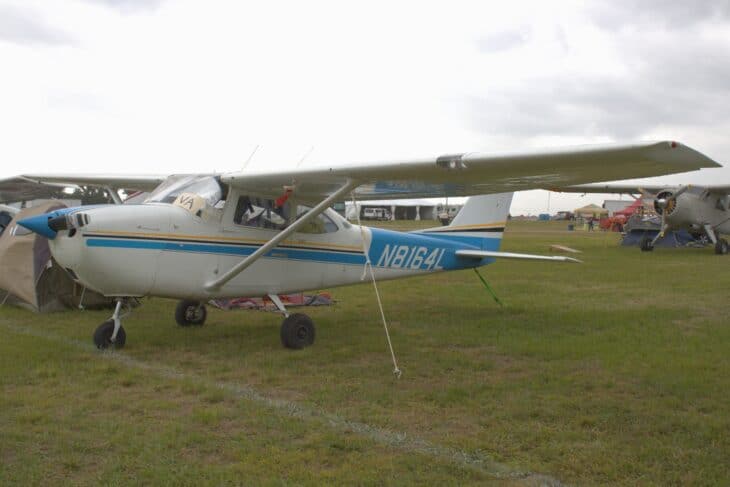
The airplane was a Cessna 172H, a four-seat single-engine airplane. FAA records list N3149X, serial 17255299, built in 1966, under Executive Flyers Inc. of Grimes, Iowa, the operator the NTSB file names. The file codes the flight as pleasure flying.

Belz was a company executive, not a professional pilot. The file lists him as 36, while press accounts say 37. He held a private certificate with an airplane single-engine land rating, and no instrument rating appears in the record.
By the Iowa History Journal’s account, the Cessna left Midway at 5:58 p.m. Nearly three hours later, Belz called Des Moines to say he could not see the city. He then said he could see Newton’s lights and would land there to refuel.
Newton Municipal had a 4,100-foot asphalt runway, and the file records its lights as on and working. The Cessna came down within 3 miles of it, to the southwest, in hilly country on a dark night. Wikipedia says the pilot entered low cloud while trying to land there and attempted to go around.
What the NTSB found
File MKC70A0008 is a single coded entry, released as a “brief”, not the long narrative report the NTSB writes today. Each line comes from a fixed code list, and investigator Crawford’s name is on it. It is short, but it is the NTSB’s official record of the cause.
The probable cause has three parts, all coded to the pilot in command: “attempted operation beyond experience/ability level”, “continued VFR flight into adverse weather conditions” and “spatial disorientation”. The one contributing factor is “low ceiling”. The accident itself is coded as an uncontrolled descent and collision with the ground.
Those causes read harshly, but they describe a gap, not carelessness. Belz got a briefing, and the file rates the forecast “substantially correct”. Toxicology found no alcohol or drugs and carbon monoxide at or below 10 percent.
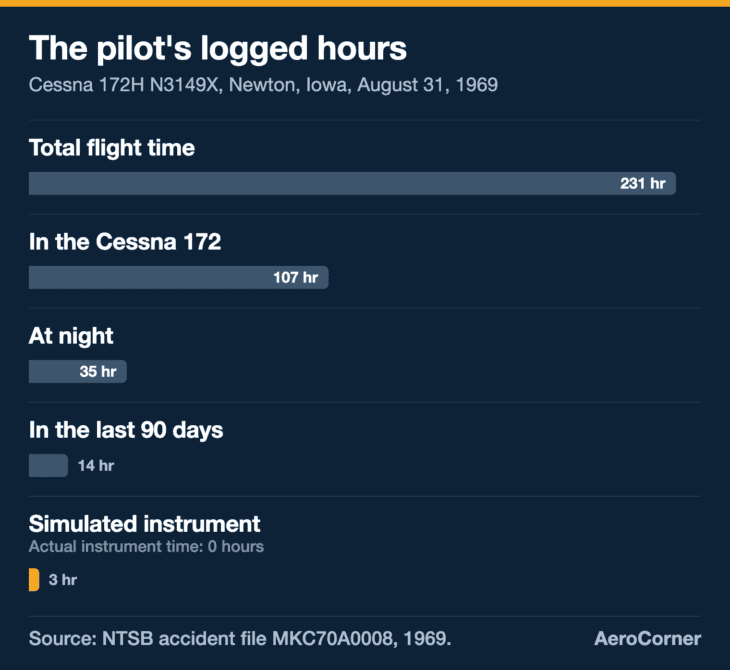
The gap is in his logbook. He had 231 hours in total, 107 of them in the 172 and 35 at night, with 14 in the previous 90 days. He had 3 hours of simulated instrument time and the file lists 0 hours of actual instrument time, meaning none in real cloud.
The weather fields show what kind of night it was. At the crash site the file records an overcast at 1,200 feet with a variable ceiling, visibility of 5 miles or more, no precipitation, a temperature of 70°F and a 5-knot wind from the northwest. It classes those conditions as VFR, and its only remark reads “dark night”.
What most accounts get wrong
The crash is usually told as a storm story, and one Iowa history post calls it a massive storm system. The NTSB file records no storm at the crash site: overcast at 1,200 feet, 5 miles or more of visibility and no precipitation. Weather nearer Des Moines is another matter, since the file does not code it, and Belz reported cloud and drizzle there. Wikipedia says the airplane was short of fuel, and one witness recalled a sputtering engine, but the file codes no fuel or engine cause. Its causes are the pilot’s experience, continued flight into adverse weather and spatial disorientation.
The time is also told two ways. Wikipedia says 8:05 p.m. CDT, and the Iowa History Journal says 9:05 p.m. The file’s 20:05 matches the first at face value, and matches the second if it is standard time. Its coded three-hour flight from a 5:58 p.m. departure points to 9:05, but the file names no time zone, so that reading is ours.
Why a dark overcast can take away which way is up
Pilots stay oriented with their eyes first, and with the horizon above all. On a dark night under an overcast, in thinly lit country, that horizon can vanish even when the weather is legal. The NTSB’s safety alert on the subject warns that night flights over areas with limited ground lighting can be challenging even in visual conditions.
Without it, the body falls back on the inner ear, which is easily fooled. As AOPA explains it, fluid in the semicircular canals senses rotation, but in a steady turn the fluid catches up after about 15 seconds. The pilot then feels level while still banked.
A pilot who rolls back toward what feels straight can tighten the turn while the nose drops, the pattern known as a graveyard spiral. The only cure is to believe the instruments over your own body, and that takes practice. It is the same trap explained in our guide to spatial disorientation in aviation.
The file records a 45-degree right bank at the end, which is consistent with lost orientation, though it draws no such link itself. What it does show is how little time Belz had spent learning to trust his instruments.
Research on this is older than the crash. In a 1954 University of Illinois experiment funded by the AOPA Foundation, 20 volunteer pilots with no instrument rating flew in simulated instrument conditions and lost control after 178 seconds on average, with a range of 20 to 480 seconds.
The famous number is only the baseline. After six one-hour sessions teaching a controlled 180-degree turn and descent, those same pilots kept control on 59 of 60 flights. The lesson of the study is that a small amount of the right training makes a large difference.
What changed
We could find no rule or safety recommendation that traces back to this crash. It was handled as a brief general aviation file, with the analysis marked complete within about a month. The hazard it describes was already known, as the 1954 study shows.
That type has not gone away. The NTSB’s safety alert on reduced visual references says about two-thirds of general aviation accidents in reduced-visibility weather are fatal, typically through spatial disorientation or controlled flight into terrain. It also notes how similar the circumstances of each new accident are to earlier ones.
Today’s rules still set a modest floor. A private pilot applicant in a single-engine airplane needs 3 hours of training by reference to instruments, the same figure as Belz’s simulated time. In most controlled airspace below 10,000 feet, a VFR pilot must also stay at least 500 feet below cloud, so a 1,200-foot ceiling leaves about 700 feet of room.
The cause chain has repeated itself with other famous names. The JFK Jr. plane crash in 1999 involved a pilot with no instrument rating, at night and without a visible horizon, on a flight that was legal under VFR. The Patsy Cline plane crash in 1963 is an earlier case of a pilot without an instrument rating pressing on into worsening weather.
FAQ
Sources and references used for research and fact-checking.
- National Transportation Safety Board, Aviation accident database, pre-1982 records (PRE1982.zip), file MKC70A0008, docket 3-2364, Cessna 172H N3149X, Newton, Iowa, August 31, 1969
- Federal Aviation Administration, Releasable Aircraft Database (deregistered aircraft file), N3149X
- National Transportation Safety Board, Safety Alert SA-020, Reduced Visual References Require Vigilance
- Cornell Legal Information Institute, 14 CFR 61.109, Aeronautical experience
- Cornell Legal Information Institute, 14 CFR 91.155, Basic VFR weather minimums
- Iowa History Journal, Publisher's Perspective: Remembering boxing legend Rocky Marciano 50 years after his tragic death
- Notes on Iowa, Rocky Marciano Plane Crash: Iowa Time Machine August 31, 1969
- Wikipedia, 1969 Newton Cessna 172 crash
- Wikipedia, Rocky Marciano
- AOPA, Which way is up?
- AOPA, P&E: Proficiency
Get the Newsletter
The latest aviation news and stories sent to your inbox.
About the Author

Tim is the owner and lead editor of AeroCorner since 2019, overseeing aviation content covering aircraft, airlines, airports, and the broader aviation industry. Through years of researching, writing, editing, and publishing aviation-focused content, he has developed extensive practical knowledge of commercial aviation and air travel. Based in Asia and a frequent traveler himself, Tim also brings firsthand passenger experience to AeroCorner’s coverage. Outside of publishing, he has also explored aviation firsthand through hands-on flight training in New Zealand.