

Table of Contents
Clint Eastwood is a licensed pilot. The Federal Aviation Administration lists him as Clinton Eastwood, holder of a private pilot certificate with one rating, Rotorcraft-Helicopter, and no rating for airplanes.
That corrects the celebrity-pilot lists that credit him with fixed-wing and rotary licenses. The same record shows his last medical certificate dated July 2011, which under FAA rules stopped covering solo flying as pilot in command at the end of July 2013.
This article is built from the FAA Airmen Inquiry record, read in November 2026, and the regulations in 14 CFR Part 61 that explain it. It also covers the one aircraft accident he was actually in: a 1951 Navy ditching in which he was a passenger, not the pilot.
March 1951
Drafted into the Army. Eastwood is assigned to Fort Ord, California, where he works as a lifeguard.
Sept. 30, 1951
Survives a Navy ditching as a passenger. The Douglas AD-1Q Skyraider he hitched a ride in runs out of fuel and ditches off Point Reyes. He and the pilot both reach shore.
1997
Flies a TV crew himself. Fox News later reported that he flew 60 Minutes correspondent Steve Kroft over a golf course he was developing in Monterey.
March 9, 2010
Current certificate issued. A private pilot certificate, Rotorcraft-Helicopter, three weeks before paper certificates stopped being valid.
July 2011
Last medical on record. A third-class medical certificate, at age 81.
May 2012
Still flying in his 80s. Carmel Magazine describes him as a helicopter pilot still flying in his 80s.
July 2013
Medical runs out. A third-class medical for a pilot over 40 lasts 24 calendar months, so the July 2011 exam covered him through July 2013.
Nov. 2026
Certificate still listed. The FAA record shows the helicopter certificate, no newer medical and no BasicMed course.
What the FAA registry shows
A search of the FAA Airmen Inquiry for the surname Eastwood and first name Clint returns exactly one airman: Clinton Eastwood, which is the actor-director’s legal name. The record’s mailing address is a business address on the Warner Bros. studio lot in Burbank, California, the studio he has worked with since the 1970s.
The identity match is ours, inferred from the name and that address, because the public record carries no birth date. He does not appear in the FAA’s monthly downloadable airmen file, which leaves out airmen who asked for their address to be withheld from it, so the online inquiry is the only public place his record shows.
Here is what that record says, line by line.
| Field | FAA record | What it means |
|---|---|---|
| Certificate | Private Pilot | He may fly for himself and passengers, not for hire |
| Rating | Rotorcraft-Helicopter | Helicopters only, no airplane rating of any kind |
| Date of issue | March 9, 2010 | The date of the current card, not his first license |
| Limits | English Proficient | The standard language endorsement |
| Medical | Third class, July 2011 | Valid for pilot-in-command flying through July 2013 |
| BasicMed | None | He has not used the newer alternative to a medical |
There is no instrument rating, no commercial certificate and no type rating. Compare that with Harrison Ford’s record, which lists airplane and helicopter ratings, an instrument rating and two Cessna Citation type ratings.
What most accounts get wrong
Celebrity-pilot roundups describe Eastwood as licensed to fly both airplanes and helicopters, and some date his license to 2010. The FAA record shows one rating, Rotorcraft-Helicopter, and the 2010 date belongs to a replacement card issued three weeks before the FAA’s deadline for retiring paper certificates. The plane crash he is famous for surviving was not a helicopter crash either: it was a Navy Skyraider in 1951, and he was a passenger.
Why the 2010 date is not when he learned to fly
FAA pilot certificates do not expire, but the old paper ones did. Under 14 CFR 61.19(g), a pilot holding a paper certificate could not use it after March 31, 2010, so pilots across the country swapped their paper cards for the plastic version in the months before that date.
Eastwood’s current card is dated March 9, 2010, 22 days before the deadline. The FAA shows only the issue date of the card a pilot holds now, so the record cannot say when he first earned the rating.
Other evidence puts his flying much earlier. Fox News reported in 2016 that he had held a pilot’s license for more than three decades and had flown 60 Minutes’ Steve Kroft over a golf course in Monterey in 1997. A year often repeated online, 1989, appears in no primary document we could find, so treat it as unverified.
He has explained the appeal in plain terms. Fox News reported that he told Ellen DeGeneres the draw is being “the only one up there”, and that he likes how anonymous pilots are, known to controllers only by their aircraft’s call sign.
Certificate, rating, medical: the three things a pilot needs
Being a pilot in the US takes three separate pieces, and celebrity-pilot lists usually blur them. The certificate is the level (student, private, commercial, airline transport). The rating is what it covers: airplane, rotorcraft-helicopter, glider, plus extras such as an instrument rating.
A helicopter rating does not let you fly an airplane, and the reverse is also true. Each category needs its own training, knowledge test and checkride. Our guide to the types of pilot licenses walks through each level.
The third piece is the medical. Under 14 CFR 61.23(a)(3), a private pilot must hold at least a third-class medical certificate to use the certificate’s privileges, unless they fly under BasicMed, the alternative set out in 14 CFR 61.113(i). For a pilot over 40, a third-class medical lasts until the end of the 24th month after the exam.
Without a current medical or BasicMed, a pilot keeps the certificate but cannot act as pilot in command. They can still take the controls with a flight instructor aboard who acts as pilot in command. The certificate stays on the record for life unless the FAA suspends or revokes it.
What changed after 2011
Eastwood took his last recorded medical in July 2011, when he was 81. Carmel Magazine’s May 2012 profile, written by his then-wife Dina Eastwood, opens with a dark gray machine descending beneath the fog line to land, and calls him a rarity: a helicopter pilot still flying in his 80s.
That fits the record. A July 2011 exam covered him through July 2013, so the 2012 flying described in the magazine sat inside a valid medical.
The record lists nothing newer. It cannot say whether he still flies with an instructor, and we have found no sourced report either way. What it does say is that he has not held the medical the rules require to fly a helicopter alone as pilot in command since the end of July 2013.
He turned 96 in May 2026. A pilot that age who wanted to fly solo again would need a new medical exam, or a completed BasicMed course and physical, before taking a helicopter up alone.
The aircraft side is quieter still. No aircraft in the FAA’s November 2026 registry file is registered to anyone named Clint or Clinton Eastwood. That does not prove he never owned one, because aircraft are often registered to companies, and lists that name a specific helicopter he flies cite no registration.
The 1951 crash: Eastwood was the passenger
Search for Clint Eastwood and aircraft and the story that comes back most is his 1951 plane crash. Even our own celebrity pilots roundup has called it a helicopter crash. It was not.
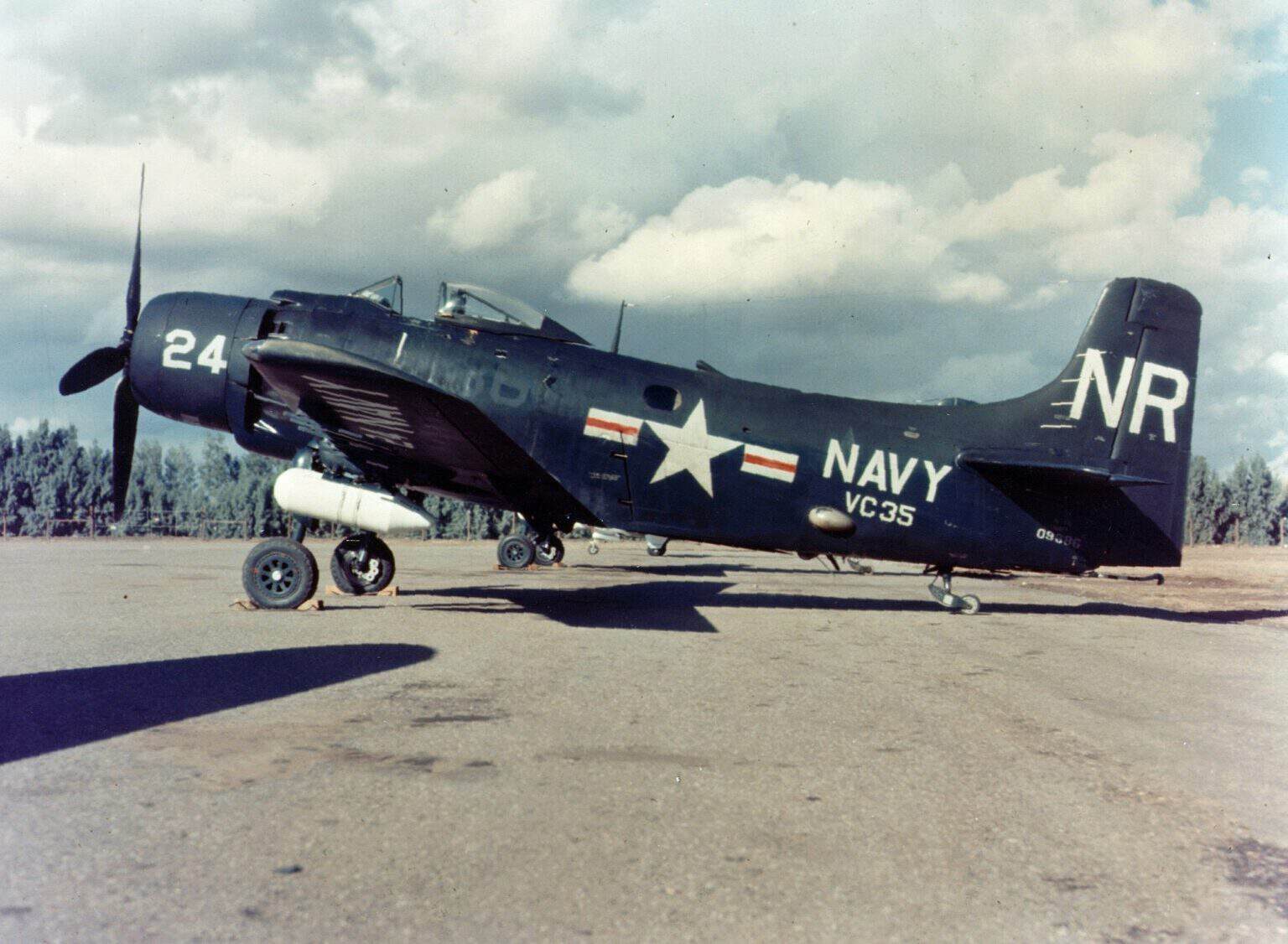
Eastwood was drafted into the Army in March 1951 and posted to Fort Ord, California. On September 30, 1951, returning from a weekend in Seattle, he caught a ride from Naval Air Station Seattle at Sand Point in the radar operator’s compartment of a Douglas AD-1Q Skyraider, a single-engine Navy attack aircraft, Bureau Number 09283.
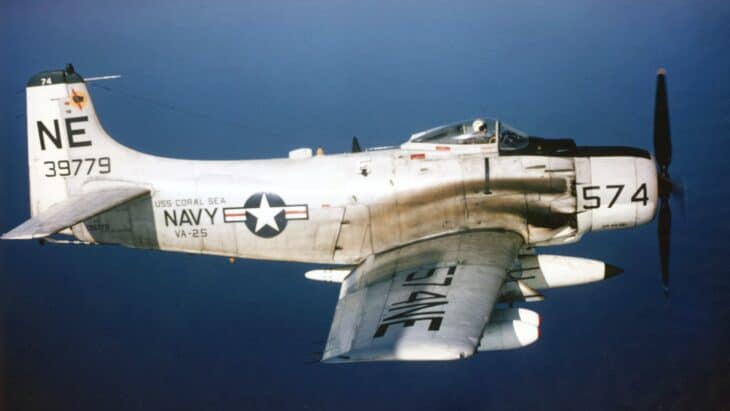

According to the account in his biographies, which cite the Navy’s accident report, the rear door would not stay shut and the oxygen, navigation and intercom systems failed. The aircraft ran out of fuel and the pilot, Lt. Francis C. Anderson, ditched it in the Pacific off the Point Reyes Peninsula.
Both men got out and reached shore separately. Accounts of the swim range from one to three miles. Eastwood walked toward a light that turned out to be a radio receiving station, and was later taken to the Coast Guard lifeboat station at Point Reyes, where he found Anderson.
Two details the lists get wrong come from this one night. He was in the Army, not the Navy, and he was a passenger, not a pilot. Decades later he directed Sully (2016), the film about US Airways Flight 1549, the airliner that ditched in the Hudson River in 2009.
Owns a jet versus flies one
Eastwood is the rare case where the celebrity-pilot claim holds up. Many names on those lists own aircraft and are flown by professionals. He holds a real certificate, earned in a category many fixed-wing pilots never try.
A private certificate lets him carry friends and family, and fly himself to a film location, but not carry passengers or cargo for hire. Under 14 CFR 61.113, that kind of flying needs a commercial certificate, and his record shows none.
The honest version is narrower than the lists. He is a private helicopter pilot with no airplane rating, and on the public record his last medical lapsed more than 13 years ago.
FAQ
Sources and references used for research and fact-checking.
- Federal Aviation Administration, Airmen Inquiry, record for Clinton Eastwood (private pilot, Rotorcraft-Helicopter; third-class medical July 2011)
- Federal Aviation Administration, Releasable Airmen Database and Releasable Aircraft Database, November 2026
- eCFR, 14 CFR 61.19, Duration of pilot and instructor certificates
- eCFR, 14 CFR 61.23, Medical certificates: Requirement and duration
- eCFR, 14 CFR 61.113, Private pilot privileges and limitations: Pilot in command
- Wikipedia, Early life and work of Clint Eastwood
- Wikipedia, Clint Eastwood
- Fox News, Celebrity pilots flying the friendly skies
- Carmel Magazine, Unstoppable Eastwood
Get the Newsletter
The latest aviation news and stories sent to your inbox.
About the Author

Tim is the owner and lead editor of AeroCorner since 2019, overseeing aviation content covering aircraft, airlines, airports, and the broader aviation industry. Through years of researching, writing, editing, and publishing aviation-focused content, he has developed extensive practical knowledge of commercial aviation and air travel. Based in Asia and a frequent traveler himself, Tim also brings firsthand passenger experience to AeroCorner’s coverage. Outside of publishing, he has also explored aviation firsthand through hands-on flight training in New Zealand.