

Table of Contents
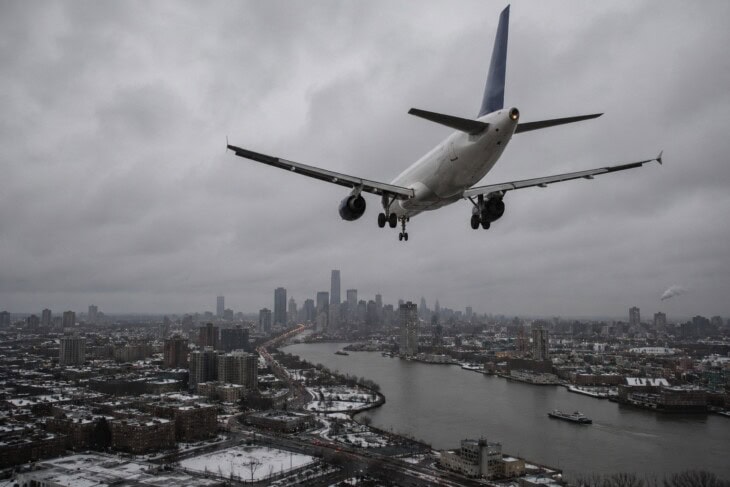
US Airways Flight 1549 departed LaGuardia Airport’s Runway 04 at 15:24:54 local time on January 15, 2009, bound for Charlotte Douglas with 150 passengers and 5 crew members on board. At 15:27:11, approximately 2.5 minutes into the climb and at an altitude of about 2,818 feet over Queens, New York, the aircraft entered a flock of Canada geese. The birds were ingested into both engines simultaneously. Both engines lost nearly all thrust. Captain Chesley Sullenberger had 208 seconds.
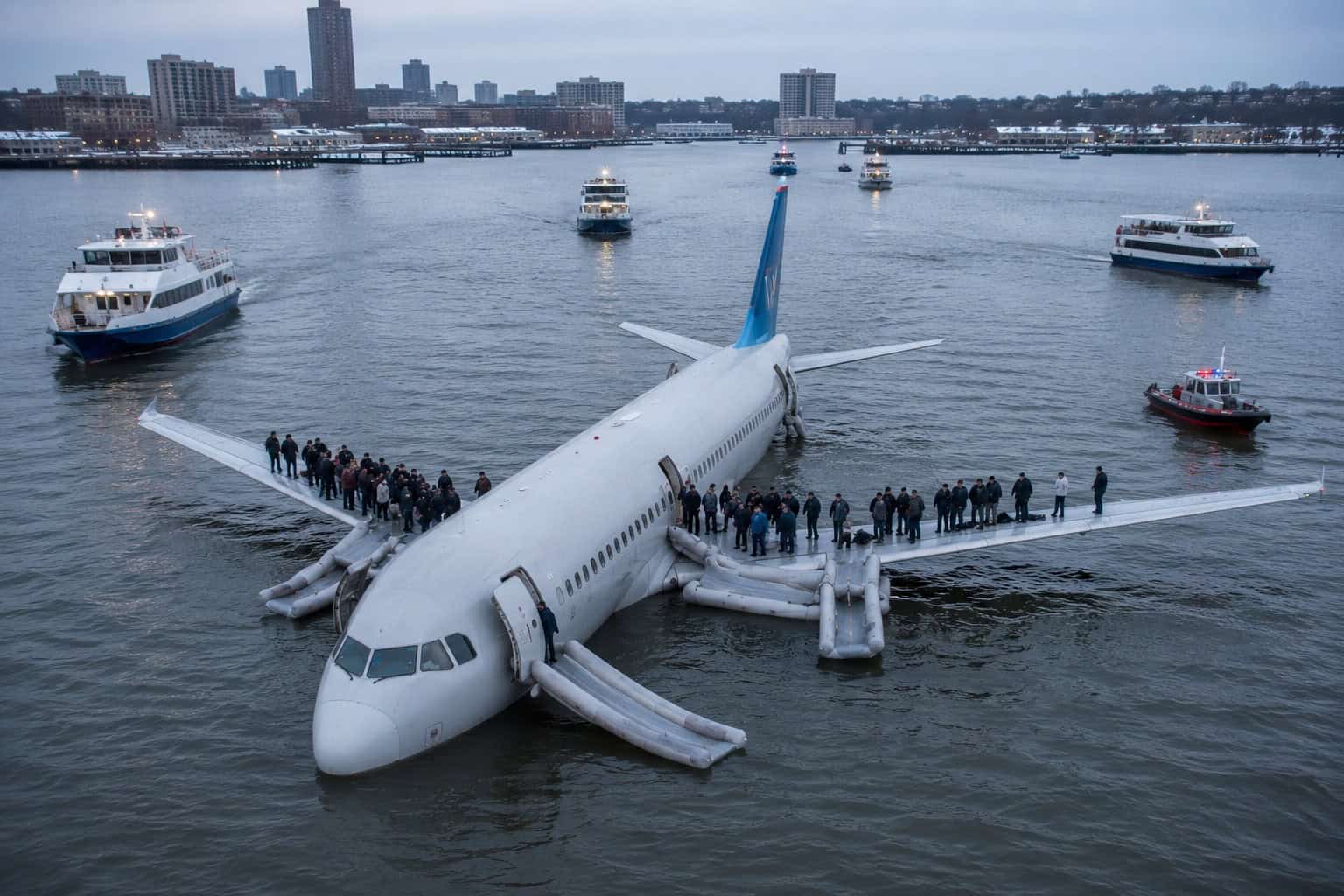
In those 208 seconds, Sullenberger evaluated three options: return to LaGuardia, divert to Teterboro Airport in New Jersey, or ditch in the Hudson River. He determined the first two were not achievable with the altitude and distance he had. The aircraft touched down on the Hudson at 15:30:43, wings level and at approximately 130 knots. The fuselage held together. All 155 people on board survived. Commercial ferry boats operating nearby reached the aircraft within minutes and began pulling passengers from the wings and slides before the aircraft had fully stopped moving.
The outcome was called a miracle. Sullenberger has consistently declined that framing. The National Transportation Safety Board, after a 15-month investigation, called it something more specific: a result of professional preparation, correct decision-making, and favorable circumstances, followed by a documented set of gaps in aviation safety that the accident had revealed. This series covers events that changed aviation. Flight 1549 belongs on the list not despite the fact that everyone survived, but because everyone survived and the investigation could therefore run to completion, and find what needed to change.
What the NTSB found about the bird strike, the decision, and the gaps it revealed
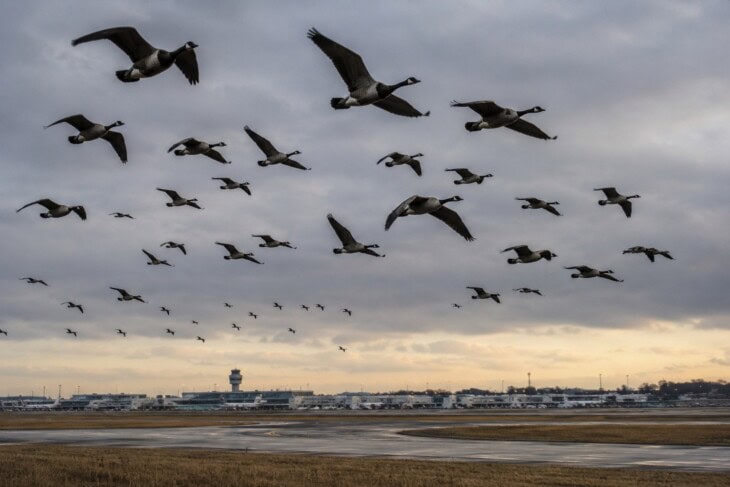
The Canada geese that brought down both of Flight 1549’s CFM56-5B engines weighed an estimated 3.2 to 8 kilograms each. At the time of the accident, the CFM56-5B was certified to ingest a single bird weighing up to 1.81 kilograms into the critical area of one engine. The geese that entered both engines on January 15, 2009, exceeded the certification standard by a substantial margin, in both size and number. The engines did not disintegrate: they absorbed the impact and lost thrust rather than failing catastrophically. But the standard against which they had been tested did not reflect the actual wildlife risk present on departure from LaGuardia, where the airspace over the Hudson and its surrounding rivers sits within Canada goose migration corridors year-round.
The investigation also examined Sullenberger’s decision to ditch rather than attempt a runway landing. When simulator pilots were given the same scenario with advance knowledge and preparation time, some successfully returned to LaGuardia. When given the scenario with no forewarning and only the time window that Sullenberger had in the actual aircraft, none succeeded. The NTSB concluded that Sullenberger’s decision to ditch was the correct one given the information and altitude available to him in real time, while also noting that the margin between “barely possible” and “not achievable” was narrower than the popular narrative had suggested. His 208-second decision process was later modeled extensively in training research as a case study in time-compressed decision-making under complete system failure.
The NTSB investigation examined the wildlife management program at LaGuardia in detail and found that while it was compliant with FAA requirements at the time, the program was reactive in its structure: airports were required to respond to wildlife incidents after they occurred rather than systematically assess and manage the risk of large birds in their flight paths. Canada geese had been documented in the vicinity of LaGuardia previously, including at altitudes above the airport perimeter where most management activities were concentrated. The flock that struck N106US was at approximately 2,818 feet, traveling southbound on a migratory path that crossed the departure corridor. No management program then in place was designed to address that scenario.
208 seconds: what the cockpit voice recorder captured
At 15:27:32, 21 seconds after the bird strike, Sullenberger transmitted to LaGuardia approach control: “Hit birds. We’ve lost thrust in both engines. We’re turning back toward LaGuardia.” When the controller asked which runway he wanted, Sullenberger was already calculating that LaGuardia was not reachable. The controller then offered Teterboro Airport in New Jersey. Sullenberger’s response: “We can’t do it.” Then: “We’re gonna be in the Hudson.” The controller replied: “I’m sorry, say again?” There was no further response from the flight deck. Sullenberger was flying the aircraft. The NTSB found that this exchange, and the decision it recorded, was consistent with the correct management of a dual-engine failure at low altitude given the time and altitude available.
The wildlife management and engine certification rules that followed Flight 1549
The NTSB issued 34 safety recommendations from the Flight 1549 investigation, directed to the FAA, the aircraft manufacturer, and the aviation industry. Several addressed the wildlife management framework for certificated airports. The FAA strengthened its requirements for wildlife hazard management plans at airports certificated under 14 CFR Part 139, the regulation that governs commercial service airports. Airports are now required to conduct more comprehensive wildlife hazard assessments that address the specific species, habitats, and risk factors present at their location, including migratory bird corridors and the altitude ranges where hazards can occur. The USDA’s Wildlife Services expanded its partnership with the FAA to train additional airport personnel in wildlife management and conduct assessments at a larger number of facilities. These changes moved the regulatory approach from reactive to more systematically proactive, though aviation safety experts have continued to note that managing large migratory bird populations around airports is an ongoing challenge rather than a solvable problem.
The gap in engine bird ingestion certification standards proved slower to close. The FAA initiated rulemaking on large-bird ingestion requirements following the NTSB’s recommendations in 2009. The technical work required to establish new standards involved extensive testing data, coordination with engine manufacturers, and evaluation of which engine sizes should face which test requirements. A final rule establishing updated large-bird ingestion certification standards for turbofan engines was published approximately 14 years after the accident, requiring manufacturers of larger engines to demonstrate the ability to withstand ingestion of birds heavier than those required by the previous standard. This delay is worth noting directly: the certification gap the geese exposed in January 2009 was documented, recommended for closure, and took a decade and a half to become a binding regulatory requirement. The rulemaking system worked as it is designed to work, but it worked slowly.
The NTSB recommended that all Part 121 operators develop aircraft-specific ditching procedures and incorporate them into recurrent training. Before the accident, simulator training for water landings was not consistently required for operators whose routes were predominantly overland. The procedures existed in aircraft flight manuals, but the practical training to execute them under pressure was uneven. The FAA required Part 121 operators to expand their simulator training programs to include dual engine failure at low altitude, a scenario that had been consistently addressed in training only for single-engine failures at altitude. The dual-engine failure at low altitude shortly after takeoff, the most demanding version of the scenario, became a standard training item. The fact that Sullenberger had dual-engine failure procedures clearly in mind within seconds of the bird strike was a function of prior training; the investigation found that the same clarity could not be assumed across all operators.
The NTSB’s investigation also highlighted Sullenberger’s own account of his preparation: his glider ratings, his career-long study of accident reports, his work as an airline safety representative. He has described the ditching not as instinct but as the application of accumulated knowledge, compressed into 208 seconds. This framing, and the NTSB’s endorsement of it, informed FAA and ICAO guidance on pilot professionalism and safety culture. The concept that professional preparation, not just simulator currency, is a meaningful safety factor found its way into both domestic and international guidance documents on what Part 121 professionalism means. It is not a regulatory change in the conventional sense, but it shaped how the industry talks about what pilots are for.
What changed because of Flight 1549
Wildlife hazard management: FAA strengthened Part 139 requirements for certificated airports, mandating more comprehensive wildlife hazard assessments and management plans addressing species, habitats, and altitude risks specific to each location. Engine bird ingestion certification: FAA rulemaking, initiated in 2009 following NTSB recommendations, produced updated large-bird ingestion standards for larger turbofan engines, with the binding rule finalized approximately 14 years after the accident. Part 121 training: FAA required expansion of simulator training to include dual engine failure at low altitude and aircraft-specific ditching procedures, scenarios that had been inconsistently covered in recurrent training programs before the accident. Wildlife strike reporting requirements were strengthened to improve the data foundation for both management and rulemaking.
What Flight 1549 changed most durably may be less about specific regulations than about what aviation now uses it for. The 208-second decision sequence is taught in crew resource management programs worldwide as a model of time-compressed task prioritization: fly the aircraft first, evaluate options second, communicate third. The ditching itself, and the rapid rescue that followed, became a model for airport emergency planning, demonstrating both what works when everything functions correctly and what gaps remain when it does not. The investigation produced 34 recommendations not because the outcome was a disaster, but because the NTSB had the chance to examine a complete event from beginning to end and document every element of it. Most accident investigations work from wreckage. This one had survivors who could say exactly what they experienced.
The Flights That Changed Aviation series covers accidents that produced specific, traceable changes to how aviation operates. Flight 1549 belongs here because the investigation found real things that needed fixing, even in an event where no one died. The contrast with United Airlines Flight 232 is instructive: both are cases of improvised airmanship under total system failure, both are now taught as examples of crew resource management working as intended, and both produced lasting regulatory changes. For the ongoing challenge of managing wildlife at airports and the pace at which certification standards are written and updated, Aloha Airlines 243 tells a comparable story about a known problem that takes a dramatic event to force to a resolution.
FAQ
Sources and references used for research and fact-checking.
- Aircraft Accident Report: Loss of Thrust in Both Engines After Encountering a Flock of Birds — US Airways Flight 1549 (NTSB/AAR-10/03) - National Transportation Safety Board
- FAA updates turbofan bird-strike rules, 14 years after US Airways Flight 1549 - FlightGlobal
- US Airways Flight 1549 Accident Report Recommendations - Federal Aviation Administration
- NTSB Aircraft Accident Report AAR-10/03: A320 Ditching on Hudson River after Bird Strike - SKYbrary
- Aerospace Industries Association Bird Ingestion Working Group Report - Federal Aviation Administration
- Wildlife-Strikes-to-Civil-Aircraft-in-the-United-States 1990-2020 - Federal Aviation Administration / NBAA
Get the Newsletter
The latest aviation news and stories sent to your inbox.
About the Author

Tim is the owner and lead editor of AeroCorner since 2019, overseeing aviation content covering aircraft, airlines, airports, and the broader aviation industry. Through years of researching, writing, editing, and publishing aviation-focused content, he has developed extensive practical knowledge of commercial aviation and air travel. Based in Asia and a frequent traveler himself, Tim also brings firsthand passenger experience to AeroCorner’s coverage. Outside of publishing, he has also explored aviation firsthand through hands-on flight training in New Zealand.