

Table of Contents
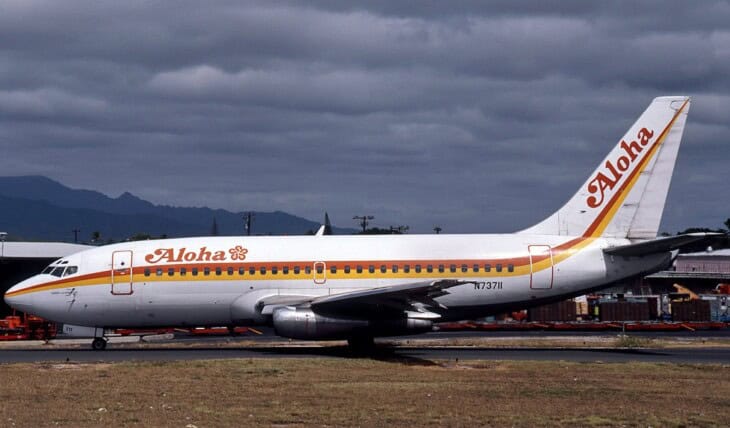
On the morning of April 28, 1988, Aloha Airlines Flight 243 departed Hilo Airport on the eastern tip of Hawaii for a routine interisland hop to Honolulu. The flight was expected to take about 35 minutes. The aircraft was a Boeing 737-200 that had been in service for 19 years, registration N73711, and had flown this route and others like it hundreds of times. Hawaii’s short interisland routes are hard on aircraft: multiple hops per day, each one pressurising and depressurising the fuselage, stressing the structure in ways a long-haul jet never experiences. By that April morning, N73711 had accumulated approximately 89,680 pressurisation cycles — nearly twice what a comparable mainland aircraft of the same age would have seen.
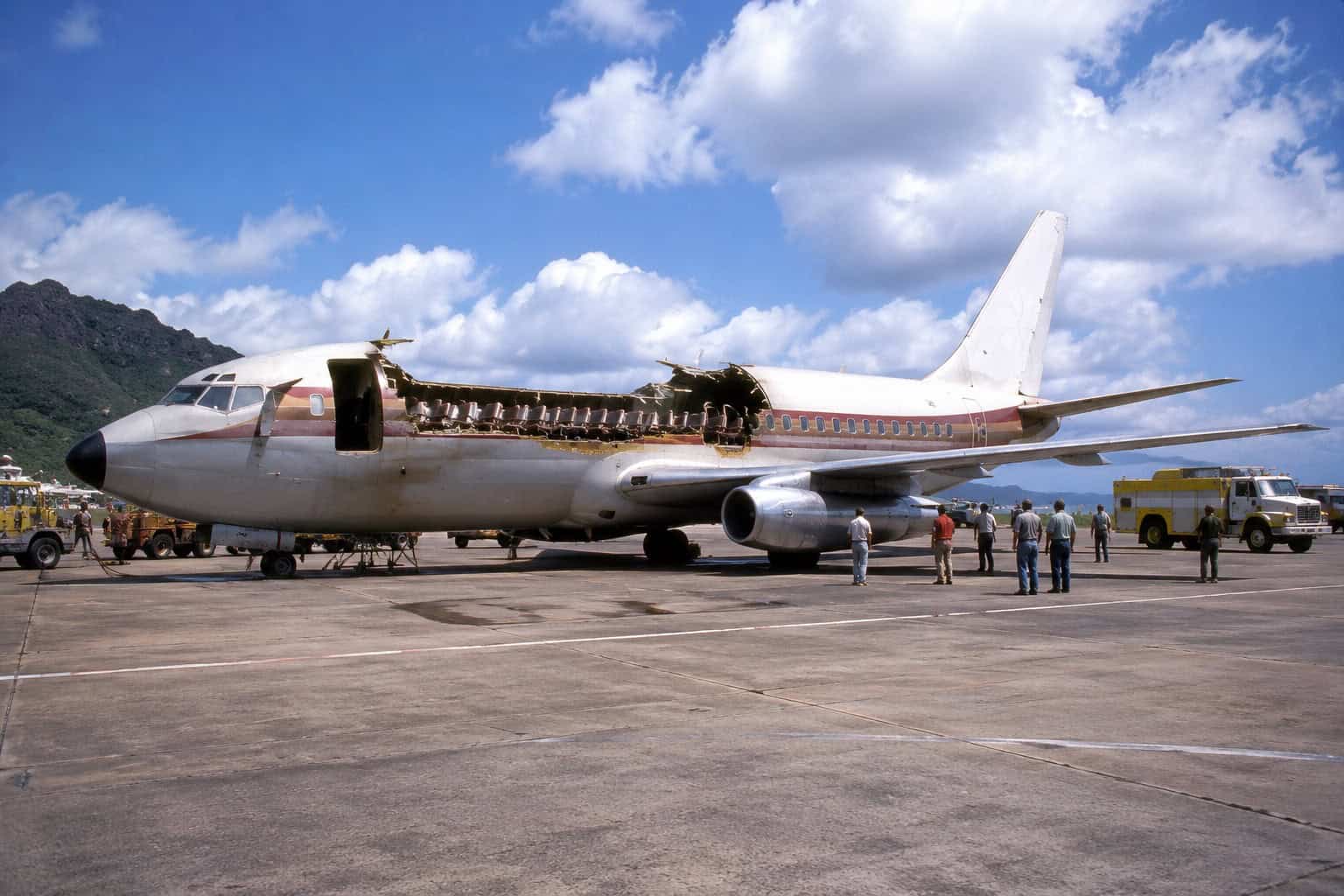
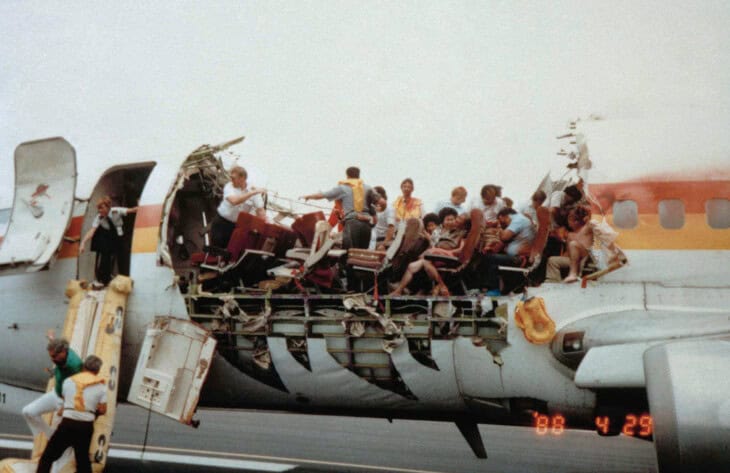
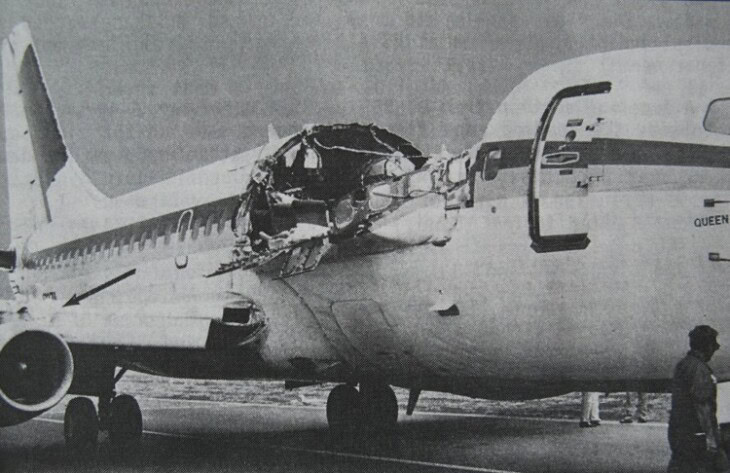
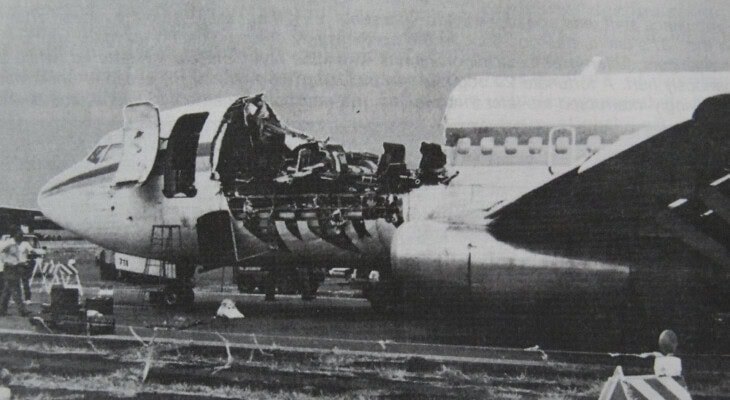
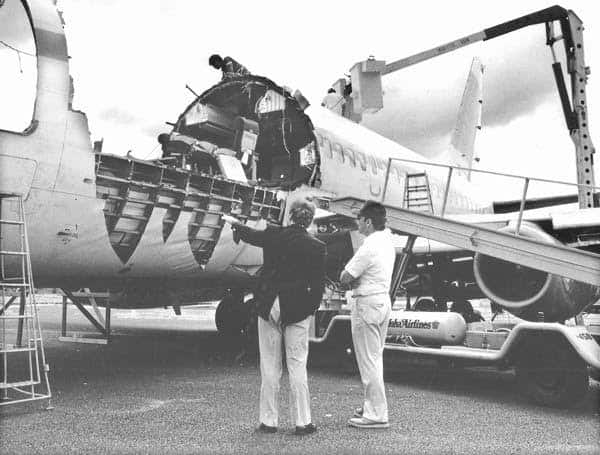
Twenty-three minutes after departure, at 24,000 feet over the ocean, the crew heard a loud crack. Captain Robert Schornstheimer and First Officer Madeline Tompkins felt the aircraft shudder. What they did not yet know was that an 18-foot section of the upper fuselage, the entire roof of the forward cabin, had torn away from the aircraft and been carried off into the sky. The cabin was open to the air. Passengers were held in their seats only by their seatbelts. Senior flight attendant C.B. Lansing, who had been working the forward aisle, was swept out of the aircraft. She was never found. Sixty-five people were injured, eight of them seriously. The other two flight attendants, despite being injured, continued to move through the aircraft and assist passengers.
Schornstheimer and Tompkins could not communicate verbally over the noise of the open fuselage. They flew by gesture and procedure, diverting to Kahului Airport on Maui. They had no way to know the structural condition of the rest of the aircraft or whether it would hold together on approach. It did. Flight 243 landed at Kahului at 13:58 local time. It remains one of the most astonishing survivals in commercial aviation history, and one of the most consequential accidents. The questions it forced the industry to confront changed the rules for every ageing commercial aircraft in the world.
What the investigation found
The National Transportation Safety Board investigated Flight 243 in what became one of the most technically significant accident investigations in the board’s history. The NTSB’s probable cause, published in AAR-89/03, identified “the failure of the Aloha Airlines maintenance program to detect the presence of significant disbonding and fatigue damage which ultimately led to failure of the lap joint at S-10L and the separation of the fuselage upper lobe.” But the underlying finding was more unsettling than a single maintenance oversight. The investigation introduced the industry to a failure mode it had not adequately considered: widespread fatigue damage.
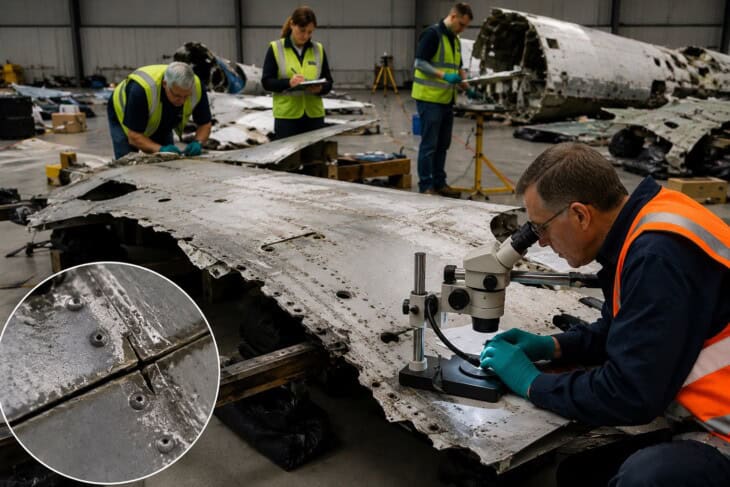
A traditional fatigue crack in an aircraft structure originates at a single point, a scratch or a fastener hole under stress, and grows outward. Engineers design inspection programmes around this model: find the crack early enough, and you can repair it before it becomes critical. The 737-200’s fuselage lap joints, however, had developed something different. Fatigue cracks had initiated simultaneously at dozens of fastener holes across the joint, growing independently and eventually linking up into a continuous crack line large enough to cause catastrophic failure. No single crack had grown long enough to be detectable by the inspection methods in use. The sum of many small cracks had failed the structure, and existing inspection technology had no way to see it coming.
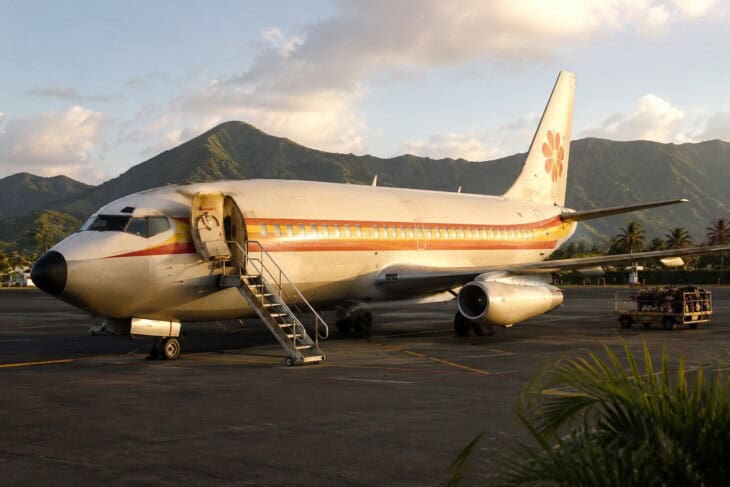
The lap joint design of the Boeing 737-200 was identified as a contributing factor. The original design used a “knife-edge” joint configuration that created a stress concentration at the skin edge, accelerating fatigue at that location. The adhesive bonding between the skin panels, which was meant to distribute load and slow crack propagation, had deteriorated significantly. Hawaii’s warm, humid environment had allowed moisture to penetrate between the bonded surfaces over years of service, breaking down the adhesive and leaving the joint depending almost entirely on its fasteners. The corrosion-driven disbonding and the fatigue cracking reinforced each other. By 1988, the structure was far more damaged than any inspection had suggested.
The fleet-wide finding
When NTSB investigators examined other Aloha Airlines 737-200 aircraft after the accident, they found similar lap joint cracking and disbonding in multiple airframes across the fleet. N73711 was not a unique case. The same failure mode, at different stages of progression, existed in other aircraft that had been inspected and cleared to fly. The accident had not revealed a single aircraft with a hidden problem. It had revealed a systemic inspection gap affecting a whole category of high-cycle aircraft.
The inspection methods available in 1988 were designed around the single-crack model. Eddy current inspection could detect a crack once it had grown to a detectable length at a specific location. Visual inspection could find obvious damage. Neither method was suited to detecting the distributed, linked micro-cracking that characterises widespread fatigue damage. The aircraft had been inspected according to the programme Boeing and the FAA required. The programme simply did not cover the failure mode that killed it.
What changed
The regulatory response to Aloha 243 unfolded over more than two decades, producing some of the most significant structural airworthiness rules in commercial aviation history. The immediate response was a set of FAA Airworthiness Directives requiring enhanced inspection of Boeing 737-200 lap joints, specifically mandating eddy current inspection at locations and intervals not previously required.
But the NTSB’s broader safety recommendations pointed to something the industry had never formally confronted: that the existing certification framework assumed aircraft would be maintained safely for an indefinite period, with no defined end to what a given inspection programme could reliably guarantee. That assumption was wrong.
In 1991, Congress passed the Aging Aircraft Safety Act, directly mandating that the FAA establish regulations for the continued airworthiness of ageing transport aircraft. This was an unusual step: Congress rarely legislates specific safety rules, preferring to leave rulemaking to the FAA. That it did so here reflects how seriously the industry and the public had been shaken by the image of a 737 flying without its roof.
The FAA responded with the Aging Airplane Program, which required operators of older transport category aircraft to adopt Supplemental Structural Inspection Documents specifying enhanced inspection regimes beyond those required at original certification. The programme applied to aircraft that the existing system had quietly assumed were being maintained adequately. The accident revealed that assumption had never been tested against the failure modes of very high-cycle operation.
The most consequential long-term change came nearly two decades later, in 2010, when the FAA issued a final rule creating 14 CFR Part 26, which established specific requirements for addressing widespread fatigue damage in transport category aircraft. The centrepiece of Part 26 was the concept of a “limit of validity,” or LOV: a defined number of flight cycles or hours beyond which an aircraft’s structural inspection programme can no longer be assumed to reliably detect fatigue damage.
Once an aircraft reaches its LOV, the operator cannot continue to fly it on the existing programme without new engineering analysis demonstrating that the inspections remain valid for extended operation. For the first time, the regulations acknowledged that periodic inspection has an endpoint, that there is a threshold beyond which the inspection model breaks down. That concept, now embedded in the airworthiness framework for every transport category aircraft, came directly from Aloha 243.
The accident also prompted a fundamental reassessment of non-destructive testing methods for aircraft structure. Advanced inspection techniques, including high-frequency eddy current methods and thermographic imaging, were developed and validated specifically to address widespread fatigue damage in lap joints and other high-stress locations. These methods are now part of the inspection toolkit for high-cycle aircraft worldwide. The NTSB’s investigation effectively created a research agenda that the FAA, Boeing, and the aviation research community spent the following decade completing.
What changed because of Aloha Airlines 243
The Aging Aircraft Safety Act of 1991 mandated that the FAA create ageing aircraft regulations for the first time. The FAA Aging Airplane Program required enhanced structural inspections beyond original certification standards. 14 CFR Part 26 (2010) introduced the “limit of validity” concept: a defined endpoint beyond which a structural inspection programme cannot be assumed to remain valid without new engineering proof. FAA Airworthiness Directives mandated advanced non-destructive testing of 737-200 lap joints at locations not previously covered. Aviation authorities worldwide adopted similar ageing aircraft oversight frameworks, citing Aloha 243 as the initiating event.
The international impact was significant. ICAO and national aviation authorities in Europe, Australia, Canada, and elsewhere developed their own ageing aircraft oversight programmes in the years following Aloha 243, most of them citing the accident directly as the reason these programmes were necessary. The accident established a new principle in global aviation safety: that an aircraft type certified to airworthiness standards at one point in its life requires a separate and ongoing demonstration of continued structural integrity as it ages. That principle is now unremarkable. Before April 28, 1988, it was not enforced anywhere.
For passengers boarding a commercial aircraft today, the consequences of Aloha 243 are invisible and everywhere. Every Boeing 737 in service has a limit of validity in its maintenance programme. Every ageing widebody has been subjected to structural audits and enhanced inspection regimes that did not exist before 1988. The regulations that govern how airlines must monitor, inspect, and eventually retire their older aircraft were written, in large part, because a 737-200 flew over the Pacific with its roof open and somehow landed with most of its passengers alive.
The accident sits at the beginning of the Flights That Changed Aviation series not because it is the most dramatic on the list, but because its regulatory legacy is among the clearest. There is a specific law, a specific regulation part, and a specific concept in airworthiness law that would not exist without this flight. If you want to understand how the 737 MAX investigation later exposed gaps in aircraft certification oversight, it helps to start here, with an earlier generation of investigators discovering that the certification system had a blind spot it had never been forced to examine. The industry learned. The rules changed. That is the pattern this series traces.
FAQ
Sources and references used for research and fact-checking.
- Aircraft Accident Report: Aloha Airlines, Flight 243, Boeing 737-200, N73711 (AAR-89/03) - National Transportation Safety Board
- Aging Aircraft Safety Act of 1991 - United States Congress
- Aging Airplane Safety Rule (14 CFR Part 26) - Federal Aviation Administration / Federal Register
- Aloha Airlines Flight 243 - SKYbrary
- Widespread Fatigue Damage - SKYbrary
Get the Newsletter
The latest aviation news and stories sent to your inbox.
About the Author

Tim is the owner and lead editor of AeroCorner since 2019, overseeing aviation content covering aircraft, airlines, airports, and the broader aviation industry. Through years of researching, writing, editing, and publishing aviation-focused content, he has developed extensive practical knowledge of commercial aviation and air travel. Based in Asia and a frequent traveler himself, Tim also brings firsthand passenger experience to AeroCorner’s coverage. Outside of publishing, he has also explored aviation firsthand through hands-on flight training in New Zealand.