

Table of Contents
On the afternoon of July 31, 1964, a single-engine Beechcraft Debonair flown by country singer Jim Reeves went down in woods in Brentwood, Tennessee, south of Nashville’s airport. Reeves, 40, died with his pianist and road manager, Dean Manuel, 30.
The crash is usually told as a sudden storm that caught a singer flying his own plane. The record says otherwise. The airplane was registered to a Nashville Beechcraft dealer, and the cause it gives is a decision: “continued VFR flight into adverse weather conditions”, with rain as the factor.
This article is built from the Civil Aeronautics Board’s accident record, docket 2-0613, as the NTSB preserves it in its pre-1982 accident database, and from the FAA’s registration file for the airplane, N8972M. The record also codes the weather briefing Reeves received, and it codes the forecast as substantially correct.
January 17, 1964
A new Debonair. The FAA issues the registration for N8972M, a 1964 Beechcraft 35-B33, serial CD-724, to Southeastern Beechcraft Inc. of Nashville.
Late July 1964
Arkansas. Reeves and Manuel spend about a day near Jamestown, Arkansas, where Reeves is buying the old Manuel family place as a retreat.
July 31, afternoon
Departure. Reeves takes off from Batesville, Arkansas, for Nashville with Manuel as his only passenger. The record shows a telephone weather briefing and no flight plan.
4:52 p.m.
The accident. About two hours after takeoff, in rain near Nashville, the Debonair descends out of control into dense woods in Brentwood, more than 5 miles from the airport. Both men die.
August 2, 1964
Found. After a two-day search joined by Chet Atkins, Eddy Arnold, Stonewall Jackson and Ernest Tubb, the wreckage is located in the woods.
September 9, 1964
The registration ends. The FAA cancels N8972M’s registration.
What happened
By the summer of 1964, Reeves was one of country music’s biggest stars. He was also a pilot, and he often flew himself.
The trip to Arkansas was personal. According to the Encyclopedia of Arkansas, Reeves and Manuel spent about a day near Jamestown, where Reeves was closing a deal to buy the old Manuel family place on Jamestown Mountain as a retreat. The accident record classes the flight as business flying.
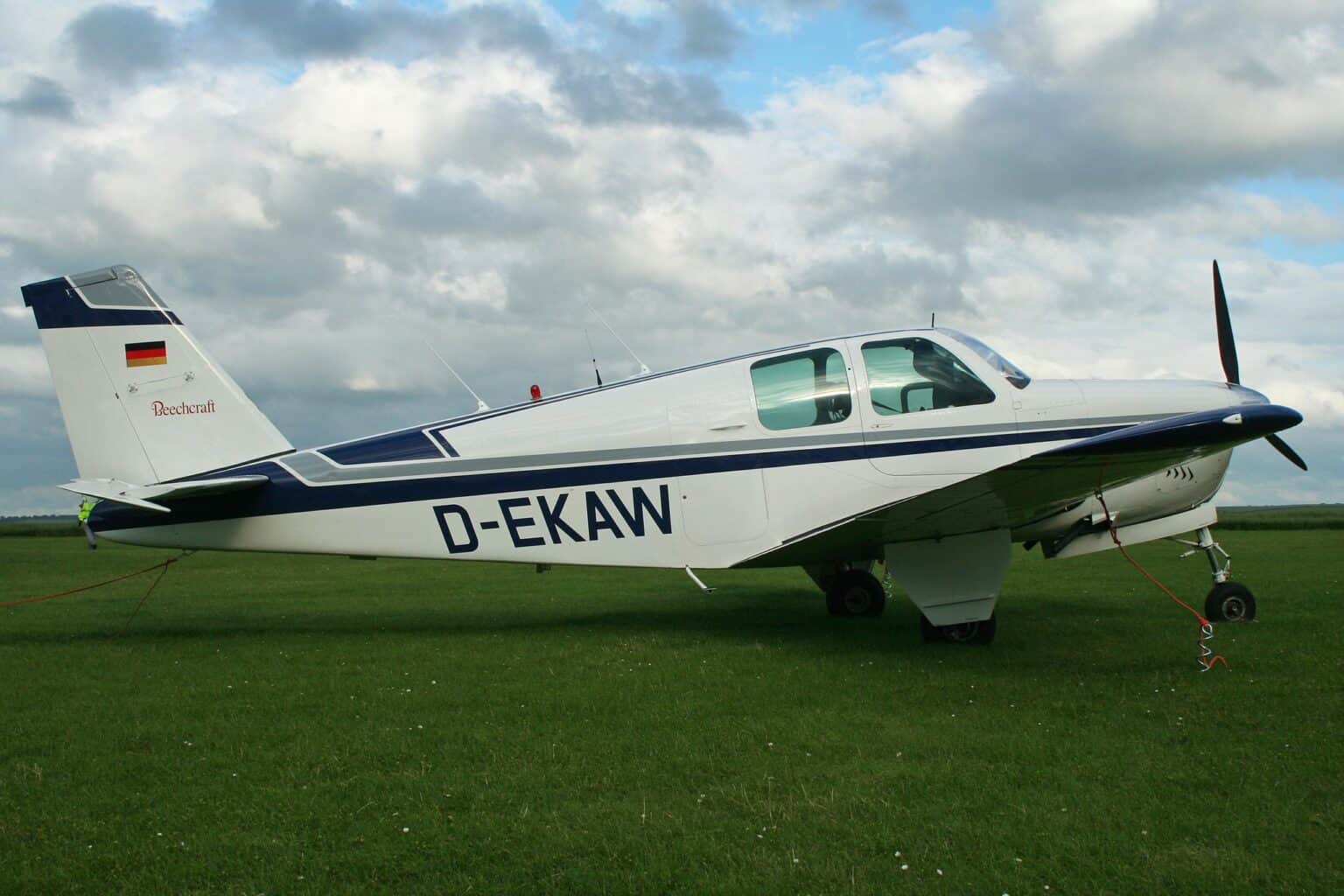
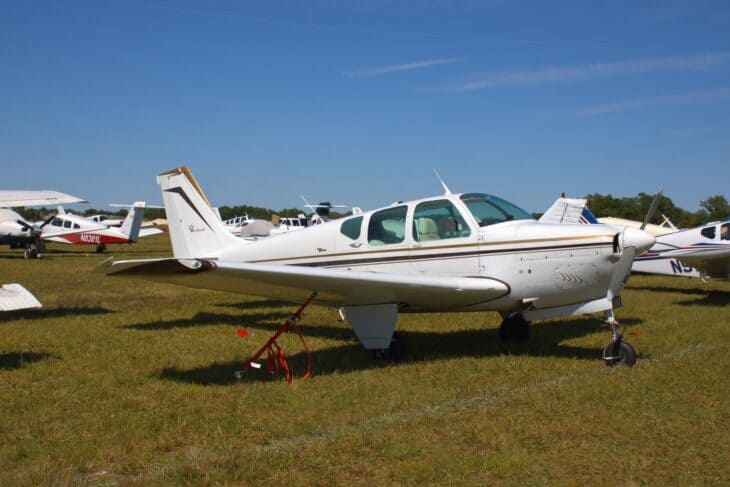
The airplane was a Beechcraft Model 35-B33 Debonair, the straight-tailed, lower-priced sibling of the V-tail Bonanza. The line continues today as the Beechcraft Bonanza G36. N8972M, serial CD-724, was built in 1964, so it was months old.

Manuel, born in Cleveland, Arkansas, in 1934, played piano in Reeves’s band, the Blue Boys, and was his unofficial road manager. He was the only passenger.
Reeves left Batesville for Nashville in the afternoon. He flew under visual flight rules with no flight plan filed, which was legal for a private flight. Near Nashville he met rain.
The record logs the accident at 4:52 p.m. and describes it as an in-flight uncontrolled descent into terrain dense with trees, at an elevation of 587 feet (179 m). The site was more than 5 miles from the airport.
The airplane was reported missing. Fellow stars, among them Chet Atkins, Eddy Arnold, Stonewall Jackson and Ernest Tubb, joined the search. The wreckage was found in the woods on August 2, two days later.
What the CAB found
In 1964 the Civil Aeronautics Board investigated civil aviation accidents. The NTSB took over that job in 1967 and absorbed the CAB’s files, which is why the Reeves record now sits in an NTSB database under a CAB docket number, 2-0613.
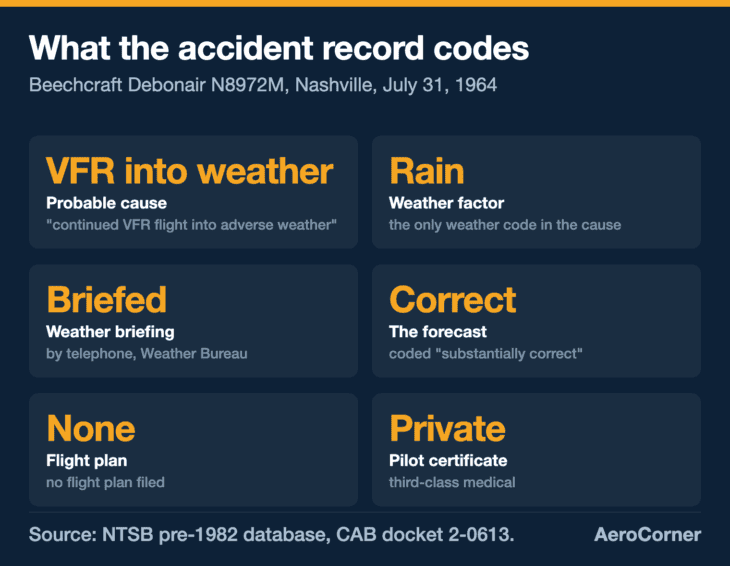
The probable cause is coded as 6404, which the database’s own code table spells out as “continued VFR flight into adverse weather conditions”. It assigns it to the pilot in command.
One factor follows it: weather, code 82B, “rain”. The code table has separate entries for thunderstorm activity, low ceiling and turbulence associated with thunderstorms. None of them appears in this cause sequence.
The same table has a separate code, 6403, for a pilot who “became lost/disoriented”. The CAB did not use it here. It coded the decision that comes before any disorientation, which is the choice to keep flying visually into weather.
The fields around the cause matter as much. The record codes a weather briefing by telephone from the Weather Bureau, today’s National Weather Service. It codes the forecast as substantially correct. It shows no flight plan.
It lists Reeves as a private pilot with a third-class medical. His ratings field is coded unknown. The record’s pilot-hours entry is ambiguous in the database’s 1964 format, so we have not printed a number from it.
A note on method. The database splits each accident across two tables, and in this stretch of the file the second table’s rows sit three or four records away from their partners. We used only the first table and the cause sequence, which agree with each other, and left the second table out.
What most accounts get wrong
Popular accounts say Reeves unexpectedly ran into a storm while flying his own plane, and many repeat spatial disorientation as if it were the official finding. The record is narrower. The FAA’s registration file lists N8972M under Southeastern Beechcraft Inc. of Nashville, not under Reeves, and the accident record classes the operator as a fixed-base operator. The investigation was the CAB’s, since the NTSB did not yet exist. Its coded cause is continued VFR flight into adverse weather, with rain as the factor and no thunderstorm code. Reeves had been briefed by the Weather Bureau, and the record codes the forecast as substantially correct. Disorientation is the likely mechanism, but it is not the coded finding.
Why a VFR pilot loses control in rain
Flying under visual flight rules means flying by looking outside. The horizon tells the pilot which way is up. Heavy rain and low cloud take that reference away, and what is left is the inner ear, which is easily fooled.
The FAA’s Civil Aerospace Medical Institute explains why in its spatial disorientation brochure. The semicircular canals sense a turn only while it starts. Hold a steady turn for about 20 seconds and the fluid inside catches up, so the pilot feels level while the airplane is still turning.
That sets up what the FAA calls the graveyard spiral. Leveling the wings now feels like a bank the other way, so the pilot rolls back into the original turn. The airplane loses height, and pulling back on the yoke only tightens the turn.
That is why the cause code turns on the word “continued”. A pilot flying visually who meets a shower still has choices while he can see: turn back, land short, or go around the rain. The finding is that the flight went on into conditions a visual flight cannot handle.
The brochure says 5 to 10% of all general aviation accidents can be attributed to spatial disorientation, and that 90% of those are fatal. Its advice to pilots qualified only for visual flight is blunt: do not attempt visual flight when there is a possibility of getting trapped in deteriorating weather.
How fast it happens had been measured a decade before the crash. In a 1954 University of Illinois study, 20 pilots with no instrument rating flew a Bonanza C35 into simulated instrument conditions. All of them lost control, after 20 to 480 seconds, with an average of 178.
Sixteen months earlier, the Patsy Cline plane crash had ended the same way, on the same kind of flight into Nashville. The CAB found that a non-instrument pilot attempted visual flight in adverse weather. In 1980, two posthumous Reeves and Cline duets became top-10 hits.
What changed
We could find no rule or recommendation that traces back to this crash. The finding named a pilot’s decision, not a defect in the airplane or the air traffic system, so there was nothing new for regulators to fix.
It kept happening to musicians who flew between dates in small aircraft. Cline died in 1963 and Reeves in 1964. Three years later, the Otis Redding plane crash put a Beech 18 into Lake Monona in fog and drizzle, and that file never found out why.
Training is what looks different now. Under 14 CFR 61.109, a private pilot applicant must log at least 3 hours of training in controlling an airplane solely by reference to instruments, including recovery from unusual attitudes. It is meant to get a pilot out of cloud, not to let him fly in it.
The registration has its own afterlife. The FAA cancelled N8972M on September 9, 1964, and has issued the number twice since. A registry search for N8972M today returns a 1981 MBB Bo 105 helicopter in Montana, not the Debonair.
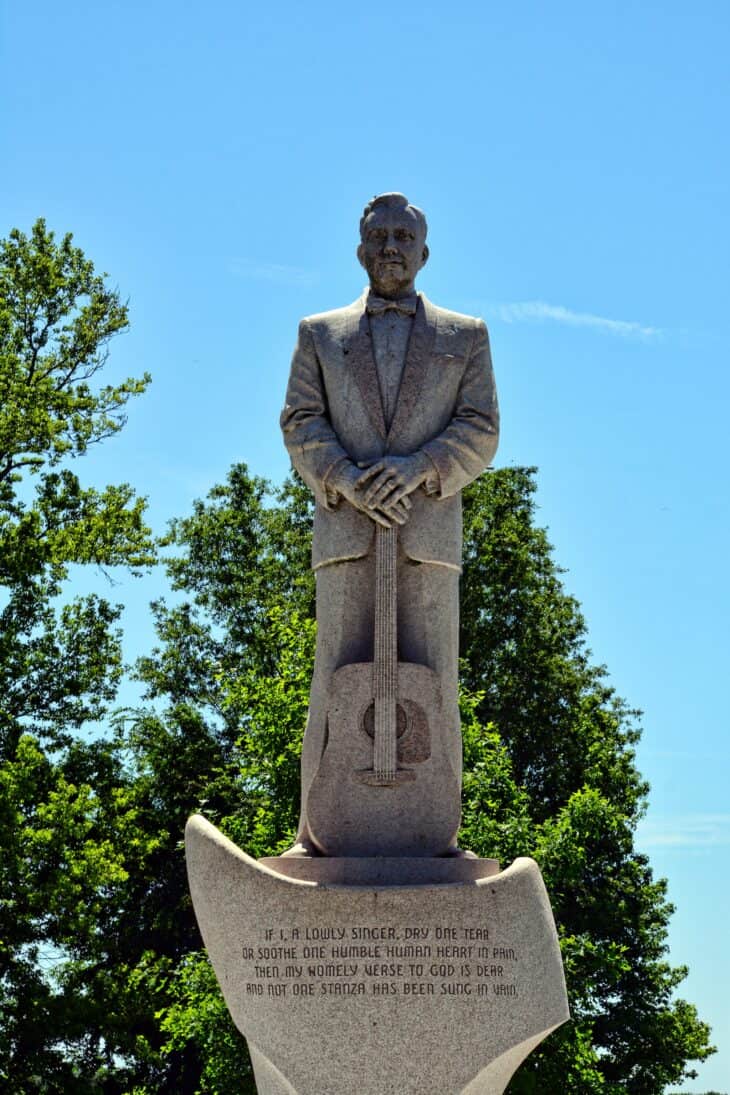
The music kept going. His records kept reaching the Billboard charts for two decades, and “Distant Drums” reached No. 1 on the UK Singles Chart in 1966. He is buried at the Jim Reeves Memorial near Carthage, Texas.

FAQ
Sources and references used for research and fact-checking.
- National Transportation Safety Board, NTSB pre-1982 aviation accident database (PRE1982.MDB), RecNum 871: CAB docket 2-0613, Beechcraft 35-B33 N8972M, Nashville, Tenn., July 31, 1964
- Federal Aviation Administration, Releasable Aircraft Database (deregistered and master files), N8972M
- FAA Civil Aerospace Medical Institute, Spatial Disorientation: Why You Shouldn't Fly By the Seat of Your Pants (AM-400-03/1)
- AOPA, The lost lessons of '178 seconds to live'
- Legal Information Institute, Cornell Law School, 14 CFR 61.109, Aeronautical experience
- CALS Encyclopedia of Arkansas, Dean Manuel (1934-1964)
- Wikipedia, Jim Reeves
- Wikipedia, Beechcraft Bonanza
- HistoryNet, Musicians Who Died in Plane Crashes
- American Songwriter, On This Day in 1964: The Tragic Plane Crash That Took Jim Reeves Too Soon
- PlaneCrashInfo, Jim Reeves crash, 1964
Get the Newsletter
The latest aviation news and stories sent to your inbox.
About the Author

Tim is the owner and lead editor of AeroCorner since 2019, overseeing aviation content covering aircraft, airlines, airports, and the broader aviation industry. Through years of researching, writing, editing, and publishing aviation-focused content, he has developed extensive practical knowledge of commercial aviation and air travel. Based in Asia and a frequent traveler himself, Tim also brings firsthand passenger experience to AeroCorner’s coverage. Outside of publishing, he has also explored aviation firsthand through hands-on flight training in New Zealand.