



Table of Contents
| Airbus A380-800 | Airbus A350-900 | |
|---|---|---|
| First flight | April 27, 2005 | June 14, 2013 |
| Entered service | October 2007, Singapore Airlines (first delivery October 15, 2007) | January 15, 2015, Qatar Airways |
| Decks | Two full-length passenger decks | One passenger deck |
| Typical three-class layout | 525 passengers | About 325 passengers |
| Production status | Ended; last delivery to Emirates on December 16, 2021 | Still in production |
| Built | 254, including 3 test aircraft | 743 A350s of all variants delivered by October 2026 |
| Best at | Moving huge crowds between congested hubs | Flying long routes without needing a full cabin |
Which variants this page compares
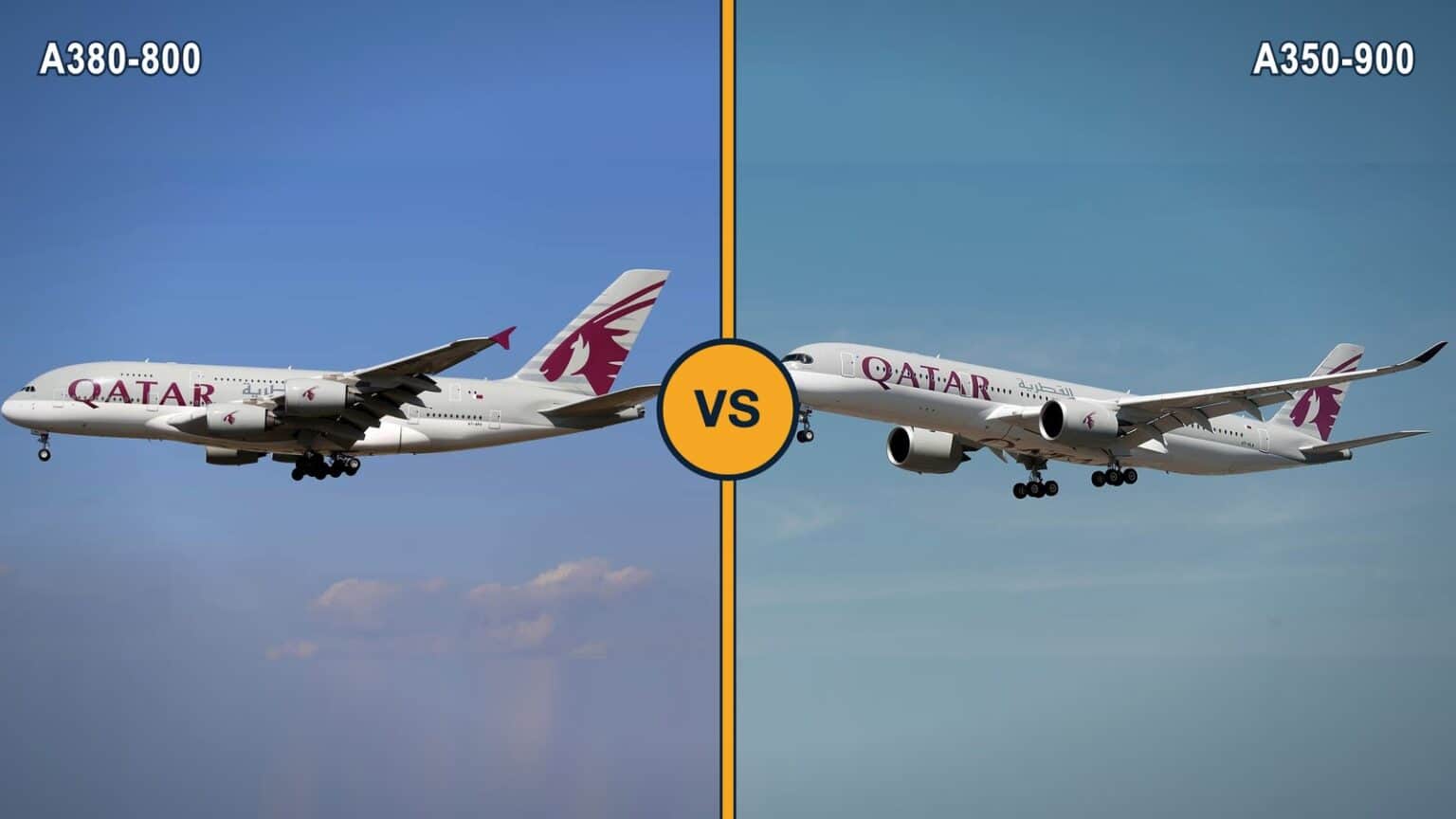
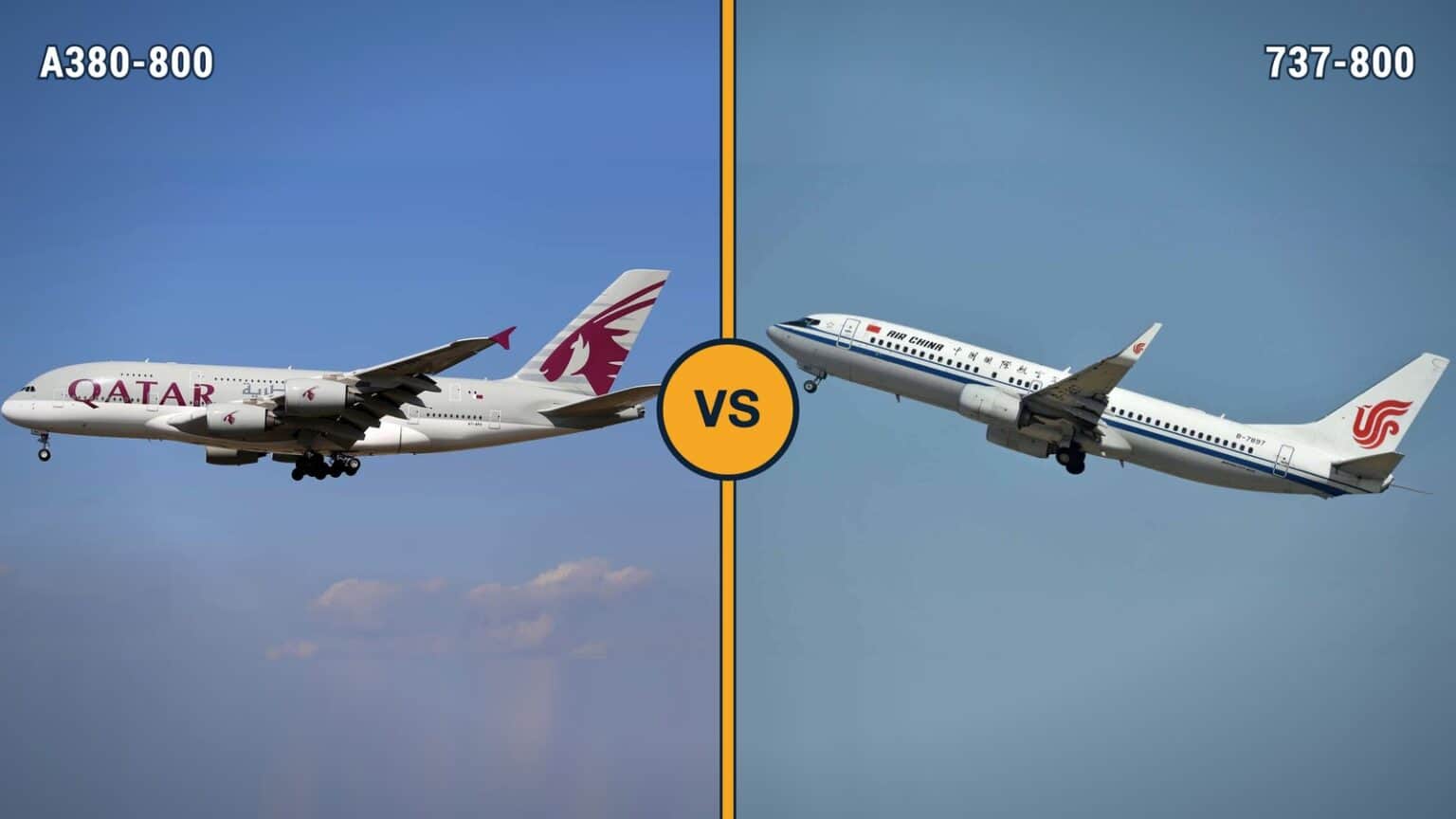
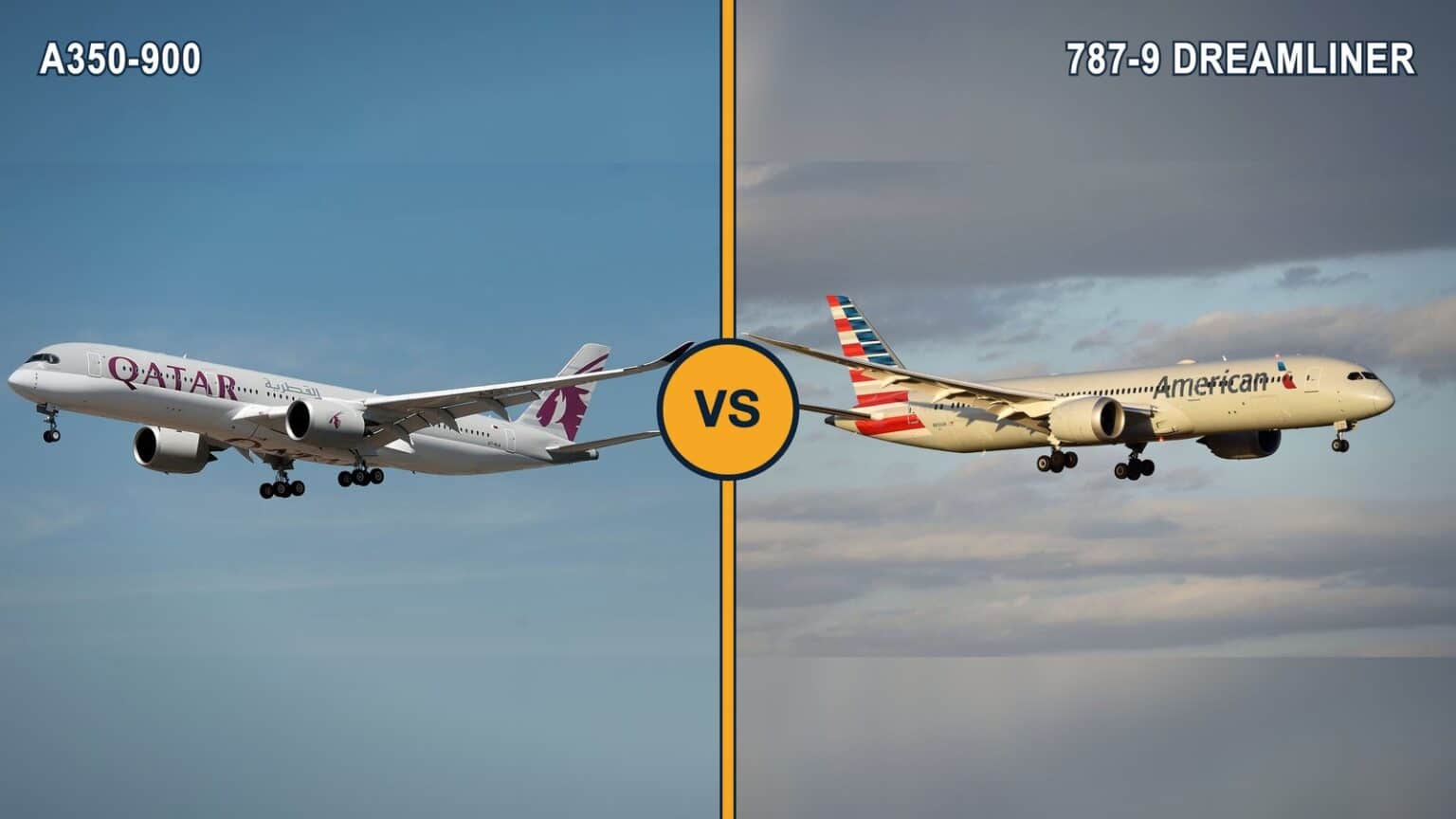
The panel above compares the A380-800, the only A380 version ever built, with the A350-900, the most common A350. Airbus also built a longer A350-1000, which seats more and first flew on November 24, 2016. Where the -1000 changes the answer, this page says so.
Size: the A380 is in a class of its own
The A380-800 is 238 ft 7 in (72.73 m) long, with a wingspan of 261 ft 8 in (79.75 m). The A350-900 is 219 ft 2 in (66.80 m) long, with a wingspan of 212 ft 5 in (64.75 m).
The A380 is the taller and wider aircraft too. Its tail stands 79 ft 0 in (24.09 m) high against 55 ft 11 in (17.05 m).
Weight is where the gap becomes dramatic. The A380’s maximum takeoff weight is 1,268,000 lb (575,000 kg), more than double the A350-900’s 624,000 lb (283,000 kg).
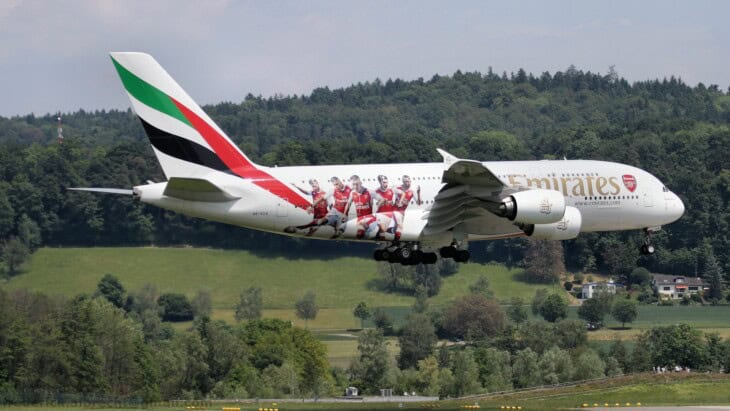
The fuselage tells the same story. The A380 is 23 ft 5 in (7.14 m) across, while the A350-900 is 19 ft 6 in (5.94 m). For how both rank among the biggest passenger jets, see our list of the largest commercial airplanes.
Range: the smaller jet flies farther
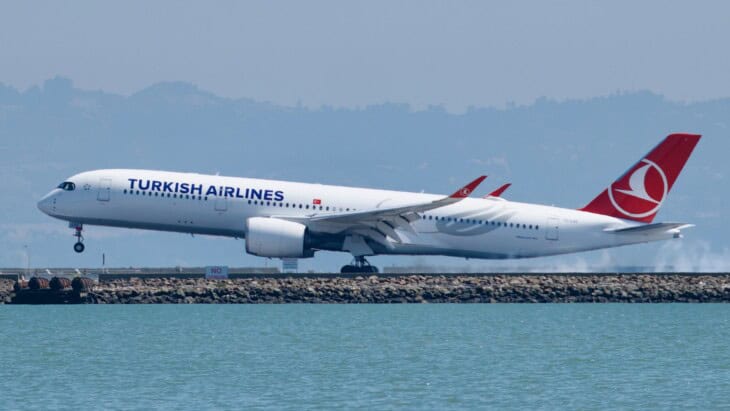
This is the surprise. The A350-900 has a listed range of 8,500 nautical miles (9,780 miles, 15,740 km). The A380-800 is listed at 8,000 nautical miles (9,210 miles, 14,820 km).
The A350 does it with half the engines. It carries 37,200 gal (140,800 L) of fuel, against 85,500 gal (323,500 L) for the A380.
Both cruise at the same listed speed of 562 mph (904 km/h), and both are listed with a 43,100 ft ceiling. Speed is not a reason to pick either one.
The A380 does keep one record that matters to airlines. Few other passenger jets can move so many people per takeoff slot, which is exactly why it suited the busiest hubs.
Engines and efficiency: four against two
The A380 has four engines, either Rolls-Royce Trent 900 or Engine Alliance GP7200, each rated at 76,752 lbf (341 kN). The A350-900 has two Rolls-Royce Trent XWB-84 engines at 84,200 lbf (375 kN) each.
Two engines burn less fuel than four, and the A350 is also lighter because much of its airframe is carbon-fibre composite. Wikipedia gives the whole-airframe figure as 53 percent composites.
That matters because an airline pays for fuel on every trip, not only when the cabin is full. A twin that fills 325 seats is far cheaper to run than a quad that needs 525.
Capacity and the passenger experience
The A380 can be certified for up to 853 passengers in a single-class layout. Airlines rarely do that, and the typical three-class layout is 525.
The A350-900 typically seats about 325 in three classes. The longer A350-1000 reaches roughly 350 to 410.
Passengers often single out the A380 for its two-deck cabin. Which is more comfortable depends mostly on your airline’s seat map, not the aircraft type.
The A350 has its own advantage. A 325-seat jet can fly routes the A380 could never fill.
Cabin and cargo: closer than you would think
Inside, the A380’s main cabin is 21 ft 7 in (6.58 m) wide and 9 ft 10 in (3.00 m) high. The A350-900’s cabin is 17 ft 9 in (5.40 m) wide and 7 ft 3 in (2.20 m) high.
Cabin length is nearly a tie. The A350-900 is listed at 167 ft 5 in (51.04 m), the A380 at 163 ft 9 in (49.90 m), because the A380’s extra capacity comes from a second deck, not a longer tube.
The cargo holds are almost the same size too. The A380 is listed at 6,187 ft³ (175.2 m³) of baggage volume, the A350-900 at 6,088 ft³ (172.4 m³). Per passenger, the A350 has far more room for bags.
So the real contest is not space per passenger on paper. It is how many passengers an airline can find for each trip.
Runways and airports
The A380 needs more runway. Its listed minimum takeoff distance is 9,850 ft (3,000 m), against 8,550 ft (2,600 m) for the A350-900.
Its size also limited where it could go. Airports had to rebuild gates and taxiways for a 261 ft 8 in (79.75 m) wingspan, which helps explain why airlines mostly flew it between a short list of big hubs.
Cost and economics
The A380’s list price is $445.6 million (2018). The A350-900’s is $317.4 million (2018).
List prices are rarely what airlines pay, but the gap shows the point. The A380 only made sense for airlines that could fill it every day on slot-constrained routes.
The myth about the A380
“The A380 failed because passengers didn’t like it” misses the point. Passengers generally liked it. Airlines stopped buying it because a four-engine jet with more than 500 seats was harder to fill and costlier to fly than a twin, and the A350 and Boeing’s 787 and 777 offered long range with less risk.
History: the giant that arrived too late
The A380 first flew on April 27, 2005. Singapore Airlines took the first delivery on October 15, 2007, and Emirates took the last one on December 16, 2021.
Airbus built 254 A380s, including three test aircraft. Production ended in 2021 after only a few big customers ordered it.

The A350-900 first flew on June 14, 2013. Qatar Airways, the launch customer, started service on January 15, 2015, from Doha to Frankfurt.
The A350-1000 followed, with a first flight on November 24, 2016, and entry into service with Qatar Airways on February 24, 2018. By October 2026 Airbus had delivered 743 A350s of all variants against 1,628 ordered.
Is the A380 still flying?
Yes. Wikipedia lists 10 operators with A380s in service as of April 2024, and 15 airlines have flown the type in total. Five of those have retired it.
Several airlines parked their A380s during the pandemic, and some never brought them back. For the airlines that did, see our guide to airlines still flying the A380.
How to tell them apart
The easiest clue is the cabin windows. The A380 has two full decks of windows, while the A350 has one.
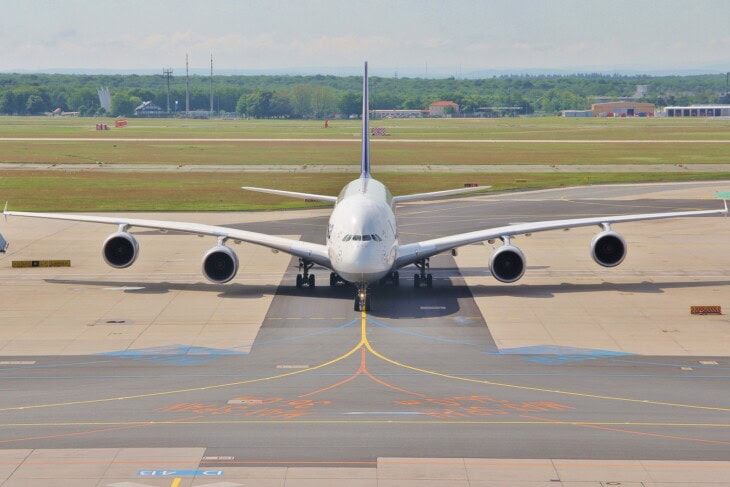
Count the engines next. Four means A380, two means A350. The wingtips differ too: the A350 has blended tips, while the A380 has wingtip fences.
Verdict
The A380 is the better choice for sheer capacity and the more memorable passenger experience. The A350-900 is the better choice for nearly everything else: range, fuel burn, price and flexibility.
Airlines voted with their orders. For another current twin that took over long routes, see how the A350 compares in our A350 vs 777 comparison.
FAQ
Sources and references used for research and fact-checking.
About the Author

Tim is the owner and lead editor of AeroCorner since 2019, overseeing aviation content covering aircraft, airlines, airports, and the broader aviation industry. Through years of researching, writing, editing, and publishing aviation-focused content, he has developed extensive practical knowledge of commercial aviation and air travel. Based in Asia and a frequent traveler himself, Tim also brings firsthand passenger experience to AeroCorner’s coverage. Outside of publishing, he has also explored aviation firsthand through hands-on flight training in New Zealand.