


Table of Contents
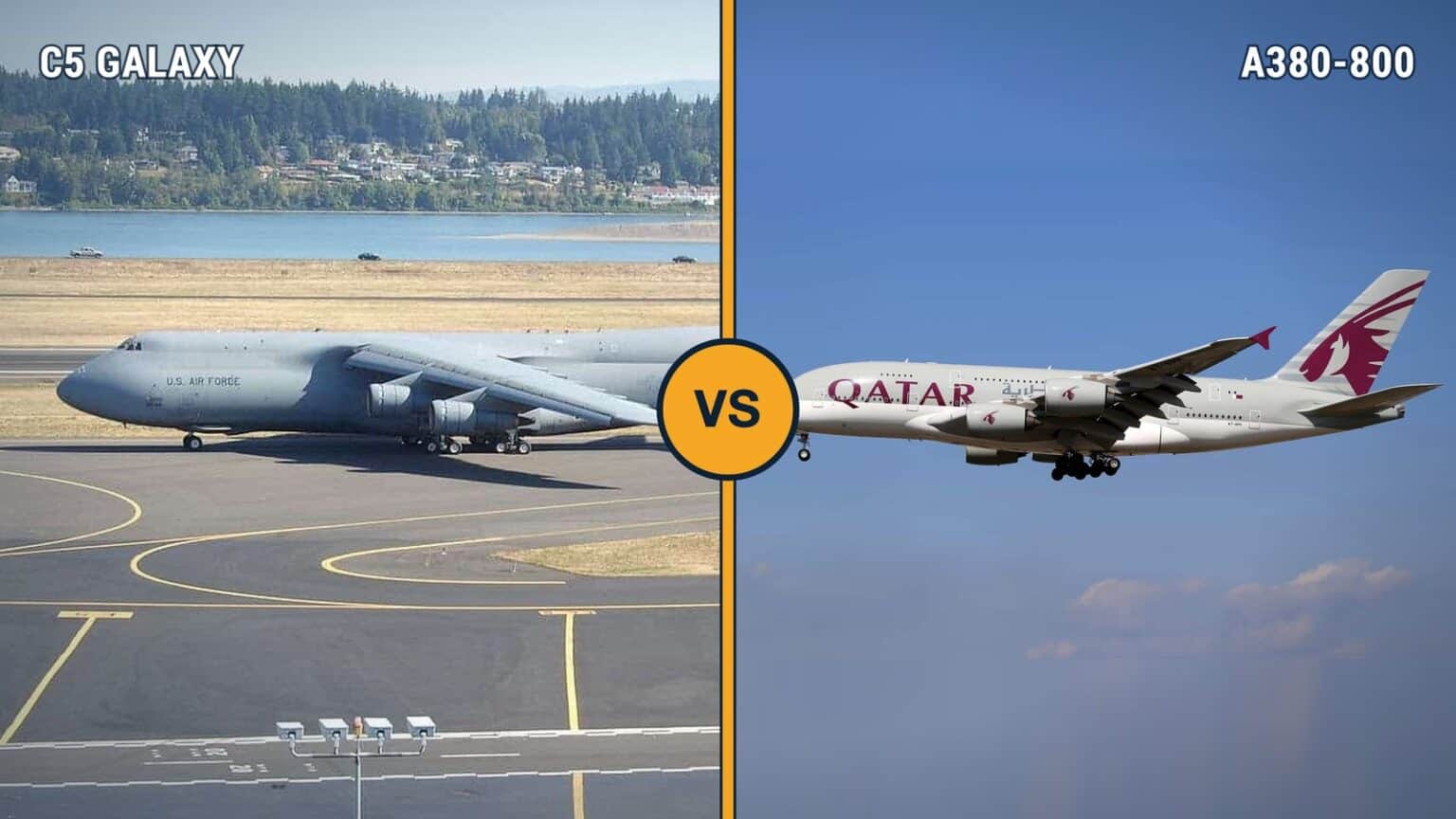
The C-5 Galaxy and the Airbus A380 are two of the largest aircraft ever to fly, and searches for one almost always end up comparing it to the other. They are close enough in size to be worth the argument, but they were built for opposite jobs.
The A380 is a commercial airliner that moves passengers between major hub airports. The C-5 is a military transport that moves tanks, helicopters and outsize equipment for the United States Air Force. Almost every difference between them follows from that.
Full dimensions, weights and engine data for both aircraft are in the database comparison at the top of this page. The table below covers what those numbers do not: role, cargo, basing and fleet status.
| Measure | C-5M Super Galaxy | Airbus A380-800 |
|---|---|---|
| Type | Military strategic airlifter | Commercial passenger airliner |
| Operator | US Air Force only | About 11 airlines worldwide |
| What it carries | Vehicles, helicopters, pallets, troops | Passengers and belly containers |
| Maximum cargo weight | 281,001 lb (127,460 kg) | About 180,000 lb structural, mostly people and bags |
| People carried | 73 on the upper deck | 525 typical, up to 853 |
| Loading | Nose and tail doors, drive-through, kneeling gear | Passenger doors and belly holds, no through-loading |
| Runways | Can use relatively short and semi-prepared strips | Long paved runways and A380-rated gates only |
| Number built | 131 (1968 to 1989) | 254 (2005 to 2021), 251 delivered to airlines |
| In service, 2026 | 52, all upgraded to C-5M | About 159, most with Emirates |
How we are comparing the C-5 and the A380
“Bigger” is the question people actually type, and it has more than one answer depending on the measure. This article separates four of them: overall size, how much weight the aircraft lifts, how far it flies, and where it can operate.
The A380 wins on overall size and on people moved. The C-5 wins on cargo weight and on the kind of runway it can use. Range depends entirely on the load.
Where an official figure exists we use it, from the US Air Force fact sheet for the C-5 Galaxy and from Airbus data for the A380-800. Fleet and status numbers move year to year, so they are anchored to 2026.
The short answer
The A380 is the bigger aircraft: a wider wingspan, a taller tail, roughly 50 percent more maximum weight and two full passenger decks. The C-5 Galaxy is the bigger freighter: a longer, unobstructed cargo hold that loads through the nose and the tail and lifts 281,001 pounds of vehicles and equipment. The A380 moves people, the C-5 moves an army.
Which is bigger, the C-5 Galaxy or the A380?
By most measures the A380 is bigger. Its wingspan is 261 feet 10 inches (79.75 m) against 222 feet 9 inches (67.89 m) for the C-5, so the Airbus is nearly 40 feet wider.
The A380 also stands 79 feet 1 inch (24.1 m) tall against 65 feet 1 inch (19.84 m) for the Galaxy, and its maximum takeoff weight is about 1.27 million pounds (575,000 kg) against 840,000 pounds (381,000 kg).
The C-5 wins one dimension: length. It is 247 feet 10 inches (75.3 m) long, about 9 feet longer than the A380 at 238 feet 7 inches (72.7 m).
Inside, the comparison flips depending on what you count. The A380 has more total enclosed volume because it is a double-decker, with a pressurized cabin running the full length of both floors.
The C-5 has the larger single usable hold: one clear box 143 feet 9 inches long, 19 feet wide and 13 feet 6 inches high, just over 31,000 cubic feet, with nothing in the way.
So the honest summary is that the A380 is the larger airframe and the C-5 is the larger cargo aircraft. Both sit near the top of any list of the largest cargo planes and the largest commercial airplanes, just in different columns.
Where the A380 wins
Passengers
This is not close. A typical three-class A380 seats about 525 passengers, and the certified maximum in an all-economy layout is 853. The C-5 has a rear upper-deck compartment with 73 seats, used mainly for the crew and support personnel who travel with a load.
The A380 is the only full-length double-deck airliner ever built, and moving very large numbers of people through a slot-constrained hub was the reason it exists.
Range
Carrying its normal load, the A380 flies about 8,500 nautical miles, enough for Dubai to Los Angeles or Sydney to Dallas nonstop. It cruises at Mach 0.85, roughly 560 mph (900 km/h).
The C-5M matches that only when it is nearly empty. With 120,000 pounds of cargo it flies about 4,800 nautical miles unrefueled, and with no cargo it reaches roughly 7,000 nautical miles.
Loaded to its full 281,001 pounds the Galaxy can fly 2,150 nautical miles, unload, and reposition 500 nautical miles further, all without tanking. Its cruise speed is 518 mph, close to Mach 0.77.
Efficiency per seat
On a full flight the A380 burns less fuel per passenger than almost any other aircraft its age. The C-5 has no equivalent figure because it is not measured that way: a military airlifter is judged on tons delivered and readiness, not cost per seat-mile.
For scale, a C-5M flying hour costs the US Department of Defense about $34,499 at 2025 reimbursable rates.
The C-5 can carry another aircraft
Two Galaxies were rebuilt as C-5C variants with widened aft doors and no troop compartment so they could haul Space Shuttle program cargo containers, and the C-5 routinely loads helicopters with their rotors still attached. The A380 has never carried anything larger than a belly container the size of a small shipping crate.
Where the C-5 Galaxy wins
Cargo weight and outsize loads
The C-5 carries a maximum of 281,001 pounds (127,460 kg), up to 36 standard 463L pallets, or loads such as two M1 Abrams main battle tanks in a single aircraft. It swallows mobile bridging, attack helicopters and vehicles too tall or too long for anything else in the US fleet.
The A380 has no comparable number. Its structural payload is on the order of 180,000 pounds, but in service that capacity carries passengers, baggage and about 25,000 pounds of containerized belly freight, not heavy machinery. There is no cargo door and no flat loading deck.
Loading
Both the nose and the tail of the C-5 open. The nose visor hinges up and out of the way, and full-width ramps at each end let ground crews drive vehicles in one door and out the other. The aircraft can also kneel on its landing gear until the cargo floor sits at truck-bed height.
The A380 is loaded like any airliner: passengers through jet bridges on two levels, cargo through belly hatches. It cannot be driven through, and it needs a gate specifically rated for its size and its two boarding levels.
Runways
The C-5 spreads 840,000 pounds across five sets of landing gear and 28 wheels, which lets it use relatively short runways and semi-prepared surfaces that would be closed to a large airliner. That flexibility is central to the airlift mission.
The A380 needs a long paved runway and an airport that has invested in wider taxiways, reinforced pavement and double-deck gates. Relatively few airports worldwide are equipped for it, which is one reason the fleet has shrunk.
Isn't the A380 a freighter too?
No. Airbus designed an A380F with a 330,000-pound payload, but FedEx and UPS cancelled their orders during the program’s delays and the freighter was never built. Every A380 ever delivered is a passenger aircraft, so any A380 cargo figure you see compared with the C-5 is a theoretical structural limit, not a load it has ever flown.
How to tell them apart
They are hard to confuse once you know where to look. The A380 is a low-wing airliner with a smooth double-deck fuselage, a row of windows on each level, and engines slung under the wing close to the body. Its paint is an airline livery.
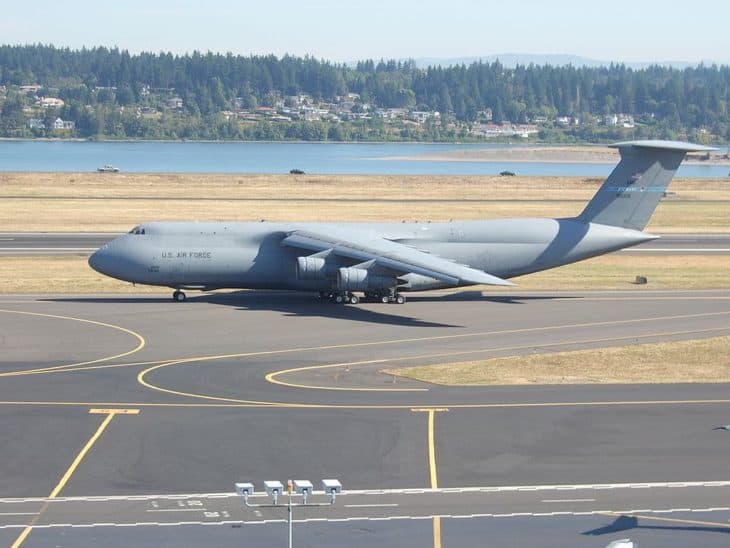
The C-5 is a high-wing military jet in gray, with a T-tail, engine pods hanging well forward of the wing, and a blunt nose because the whole front of the aircraft hinges upward. It sits high off the ground on 28 visible main-gear wheels.
Is the C-5 Galaxy the biggest plane in the world?
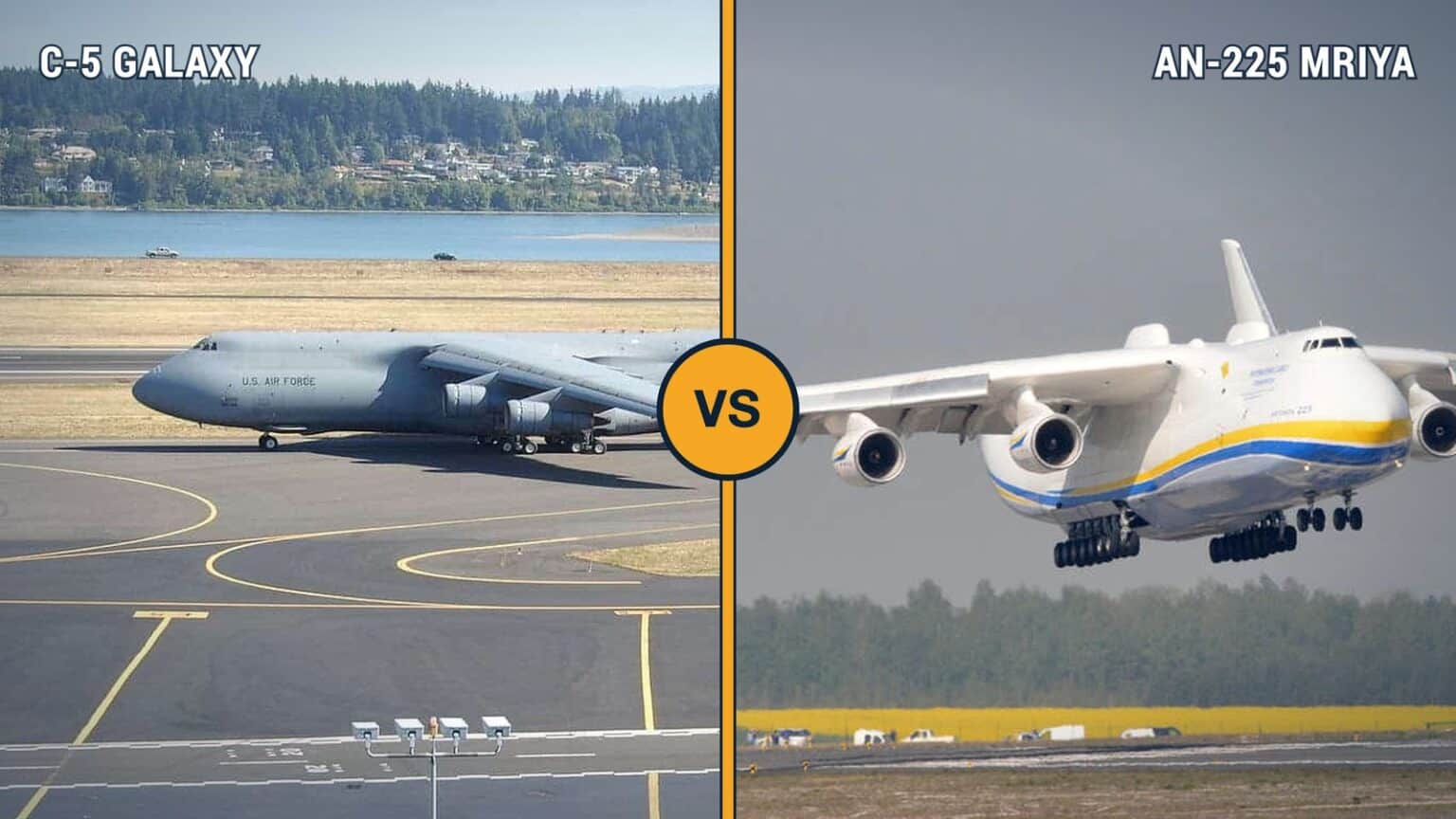
No. The Antonov An-124 Ruslan is larger and heavier, and the one-off Antonov An-225 Mriya, destroyed in Ukraine in 2022, was bigger again. The A380 outranks the C-5 on wingspan, height and weight.
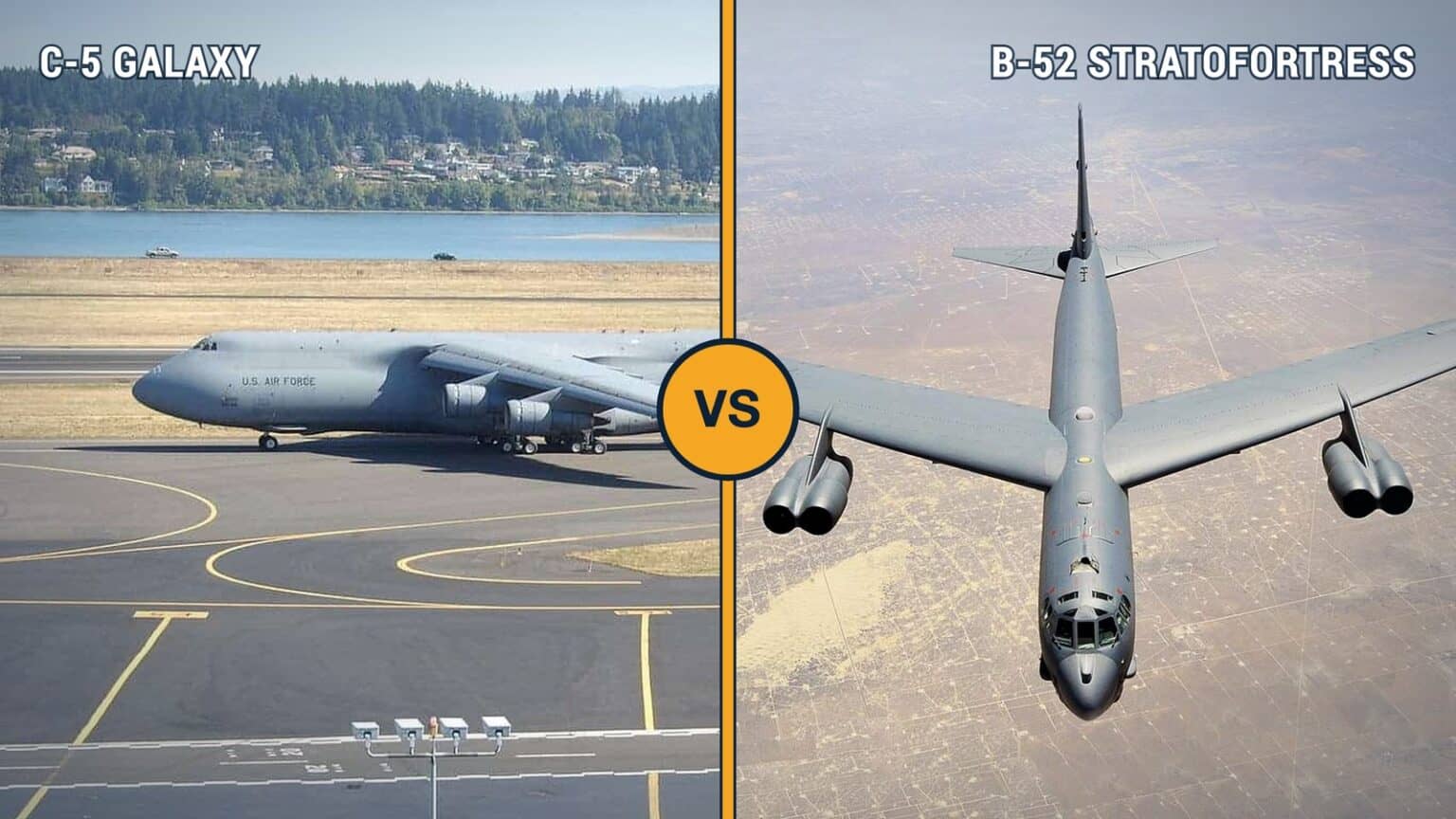
Among aircraft still flying, the C-5 and the A380 are both in the top handful, and the C-5 is the largest military aircraft the United States operates. Our guide to the biggest military airplanes puts the field in order.
Which is bigger, the C-5 or the 747?
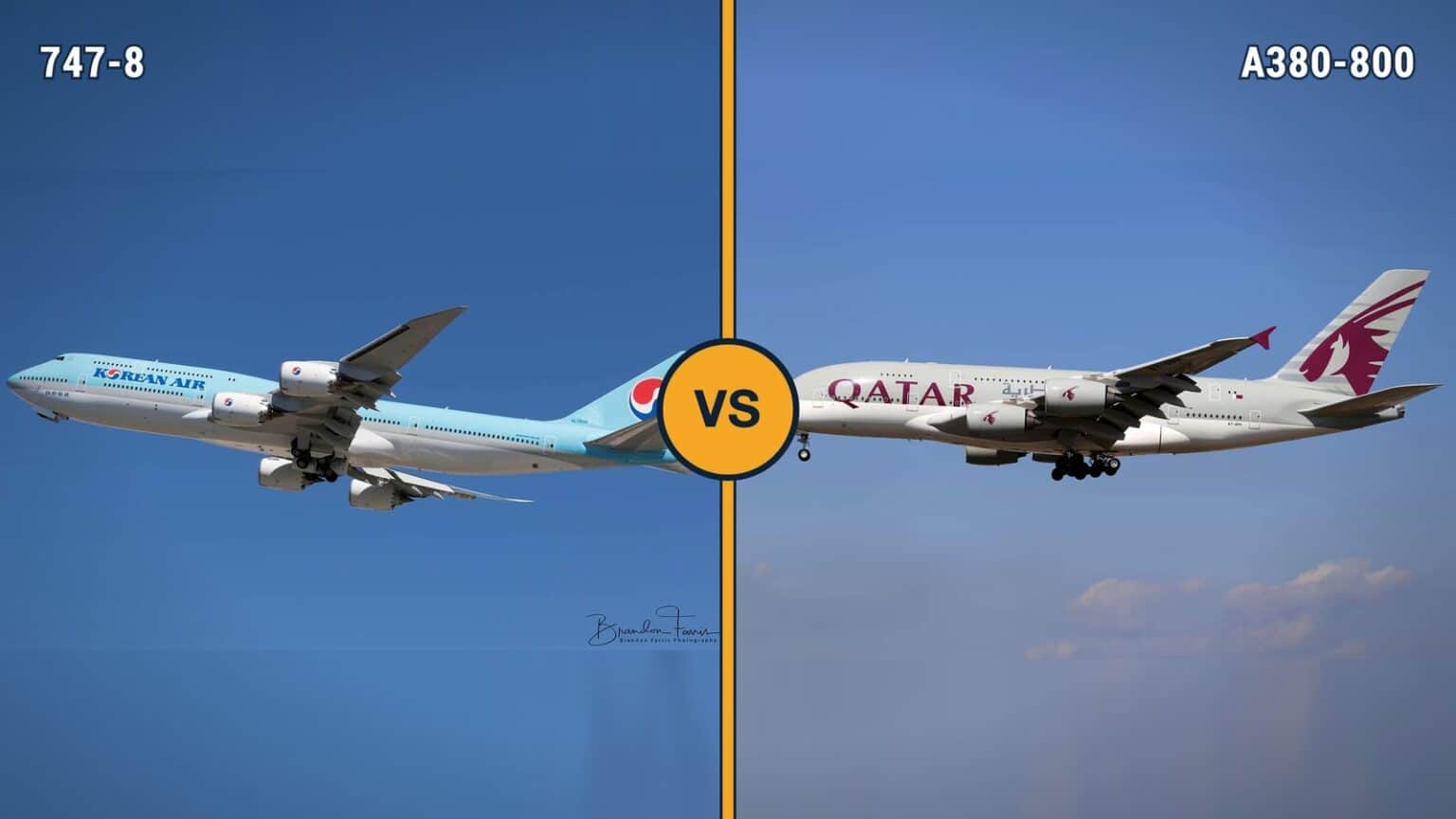
It is close. The Boeing 747-8 is longer, at about 250 feet, and has a higher maximum takeoff weight. Wingspan is almost identical: 222 feet 9 inches for the C-5 against 224 feet 7 inches for the 747-8.
The C-5 keeps the advantage that matters for freight: a wider, taller hold with drive-through loading, where even a 747 freighter loads only through a nose or side door onto a single deck.
Are they still being built?
Neither. Lockheed built 131 Galaxies between 1968 and 1989. The 52 best airframes were re-engined and modernized into C-5M Super Galaxies, which the Air Force expects to fly into the 2040s. The rest have retired.
Airbus built 254 A380s, delivered 251 to airlines between 2007 and 2021, and closed the line. About 159 are still in service in 2026, most of them with Emirates, which plans to keep flying them into the 2040s. Our roundup of the airlines still flying the A380 tracks the current operators.
The verdict
If the question is which is the bigger aircraft, it is the A380: wider, taller, heavier, and able to carry more than 500 people on two decks.
If the question is which can carry more, it is the C-5 Galaxy: 281,001 pounds of tanks, trucks and helicopters in one clear hold, loaded through the nose and the tail, delivered to runways an airliner cannot use.
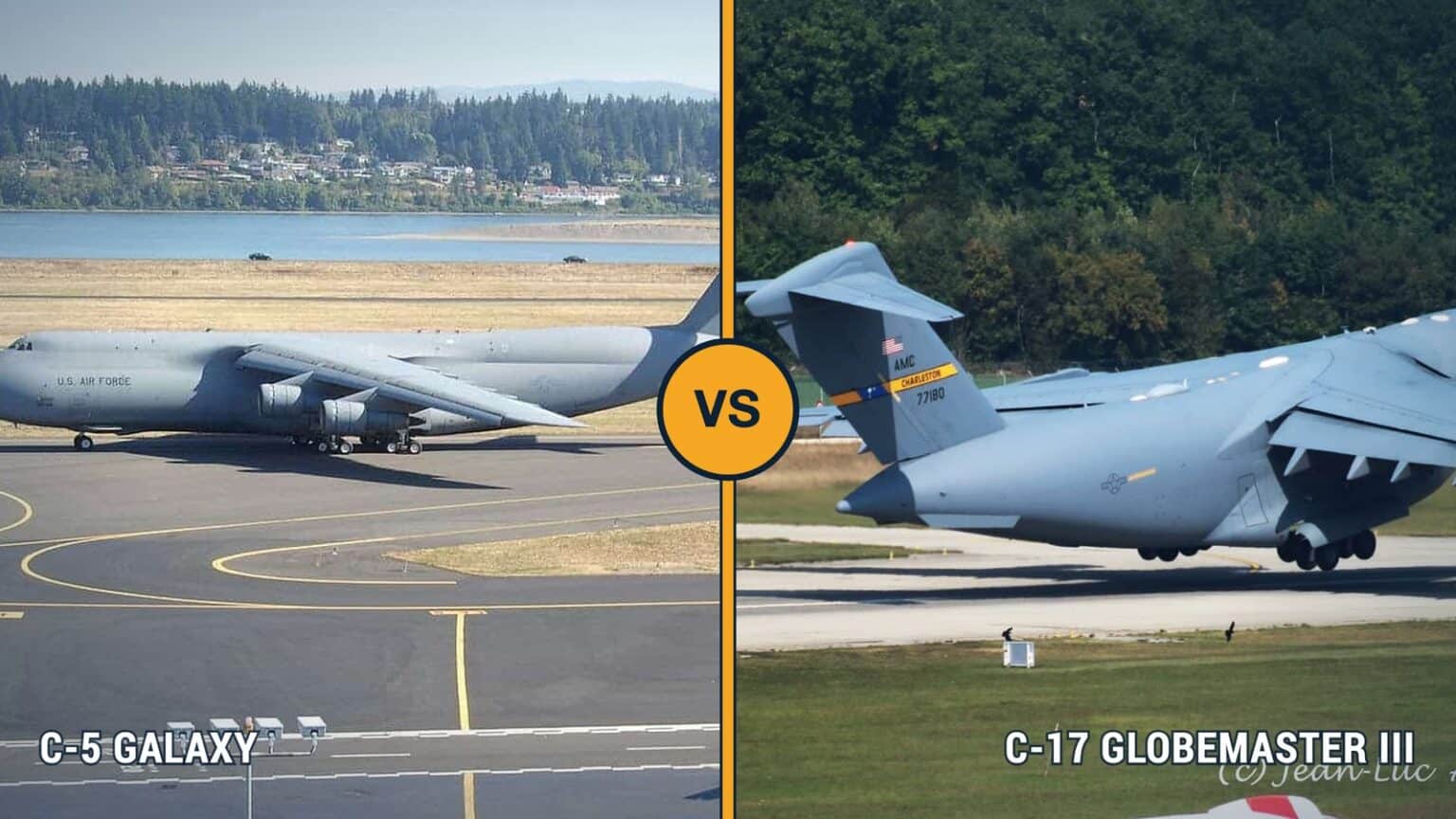
They were never really rivals. The A380 is the extreme version of a passenger jet, and the C-5 is the extreme version of a military truck. For the airlift side of that story, see how the Galaxy compares with its stablemate in C-5 Galaxy vs C-17 Globemaster III.
FAQ
Sources and references used for research and fact-checking.
- U.S. Air Force, C-5 A/B/C Galaxy and C-5M Super Galaxy Fact Sheet
- Wikipedia, Lockheed C-5 Galaxy
- Wikipedia, Airbus A380
- flugzeuginfo.net, Airbus A380-800 Technical Data
- Simple Flying, Is A Lockheed C-5 Galaxy Bigger Than An Airbus A380?
- Aerospace Global News, Which airlines fly the Airbus A380 in 2026?
- Office of the Under Secretary of Defense (Comptroller), Department of Defense Fiscal Year 2025 Fixed Wing and Helicopter Reimbursable Rates
About the Author

Tim is the owner and lead editor of AeroCorner since 2019, overseeing aviation content covering aircraft, airlines, airports, and the broader aviation industry. Through years of researching, writing, editing, and publishing aviation-focused content, he has developed extensive practical knowledge of commercial aviation and air travel. Based in Asia and a frequent traveler himself, Tim also brings firsthand passenger experience to AeroCorner’s coverage. Outside of publishing, he has also explored aviation firsthand through hands-on flight training in New Zealand.