



Table of Contents
| Judgment call | Boeing 787-10 | Airbus A380-800 |
|---|---|---|
| What it is for | Dense medium and long-haul routes, point to point | Slot-limited hub routes with very high demand |
| Production status | In production | Ended in 2021 |
| Built or delivered | 143 (of 1,303 787s through June 2026) | 254, including 3 test aircraft |
| Passenger decks | One | Two, both full length |
| Airlines flying it today | Singapore, United, Etihad, KLM, British Airways, EVA and others | About 10, led by Emirates |
| Seats airlines actually fit | Around 300 to 375 in two classes | 407 to 615, averaging 480 to 490 |
| What wins it | Economics, flexibility, availability | Cabin space, quiet, sheer presence |
Size: the A380 is bigger by every measure
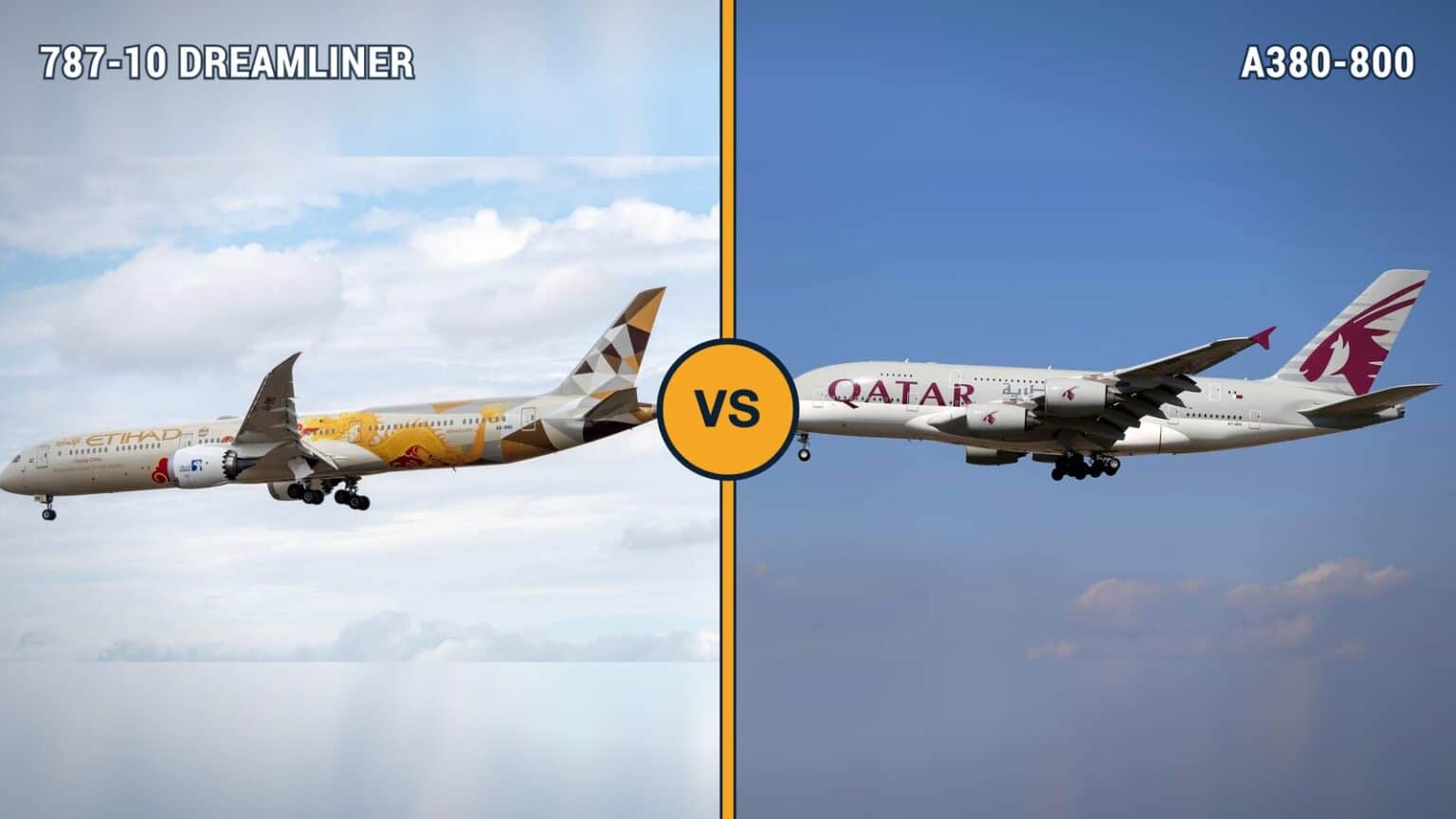
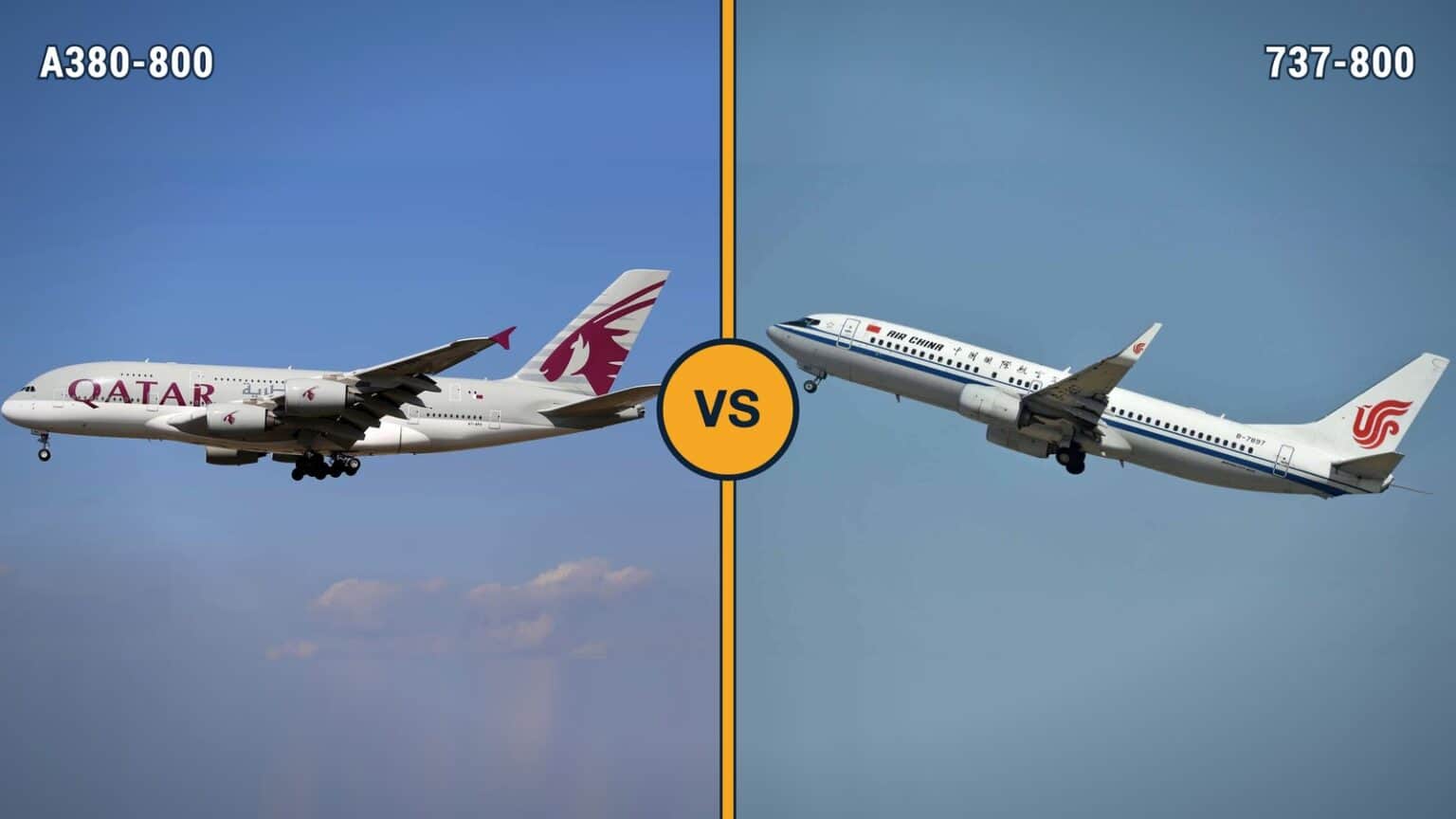
This is not a close contest. The A380-800 is 238 ft 7 in long against the 787-10’s 224 ft 1 in, and its wingspan of 261 ft 8 in is 64 ft wider than the Dreamliner’s 197 ft 3 in.
The tail tells the story best. The A380 stands 79 ft high, roughly a seven-story building, while the 787-10 tops out at 55 ft 10 in.
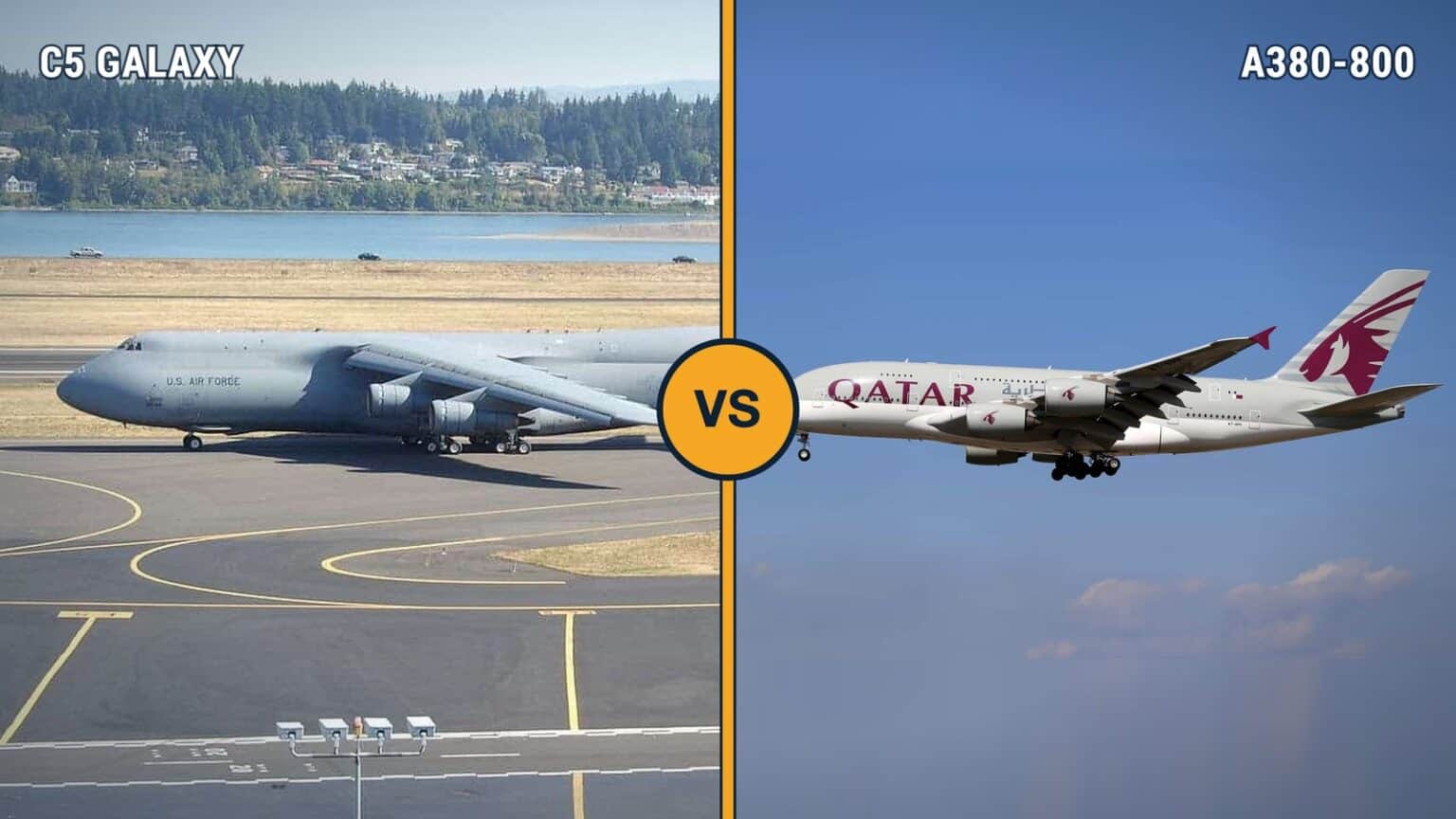
Weight is where the gap becomes absurd. The A380 is certified to take off at 1,267,658 lb (575,000 kg). The 787-10 is certified at 574,000 lb (260,360 kg), so a fully loaded A380 weighs more than two fully loaded 787-10s.
That mass buys floor. Airbus gives the A380 about 5,920 sq ft of usable cabin floor across its two decks, which is what lets operators fit 500-plus seats without cramming.
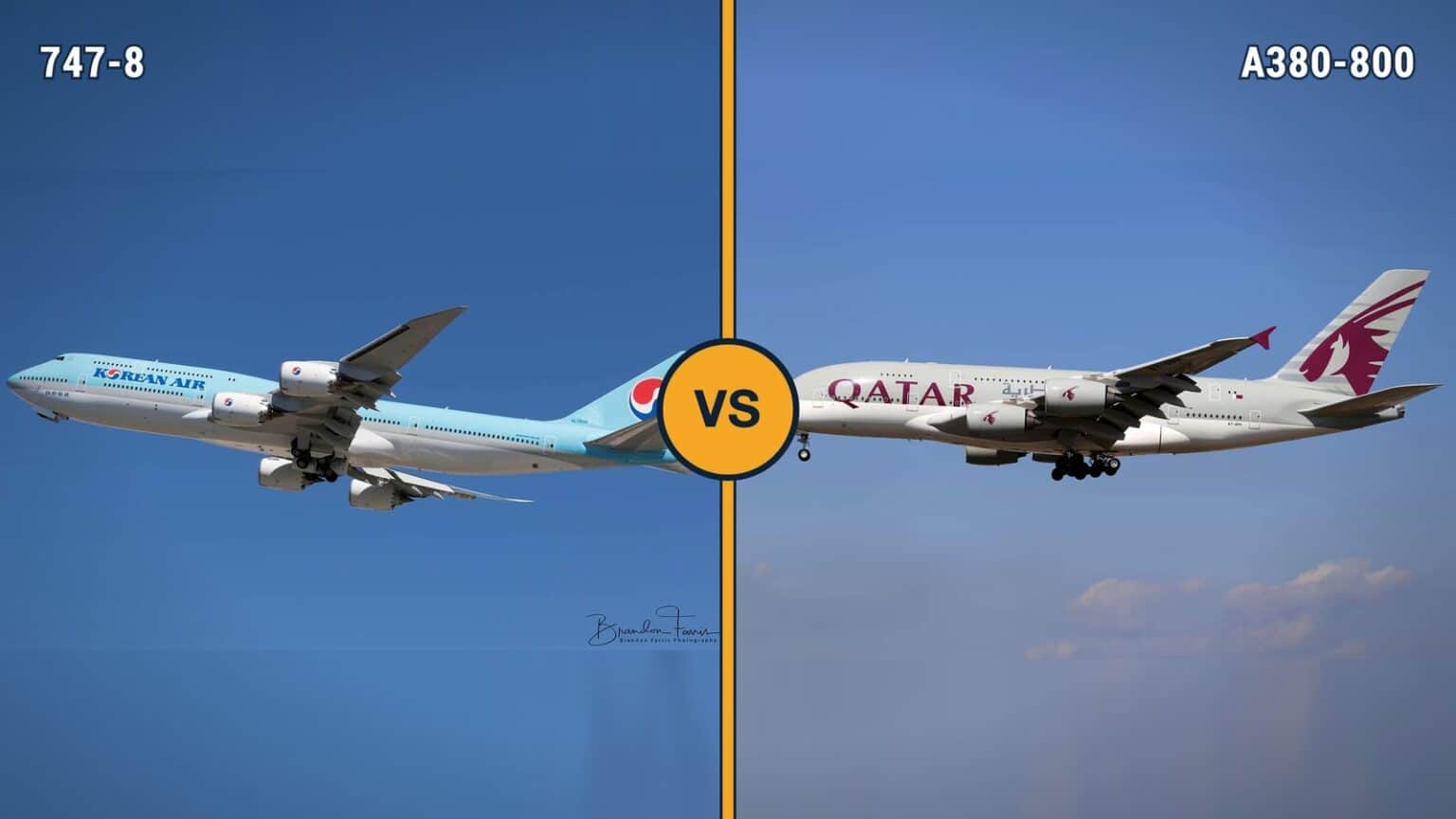
The edge: A380, decisively, on length, span, height, weight and floor area. If you want to compare it against the other four-engine giant, see our Boeing 747-8 vs Airbus A380-800 comparison.
Range: much closer than the size gap suggests
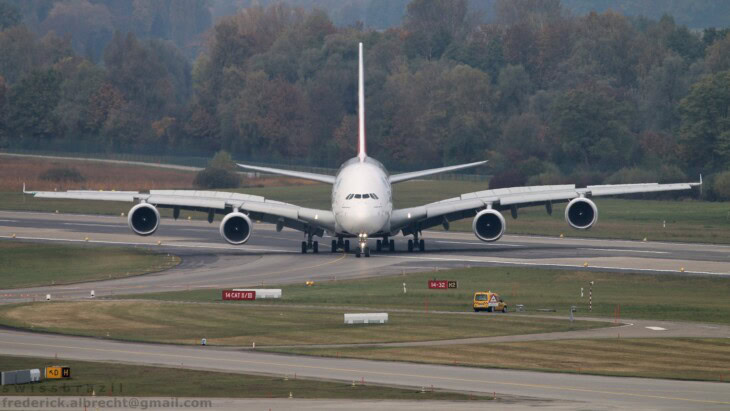
Airbus rates the A380-800 at 8,000 nautical miles. Boeing currently publishes up to 7,500 nautical miles (13,890 km) for the 787-10.
On those figures the A380 flies about 500 nautical miles farther, a gap of roughly 7 percent between two aircraft separated by a factor of two in weight.
Neither aircraft is an ultra-long-haul specialist. The 787-10 is the stretched, range-limited member of the Dreamliner family, and the 787-9 actually flies farther at 8,300 nautical miles.
Why you will see two different range figures for the 787-10
Most reference sources still list the 787-10 at 6,330 nautical miles, the figure published for its original 560,000 lb takeoff weight. Boeing’s own site now quotes up to 7,500 nautical miles, and in March 2026 the FAA cleared a roughly 14,000 lb takeoff weight increase for the 787-10 that Boeing says adds more than 400 nautical miles of range. Check which weight a figure belongs to before comparing it with anything.
The edge: A380 on paper, but narrowly, and the 787-10 has been closing it rather than falling behind.
The economy seat: the A380 usually gives you more room
This is the comparison most readers actually want, and the answer surprises people who have absorbed the Dreamliner’s comfort marketing.
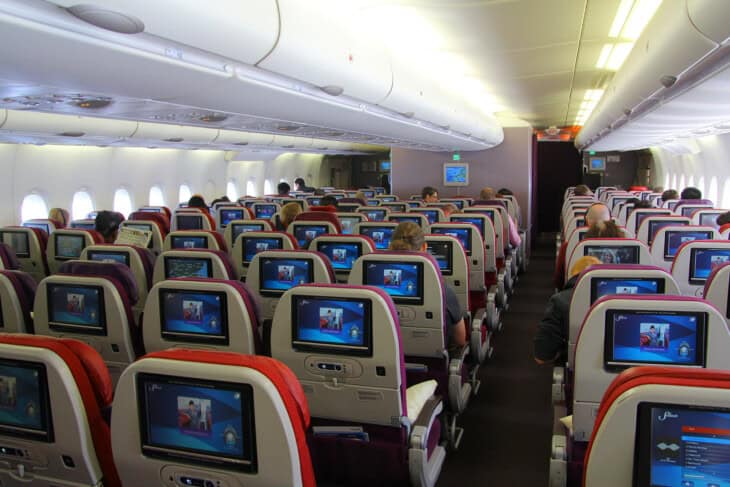
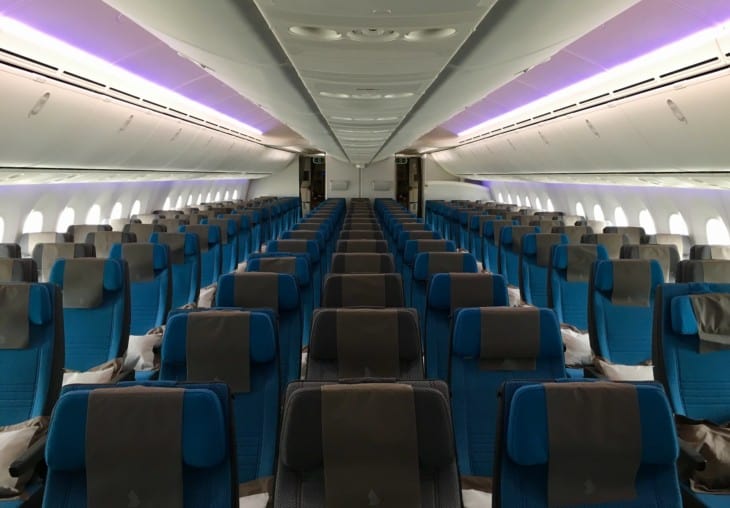
The A380’s main deck is normally fitted ten across in a 3-4-3 layout, with seats around 18 inches wide. The 787 is normally fitted nine across in a 3-3-3 layout, with seats around 17 to 17.3 inches wide.
More seats per row, wider seats in each row. The A380’s fuselage is simply broad enough to absorb the extra column, at 23 ft 5 in across against the 787’s 18 ft 10 in.
The A380’s upper deck is better still. Economy there is usually 2-4-2, and the curved sidewalls leave window-seat passengers a storage bin most aircraft do not have.
Noise goes the same way. A 2022 study in Applied Acoustics measured cruise cabin noise at 69.5 dB(A) on the A380-800 against 72.7 dB(A) on the 787-9, making the A380 the quietest of the widebodies tested.
A 3 dB(A) difference is a halving of sound energy, though the researchers noted the whole widebody field sat within about 3 dB of each other.
The myth: the Dreamliner is the more comfortable aircraft
In economy, on the measures you can feel in your seat, it usually is not. The A380 gives most passengers a wider seat and a quieter cabin. The 787’s comfort advantages are real but they are atmospheric rather than spatial, and seat width, pitch and padding are the airline’s decision on either aircraft.
The edge: A380, on width and on noise.
Where the 787 wins the comfort argument
The Dreamliner’s advantages are in the air you breathe rather than the space you occupy, and they come from the same source: a fuselage that is about 50 percent composite by weight.
Composites do not corrode, so Boeing can pressurize the 787 cabin to 6,000 feet instead of the 7,000 to 8,000 feet typical of aluminum airliners, and hold a higher humidity level.
Both changes attack the dehydration and fatigue that make long flights unpleasant. On a 14-hour sector that is a genuine difference, even if it is less obvious than an extra inch of seat.
The 787 also has the largest windows of any widebody flying, and they dim electronically rather than with a pull-down shade. Its gust-suppression system trims the small bumps out of a rough cruise.
The edge: 787-10, on cabin altitude, humidity, windows and ride.
Two engines or four: the argument that ended the A380
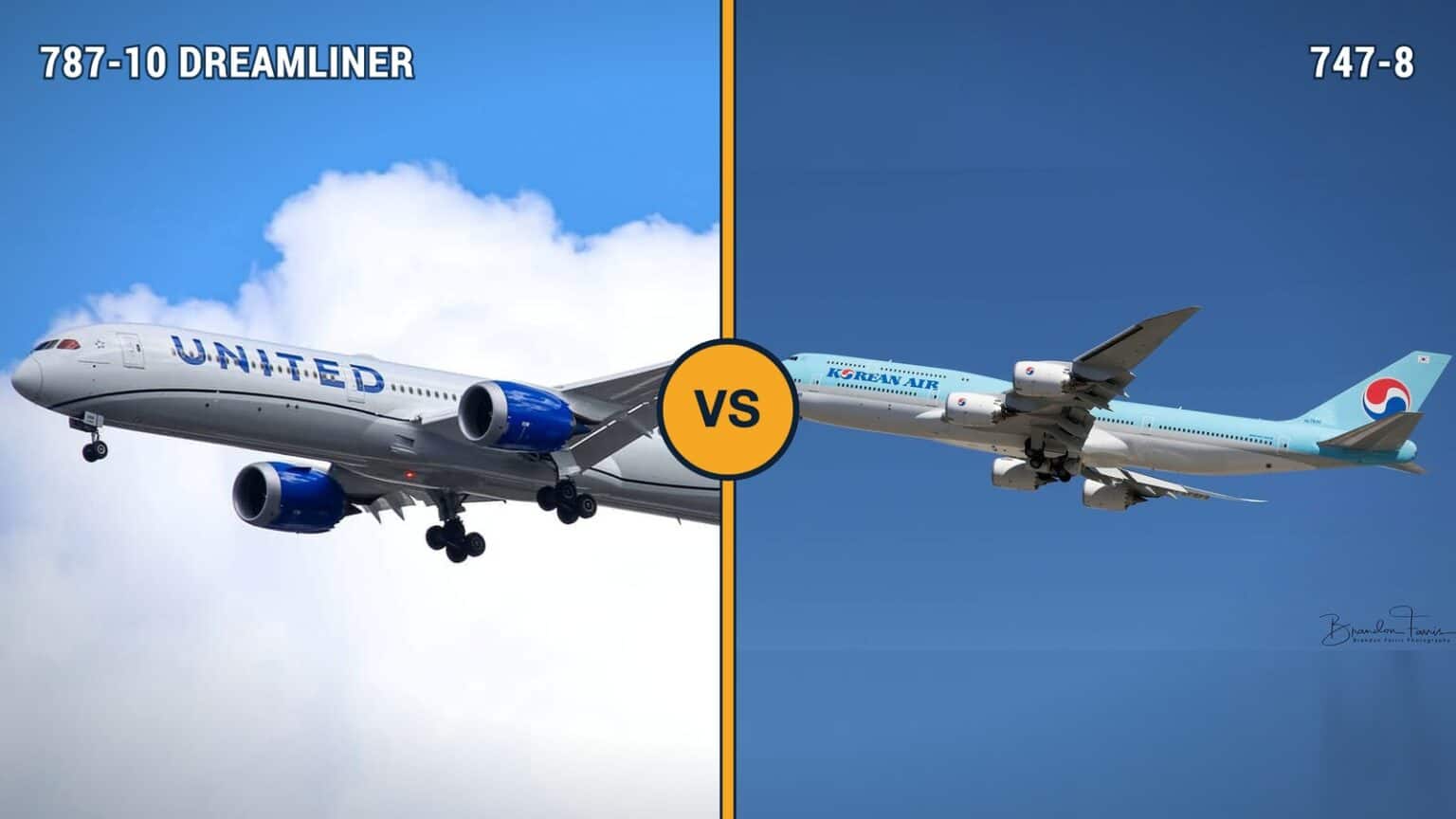
Here is the fact that explains the whole story. Each of the A380’s four engines is rated around 76,752 lbf. Each of the 787-10’s two engines is rated at 76,000 lbf.
One 787 engine is an A380 engine
The Rolls-Royce Trent 1000 and GEnx-1B76 on a 787-10 produce essentially the same thrust as each Trent 900 or GP7200 on an A380. Engines got powerful enough that a twin could do the job a quadjet was designed for, and neither Boeing nor Airbus offers a four-engine passenger jet today.
Four engines mean four of everything to maintain, overhaul and insure. Two do the same work on routes a modern twin is certified to fly, which is now almost all of them.
The fuel tanks show the scale difference. The A380 holds 85,472 US gallons against the 787-10’s 33,380, which is about 2.6 times the fuel for roughly 1.5 times the seats.
That is tank capacity, not fuel burn, and the A380 is efficient per seat when it flies full. The problem is that it has to fly full, and it has to fly between two airports with enough demand to fill it.
Airlines went the other way. Twins let them fly thinner routes directly instead of funneling everyone through a hub, which is the business case the 787 was built for.
Airbus ended A380 production in 2021 after building 254, including three test aircraft. Boeing has delivered 1,303 787s and is still building them.
The edge: 787-10, and the market settled this one.
Which one can you actually book in 2026?
About ten airlines still fly the A380 in passenger service. Emirates dominates with 116 aircraft, 21 of them parked, ahead of Singapore Airlines and British Airways on 12 each, Qantas on 10, Etihad on 9, and Qatar Airways and Lufthansa on 8.
Asiana has 6, Korean Air 5, and All Nippon Airways 3. Air France, China Southern, Malaysia Airlines and Thai Airways have all retired theirs since 2020.
As of August 2025, 186 A380s remained in service, 36 were stored and 24 had been scrapped. Our guide to the airlines still flying the A380 tracks the fleet in more detail.
The retirement clock is running. Qantas begins phasing its A380s out from 2028, Lufthansa plans to retire after 2030, and Qatar Airways is looking at replacements around 2035.
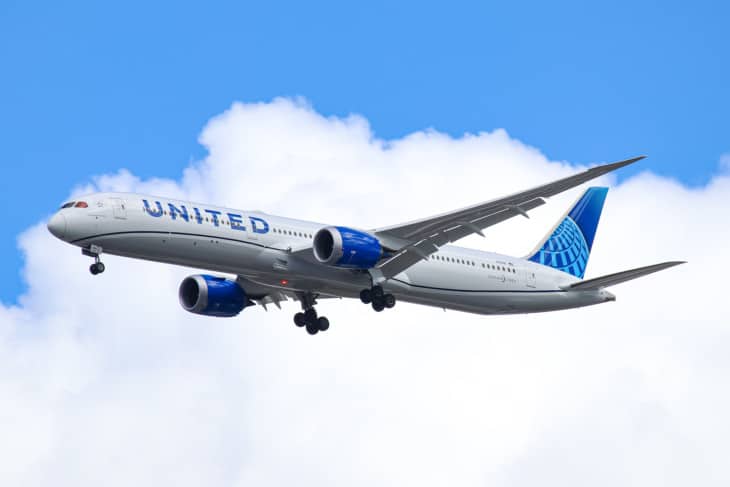
The 787-10 is the opposite case. It entered service with Singapore Airlines in April 2018, 143 have been delivered, and United, Etihad, KLM, British Airways and EVA Air all fly it on routes you can book any day of the week.
The edge: 787-10, on availability. If you want to fly an A380, the window is closing.
The verdict
As a passenger, pick the A380. It gives you a wider economy seat, a quieter cabin, more room to move, and an aircraft that will not be flying much longer. The upper deck is one of the best economy experiences in commercial aviation.
As an airline, pick the 787-10. Two engines, a cabin that fills on routes the A380 could never serve, and a production line that still exists.
Both answers are correct, which is exactly why the A380 was a magnificent aircraft and a commercial failure. For the full spec sheets, see our Airbus A380-800 and Boeing 787-10 Dreamliner pages, or the ranking of the biggest aircraft in the world.
FAQ
Sources and references used for research and fact-checking.
- European Union Aviation Safety Agency, Type-Certificate Data Sheet No. EASA.IM.A.115, Boeing 787, Issue 30
- Boeing, 787 Dreamliner technical specifications
- Boeing, 787 Dreamliner By Design
- Boeing, FAA clears higher takeoff weight for 787-9 and 787-10
- Airbus, A380 Aircraft Characteristics: Airport and Maintenance Planning
- Airbus, A380 Facts and Figures, December 2021
- Wikipedia, Airbus A380
- Wikipedia, List of Airbus A380 operators
- Wikipedia, List of Boeing 787 orders and deliveries
- Applied Acoustics (Lee, Kumar, Garg and Lim), Assessment of in-cabin noise of wide-body aircrafts
- Wikipedia, Qantas Flight 32
- Wikipedia, Air India Flight 171
About the Author

Tim is the owner and lead editor of AeroCorner since 2019, overseeing aviation content covering aircraft, airlines, airports, and the broader aviation industry. Through years of researching, writing, editing, and publishing aviation-focused content, he has developed extensive practical knowledge of commercial aviation and air travel. Based in Asia and a frequent traveler himself, Tim also brings firsthand passenger experience to AeroCorner’s coverage. Outside of publishing, he has also explored aviation firsthand through hands-on flight training in New Zealand.