


Table of Contents
C-5 Galaxy vs Il-76 at a glance
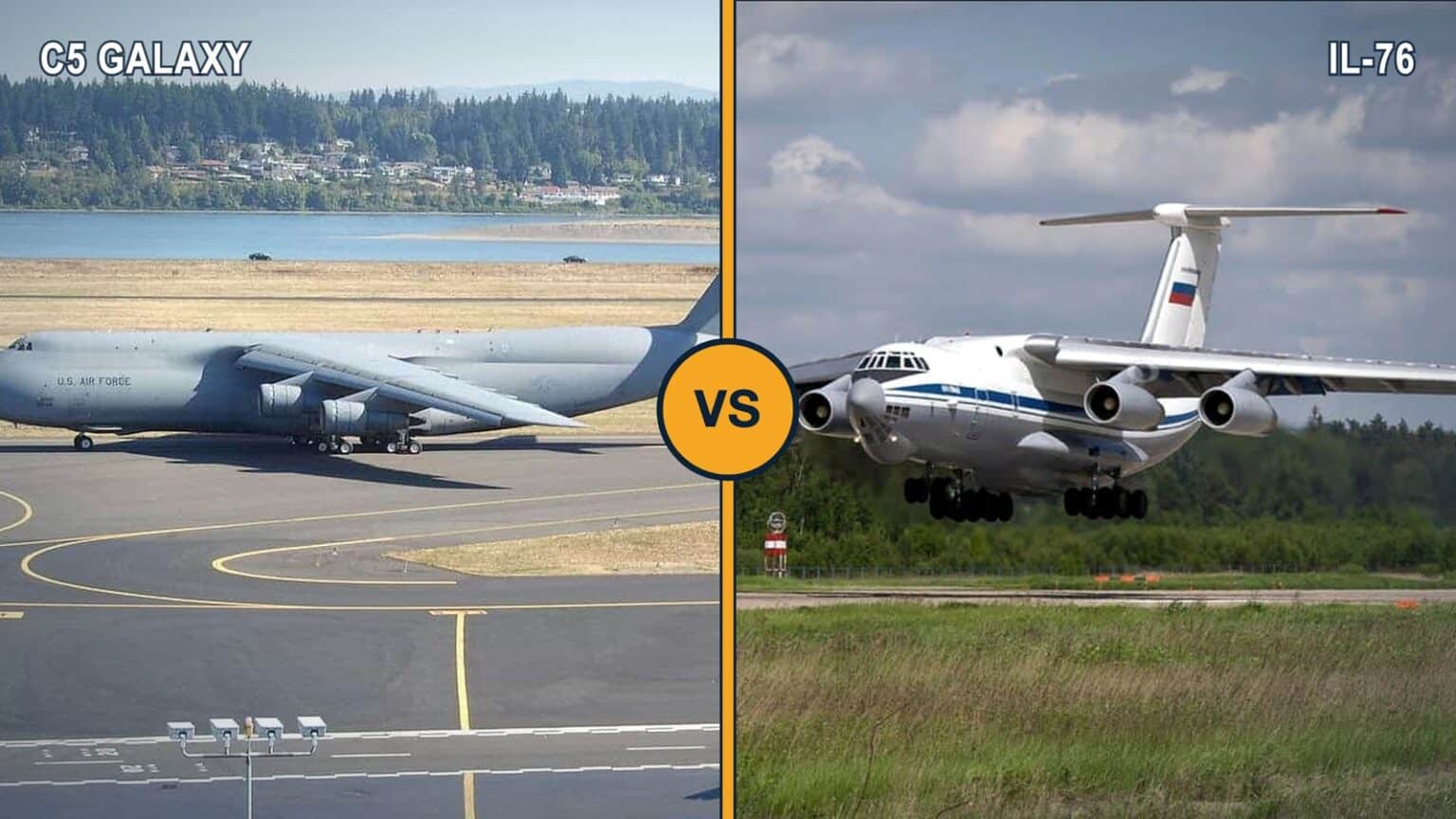
One common claim says these two share a wingspan. They do not. The C-5 Galaxy spans 222 ft 9 in (67.89 m), while the Il-76 spans 165 ft 8 in (50.50 m).
| C-5 Galaxy | Il-76 | |
|---|---|---|
| Role | Strategic airlifter for outsize cargo | Tactical and strategic airlifter, also tanker and AEW&C |
| First flight | June 30, 1968 | March 25, 1971 |
| Service entry | June 1970 | June 1974 (Soviet Air Force) |
| Built | 131 (81 C-5A, 50 C-5B) | Some 860 transport variants, plus around 50 Il-78 tankers and 25 A-50s |
| In service today | 52 upgraded C-5Ms with the USAF (April 2025) | In service with 17 military operators and many cargo airlines; new Il-76MD-90A still in production |
| Loading | Nose visor and rear ramp, kneeling landing gear | Rear ramp, rough-field landing gear |
The short verdict
Pick the C-5 for outsize loads over intercontinental distances. Pick the Il-76 for short, rough runways and a cheaper, simpler airframe.
Where the C-5 Galaxy wins
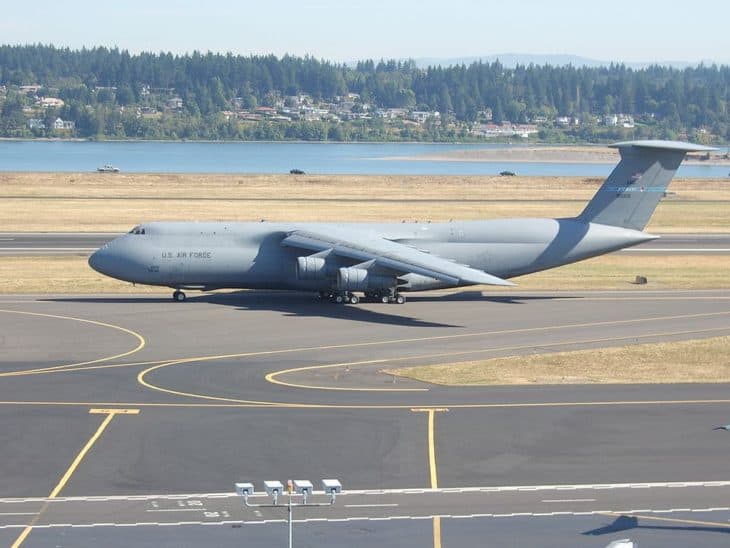
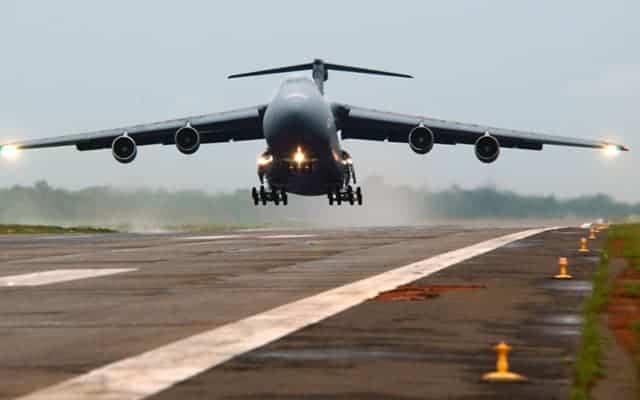
The C-5 Galaxy was built to move what nothing else can lift. It carries 36 463L master pallets, or 281,000 lb (127,500 kg).
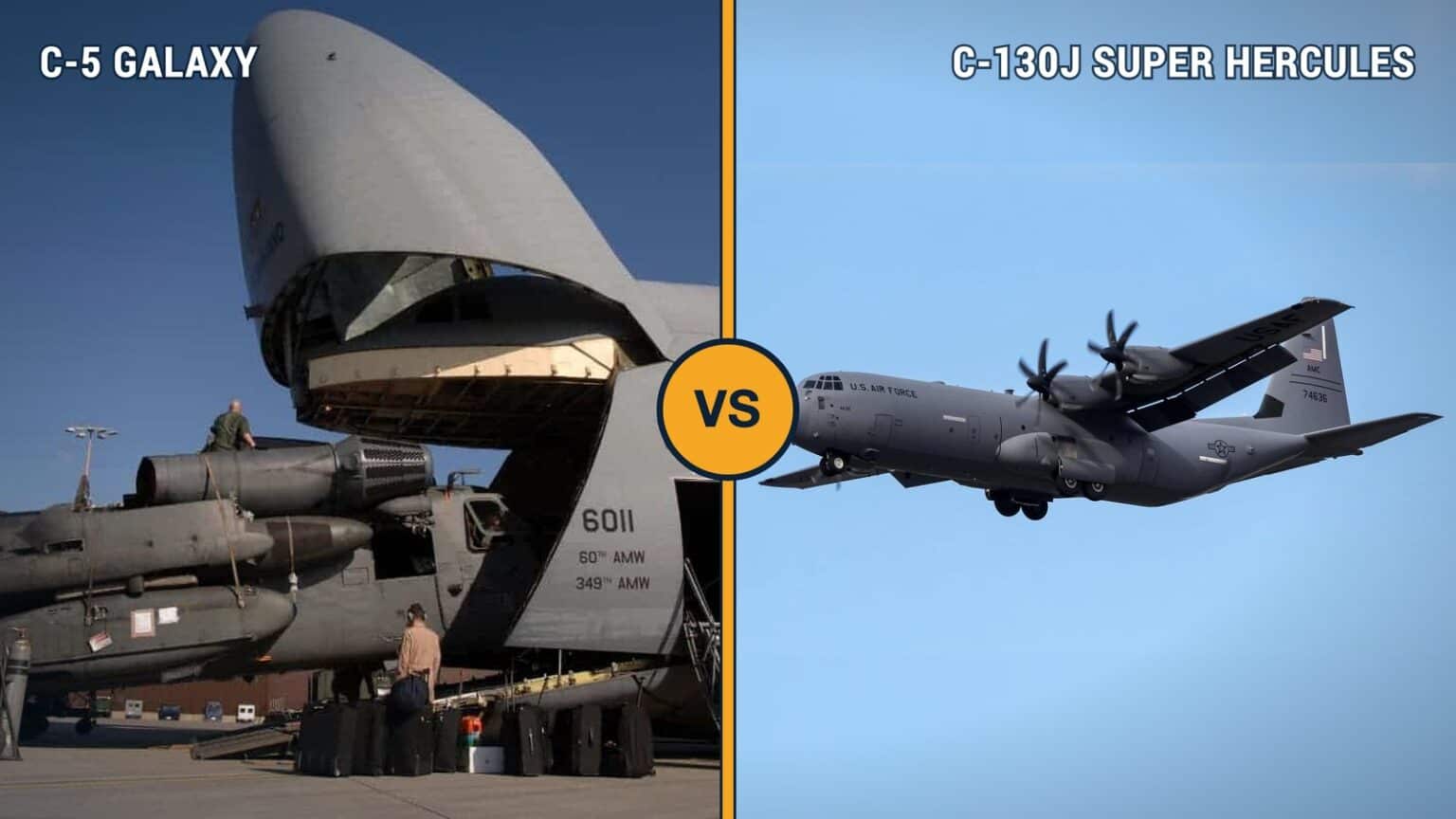
That includes the 74-short-ton armored vehicle launched bridge, up to six AH-64 Apache helicopters, or five Bradley fighting vehicles.

Kneeling landing gear lowers the cargo deck to truck-bed height. The nose visor lifts, so loads go in the front and roll out the back.
The Air Force upgraded its fleet to the C-5M Super Galaxy. It had 52 in service in April 2025 and expects to fly the type until 2045.
Where the Il-76 wins
The Il-76 started from a 1967 Soviet requirement for short and unprepared airstrips. Its landing distance is 1,480 ft (450 m), compared with 3,600 ft (1,100 m) for the C-5.
It is also the more flexible airframe. The Il-76 family includes the Il-78 tanker, around 50 of them built, and the Beriev A-50 radar plane, around 25.

Soviet Il-76s flew 14,700 flights during the Afghanistan war from 1979 to 1991. The design is still in production as the Il-76MD-90A, which has a glass cockpit and a new one-piece carbon-fibre wing.


Size and payload
The C-5 is 247 ft 1 in (75.30 m) long. The Il-76 is 152 ft 11 in (46.60 m).
Its cargo compartment is 143 ft 8 in (43.80 m) long and 13 ft 6 in (4.11 m) high. The Il-76 hold is 80 ft 6 in (24.54 m) long and 11 ft 2 in (3.40 m) high.
That is why the C-5 can carry outsize cargo, and the Il-76 cannot.
Range, speed and engines
The C-5 flies 4,800 nm (5,520 mi, 8,890 km). The Il-76 flies 3,600 nm (4,140 mi, 6,670 km).
Both cruise at similar speeds. The C-5 cruises at 450 kt (518 mph, 833 km/h) and the Il-76 at 432 kt (497 mph, 800 km/h).
The C-5M uses four General Electric F138-GE-100 engines. The Il-76 uses four Soloviev D-30KP turbofans.
A correction
Older write-ups give the C-5 a 41,000 ft ceiling. The listed service ceiling is 34,000 ft (10,400 m), while the Il-76 reaches 40,000 ft (12,200 m).
Which cargo jet is better?
The C-5 is the better strategic airlifter. No Il-76 can carry a tank bridge or six Apaches.
The Il-76 is the better field aircraft. It costs far less (about $50 million against $179 million in the aircraft database) and lands on strips the C-5 cannot use.
For a cheaper alternative in the same class, look at the Il-76 first. For raw lift, nothing here beats the C-5.
How each aircraft came about
The C-5 first flew on June 30, 1968 and entered service in June 1970. Lockheed built 131 of them, 81 C-5As and 50 C-5Bs.
It became a major supply asset for the coalition in the 1990-91 Gulf War. The last unmodified C-5A retired in 2017, and every surviving airframe now flies as a C-5M.
The Il-76 first flew on March 25, 1971, and the first aircraft reached the Soviet Air Force in June 1974. Ilyushin designed it, and production moved to Tashkent and later to Ulyanovsk.
About 860 transport versions were built. The design also became a tanker and a radar aircraft.
Takeoff and landing performance
Both aircraft list the same takeoff distance, 5,250 ft (1,600 m), in the aircraft database. That figure is for a light load.
At maximum load the C-5 needs far more. Wikipedia gives 8,300 ft (2,500 m) for takeoff and 4,900 ft (1,500 m) for landing at maximum-load weight.
The Il-76 has a much smaller landing requirement, 1,480 ft (450 m), and its landing gear is built for unprepared surfaces. That difference decides who can use remote strips.
Crew, cost and who flies them
The C-5 carries a crew of 7 and the Il-76 a crew of 5. Both can also carry passengers, though the C-5 lists 73 seats against 5 for the Il-76.
The aircraft database lists a price of $179 million (1998) for the C-5 and $50 million (2008) for the Il-76. The two figures come from different years, so treat them as a rough guide only.
The C-5 is flown almost entirely by the US Air Force. The Il-76 serves 17 military operators, plus many cargo airlines around the world.
Which one would you choose?
Choose the C-5 when the load is huge and the runway is long. It moves outsize military cargo across oceans in one hop.
Choose the Il-76 when the airfield is short, rough or remote. It lands in less than half the distance and costs a fraction of the price.
Neither is a direct substitute for the other, which is why both have stayed in service for decades. One is a strategic heavy lifter and the other is a flexible field transport, and each does its own job better than the other could.
FAQ
Sources and references used for research and fact-checking.
About the Author

Tim is the owner and lead editor of AeroCorner since 2019, overseeing aviation content covering aircraft, airlines, airports, and the broader aviation industry. Through years of researching, writing, editing, and publishing aviation-focused content, he has developed extensive practical knowledge of commercial aviation and air travel. Based in Asia and a frequent traveler himself, Tim also brings firsthand passenger experience to AeroCorner’s coverage. Outside of publishing, he has also explored aviation firsthand through hands-on flight training in New Zealand.