


Table of Contents
The Chengdu J-10C beats the JAS 39 Gripen C/D on radar and missiles, and it has been built in far larger numbers. The Gripen offers a published low cost per flight hour and is easy to run from a road or a small base.
That split is the short answer. The longer one depends on which version of each jet you mean, because the J-10 family and the Gripen family both span several generations.
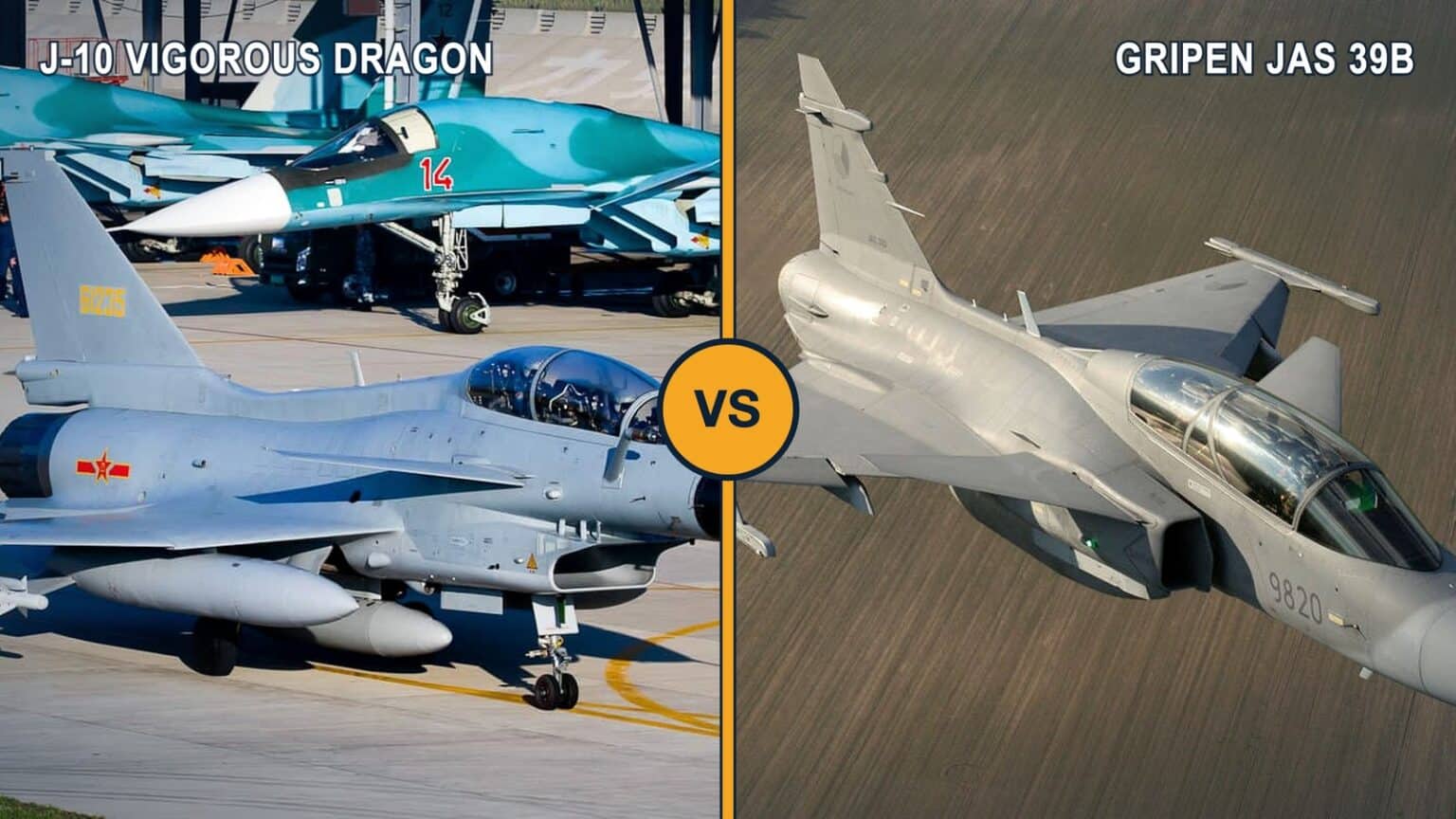
The widget above this article compares the two airframes side by side. This page covers what a spec sheet leaves out: sensors, weapons, support, operators and combat claims. Specs for each jet live on the Chengdu J-10 and Saab Gripen pages.
| Category | Chengdu J-10 | JAS 39 Gripen |
|---|---|---|
| First flight | March 23, 1998 | December 9, 1988 |
| Radar | J-10C: KLJ-7A AESA | C/D: PS-05/A pulse-Doppler. E/F: Raven ES-05 AESA |
| Missiles | J-10C: PL-10 and PL-15 | Not compared here |
| Built | More than 600 (2024) | About 300 (2023) |
| Operators | China, Pakistan, Uzbekistan | Sweden, Brazil, South Africa, Hungary, Thailand, Czech Republic (leased) |
| Cost to fly | No comparable figure published | C/D: $20,643 per flight hour (2023 estimate) |
Radar and weapons: the J-10C leads
Early J-10s carried the Type 1473 pulse-Doppler radar. The J-10C moved to an indigenous AESA fire-control radar, listed as the KLJ-7A, and carries the PL-10 and PL-15 missiles.
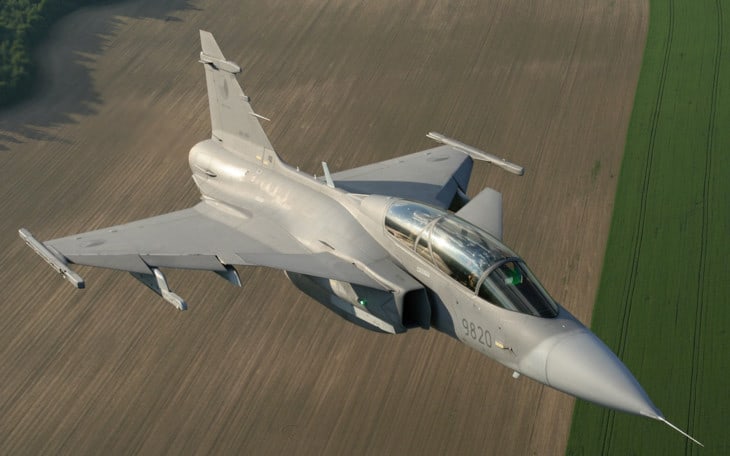
The Gripen C/D flies with the PS-05/A pulse-Doppler radar. The Gripen E/F brings the Raven ES-05 AESA radar, which is the fair match for the J-10C.


The J-10C was first flown in December 2013 and entered serial production in 2015. Analyst Justin Bronk describes it as a 4.5-generation fighter.
Edge: J-10C, and clearly so against the Gripen C/D.
Engines and airframe: two different answers
Both jets pair a delta wing with canards and a single engine. The Gripen is a light, relaxed-stability design with fly-by-wire controls, and the J-10 also uses a digital fly-by-wire system.
The J-10A entered production with the Russian AL-31FN engine. The J-10C switched to the Chinese WS-10B, which Wikipedia says was in service by November 2021, so the newest J-10 no longer depends on Russian engines.
In service Gripens use the RM12, a licence-built derivative of the General Electric F404-400. The E/F adopts the F414G, which Wikipedia says can produce 20% greater thrust than the RM12.
Edge: J-10C on engine independence and growth, Gripen on a long record. Volvo said in 2010 that the Gripen fleet had logged more than 143,000 flight hours without an engine-related failure or incident.
The J-10 also comes in more versions. The J-10CE is the export model, and the J-10CY is an aerobatic variant. A possible electronic-warfare J-10D is unconfirmed.
Cost and support: the Gripen’s case
A Saab and Aviation Week estimate from 2023 puts the Gripen C/D at $20,643 per flight hour, and the E/F at $22,174. The JAS 39C flyaway cost came in under $30 million after one batch was delivered 10% below the agreed price.
The J-10 is not cheap to buy either. Our aircraft page lists a price of $50 million (2013), and no comparable cost-per-hour figure has been published.

Sweden designed the Gripen to fly from road runways under its Bas 90 dispersal system, with snow-covered strips of about 1,600 feet (500 m) as a design goal. Its engine is a licence-built derivative of the General Electric F404.
A team of one technician and five conscripts is said to be able to rearm and refuel it in ten minutes for an air-to-air mission, or twenty for an air-to-ground one. Those are Swedish design claims, not independent measurements.
Match the versions, not the names
The J-10C and the Gripen E/F are the modern pair, and both carry AESA radar. Most online arguments pit a J-10C against a Gripen C/D, which flatters the Chinese jet. Check which version a source means before trusting its verdict.
Edge: Gripen on dispersed operation and a documented running cost. The J-10 has no published cost to compare.
Numbers and operators: the J-10 leads
More than 600 J-10s had been built by 2024, according to the IISS figure Wikipedia cites. As of 2023, the PLAAF listed 236 J-10A, 55 J-10B, 220 J-10C and 77 J-10S. Pakistan flew 20 J-10CE in May 2025 with 16 more on order, and Uzbekistan had at least six as of August 2026.

About 300 Gripens of all models have been built. Sweden, Brazil, South Africa and Hungary are the main users, Thailand bought 12, and the Czech Republic leases 14 ex-Swedish aircraft, with the lease extended to 2027.
The Gripen is still winning orders. The first Gripen E was delivered to the Swedish Air Force on October 20, 2025, and in June 2026 Brazil signed a memorandum of understanding for 20 more Gripen Es to be built in Brazil.
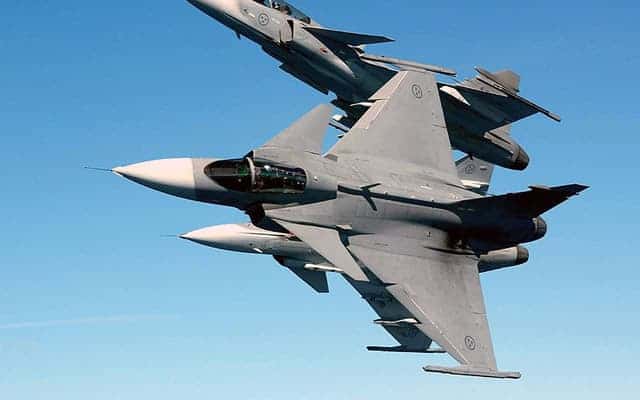
Edge: J-10 on production volume. Both jets have export customers, and the Gripen is still winning orders.
The Rafale claims: what is and is not known
After the May 2025 India and Pakistan clashes, Pakistan said its J-10CEs shot down five Indian aircraft, three of them Dassault Rafales. Those are claims. Wikipedia does not confirm the Rafale losses, and a source it cites describes the evidence as unclear.
A French deputy has said several sources credited the J-10C with a Rafale kill, possibly with a PL-15E missile. That is a secondhand account too.
Treat it as one disputed engagement, not a result. It says little about a J-10 against a Gripen, and nothing about a fair fight between them.
Who wins?
On the metrics that decide a first-day air fight, the J-10C holds the lead: an AESA radar, PL-15 and PL-10 missiles and a long production run behind it. Against a Gripen C/D that lead is real.
Against a Gripen E/F it narrows, and the Gripen keeps its dispersed-basing strength and documented running cost. An air force with a small budget and a road network should look at the Gripen. One that wants volume and a missile-heavy loadout should look at the J-10C.
For the wider Chinese fleet see the best Chinese fighter jets, and for how the two air forces stack up see US vs China fighter jets.
FAQ
Sources and references used for research and fact-checking.
About the Author

Tim is the owner and lead editor of AeroCorner since 2019, overseeing aviation content covering aircraft, airlines, airports, and the broader aviation industry. Through years of researching, writing, editing, and publishing aviation-focused content, he has developed extensive practical knowledge of commercial aviation and air travel. Based in Asia and a frequent traveler himself, Tim also brings firsthand passenger experience to AeroCorner’s coverage. Outside of publishing, he has also explored aviation firsthand through hands-on flight training in New Zealand.