Mid Size Passenger Jets
The Soviet Union's first long-haul jetliner, still flying government missions six decades on
Updated: by Tim de Vries
The latest aviation news and stories sent to your inbox.
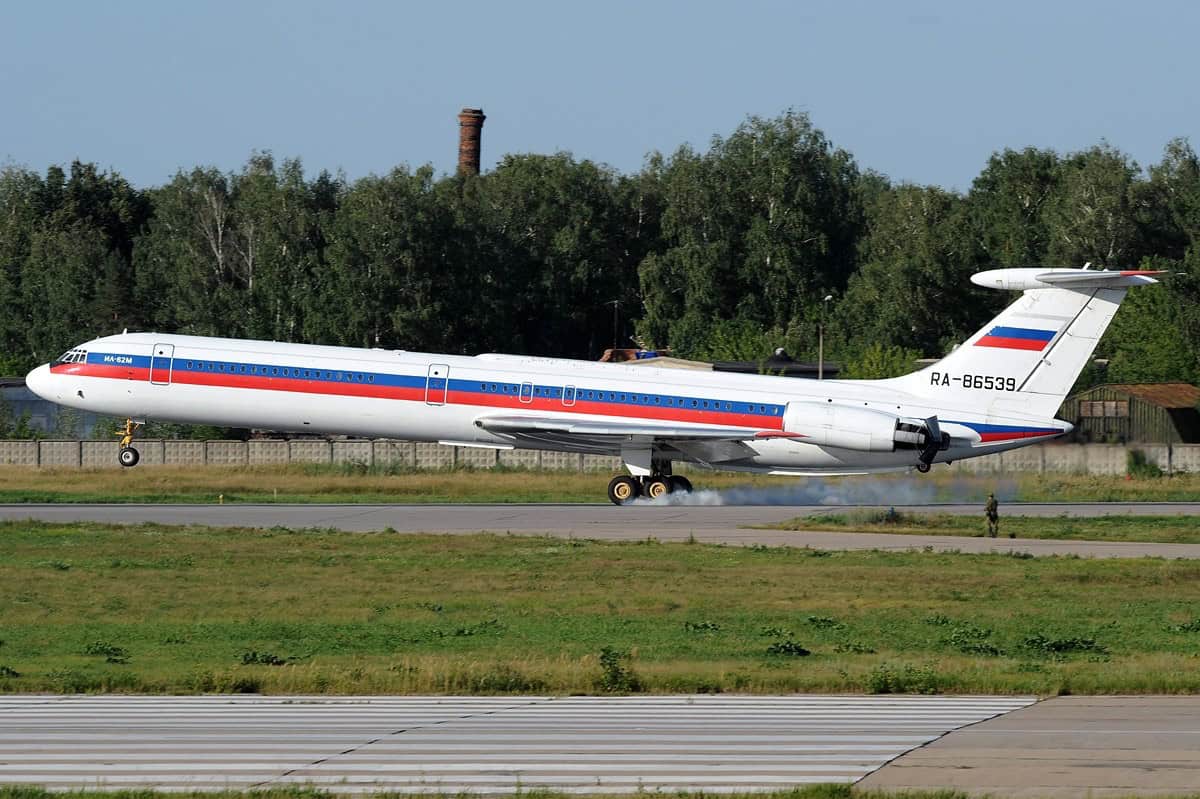
The Ilyushin Il-62 was the Soviet Union’s first long-range jet airliner, a narrow-body with four engines paired at the tail beneath a T-tail. It first flew in January 1963 and opened Aeroflot’s Moscow to Montreal service in September 1967. The improved Il-62M, with quieter and more economical Soloviev D-30KU turbofans, became the definitive version, and a handful still fly for the Russian and North Korean governments and a Belarusian cargo airline.
Live Fleet Activity (IL62)
Fetching live data…


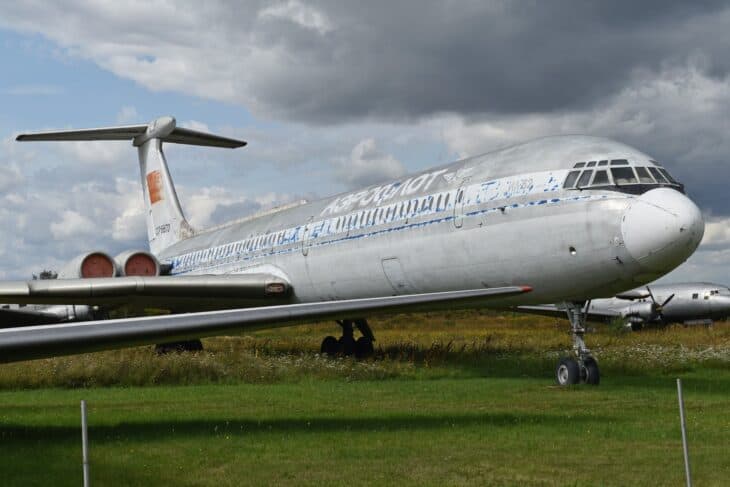
The Ilyushin Il-62 was the Soviet Union’s first long-range jet airliner and, for three decades, the aircraft that carried Aeroflot’s flag across the Atlantic and to Cuba. NATO called it “Classic.” With four engines paired at the tail beneath a T-tail, it looks so much like Britain’s Vickers VC10 that Cold War commentators called it the “VC10-ski.”
The Il-62M covered on this page is the improved version, with quieter and more economical Soloviev D-30KU turbofans. It was built in roughly twice the numbers of the original and makes up almost all of the Il-62s still flying.
At the start of the 1960s, Aeroflot’s longest routes were flown by the Tupolev Tu-114, a fast turboprop, while the Boeing 707 and Douglas DC-8 were setting the standard in the West. Andrei Tupolev’s bureau was busy with other projects, so Sergey Ilyushin’s design bureau took on an intercontinental jet.
The government approved the program in June 1960. Aeroflot’s requirement called for an airliner that could fly nonstop from Moscow to Havana or to Khabarovsk in the Far East, and that matched the 707 and DC-8 on safety, reliability and economics.
The Soviet Union was not yet a member of ICAO, but the design bureau chose to meet ICAO’s main safety requirements anyway. That decision mattered later, when the Il-62 began flying into Western airports.
The first prototype flew in January 1963 with test pilot Vladimir Kokkinaki in command. Its intended Kuznetsov NK-8 turbofans were not ready, so it flew on much less powerful Lyulka AL-7 turbojets, and it was badly underpowered.
On February 25, 1965, that prototype crashed on takeoff at Ramenskoye near Moscow. Ten of the 17 people aboard were killed.
The second prototype received NK-8 engines in 1964 and carried the test program for four years. Series production began at the Kazan aircraft plant, which completed its first production Il-62 in January 1966.
The Il-62 entered Aeroflot passenger service on September 15, 1967, with a flight from Moscow to Montreal. It was the last aircraft designed under Sergey Ilyushin himself; Genrikh Novozhilov succeeded him as general designer in 1970.
Ilyushin began work on an improved version in 1969. The Il-62M swapped the NK-8 for the Soloviev D-30KU, a more powerful and more economical turbofan, and added an extra fuel tank inside the fin.
The changes ran deeper than the engines. The M has a revised flap system, spoilers that work with the ailerons for roll control, a wider range of tailplane trim, better-shaped engine nacelles and a modernized flight deck with improved navigation equipment.
The Il-62M entered Aeroflot service in the early 1970s and took over the longest routes in the network. From July 1978, Kazan also delivered aircraft with a strengthened wing, cleared for a higher takeoff weight and a longer airframe life.
By the factory’s count, 193 of the 292 Il-62s built were the M model. Russian registry tallies give 289 in total, and production records for the last few airframes, completed one at a time after regular series production ended, are not consistent across sources.
The Il-62 is a conventional all-metal, low-wing airliner with four turbofans mounted in pairs on either side of the rear fuselage. Moving the engines off the wing left it aerodynamically clean, kept engine noise away from the cabin and reduced the yaw an engine failure would cause.
The layout has costs. The wing and rear fuselage must be heavier, and a T-tail can be blanketed by the wing at very high angles of attack, the condition known as a deep stall.
The Il-62’s answer is the distinctive “dogtooth” step in the wing’s leading edge. It acts like a fence and a fixed leading-edge device, giving gentle behavior at high angles of attack without the stick shakers and stick pushers that other T-tail jets of the era relied on.
The flight controls are mechanical, using cables, rods and aerodynamic tabs rather than hydraulic boost. Thrust reversers are fitted only to the two outboard engines.
With four heavy engines at the back, an empty Il-62 is tail-heavy on the ground. A small retractable strut extends from the rear fuselage when the aircraft is parked to stop it tipping onto its tail.
The VC10 is the obvious comparison: the two are the only jetliners that entered service with four engines paired at the tail beneath a T-tail. The resemblance led to the “VC10-ski” nickname, but no evidence of copying has ever been presented.
The two aircraft differ in purpose. The VC10 was built to cope with less developed “up-country” airfields, while the Il-62 was designed only for developed airports and kept simpler, mechanical flight controls.
The Il-62 also sold far better: 292 built against 54 VC10s. China and Czechoslovakia both dropped VC10 plans and bought the Il-62 instead.
The full specification table for the Il-62M is on this page. A few of its figures need context.
The range in the panel is the distance the Il-62M covers carrying a modest load, not a full cabin and hold. Jane’s quotes it with a 22,000 lb (10,000 kg) payload; with its maximum payload aboard, the published range drops to about 4,300 nautical miles (8,000 km).
The panel gives speeds in knots, but airliners cruise by Mach number. The Il-62M’s normal cruise works out to Mach 0.80 at 34,400 feet (10,500 m), against a maximum operating Mach number of 0.84.
The seat figure is the high-density maximum. Typical airline layouts carried fewer, and the government VIP aircraft still flying carry far fewer passengers in conference and rest areas.
Aeroflot was by far the largest operator, and the Il-62 became its long-haul flagship to North America and Cuba. Air France, Japan Air Lines and KLM all wet-leased Aeroflot Il-62s for joint long-haul services.
Exports went first to Soviet allies. CSA Czechoslovak Airlines received the first export aircraft in late 1969, and East Germany’s Interflug, Poland’s LOT, Cuba’s Cubana and China’s CAAC all flew the type.
For decades the Il-62 was also the Soviet and Russian leader’s aircraft, carrying every head of state from Leonid Brezhnev to Boris Yeltsin. The Ilyushin Il-96-300 replaced it in that role in 1995.
By the early 1990s, a four-engine narrow-body burned too much fuel per passenger to compete. Aeroflot retired its last Il-62s in 2005. Regular Il-62 passenger flights in Russia ended in late 2008, Interavia, the last Russian commercial operator, stopped flying it in early 2009, and Cubana retired its last examples in 2011.
It belongs to the generation of four-engine passenger planes that opened the jet age, alongside the 707, the DC-8 and the VC10.
The deadliest Il-62 accident was LOT Polish Airlines Flight 5055 on May 9, 1987. An engine shaft disintegrated because of faulty bearings, destroying both left engines and starting a fire that burned through the flight controls, and all 183 people aboard died near Warsaw.
It remains the deadliest air disaster in Polish history. Seven years earlier, on March 14, 1980, LOT Flight 007 had been lost in a similar uncontained turbine shaft failure, killing 87.
After 1987, LOT introduced engine vibration monitoring and shortened its inspection intervals. Russian Wikipedia’s tally, drawn from 2014 fleet data, counts 23 Il-62 accidents that ended in a write-off.
As of April 2026, aeroTELEGRAPH counted 11 Il-62s still flying out of nearly 300 built. None flies scheduled passenger services.
The Russian Aerospace Forces’ 223rd Flight Unit flies Il-62Ms as government and military transports from Chkalovsky near Moscow.
Air Koryo’s fleet lists two in VIP configuration for the North Korean government, one of them in an all-white livery used by Kim Jong Un. Our guide to North Korea’s air force covers the rest of the country’s aging fleet.
Belarus’s Rada Airlines flies two Il-62 freighters, EW-450TR and EW-505TR, and in 2026 began restoring a third, a 1993-built former Gambian government aircraft. Rada has been on the U.S. Treasury sanctions list since 2024.
Yes, in small numbers. As of April 2026, 11 Il-62Ms were still flying, operated by the Russian Aerospace Forces, the North Korean government and the Belarusian cargo airline Rada Airlines. None flies scheduled passenger services.
Vladimir Putin flies in the Ilyushin Il-96-300PU, a highly customized Il-96 used as a command post and VIP transport by the Rossiya Special Flight Detachment. The Il-62 was the Russian leader’s aircraft until 1995, when the Il-96 replaced it.
Pilots and passengers rated it for its stability in turbulence and its quiet cabin, thanks to the rear-mounted engines, and the Il-62M had a reputation in Aeroflot service for high reliability. Its weaknesses were heavy fuel burn, which ended its airline career in the 1990s and 2000s, and two fatal LOT accidents caused by engine failures.
The factory figure is 292: five prototypes, 94 original Il-62s and 193 Il-62Ms. Some Russian registry counts give 289. Only 11 were still flying as of April 2026.
The first prototype flew in January 1963, powered by temporary Lyulka AL-7 turbojets. Sources differ on whether the date was January 2 or January 3. The type entered Aeroflot service on September 15, 1967.
There is no evidence that it was. The two share the same rear-engine, T-tail layout, but they were designed for different jobs, and the Il-62 is larger, uses simpler mechanical controls and was built in far greater numbers.
Four Soloviev D-30KU turbofans, mounted in pairs on either side of the rear fuselage. The original Il-62 used the Kuznetsov NK-8-4, which the D-30KU replaced because it was more powerful and more economical.
Sources and references used for research and fact-checking.