Mid Size Passenger Jets
Embraer E195-E2
ICAO: E295
The re-engined E-Jet that burns about 17 percent less fuel than the E190.
Updated: by Tim de Vries
The latest aviation news and stories sent to your inbox.
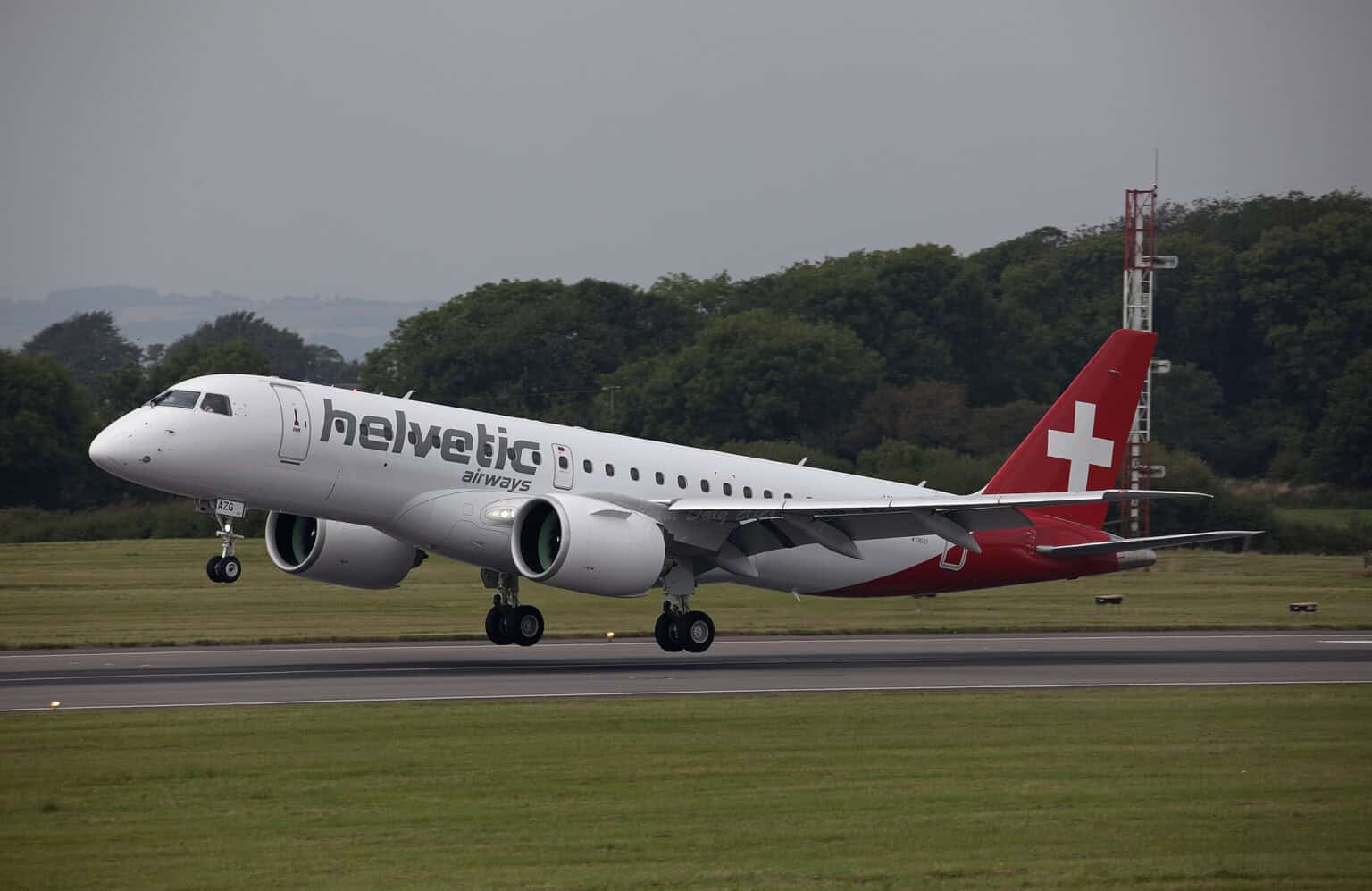
The Embraer E190-E2 is a twin-engine, single-aisle airliner built in Brazil and certified in February 2018. Officially designated the ERJ 190-300, it seats up to 114 passengers in a two-by-two cabin with no middle seat, and it flies on Pratt & Whitney PW1900G geared turbofans that cut fuel burn roughly 17 percent below the first-generation E190. It is the middle member of the E-Jet E2 family, sitting between the E175-E2 and the larger E195-E2.
Live Fleet Activity (E290)
Fetching live data…


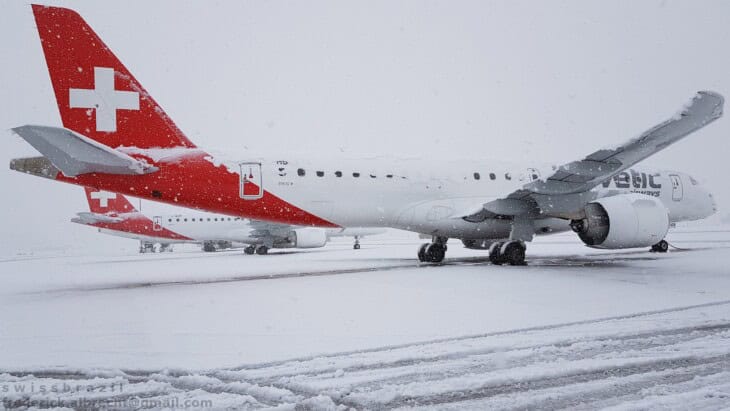
The Embraer E190-E2 is a twin-engine, single-aisle airliner built in Brazil and sold under Embraer’s “Profit Hunter” branding. It carries between 97 and 114 passengers depending on how an airline lays out the cabin, and it first entered service in April 2018.
Officially the aircraft is the ERJ 190-300. The E190-E2 name is a marketing designation, and the type certificate says so in as many words.
It is the middle member of the E-Jet E2 family, sitting between the smaller E175-E2 and the larger E195-E2. The E2s look much like the first-generation E-Jets they replace, but almost everything that matters underneath is new.
The easiest mistake to make with this aircraft is to treat it as a re-engined Embraer 190. The engines are the headline change, but they are not the only one.
The E2 got a new wing with a higher aspect ratio and raked tips, full fly-by-wire flight controls, a new main landing gear, and a redesigned cockpit. The horizontal tail shrank by 26 percent, because closed-loop fly-by-wire holds the aircraft steady without needing as much tail surface to do it.
Those changes compound. Embraer measured fuel burn in flight test at 17.3 percent below the E190, better than the 16 percent it had predicted, and hot-and-high range improved enough that the company revised its published figures upward in early 2018.
Maintenance intervals moved too. Basic inspections stretched from 850 flight hours on the E190 to 1,000 on the E2, and the intermediate check went from 8,500 hours to 10,000.
The E190-E2 is powered by two Pratt & Whitney PW1900G engines, members of the same PW1000G geared turbofan family that powers the Airbus A220 and the A320neo. A reduction gearbox lets the fan turn slowly while the turbine driving it spins fast, so both run near their best efficiency instead of compromising.
The result is a 73-inch fan and a bypass ratio around 12 to 1, roughly double what the E190’s CF34 managed. Big, slow-turning fans are both more efficient and much quieter.
The type certificate approves two ratings on this airframe, the PW1919G and the higher-thrust PW1922G. Most E190-E2s fly on the PW1919G, and the takeoff field length Embraer publishes assumes that standard engine.
Noise was one of the quieter wins. Embraer measured the E190-E2 at 20 EPNdB below the Stage 4 limit, three decibels better than the specification it was designed to.
The E2 keeps the double-bubble fuselage cross-section of the original E-Jets, which is the whole reason these aircraft feel the way they do. Every seat is either a window or an aisle, in a two-by-two layout with no middle seat anywhere in the cabin.
Seats are 18.3 inches wide, which is wider than the economy seat on most mainline narrowbodies, and the aisle is 1 ft 7 in (0.49 m) across. Embraer’s own cabin drawings show 2 cubic feet of overhead bin space and 1.4 cubic feet of underseat volume per passenger.
There is no single E190-E2 seat map, because the certified layouts differ sharply. Embraer’s nominal single-class arrangement is 104 seats at 31-inch pitch, the maximum certified layout is 114 seats at 29-inch pitch, and a three-class version carries 97 with nine business seats, 20 premium economy and 68 economy.
Airlines pick their own point on that scale. Helvetic Airways took its first aircraft in a 110-seat single-class layout, while carriers that sell a business cabin run closer to 96 or 97 seats.
Business class on the E190-E2 is usually a blocked-middle arrangement in name only, since there is no middle seat to block. Operators instead fit a wider seat with more pitch in the forward rows.
Below the floor sit two class C cargo compartments, one forward of the wing and one aft, with the aft compartment reached through its own door on the right side.
The flight deck is built around Honeywell’s Primus Epic 2 suite, with large landscape-format displays and graphics well beyond what the first-generation E-Jets showed. Embraer chose it partly to keep commonality with the E1 cockpit.
Flight controls are full fly-by-wire, with the primary flight control system supplied by Moog. The E190-E2 also carries envelope protection, including high angle-of-attack protection, which required its own set of EASA special conditions during certification.
The aircraft is certified for Category II and Category III fail-passive autoland without rollout guidance, and a runway overrun awareness and alerting system is available as an option.
Minimum flight crew is two pilots. Usefully for operators, the type rating is the shared “EMB170” endorsement, so the ERJ 190-300 and the ERJ 170 series are variants of the same type for licensing purposes.
The full specification table for the aircraft is on this page. Four of the figures in it are worth explaining, because the way they are measured is not obvious.
Range first. Embraer’s 2,950 nm figure is with a full passenger load, long-range cruise, typical reserves and a 100 nm alternate, so it is a realistic number rather than a ferry figure. Third-party references sometimes print a lower value, usually because they are quoting an older pre-2018 specification.
Speed next. The panel stores knots, but Embraer publishes this aircraft in Mach, and the two cruise settings that matter are Mach 0.82 maximum and Mach 0.78 normal cruise, both quoted at 35,000 ft.
Takeoff and landing distances are field lengths, not ground rolls, and both assume a dry, level, paved runway at sea level in standard atmosphere. The takeoff figure is at maximum weight. On a typical 500 nm sector with a full cabin, the same aircraft needs about 3,773 ft (1,150 m).
Fuel capacity is worth a note because published values disagree. Embraer states maximum usable fuel as a weight, and converting it depends on the density assumed, so the same tank is quoted as 4,440 US gallons in the 2018 planning manual and closer to 4,500 in the current spec sheet.
The E190-E2 is a better aircraft than the E190 by essentially every technical measure, and it has sold far worse. That contradiction is the most interesting thing about it, and almost no spec page explains it.
Part of the answer is American labor contracts. Scope clauses in mainline pilot union agreements cap the takeoff weight of aircraft a regional partner may operate at 39,000 kg, and the E190-E2 is well above that ceiling, so the huge US regional market that absorbed hundreds of E175s is closed to it.
That barrier also killed the smallest E2. SkyWest ordered 100 E175-E2s as launch customer in 2013, then cancelled in late 2018 because the aircraft was too heavy to fly under scope, and the E175-E2 has now slipped past 2027 for lack of demand.
The other half of the answer is the Airbus A220-100, which lands in the same seat count with a wider cabin and the backing of Airbus’s sales organization. Against that, the E190-E2 has struggled to win campaigns outside its niche.
Buyers who want an E2 have mostly wanted a bigger one. Embraer had delivered 38 E190-E2s by July 2026 against 175 of the stretched E195-E2, out of 532 E2 family orders and 213 deliveries overall.
The operator list reflects exactly what the scope clause problem predicts. There are no US regional carriers on it, and the airlines that do fly the type use it on thin routes where a full narrowbody would go out half empty.
In mid-2026 about 32 E190-E2s were in commercial service with seven airlines. Scoot flew nine, Helvetic Airways eight, Royal Jordanian and Virgin Australia Regional Airlines four each, Widerøe three, and Hunnu Air and Placar Linhas Aéreas two each.
Widerøe was the launch operator, taking the first aircraft on 24 April 2018 for Norwegian regional flying. Helvetic followed in October 2019 and flew its first revenue service the next day, a 95-minute leg from Zürich to Bremen.
Air Astana was an early customer too, receiving its first E190-E2 in December 2018 to replace older E190LRs on domestic and regional routes.
Embraer put the E190-E2 unit cost at 53.6 million dollars when it launched the program in 2013, and that figure is still the one most often quoted. It has not been meaningfully refreshed since, because Embraer, like Airbus and Boeing, stopped publishing list prices.
List prices were never what airlines paid anyway. Fleet buyers routinely take deep discounts, and a newly delivered E190-E2 was appraised around 34 million dollars in 2018.
Embraer launched the E2 program at the Paris Air Show in June 2013. The first E190-E2 was rolled out on 25 February 2016 and flew from São José dos Campos on 23 May that year, three months ahead of schedule.
That first flight lasted three hours and twenty minutes, reached Mach 0.82 and climbed to 41,000 ft with the fly-by-wire in normal mode. The program ran unusually cleanly, helped by heavy use of simulation and static test rigs early on.
Certification came from Brazil’s ANAC, the FAA and EASA on the same day, 28 February 2018, after roughly 46,000 hours of ground testing and 2,200 hours in the air.
The E190-E2 has been in airline service since 2018 and has not been involved in a fatal accident. The wider E-Jet family it descends from has a strong safety record across more than two decades and thousands of aircraft.
The E2 was certified to the same transport-category standards as any Airbus or Boeing airliner, under Brazilian RBAC 25, US 14 CFR Part 25 and European CS-25. Three authorities reviewed it independently and certified it on the same date.
Yes. Both the E190 and the newer E190-E2 are well regarded by airlines for reliability and by passengers for the two-by-two cabin, which means no middle seats. The E2 improves on the original with quieter geared turbofan engines, roughly 17 percent lower fuel burn and longer maintenance intervals.
Yes. The E190-E2 has flown in commercial service since April 2018 without a fatal accident, and it was certified simultaneously by ANAC in Brazil, the FAA in the United States and EASA in Europe on 28 February 2018. It also carries fly-by-wire envelope protection, including high angle-of-attack protection, that the first-generation E190 did not have.
Both build to the same certification standards, so neither manufacturer is inherently safer than the other. Embraer’s E-Jet family has an excellent record, and the E190-E2 specifically has no fatal accidents, but the fleet is small and young compared with Boeing’s, which makes a direct statistical comparison unreliable.
Yes. The original E190 has been flying since 2005 with well over a thousand aircraft delivered across the E-Jet family, and it is considered one of the safer regional airliners in service. The E190-E2 that replaced it adds full fly-by-wire flight controls and envelope protection.
The E2 is a substantially new aircraft rather than a refresh. It has geared turbofan engines instead of CF34s, a new higher-aspect-ratio wing with raked tips, full fly-by-wire controls, a 26 percent smaller horizontal tail and a new cockpit, and it burns about 17 percent less fuel than the E190.
It is certified for a maximum of 114 passengers at 29-inch pitch. Embraer’s nominal single-class layout is 104 seats at 31-inch pitch, and a three-class cabin carries 97, with nine business, 20 premium economy and 68 economy seats.
Two-by-two throughout, with a single aisle and no middle seat, so every passenger gets a window or an aisle. Seats are 18.3 inches wide and the aisle is 1 ft 7 in (0.49 m) across.
The program was launched in June 2013, the aircraft first flew on 23 May 2016, and it was certified on 28 February 2018. It entered commercial service on 24 April 2018 with the Norwegian airline Widerøe.
Embraer quoted a unit cost of 53.6 million dollars in 2013, which remains the most commonly cited figure. Airlines pay considerably less in practice, and a newly delivered aircraft was appraised at about 34 million dollars in 2018.
Embraer S.A. of São José dos Campos, Brazil, builds it. The company is the third-largest commercial aircraft manufacturer in the world after Airbus and Boeing.
Scoot, Helvetic Airways, Royal Jordanian, Virgin Australia Regional Airlines, Widerøe, Hunnu Air and Placar Linhas Aéreas operated the type in mid-2026. No US regional carriers fly it, because its takeoff weight exceeds the scope clause limits in American mainline pilot contracts.
Two Pratt & Whitney PW1900G geared turbofans, from the same engine family as the A220 and A320neo. The type certificate approves both the PW1919G and the higher-thrust PW1922G, with the PW1919G as the standard fit.
The ICAO type designator is E290, with the description code L2J and a medium wake turbulence category. The IATA code is 290, and the official model designation on the type certificate is ERJ 190-300.
Sources and references used for research and fact-checking.