


Table of Contents
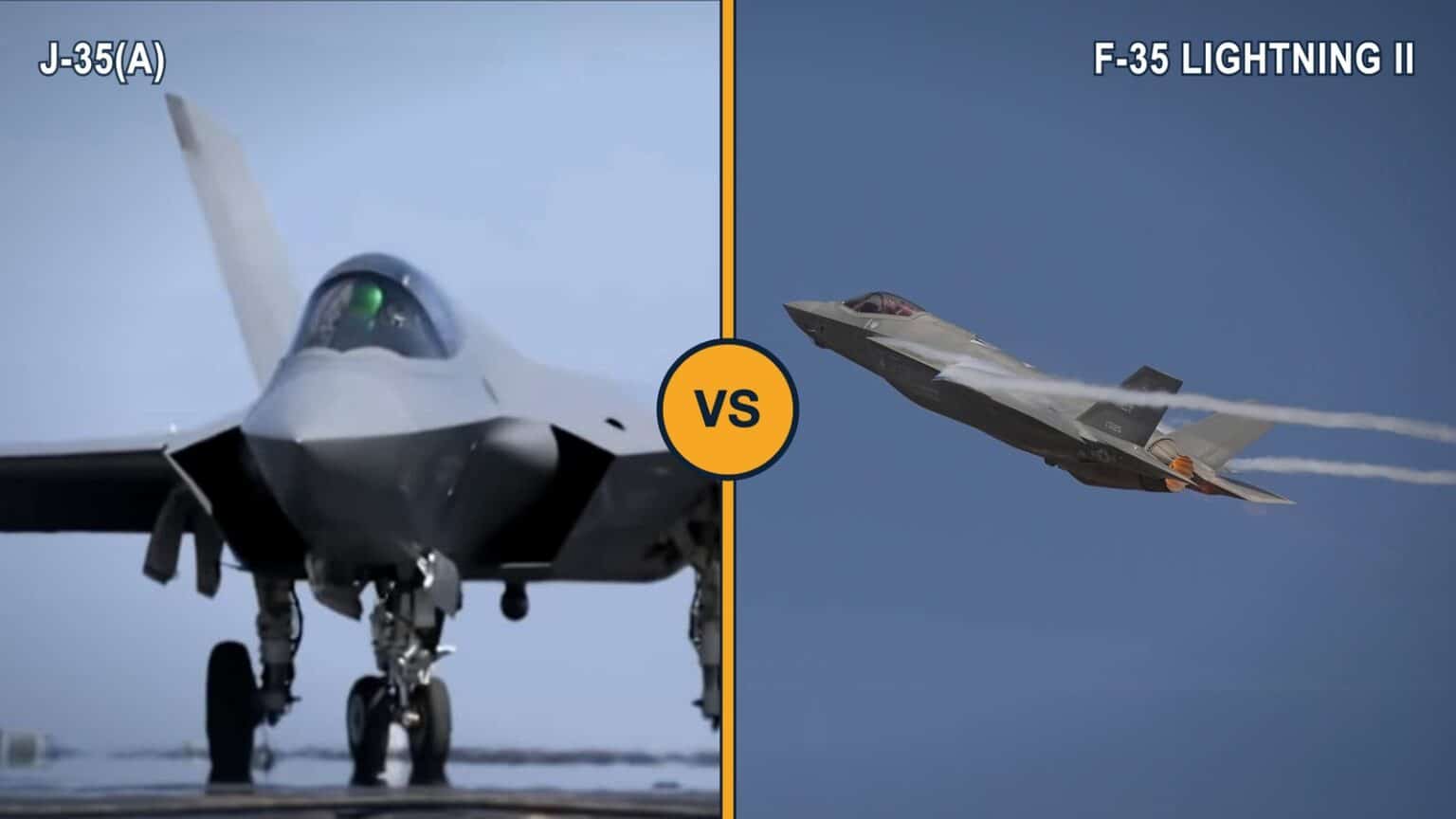
| Measure | F-35A Lightning II | Shenyang J-35A |
|---|---|---|
| Layout | Single engine, one airframe in three variants | Twin engine, naval J-35 and land-based J-35A |
| Origin | Joint Strike Fighter program, first built in 2006 | Private FC-31 venture, first flown in 2012 |
| Internal missiles | 4 (6 with Sidekick, Block 4) | Up to 6 reported (PL-15E, PL-10) |
| Internal gun | 25 mm GAU-22/A, 180 rounds | None confirmed |
| Radar | AN/APG-81, in service | Not disclosed |
| Flyaway cost, latest lot | $92.0 million (Lots 18-19) | Not published |
| Production | 1,355+ delivered (Sept 2026) | 57+ estimated (Oct 2025) |
| Operators | 20+ countries | China only; no export delivered |
| Combat use | Yes, since 2018 | None |
How to read this comparison
Every F-35 figure here is official. Nearly every J-35 figure is an estimate built from photographs and state media, because China publishes very little. Neither jet has fought the other. The spec panel above compares the F-35A, the Air Force version, with the land-based J-35A.
Is the J-35 a copy of the F-35?
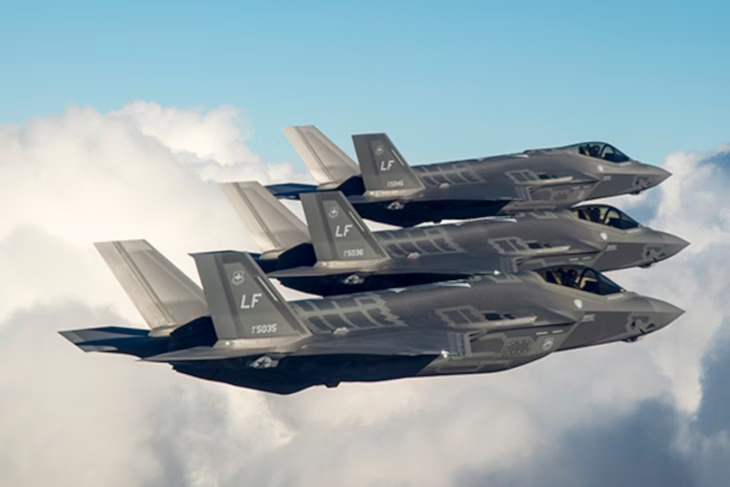
The resemblance is real. Both are medium-sized fifth-generation fighters with canted twin tails and side-mounted inlets, and Chinese cyberespionage against the F-35 program is documented.
But the J-35 is a different aircraft. It has two engines where the F-35 has one, and it began life as the privately funded FC-31, which first flew in October 2012, before the F-35 was in service.
Analysts note that the twin-engine KF-21 and India’s AMCA converged on a similar layout without any theft, because similar requirements push designers toward similar answers. Stolen data is considered more likely to have helped with subsystems than with the airframe.
Two different programs
The F-35 Lightning II is one design in three versions from one production line: conventional, short takeoff and carrier. Lockheed Martin had delivered more than 1,355 by September 2026.
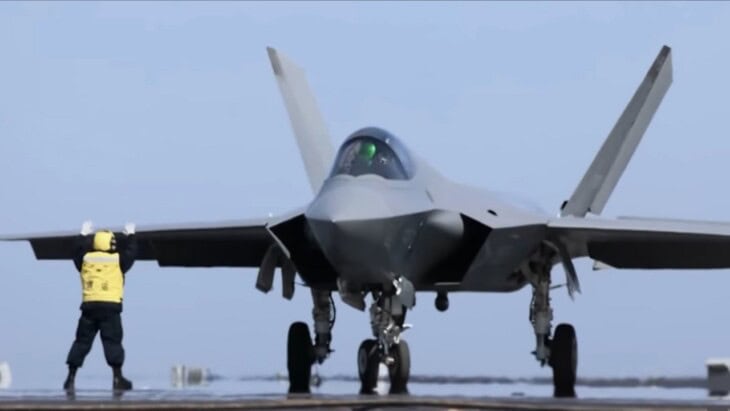
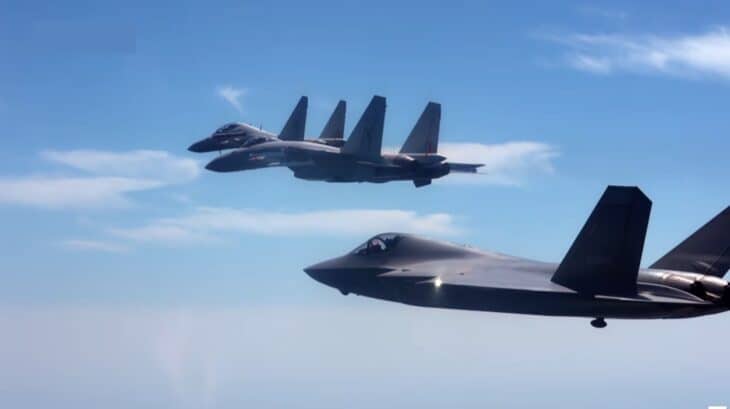
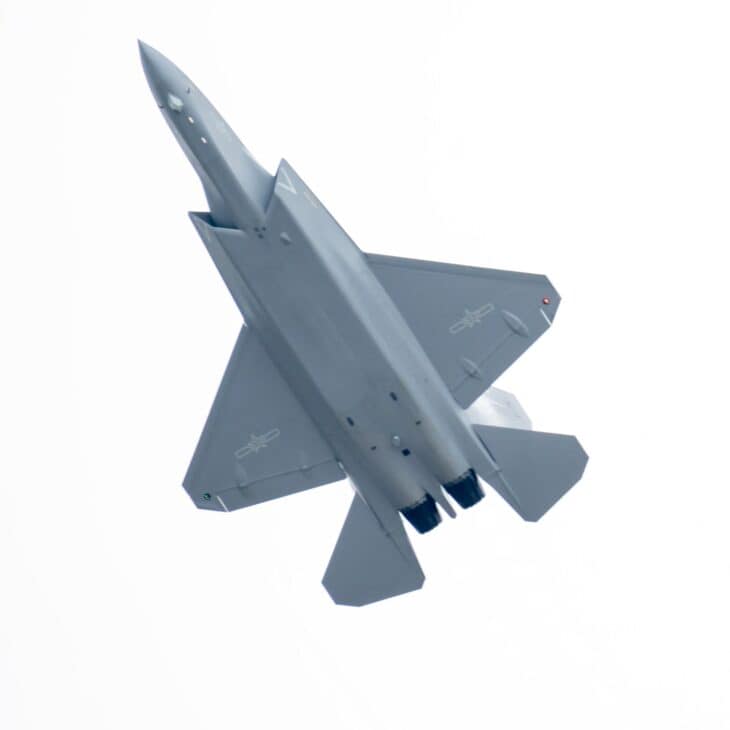
The Shenyang J-35 split in two. The naval J-35 has a catapult launch bar, a tailhook, folding wings and a larger wing area. The J-35A drops all of that, with a smaller wing and single-wheel nose gear.

Engines: the J-35’s open question
The F-35A has one Pratt & Whitney F135 making 43,000 lb of thrust. The J-35 has two engines, and that is its most visible difference.
Production J-35s are generally assessed to fly on the Chinese WS-21, at 87.2 to 93 kN per engine. The intended engine is the WS-19, rated at 116 kN, which is expected to allow supercruise.
As of September 2026 there is no official statement that production aircraft use the WS-19. In February 2026 Defence Blog relayed one Chinese commentator’s claim that a J-35 on the current engine can loiter only about seven minutes at 560 miles (900 km) from its carrier. That is one assessment, not a released figure.
Edge: F-35, because its engine is the one it was designed around.
Stealth and sensors
Aviation Week has reported the F-35’s radar cross-section at about 0.001 square meters, roughly the return of a golf ball. That figure is an analogy from an interested party.
China’s state broadcaster CCTV said in September 2025 that the J-35 series has a radar cross-section smaller than a human palm. That is also a claim from the manufacturer’s own side, and no independent measurement exists for either jet.
The J-35 has the standard stealth features: edge alignment, chines, serrated panel edges, diverterless inlets and serrated nozzles. The radar advertised for the FC-31 was the KLJ-7A, reportedly comparable to the F-35’s APG-81, but what production aircraft carry has not been disclosed.
The sensor layout is known: a chin-mounted electro-optical turret and optical apertures around the airframe. The F-35 has the same idea, proven in service since 2018, with every jet sharing one fused picture.
Edge: F-35, on what can be verified.
Myth: the J-35 is stealthier than the F-35
Chinese media have claimed the J-35 beats the F-35 on radar signature. The claim rests on a state broadcaster’s statement, with no measurement behind it. Neither government releases the data that would settle it, so no ranking of the two on stealth is supported.
Weapons
The F-35A has four internal stations. In an air-to-air setup that usually means four AIM-120s, and the Sidekick rack offered with Block 4 raises it to six.
The J-35 is credited with six internal hardpoints. The PL-15E with folding fins shown at Zhuhai in 2024 lets six fit in a bay that previously held four, and designers told CCTV in 2025 that the carrier jet carries up to six missiles.

The F-35A carries a 25 mm GAU-22/A cannon with 180 rounds. No gun has been confirmed on either J-35 variant.
Edge: even, with the F-35 ahead on proven weapons integration.
Speed and range
The J-35’s published limit is Mach 1.8 at altitude, about 1,188 mph (1,911 km/h). The Air Force lists the F-35A at Mach 1.6, about 1,200 mph. The two are close.
Figures near 2,200 km/h for the J-35 come from applying a high-altitude Mach limit at sea-level conditions. The same source gives a sea-level maximum of Mach 1.14.
No range has been published for the J-35, only a combat radius of roughly 780 miles (1,250 km) on internal fuel. The F-35A’s published range is 1,380 miles. A radius is not a range, so the two cannot be compared directly.
Edge: F-35, on published figures.
Carrier operations
The J-35 is the first Chinese stealth fighter flown from an electromagnetic catapult. On 22 September 2025 state media showed J-35, J-15T and KJ-600 aircraft launching from the carrier Fujian, commissioned on 5 November 2025.
The claim that this was a world first does not hold. F-35Cs of the Navy’s VX-23 flew catapult launches and arrested landings aboard USS Gerald R. Ford in 2022.
The F-35C is in squadron service. As of September 2026 no carrier strike group deployment with an embarked J-35 squadron has been documented.
Edge: F-35, though the J-35 is learning the job fast.
Numbers, cost and exports
The F-35A costs $92.0 million per aircraft in Lots 18 and 19. China has not published a J-35 price.
The most-quoted J-35 count is more than 57 aircraft as of October 2025, read from serial numbers on state television footage. It is an inference, not an official figure.
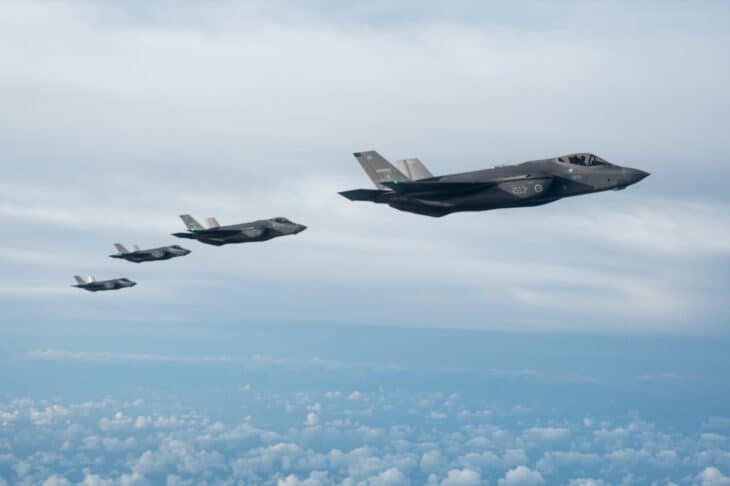

The J-35AE, an export version of the J-35A, was unveiled on 1 May 2026. Pakistan is the customer everyone names, but its defense minister dismissed sale reports in June 2025. The Diplomat concluded in July 2026 that China is not selling the J-35A to Pakistan yet.
Edge: F-35 by a wide margin.
J-35 vs F-35 vs J-20 and F-22
The J-35 is China’s second stealth fighter after the J-20, which is larger, longer-ranged and built for a different job. Our F-35 vs J-20 comparison covers that matchup.
The F-22 is the F-35’s air-superiority stablemate. See our US vs China fighter jets comparison for the wider picture, and our list of the best Chinese fighter jets.
The verdict
The F-35 is the better fighter today. It has a combat record, a mature production line, proven sensors and a catapult carrier version already in service.
The J-35 is the more interesting question for the future. Its gaps are an interim engine, a production rate still ramping and an air wing still qualifying, not aerodynamics. If the WS-19 arrives and numbers grow, the comparison tightens.
Both appear in our ranking of the best fighter jets in the world.
FAQ
Sources and references used for research and fact-checking.
- U.S. Air Force, F-35A Lightning II fact sheet
- Wikipedia, Lockheed Martin F-35 Lightning II
- Lockheed Martin, F-35 Fast Facts
- Air & Space Forces Magazine, What Each F-35 Variant Really Costs Right Now
- Wikipedia, Shenyang J-35
- The Diplomat, Assessing the J-35A, the Chinese Air Force's New Stealth Fighter
- The Diplomat, Why China Will Not Sell 5th-Generation J-35 Fighter Jets to Pakistan Yet
- Defence Blog, Chinese J-35 face engine restrictions on Fujian carrier
- Wikipedia, Chinese aircraft carrier Fujian
- South China Morning Post, China's J-35 Fighter Jet Stealthier Than US F-35
About the Author

Tim is the owner and lead editor of AeroCorner since 2019, overseeing aviation content covering aircraft, airlines, airports, and the broader aviation industry. Through years of researching, writing, editing, and publishing aviation-focused content, he has developed extensive practical knowledge of commercial aviation and air travel. Based in Asia and a frequent traveler himself, Tim also brings firsthand passenger experience to AeroCorner’s coverage. Outside of publishing, he has also explored aviation firsthand through hands-on flight training in New Zealand.