

Table of Contents
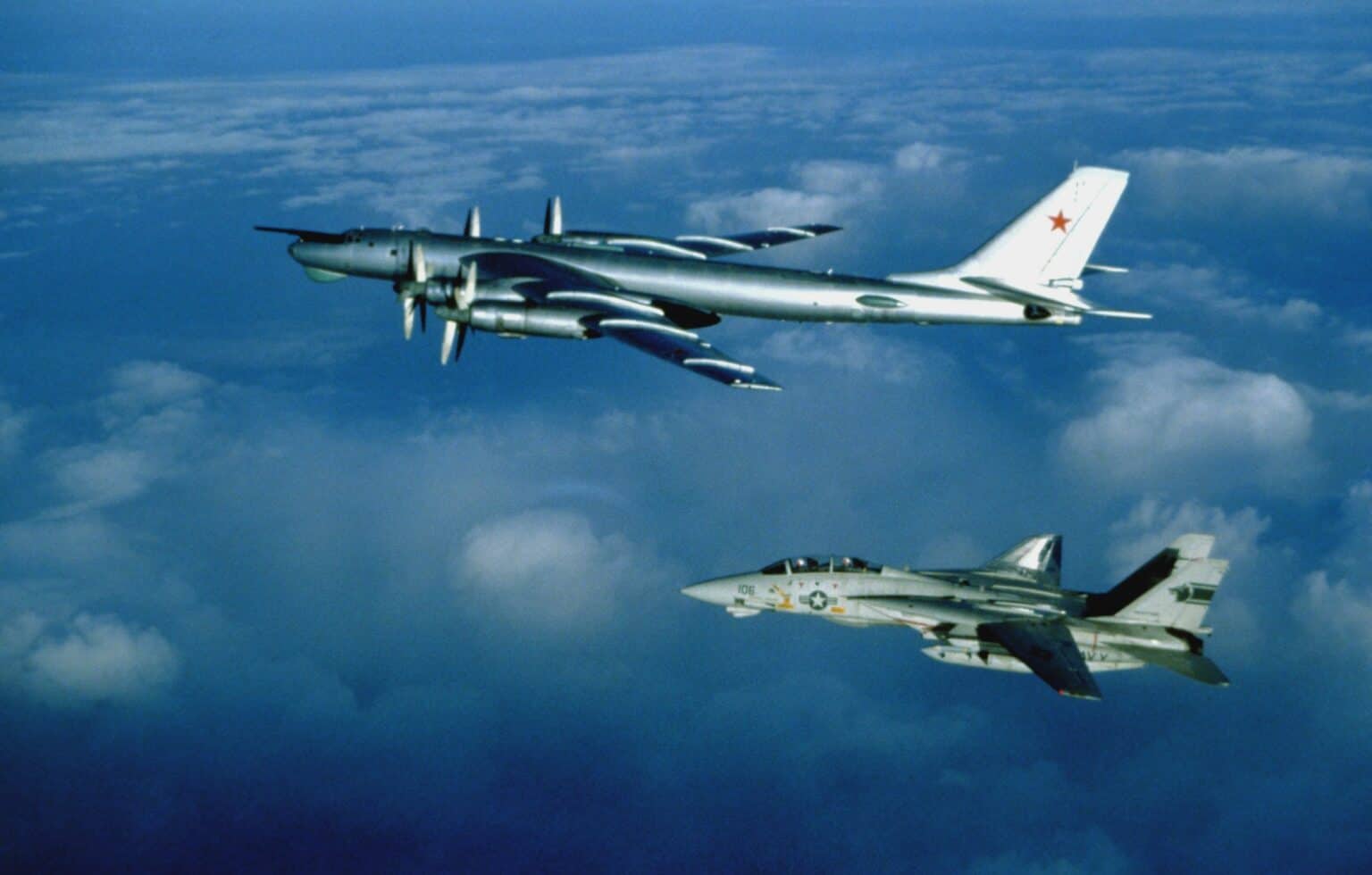
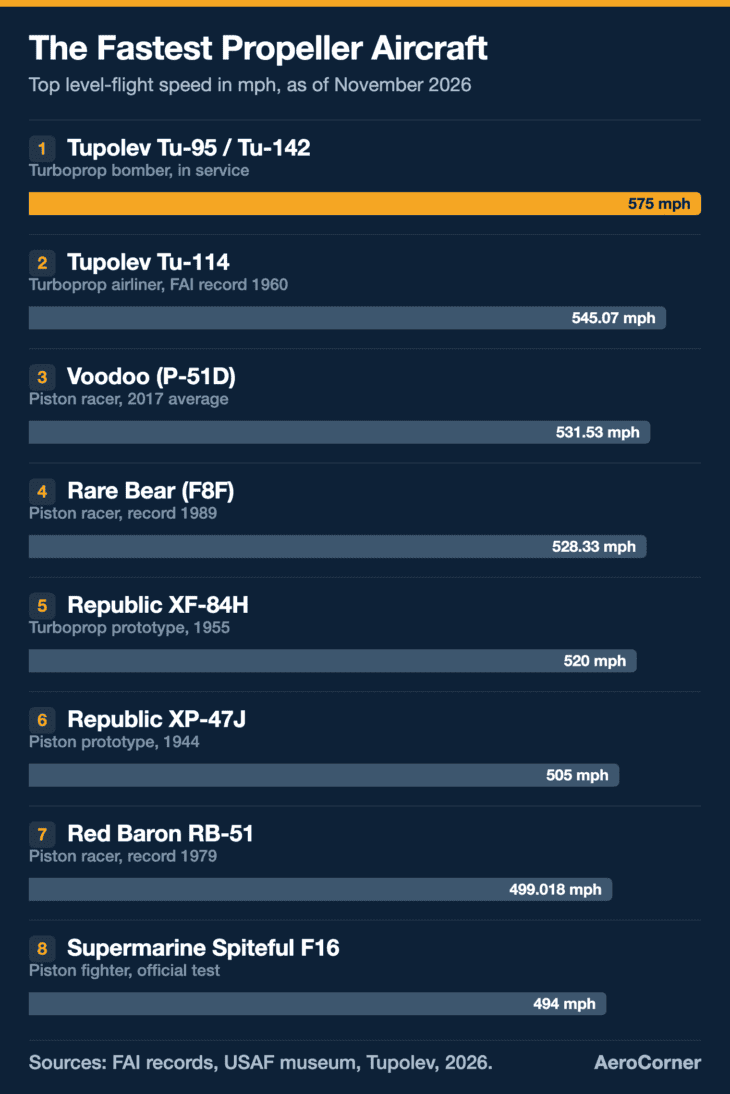
The fastest propeller plane ever built is the Tupolev Tu-95 “Bear,” a Soviet strategic bomber with a maximum speed of 575 mph (925 km/h). It first flew in 1952, and Russia still flies it in November 2026.
The fastest propeller speed ever certified as a record belongs to its airliner cousin, the Tu-114, which the FAI (the world air sports body that ratifies records) credits with 545.07 mph (877.21 km/h) around a 5,000 km closed circuit in April 1960.
Piston engines are a separate race. The official record is Rare Bear’s 528.33 mph (850.26 km/h) from 1989, although a P-51 Mustang called Voodoo averaged 531.53 mph (855.41 km/h) in 2017. Below, every contender is ranked by the highest speed it reached in level flight.
| Rank | Aircraft | Top level speed | Engine type | Status |
|---|---|---|---|---|
| 1 | Tupolev Tu-95 / Tu-142 Bear | 575 mph (925 km/h) | Turboprop | In service |
| 2 | Tupolev Tu-114 | 545.07 mph (877.21 km/h), FAI record | Turboprop | Retired 1970s |
| 3 | Voodoo (modified P-51D) | 531.53 mph (855.41 km/h), average | Piston | Racer |
| 4 | Rare Bear (modified F8F Bearcat) | 528.33 mph (850.26 km/h), record | Piston | Not raced since 2015 |
| 5 | Republic XF-84H Thunderscreech | 520 mph (837 km/h) | Turboprop | Museum piece |
| 6 | Republic XP-47J | 505 mph (813 km/h) | Piston | One prototype, 1944 |
| 7 | Red Baron RB-51 | 499.018 mph (803 km/h), record | Piston | Crashed 1979 |
| 8 | Supermarine Spiteful F Mk 16 | 494 mph (795 km/h) | Piston | Test aircraft |
| 9 | Airbus A400M Atlas | 485 mph (781 km/h) cruise | Turboprop | In service |
| 10 | Conquest 1 (modified F8F Bearcat) | 483.04 mph (777.38 km/h), record | Piston | Racer |
| 11 | Messerschmitt Me 209 V1 | 469.22 mph (755.14 km/h), record | Piston | Record aircraft, 1939 |
| 12 | Piaggio P.180 Avanti | 460 mph (740 km/h) | Turboprop | In service |
| 13 | Rolls-Royce Spirit of Innovation | 345.4 mph (555.9 km/h), record | Electric | Record aircraft, 2021 |
How this ranking works
Every aircraft is ranked by the highest speed it reached in level flight. Where the FAI ratified a record, that figure is used; otherwise the number comes from official flight tests or the manufacturer. Speeds reached in a dive are left out, and so are point-to-point records, which measure speed over the ground and can be inflated by a tailwind. Jets, rockets and helicopters are covered in their own rankings.
This list covers every kind of propeller aircraft at once, from turboprop bombers to piston racers to an electric record plane. For the jets and rocket planes that leave all of them behind, see the fastest aircraft in the world.
1. Tupolev Tu-95 and Tu-142 Bear: 575 mph (925 km/h)
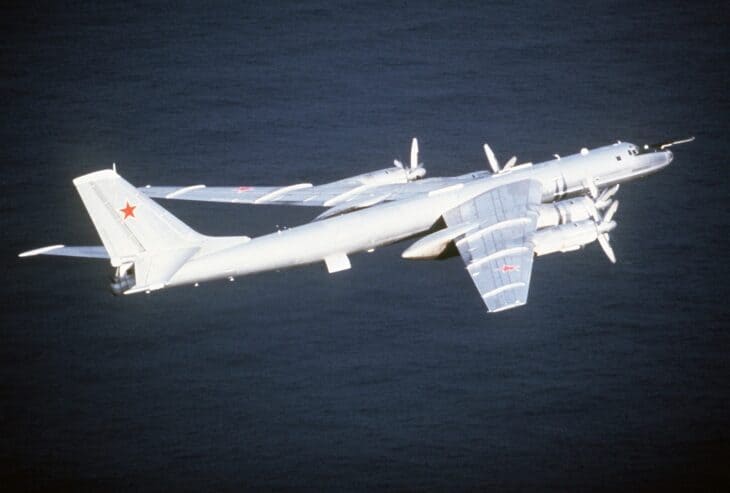

The Tupolev Tu-95 is the fastest propeller aircraft ever to enter service. The Tu-95MS bomber is rated at a maximum speed of 575 mph (925 km/h), and the Tu-142M3 maritime patrol version carries the same figure.
It gets there with four Kuznetsov NK-12 turboprops of about 15,000 hp each, every one turning a pair of contra-rotating propellers. Swept wings let it fly closer to the speed of sound than a straight-winged propeller plane can, and it is the only propeller-driven aircraft with swept wings built in large numbers.
More than 500 were built between 1952 and 1993. Russia still operates the Tu-95MS and expects to keep it until at least 2040, which would put the design in service for more than 80 years.
Its propeller tips go supersonic
At full power the tips of the Tu-95’s propeller blades move faster than the speed of sound, which makes it one of the loudest military aircraft ever flown.
2. Tupolev Tu-114: 545.07 mph (877.21 km/h)

The Tupolev Tu-114 took the Tu-95’s wings, tail and engines and gave them a wide passenger fuselage. It first flew on November 15, 1957, and 32 were built.
On April 9, 1960, pilots Ivan Sukhomlin and Konstantin Sapielkine flew a Tu-114 around a 5,000 km closed circuit at 545.07 mph (877.21 km/h). The FAI lists it as the fastest propeller-driven airliner-size aircraft.
Its normal cruise was about 480 mph (770 km/h). Aeroflot flew it on long routes from 1961 until it was retired in the 1970s.
3. Voodoo: 531.53 mph (855.41 km/h)
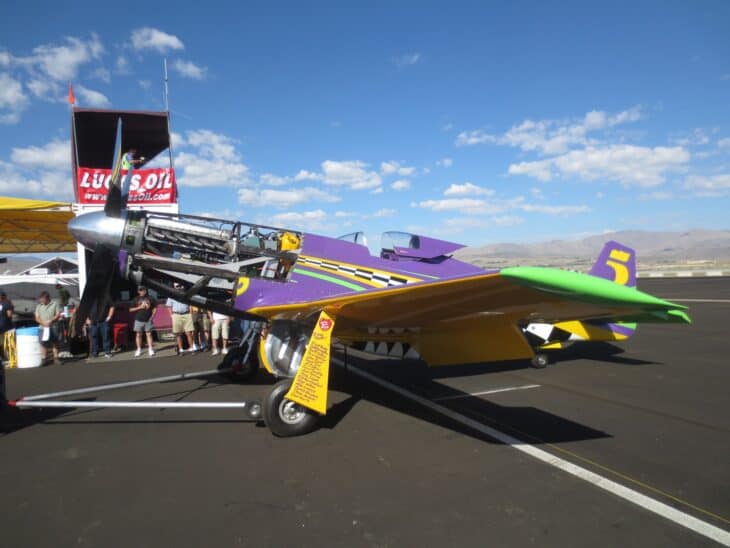

Voodoo is a heavily modified P-51D-25 Mustang, a World War II fighter rebuilt as an Unlimited-class air racer. On September 2, 2017, Steve Hinton Jr. flew it over a 3-kilometer course near Challis, Idaho.
Its four runs averaged 531.53 mph (855.41 km/h), and the fastest single pass reached 554.69 mph (892.69 km/h). That broke the record for its weight class (FAI class C-1e), set by the Yak-3U Steadfast in 2012.
That is the fastest 3-kilometer average yet flown by a piston airplane. It did not erase Rare Bear’s outright record, though, because a new record has to beat the old one by at least 1%, and that meant 533.6 mph.
4. Rare Bear: 528.33 mph (850.26 km/h)
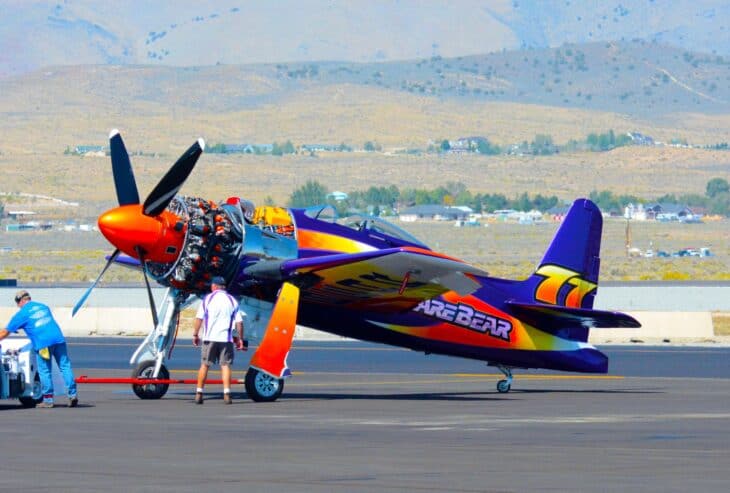

Rare Bear started life as a 1946 Grumman F8F Bearcat. Its racing team replaced the engine with a Wright R-3350 from a Douglas Skyraider, a bigger engine than the Pratt & Whitney R-2800 the airframe was designed around.
On August 21, 1989, it set the 3-kilometer record at 528.33 mph (850.26 km/h). That record still stands in its class as of November 2026.
Rare Bear also set a time-to-climb record in 1972, reaching 3,000 meters (9,842 feet) in 91.9 seconds. It has not raced since finishing second in 2015.
5. Republic XF-84H Thunderscreech: 520 mph (837 km/h)
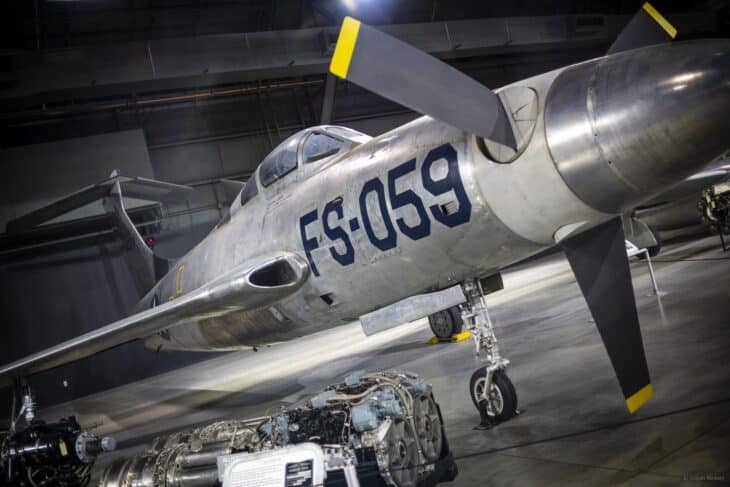

The XF-84H was a US Air Force experiment powered by a single 5,850 hp Allison XT40 turboprop. Only two were built, and they made 12 test flights from Edwards Air Force Base starting on July 22, 1955.
Its 12-foot (3.7 m) propeller spun so fast that the blade tips reached about Mach 1.18. Ground run-ups could reportedly be heard 25 miles (40 km) away, and ground crews reported nausea and headaches.
Pilot Hank Beaird flew it 11 times, and 10 of those flights ended in forced landings. The surviving prototype is on display at the National Museum of the US Air Force near Dayton, Ohio.
Was the XF-84H really the fastest propeller plane?
Guinness once listed the XF-84H as the fastest propeller-driven aircraft ever built, at 623 mph (1,003 km/h). That figure has never been verified. The Air Force museum that owns the surviving airframe gives its top speed as 520 mph (837 km/h), and its 670 mph design speed was never reached. Both Tupolevs flew faster.
6. Republic XP-47J: 505 mph (813 km/h)
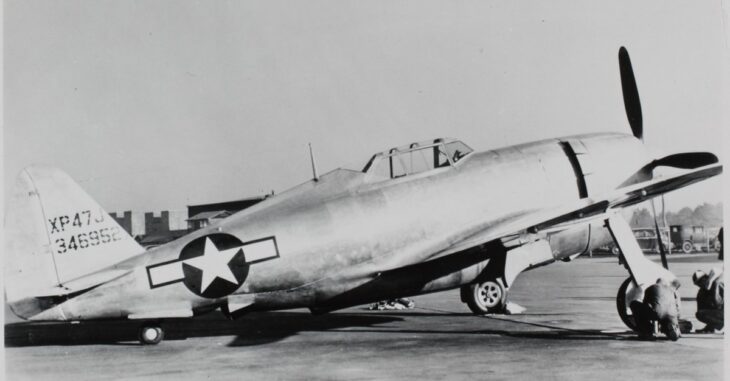

The XP-47J was a high-speed version of the P-47 Thunderbolt, with a 2,730 hp Pratt & Whitney R-2800 and a turbosupercharger. On August 4, 1944, pilot Mike Ritchie flew it to 505 mph (813 km/h) at 34,450 feet.
That is the highest level-flight speed recorded by any propeller aircraft during World War II. Only one was built.
Official documents disagree slightly: the Army Air Forces’ performance summary lists 507 mph and Republic’s own test report lists 502 mph. For the rest of the wartime field, see our ranking of the fastest planes of WW2.
7. Red Baron RB-51: 499.018 mph (803 km/h)
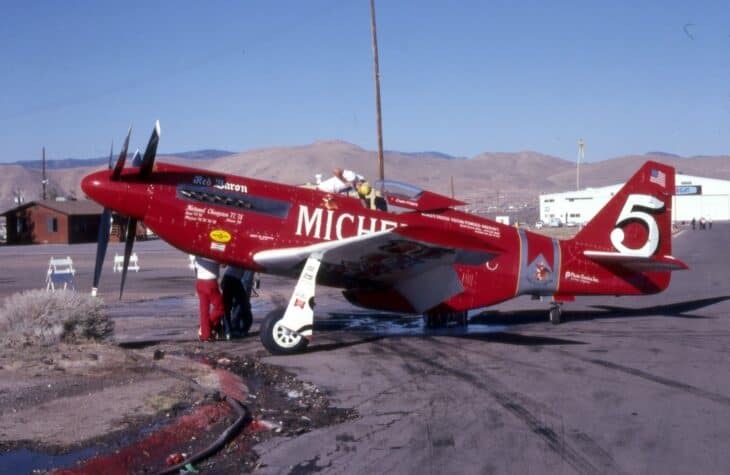

Red Baron was a P-51 Mustang rebuilt with a 3,000 hp Rolls-Royce Griffon V-12 and six-bladed contra-rotating propellers, both taken from an Avro Shackleton patrol bomber. On August 14, 1979, Steve Hinton flew it to a 3-kilometer record of 499.018 mph at Tonopah, Nevada.
The team had hoped for 100-degree desert air and believed it could reach 530 mph. The cool 68-degree air held it just under 500 mph.
A month later, on September 16, 1979, a mechanical failure at the Reno Air Races sent the propellers to flat pitch, and the aircraft crashed short of the runway. Hinton survived with a broken back, leg and ankle.
8. Supermarine Spiteful F Mk 16: 494 mph (795 km/h)
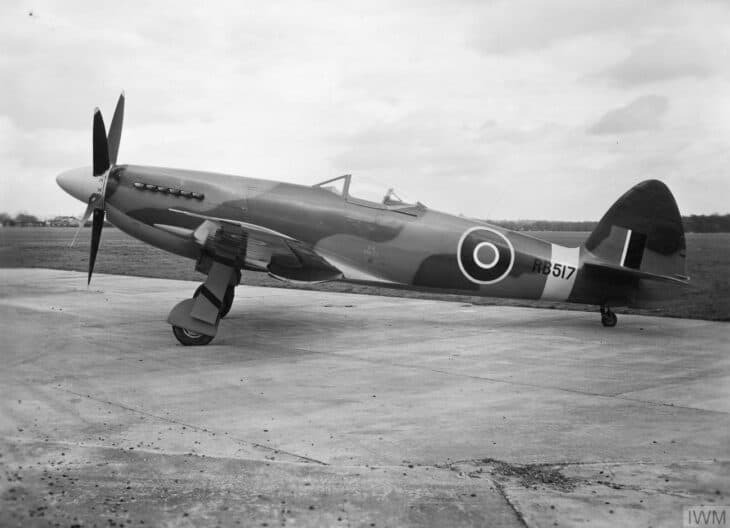

The Spiteful was Supermarine’s planned successor to the Spitfire, with a new laminar-flow wing. In official tests at Boscombe Down, the F Mk 16 reached 494 mph (795 km/h) at 28,500 feet in level flight.
It was a production-standard fighter, not a stripped-down racer or a one-off prototype. Only 19 were built, and none saw squadron service.
9. Airbus A400M Atlas: 485 mph (781 km/h) cruise

The Airbus A400M Atlas is a modern four-engine military airlifter. It cruises at 485 mph (781 km/h) at 31,000 feet, and its maximum operating speed is Mach 0.72.
Its four Europrop TP400-D6 turboprops make about 11,000 hp each, and the A400M first flew on December 11, 2009. Its everyday cruise is faster than the Me 209’s 1939 absolute world speed record.
10. Conquest 1: 483.04 mph (777.38 km/h)
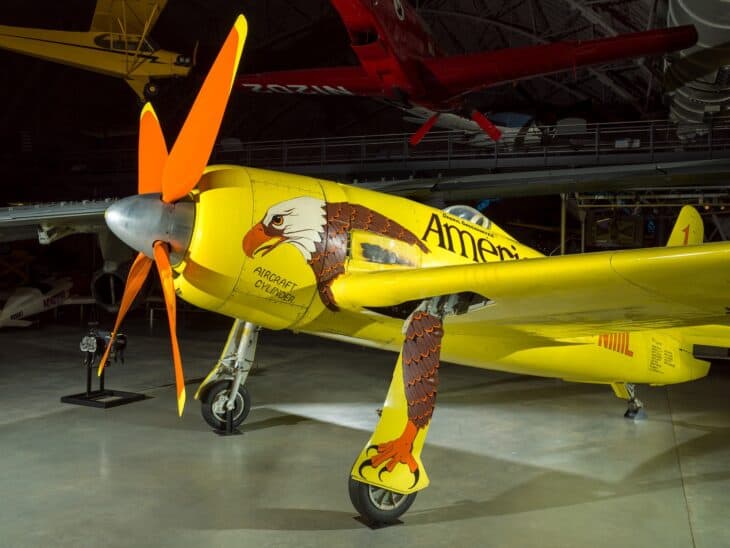

Conquest 1 was another racing Bearcat, flown by Darryl Greenamyer. On August 16, 1969, he set a 3-kilometer record of 483.04 mph (777.38 km/h).
That broke the 30-year-old piston record set by the Messerschmitt Me 209 in 1939. It also opened a 20-year run in which racers rebuilt from World War II fighters pushed the record past 500 mph.
11. Messerschmitt Me 209 V1: 469.22 mph (755.14 km/h)
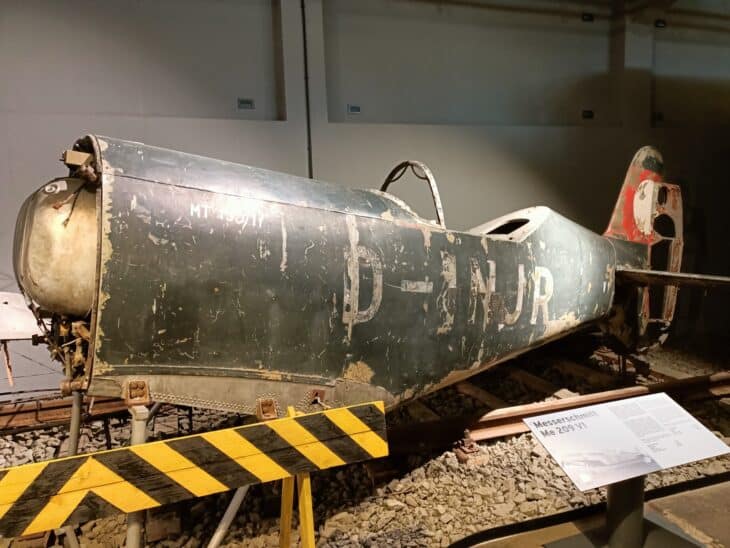

The Me 209 V1 was a German record aircraft. On April 26, 1939, Fritz Wendel flew it to 469.22 mph (755.14 km/h) at Augsburg, the absolute world speed record for any aircraft at the time.
Jets took the absolute record after World War II, but the Me 209’s mark remained the piston-engine record until Conquest 1 beat it in 1969.
1935
Hughes H-1 Racer, 354.4 mph. Howard Hughes sets a world speed record at Santa Ana, California.
1939
Messerschmitt Me 209 V1, 469.22 mph. The piston record that stands for 30 years.
1969
Conquest 1, 483.04 mph. Darryl Greenamyer’s Bearcat finally beats the Me 209.
1979
Red Baron RB-51, 499.018 mph. Steve Hinton falls just short of 500 mph at Tonopah.
1989
Rare Bear, 528.33 mph. The piston record that still stands.
2017
Voodoo, 531.53 mph. A faster average, but under the 1% margin needed to take Rare Bear’s record.
12. Piaggio P.180 Avanti: 460 mph (740 km/h)
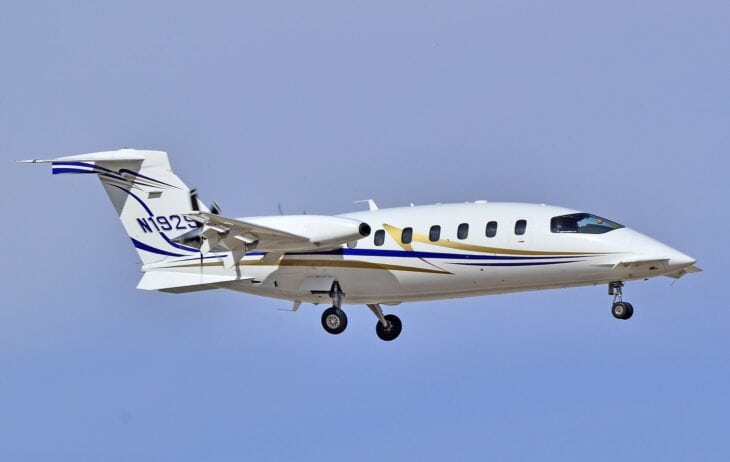

The Piaggio P.180 Avanti is the fastest civilian propeller aircraft in service. Its high-speed cruise is 400 knots (460 mph) at 31,000 feet, which Flying magazine called pretty much on par with Cessna’s M2 light jet.
In 2003, Joe Ritchie and Steve Fossett flew one coast to coast, San Diego to Charleston, in 3 hours 51 minutes, averaging 546.9 mph (880.1 km/h). That is faster than the Avanti can fly through the air, which is why ground-speed records are left out of this ranking.
13. Rolls-Royce Spirit of Innovation: 345.4 mph (555.9 km/h)
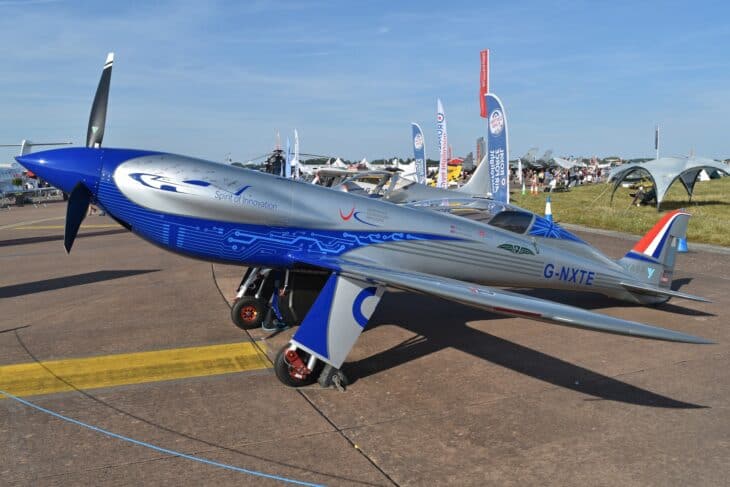

The one you might not expect is electric. Rolls-Royce’s Spirit of Innovation drives a single three-blade propeller with battery-powered motors, and in November 2021 it averaged 345.4 mph (555.9 km/h) over 3 kilometers.
The FAI accepted that run as the electric aircraft world record in January 2022. During testing it touched 336 knots (387 mph), about where piston fighters stood in the late 1930s.
The Fastest Propeller Planes in Every Category
Most readers asking this question want a plane they could actually fly or charter, not a Cold War bomber. Each category has its own deep-dive ranking.
- Single-engine turboprops, led by the TBM and Pilatus PC-12 families: the fastest single-engine turboprop planes.
- Twin turboprops, from King Airs to the Avanti: the fastest twin turboprop planes.
- Twin piston aircraft, the fastest propeller planes most private pilots can afford: the fastest twin piston aircraft.
- Airliners of every kind, jet and propeller: the fastest passenger planes.
Why Propeller Planes Hit a Wall Near 575 mph
A propeller blade moves forward with the airplane and spins at the same time, so its tips travel much faster than the aircraft does. As the plane gets faster, the tips reach the speed of sound well before the airplane does.
Once the tips go supersonic, shock waves form, efficiency drops and the noise becomes extreme. The XF-84H, with tips at about Mach 1.18, showed what that costs, and it is why every aircraft faster than the Tu-95 uses a jet or a rocket.
What about the Spitfire that hit 690 mph?
You will see claims that a Spitfire reached 690 mph (1,110 km/h). That figure is a calculation from a 1952 dive by Edward Powles in a Spitfire Mk XIX, not a level-flight speed, and dives are not comparable. Gravity does the work in a dive. The fastest level-flight record average any piston plane has flown is Voodoo’s 531.53 mph.
FAQ
Sources and references used for research and fact-checking.
- Wikipedia, Tupolev Tu-95
- Wikipedia, Tupolev Tu-142
- Wikipedia, Tupolev Tu-114
- Wikipedia, Flight airspeed record
- Wikipedia, Voodoo (aircraft)
- Wikipedia, Rare Bear
- Wikipedia, Republic XF-84H Thunderscreech
- Old Machine Press, Republic XP-47J Superbolt
- Wikipedia, Red Baron (aircraft)
- Wikipedia, Supermarine Spiteful
- Wikipedia, Darryl Greenamyer
- Wikipedia, Airbus A400M Atlas
- Wikipedia, Piaggio P.180 Avanti
- Wikipedia, Rolls-Royce ACCEL
Get the Newsletter
The latest aviation news and stories sent to your inbox.
About the Author

Tim is the owner and lead editor of AeroCorner since 2019, overseeing aviation content covering aircraft, airlines, airports, and the broader aviation industry. Through years of researching, writing, editing, and publishing aviation-focused content, he has developed extensive practical knowledge of commercial aviation and air travel. Based in Asia and a frequent traveler himself, Tim also brings firsthand passenger experience to AeroCorner’s coverage. Outside of publishing, he has also explored aviation firsthand through hands-on flight training in New Zealand.