


On October 27, 2026, the FAA published a proposed airworthiness directive that would require a visual inspection of the fan blades on every CFM International CFM56-7B engine, the engine that powers the Boeing 737 Next Generation family. The agency estimates it would apply to 3,450 engines installed on US-registered airplanes.
It is the US counterpart to the check Europe proposed a day earlier, covered in our story on EASA’s PAD 26-130. Comments are due by November 27, 2026.
What the FAA Would Require
Operators would visually inspect the fan blades under CFM Service Bulletin 72-1119, dated September 8, 2026. The FAA lists what counts as not serviceable: cracks, tears, tip curls and local distortion on the leading edge.
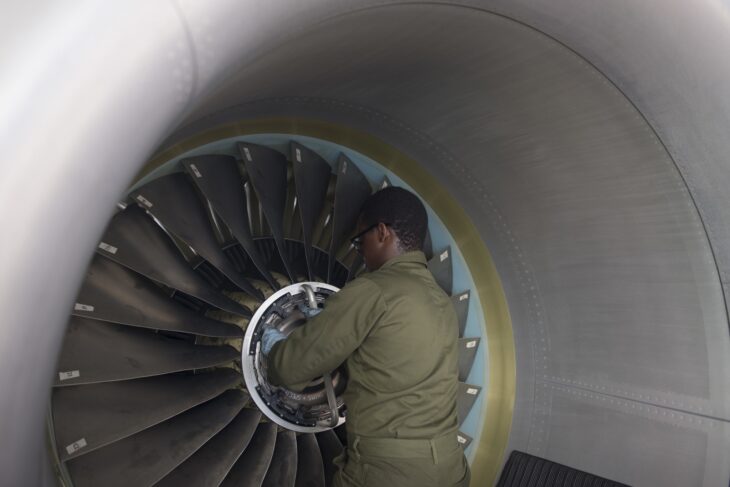

Engines already on an aircraft would have 400 flight cycles or 90 days after the rule takes effect, whichever comes first. An engine not installed as of that date would need the check before further flight.
A blade that fails would be replaced before further flight, and the next blade clockwise, looking aft from the front of the engine, would get its own inspection. Results with any unserviceable finding would go to CFM within 30 days of the inspection or of the effective date, whichever is later.
The proposal sets no repeat interval. Operators get credit for a piece-part shop inspection or an ultrasonic check under SB 72-1033 Revision 3 or later done within 100 cycles before the effective date, or for work under an earlier bulletin, SB 72-1118.
What it costs
The FAA puts the inspection at one work-hour, or $85 per engine and $293,250 across the US fleet. Replacing a fan blade would cost $51,485, mostly the $51,400 part. The agency says it cannot predict how many blades will need replacing.
The Event Behind It
The FAA does not name the flight. It says a Boeing 737-800 powered by CFM56-7B26/3 engines had a fan blade separate in flight, and debris penetrated the fuselage, causing a loss of pressurization and an emergency descent.
That matches the July 10, 2026 failure on Malta Air 737-800 9H-QEU, flying as Ryanair flight FR1879 out of Thessaloniki, Greece. The FAA’s July proposal named that flight.
The NTSB preliminary report says the right engine shed a fan blade while climbing through about 16,000 feet (4,900 m). Fragments broke through the cabin window at row 11 and the lower fuselage skin, and one of the 155 people on board was seriously injured.
The FAA calls this proposal interim action. The inspection reports are meant to give CFM a better picture of the nature, cause and extent of the failure, so it can develop a final fix that could bring further rulemaking.
How This Differs From July’s Proposal
This is the FAA’s second CFM56-7B fan blade proposal since the Malta Air failure. The first, published July 31 and covered in our story on deeper 737NG fan blade checks, would supersede AD 2018-26-01 and widen the area its repeating ultrasonic or eddy current checks cover.
That program hunts cracks in the dovetail, the root that locks each blade into the fan disk. It dates to the 2018 Southwest Airlines Flight 1380 failure, and in July the FAA said it had no factual information tying the Malta Air event to that unsafe condition.
The October proposal is a new directive, not a revision, and lists no ADs it would affect. It looks over the blades for visible damage, rather than probing the root for hidden cracks.
The two proposals also count the fleet differently: 4,553 US engines in July, 3,450 now. The FAA does not explain the gap. A Federal Register search on October 29 showed no final rule from the July proposal, whose comments closed August 31.
Why a Visual Check, and Why Now
The proposal carries one new clue to the cause. CFM’s investigation is ongoing, the FAA writes, but preliminary findings indicate that deformation of the fan blades induced a localized vibratory response in the blade that failed.
The NTSB’s preliminary report had already noted both pieces. It described the fracture as high amplitude fatigue, driven by loads that cycle faster than once per flight, and found rounded deformation on the leading edges of four other blades.
The NTSB also recovered bird remains from the engine and its nacelle, and crews had reported four suspected bird strikes on it in the previous 12 months, with no damage found. Neither agency has said what deformed the blades or named a cause.
The engine’s blades had passed an SB 72-1033 Revision 3 ultrasonic inspection on May 24, 2026, just 253 cycles before the failure, with no findings, according to the NTSB.
The FAA gave the proposal a 30-day comment period instead of the standard 45. It cites the recent in-service event and the need to align with EASA, whose own consultation closes on November 23.
Still a proposal
Nothing here is binding until the FAA reviews comments and issues a final rule, and the terms can change. The cause of the Malta Air failure is still under investigation, and the NTSB’s findings so far are preliminary.
Comments go to Docket No. FAA-2026-11817 at regulations.gov. The directive was signed on October 22 by the FAA’s Aircraft Certification Service.
Sources and references used for research and fact-checking.
- Federal Aviation Administration, Airworthiness Directives; CFM International, S.A. Engines (NPRM, Docket No. FAA-2026-11817, FR Doc. 2026-21852)
- Federal Aviation Administration, Airworthiness Directives; CFM International, S.A. Engines (NPRM 2026-15532, Docket FAA-2026-7232)
- European Union Aviation Safety Agency, Proposed Airworthiness Directive PAD 26-130: CFM56-7B engines, Fan Blades - Inspection
- National Transportation Safety Board, Aviation Investigation Preliminary Report DCA26FA274, Malta Air (Ryanair 1879) Boeing 737-8AS 9H-QEU
Get the Newsletter
The latest aviation news and stories sent to your inbox.
About the Author

AeroCorner News is the aviation news desk of AeroCorner.com. It covers accidents and incidents, safety rulings, airline and airport disruption, and new aircraft. It works from primary sources such as the NTSB, FAA, EASA and the manufacturers' own announcements.