


Table of Contents
Just before midnight on July 7, 2017, an Air Canada Airbus A320 with 140 people aboard was cleared to land on Runway 28R at San Francisco. The pilots lined up on what looked like the right runway. It was Taxiway C, and four airliners were sitting on it waiting to take off.
The A320 got down to about 60 feet before it climbed away, and the NTSB found it missed one of the waiting jets by 14 feet (4.3 m). The warning that would have prevented the whole thing had been in the crew’s paperwork all along. It was a NOTAM, and nobody had registered it.
That is the strange double life of the NOTAM. It is a safety system so essential that its failure once stopped every departure in the country, and so cluttered that the chairman of the NTSB said pilots ignore it. Here is what a NOTAM actually is, how to read one, and why fixing it has taken so long.
What Is a NOTAM?
A NOTAM, short for Notice to Airmen, is an official alert telling pilots about a change or hazard along their route or at an airport that could affect their flight. A closed runway or taxiway, a navigation aid out of service, or the airspace shut around a visiting head of state can each generate one.
Aviation authorities and airport operators issue them under Annex 15 of the Chicago Convention, the treaty that set up ICAO. In the US that means the FAA, which says it issues more than 4 million notices a year across the National Airspace System.
NOTAMs cover the temporary changes that the charts and airport directories pilots already carry cannot. Before every flight, a pilot or an airline dispatcher pulls the NOTAMs for the departure airport, the destination, the alternates and the airspace in between.
NOTAM at a glance
Stands for: Notice to Airmen (briefly Notice to Air Missions, Dec. 2021 to Feb. 2025). Issued by: aviation authorities and airport operators, under ICAO Annex 15. US volume: more than 4 million a year, per the FAA. Covers: anything temporary that a pilot needs to know before flying, from a closed taxiway to a stadium flight restriction.
How to Read a NOTAM
NOTAMs still read like telegrams. They are written in capital letters and squeezed into standard abbreviations, and aviation authorities typically exchange them over the Aeronautical Fixed Telecommunication Network.
The international ICAO format splits each notice into labeled items. The Q line is a coded summary for computers, A names the airport or flight information region, B and C give the start and end times in UTC, and E is the actual message. F and G set the lower and upper altitude limits when airspace is involved.
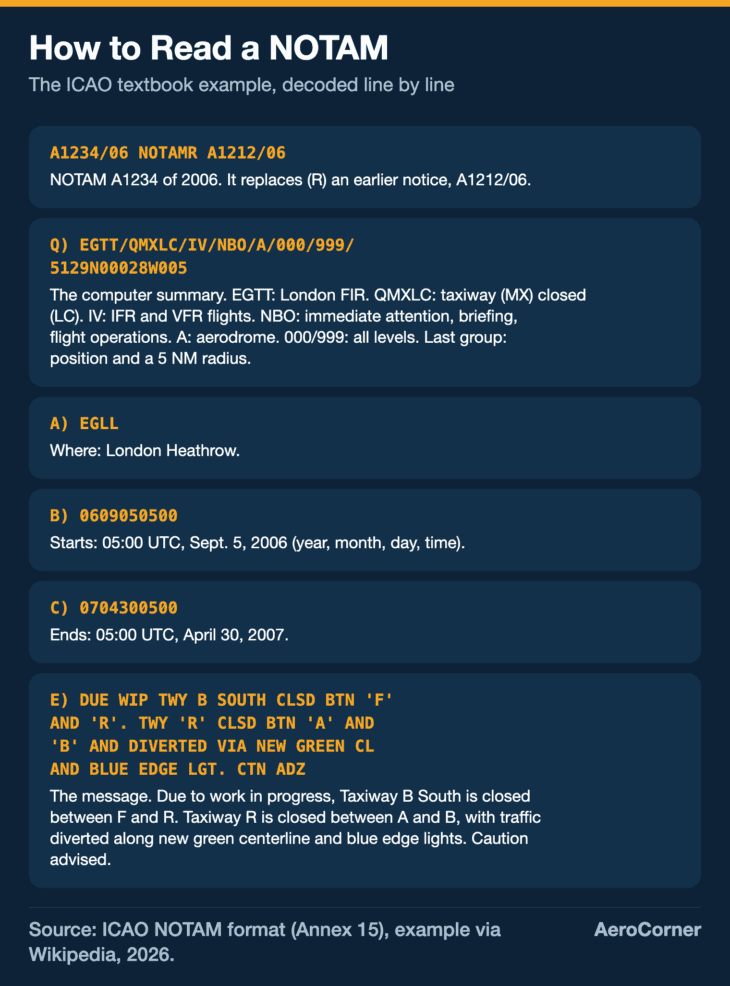
Translated, that example says work in progress has closed part of Taxiway B South at Heathrow, closed a stretch of Taxiway R, and rerouted traffic along new green centerline and blue edge lights. It ends with “CTN ADZ,” caution advised. Every pilot taxiing there for eight months needed that notice, and it is about as readable as they get.
The US Types
The FAA has used its own domestic format, with its own categories. NOTAM (D) notices cover navigation aids, public-use airports, seaplane bases and heliports.
FDC NOTAMs come from the National Flight Data Center and carry regulatory changes, such as amendments to instrument approach procedures. They are also how the FAA announces temporary flight restrictions, such as the airspace closed around a visiting head of state. Pointer, special activity airspace and military NOTAMs round out the list.
Why Pilots Call NOTAMs Unreadable
Go back to San Francisco. Runway 28L, the left of two parallel runways, had closed at 10 p.m. for construction, and its lights were off apart from a flashing lighted X at the threshold.
The Air Canada crew saw the lit 28R, took it for 28L, and lined up on the next lit strip to the right: Taxiway C, where four airliners were waiting to take off from 28R.
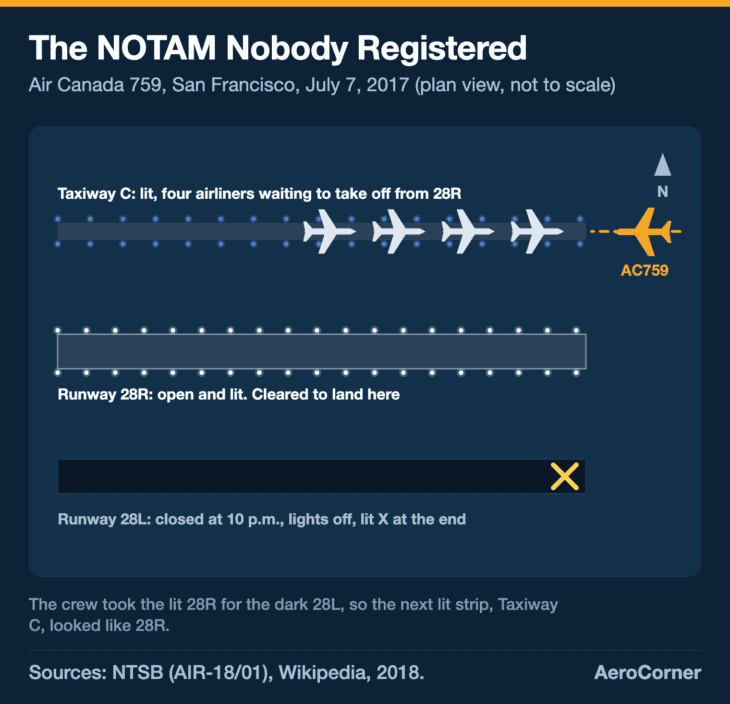
The closure was in the NOTAMs the crew received. At the NTSB’s board meeting on Sept. 25, 2018, the probable cause put it plainly: the pilots mistook the taxiway for the runway because they had overlooked the 28L closure in the NOTAM report.


The board did not stop at the pilots. It found that the way the information was presented “did not effectively convey the importance of the runway closure information.” Chairman Robert Sumwalt went further and called NOTAMs “just a bunch of garbage that nobody pays any attention to.”
Vice Chair Bruce Landsberg said the system “lays an impossibly heavy burden on individual pilots, crews and dispatchers” to dig the critical items out of the irrelevant ones. The NTSB asked the FAA to bring in human factors experts and work out how flight information should be organized and prioritized.
The problem is volume. Citing Eurocontrol statistics, ICAO says more than 1.7 million NOTAMs were issued in 2020, a seven-fold rise in two decades, and some 35,000 are active on any given day.
100 pages before takeoff
ICAO says it is not uncommon for the preflight briefing on a long-haul international flight to carry more than 100 pages of NOTAMs. When its 2021 cleanup campaign began, about 7,000 NOTAMs worldwide were more than three months old, even though a NOTAM is meant to be temporary.
That is why ICAO launched its Global Campaign on NOTAM Improvement on April 8, 2021, starting with the stale notices. The pilots’ federation IFALPA backed it, saying the flood had “resulted in several incidents where safety-critical information was missed.”
The Morning the Alerts Stopped
Unreadable is one problem. Unavailable is worse. On Jan. 10, 2023, the US NOTAM system stopped processing updates at 3:28 p.m. ET, so new safety notices could no longer reach pilots and dispatchers.
At 7:30 a.m. ET on Jan. 11, the FAA stopped departures nationwide, the step our guide to ground stops explains. Flights began moving again before 9 a.m., but airlines cancelled more than 1,300 flights and delayed nearly 10,000.


The cause was mundane. The FAA said contractors had unintentionally deleted files while correcting a synchronization problem between the live primary database and its backup, with no sign of a cyberattack.
It mattered so much because the alerts were the thing that changed. Charts and procedures were all still there, but nobody could promise that a runway closed overnight would show up in a crew’s briefing. San Francisco had already shown what that costs.
The Nov. 13, 2026 nationwide ground stop was a different failure: a telecommunications outage at the centers that handle high-altitude traffic, not the NOTAM system.
How the FAA Is Replacing a 1985 System
Congress answered with the NOTAM Improvement Act, signed June 3, 2023. It ordered an FAA task force on NOTAM improvement within 180 days and a backup for the Federal NOTAM System by Sept. 30, 2024.
The backup got its test on the night of Saturday, Feb. 1, 2025, when the primary system went down again. This time the switchover worked, and Transportation Secretary Sean Duffy called the disruption minimal, adding: “This is an old system that needs to be upgraded.”
In spring 2025, the FAA picked CGI Federal to build a cloud-based replacement, working with Google Public Sector, NG Aviation and Mosaic ATM. The new NOTAM Management Service went live for early adopters on Sept. 29, 2025.
The big cutover came in the early hours of Saturday, April 18, 2026, when the FAA shut down the legacy US NOTAM System. The FAA said in May 2026 that the infrastructure it replaced dated back to 1985, and that the other legacy platform, the Federal NOTAM Service, would be retired later in the year.
1947
The acronym takes hold. NOTAM comes into common use after the Chicago Convention takes effect on April 4.
July 2017
Air Canada 759. An A320 lines up on a crowded taxiway at San Francisco after its crew overlooks a runway closure NOTAM.
Sept. 2018
The NTSB weighs in. Its chairman calls NOTAMs garbage nobody pays attention to.
April 2021
ICAO cleanup. The Global Campaign on NOTAM Improvement starts with notices older than three months.
Jan. 11, 2023
Nationwide ground stop. Deleted files take down the NOTAM system and halt departures for about 90 minutes.
June 2023
NOTAM Improvement Act. Congress orders a task force and a backup system.
Feb. 2025
Backup works. A second outage passes with minimal disruption, and the FAA restores the name Notice to Airmen.
Sept. 2025
New system online. The cloud-based NOTAM Management Service goes live for early adopters.
April 18, 2026
Cutover. The FAA shuts down the legacy US NOTAM System.
The Myth: The New System Fixed What Pilots Read
Headlines about a brand-new NOTAM system make it sound as if the San Francisco problem is solved. It is not, at least not yet.
New plumbing, same notices
The 2026 cutover replaced the computers that store and distribute NOTAMs. The FAA said the notices would continue to be presented in their current format, and the move to ICAO’s international format is planned for late 2027 or early 2028.
What changed is resilience. A cloud system is meant to avoid the kind of outage that grounded the country in 2023, and the new service is built to show notices graphically, not only as text.
What has not changed is the volume or the language. A pilot preparing for a flight today still faces the same capitalized, abbreviated notices, and still has to find the one about the closed runway among the many that do not matter.
The name also caused a few years of confusion. The FAA renamed NOTAMs “Notice to Air Missions” in December 2021, then switched back to Notice to Airmen in February 2025, so older training material and newer sources disagree.
So when a flight is delayed for a “NOTAM issue,” it usually means one of two things. Either a notice closed something the flight needed, or, rarely, the system that delivers the notices stopped working. Both trace back to the same idea: a pilot is only as safe as the last thing they were told.
Sources and references used for research and fact-checking.
- Wikipedia, NOTAM
- Wikipedia, Air Canada Flight 759
- Flight Safety Foundation, Cleaning Up the Garbage
- ICAO, Global Campaign on NOTAM Improvement (NOTAM2021)
- FlightGlobal, Pilots back global campaign to cut excessive NOTAM burden
- Wikipedia, 2023 FAA system outage
- NPR (via WUNC), FAA contractors deleted files and inadvertently grounded thousands of flights
- Congress.gov, Public Law 118-4: NOTAM Improvement Act of 2023
- ABC7 Chicago, Critical FAA warning system restored after outage
- AirlineGeeks, FAA Adopts 'Gulf of America,' Reverses NOTAM Naming
- Military & Aerospace Electronics, FAA selects CGI Federal to lead overhaul of aging NOTAM system
- AOPA, FAA begins testing new NOTAM system
- Air Data News, FAA Launches First Phase of New NOTAM Management System
- NBAA, FAA Plans April 18 Changeover to New NOTAM System
- Executive Gov, FAA completes first phase of NOTAM modernization
Get the Newsletter
The latest aviation news and stories sent to your inbox.
About the Author

Tim is the owner and lead editor of AeroCorner since 2019, overseeing aviation content covering aircraft, airlines, airports, and the broader aviation industry. Through years of researching, writing, editing, and publishing aviation-focused content, he has developed extensive practical knowledge of commercial aviation and air travel. Based in Asia and a frequent traveler himself, Tim also brings firsthand passenger experience to AeroCorner’s coverage. Outside of publishing, he has also explored aviation firsthand through hands-on flight training in New Zealand.