

Table of Contents
When the FAA stopped every departure in the country on Nov. 13, 2026, the fault was a communications problem at the centers that run high-altitude traffic, not at the towers on the airports. It was a reminder that a tower is only one of three layers.
The United States has 527 air traffic control towers, according to the FAA’s most recent published facility count, repeated by the Congressional Research Service in an Oct. 22, 2026 report. Add the radar approach facilities and the en route centers, and the system runs on 577 staffed air traffic control facilities. The FAA itself staffs 313 of them.
How Many Air Traffic Control Towers Are in the US?
527 towers. That total has three parts: 142 stand-alone FAA towers, 121 FAA facilities that combine a tower with a radar approach control, and 264 stand-alone towers in the Federal Contract Tower program.
The contract towers are the surprise. They are staffed by private companies the FAA pays, so 264 of the 527 towers, just over half, are not run by FAA employees at all.
The count at a glance
527 control towers: 263 run by the FAA and 264 contract towers. 146 radar approach controls (TRACONs), 121 of them sharing a building with a tower. 25 en route centers, 21 of them Air Route Traffic Control Centers. 577 staffed facilities in all, 313 of them FAA-staffed.
The Breakdown: Towers, TRACONs and Centers
A flight passes through three kinds of facility. The tower handles the runway and the airspace a few miles around it. A TRACON (terminal radar approach control) works departures and arrivals in the busy airspace around one or more airports, and an en route center takes over at cruise.
| Facility type | Count | Staffed by |
|---|---|---|
| Stand-alone towers in the Federal Contract Tower program | 264 | Private contractors |
| Stand-alone FAA towers | 142 | FAA |
| Combined tower and TRACON facilities | 121 | FAA |
| Stand-alone TRACONs | 25 | FAA |
| En route centers and combined control facilities | 25 | FAA |
| Total staffed ATC facilities | 577 | 313 FAA, 264 contract |
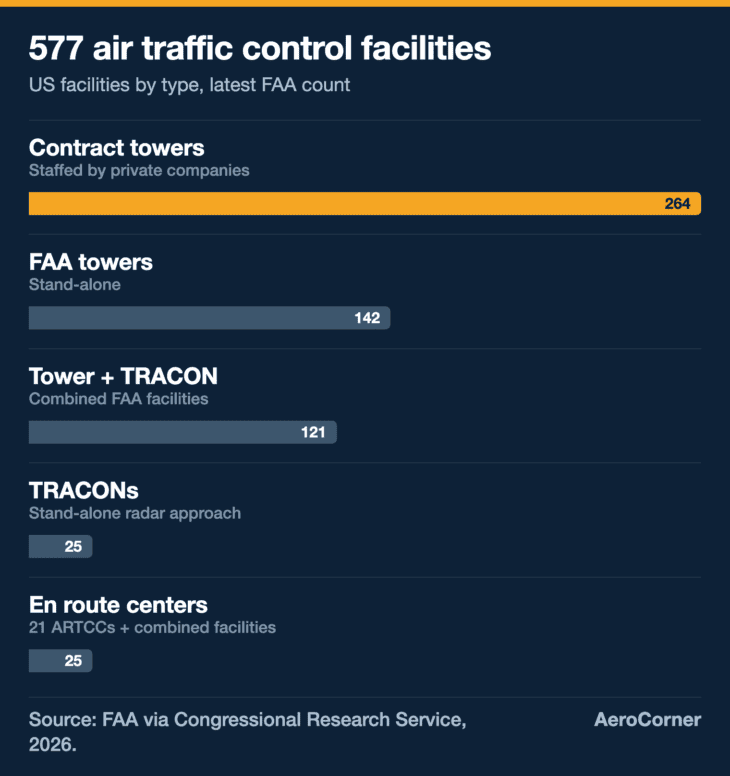
The shape is bottom-heavy. Towers make up 527 of the 577 facilities, but just 25 centers handle every flight at cruise, which is why a fault touching all of them can halt departures nationwide.
Split by who does the work, the towers divide almost exactly in half: 263 run by FAA controllers, counting the combined facilities, and 264 run by contractors. Across all 577 facilities, the FAA staffs 313, or about 54%.
The 25 centers are 21 Air Route Traffic Control Centers, 20 in the lower 48 states and one in Anchorage, plus combined control facilities that do both center and approach work, including those for Honolulu, San Juan and Guam. The physical towers vary as much as the workload, from small contract cabs to the tallest air traffic control towers in the world.
Why Other Sources Give Different Numbers
Search for this and you will see 313, about 400, 527, 22 centers, 21 centers and 4,400 facilities. Most of them are right about something different.
313 is the number of facilities with FAA staff in them: the 142 FAA towers, the 121 combined facilities, the 25 TRACONs and the 25 centers. It leaves out all 264 contract towers, so it is a count of where FAA controllers work, not of every tower.
577, the total on this page, counts every staffed facility once. A combined tower and TRACON is one facility in that total, even though it holds both a tower cab working the runways and a radar room working the approaches.
About 400 (406, exactly) counts only stand-alone towers, FAA and contract. It drops the 121 towers that share a building with a TRACON, even though each of those is a working tower too.
The 22 centers figure
News coverage of the Nov. 13, 2026 ground stop said the US has 22 Air Route Traffic Control Centers. The FAA counts 21: 20 in the lower 48 and one in Anchorage. Its wider figure of 25 centers adds combined control facilities such as Honolulu, which do center and approach work under one roof.
The contract tower count itself moves. The FAA’s own program page gave 265 contract towers in November 2024, and a March 2026 Department of Transportation Inspector General audit counted 266, staffed by more than 1,500 controllers.
More than 4,400 is not a count of control facilities. It is the number of FAA sites linked by the FAA Telecommunications Infrastructure network, run by L3Harris, which includes equipment sites as well as the rooms where controllers sit.
Military towers and radar approach controls on bases are separate again. The FAA’s civil count does not include them.
Most US Airports Have No Tower at All
527 towers sounds like a lot until you set it against the more than 19,000 airports in the US. The large majority are uncontrolled fields, where pilots coordinate on a shared radio frequency and no one gives them a clearance to land.
That makes a tower the exception rather than the rule. It goes where traffic is heavy enough, or mixed enough, that pilots sorting themselves out by radio is no longer safe.
Where the Count Is Going
The split between FAA and contract towers is starting to shift. In May 2026 the FAA announced a pilot program to move contract towers into direct FAA operation, starting with Bozeman Yellowstone International in Montana and Mesa Gateway in Arizona.
Each transfer is expected to take 29 to 44 months, so the count will move slowly. The bigger pressure is people: the Inspector General found the contract tower program about 18% understaffed in April 2025, and the FAA’s own facilities are short too, as the count of certified air traffic controllers shows.
Until the next FAA count is published, 527 is the tower figure to quote. Just note that the contract side has already crept from 264 to 266 in the latest audit, so the true total is likely a tower or two higher.
For how the three layers hand a flight from one to the next, the series on how air traffic control actually works walks through it from pushback to landing.
FAQ
Sources and references used for research and fact-checking.
- Congressional Research Service, Federal Government Shutdowns and the Impact on Civil Aviation (R49491)
- Wikipedia, List of U.S. Air Route Traffic Control Centers
- Wikipedia, Terminal radar approach control
- AVweb, FAA To Test Moving Contract Towers Into Agency Operation
- National Air Transportation Association, FAA Contract Tower Report Highlights Persistent Staffing Shortfalls
- ABC News, Coverage of the Nov. 13, 2026 nationwide ground stop
- The Register, All US flights grounded by FAA (Nov. 13, 2026)
Get the Newsletter
The latest aviation news and stories sent to your inbox.
About the Author

Tim is the owner and lead editor of AeroCorner since 2019, overseeing aviation content covering aircraft, airlines, airports, and the broader aviation industry. Through years of researching, writing, editing, and publishing aviation-focused content, he has developed extensive practical knowledge of commercial aviation and air travel. Based in Asia and a frequent traveler himself, Tim also brings firsthand passenger experience to AeroCorner’s coverage. Outside of publishing, he has also explored aviation firsthand through hands-on flight training in New Zealand.