

Table of Contents
On his first morning running the FAA’s national traffic floor, a former lawyer made two calls no one had made before, and he made the first one while Washington was still discussing it.
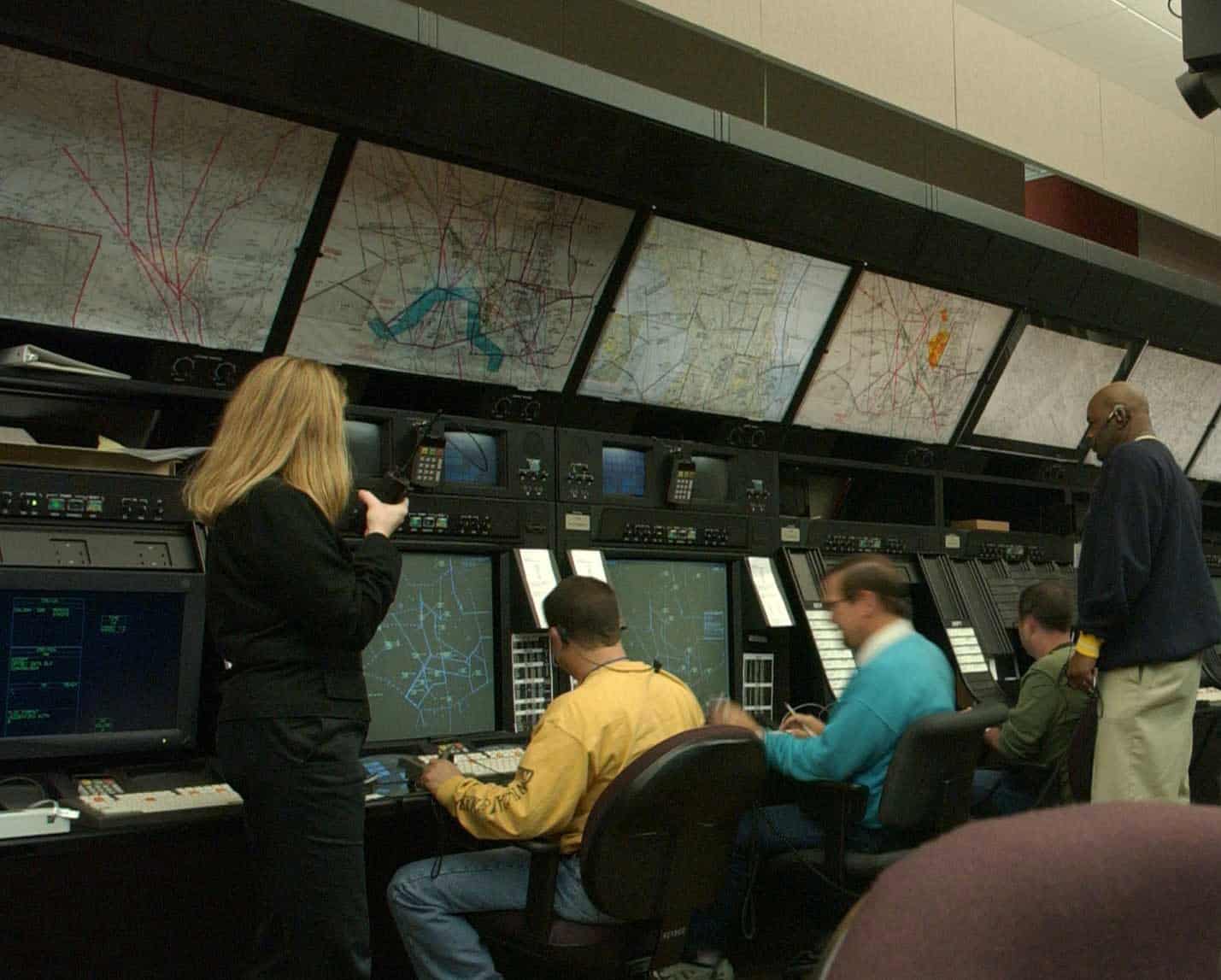
Ben Sliney began Sept. 11, 2001, as the FAA’s new national operations manager. At 9:25 a.m., the agency’s Command Center in Herndon, Virginia, stopped every takeoff in the country. At 9:42 a.m., Sliney ordered every aircraft in the air to land at the nearest airport.
About 4,500 commercial and general aviation aircraft landed without incident, the 9/11 Commission found. It called the order “unprecedented.”
At a commission hearing in June 2004, commissioner Slade Gorton put it to him directly: on his “first day on the job,” he had made two decisions that “at one level at least weren’t yours to make.” Sliney agreed, and explained why he made them anyway.
His day is back in the conversation because of the FAA’s nationwide ground stop on Nov. 13, 2026. That order held departures. Sliney’s morning went one step further and brought down everything already flying.
A Lawyer Who Fought the FAA Was Running Its Nerve Center
Sliney joined the FAA in 1969, according to his biography for the US Naval Academy’s 2013 leadership conference. He resigned in 1982, the year after President Reagan fired the striking PATCO controllers, and went on to represent 25 of them as they appealed their removal.
He came back twice, in 1985 and 1988, each time for a year of work on traffic flow management. In 2000 he returned as a traffic flow manager at the Command Center.
About nine months later, he took over as boss of the room, the Associated Press reported in 2006. The Command Center oversees daily traffic flow across the entire national airspace system, coordinating with the FAA’s 22 en route centers.
That job is normally about weather, delays and congestion. Its main tool is the ground stop, which holds departures bound for a trouble spot until the problem clears.
Two Orders, 17 Minutes Apart
By 9:25 a.m., the commission found, the Command Center and FAA headquarters knew two aircraft had crashed into the World Trade Center and that American 77 was lost. A Command Center manager asked headquarters whether it wanted a “nationwide ground stop.”
While executives at headquarters were still discussing it, the Command Center ordered one at 9:25. The airlines had moved first: American Airlines stopped its own departures nationwide between 9:05 and 9:10, and United followed.
Sliney told the commission the national stop was “a matter of scope, not of unfamiliarity with the remedy.” Ground stops already covered Boston, New York and “essentially the East Coast,” and reports of suspicious aircraft kept coming. “The national ground stop was just a natural extension of the smaller scope ground stops,” he said.
At 9:42, the Command Center learned from news reports that a plane had struck the Pentagon. Sliney ordered all FAA facilities to instruct all aircraft to land at the nearest airport.
He did not claim that call as his alone. “As to the order to land, that was the product of the men and women in the Command Center who gave me advice on that day, the supervisors and the specialists,” he testified.
4,500 Airplanes in About Two and a Half Hours
Monte Belger, the FAA’s acting deputy administrator that day, gave the commission the scale. When the order to land was given, he said, “over 4,500 aircraft were in the system.” He put the order at 9:45 a.m.; the commission’s own timeline says 9:42.
“By 12:16, for the first time in the history of the FAA, the U.S. air space was empty of all aircraft except for military and essential emergency flights,” Belger testified. That works out, in his words, to “roughly one flight every two seconds.”
That is shorter than the version usually retold. USA Today’s 2002 reconstruction was billed as “How 4,500 planes landed in four hours,” but its “four most critical hours” began at 8:15 a.m. From the land order to an empty sky, the FAA’s own figure is about two and a half hours.
Controllers did it while chasing false alarms. The commission counted “multiple erroneous reports of hijacked aircraft” that morning, including Delta 1989, a Boeing 767 bound from Boston to Las Vegas that was not hijacked and landed in Cleveland.
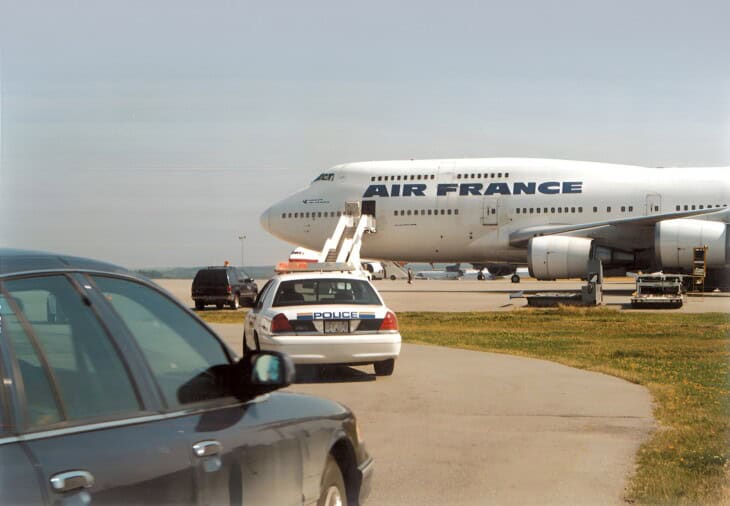
Not every inbound flight came down in the US. Transatlantic traffic was turned away to Canada, where small airports like Gander took in jets by the dozen in what became Operation Yellow Ribbon.
SCATANA Was the Military’s Plan, and It Was Rewritten on the Fly
Sliney’s order is often described as the moment America invoked SCATANA, the Cold War plan for the military to take control of civil airspace. The testimony separates the two.
NORAD commander Gen. Ralph Eberhart told the same June 2004 hearing that SCATANA was “designed, again, to counter the Soviet Union and their long-range bombers.” As written, it switched off navigation aids so enemy bombers could not use them, which was “the last thing we wanted to do” that morning.
So NORAD executed what Eberhart called “a modified SCATANA.” Navigation aids stayed on, the FAA kept controlling the traffic still flying, and law enforcement and medical flights kept operating. Commissioner Jamie Gorelick put its timing at around 11 a.m., more than an hour after Sliney’s order.
Eberhart’s reason for waiting is the clearest tribute to Sliney’s floor. With “four to five thousand airplanes airborne,” he said, a military takeover would have made things worse, because “I cannot provide traffic deconfliction like the FAA has.”
Then He Played Himself in United 93
Five years later, Sliney relived the morning on a film set. He joined Paul Greengrass’s 2006 film United 93, about the Boeing 757 whose passengers fought back, as an adviser, and was then cast in a small part as an air traffic controller.
Greengrass then replaced the actor cast as Sliney with the man himself. “I can’t think of anyone better to play Ben Sliney than Ben Sliney,” the director told the Associated Press.
Asked whether he could do it, Sliney replied: “Well, I’ve been doing it for 60 years. I guess another hour or two wouldn’t hurt.” He said the film accurately depicted the scene in the Command Center that morning.
The flight at the center of the film also changed the cockpit for good, a story we told in how United 93 led to today’s reinforced cockpit doors.
Why His Answer Still Applies to Every Ground Stop
The commission’s verdict on that morning was blunt. Individual controllers and Command Center managers “thought outside the box” in “deciding to land all aircraft and executing that unprecedented order flawlessly.”
Sliney’s own explanation is the part that has aged best. He did not reach for a new weapon. He took the most ordinary tool on the floor, the ground stop, and asked how big it needed to be.
That is still the question when the FAA’s network or its centers fail, as they did on Nov. 13, 2026, after what the agency called a temporary telecommunications outage. Asked in 2004 whether those calls had helped or hurt his career, Sliney said: “I would say in neither respect, sir.”
Sources and references used for research and fact-checking.
- National Commission on Terrorist Attacks Upon the United States, The 9/11 Commission Report, Chapter 1: "We Have Some Planes"
- National Commission on Terrorist Attacks Upon the United States, Twelfth Public Hearing, June 17, 2004: Transcript
- US Naval Academy, Panelist: Ben Sliney (2013 Leadership Conference)
- The Spokesman-Review (Associated Press), FAA official plays self in 'United 93'
- USA Today, Part I: Terror attacks brought drastic decision: Clear the skies
Get the Newsletter
The latest aviation news and stories sent to your inbox.
About the Author

Tim is the owner and lead editor of AeroCorner since 2019, overseeing aviation content covering aircraft, airlines, airports, and the broader aviation industry. Through years of researching, writing, editing, and publishing aviation-focused content, he has developed extensive practical knowledge of commercial aviation and air travel. Based in Asia and a frequent traveler himself, Tim also brings firsthand passenger experience to AeroCorner’s coverage. Outside of publishing, he has also explored aviation firsthand through hands-on flight training in New Zealand.