

Table of Contents
Push back from a gate after dark and the airfield outside your window turns into a scatter of colored points. Blue in long rows, green dotted down the middle of the pavement.
White ahead somewhere, and a few reds that flick on and off as you roll.
It looks decorative, or at best arbitrary. It is neither. Every one of those colors is specified by the Federal Aviation Administration, and no airport is free to choose its own.
Together they form a map that a crew reads at 150 mph (240 km/h) in rain, at night, with a few seconds to decide. Here is what each color means, and how to read the airfield from your seat.
What Color Are Runway Lights?
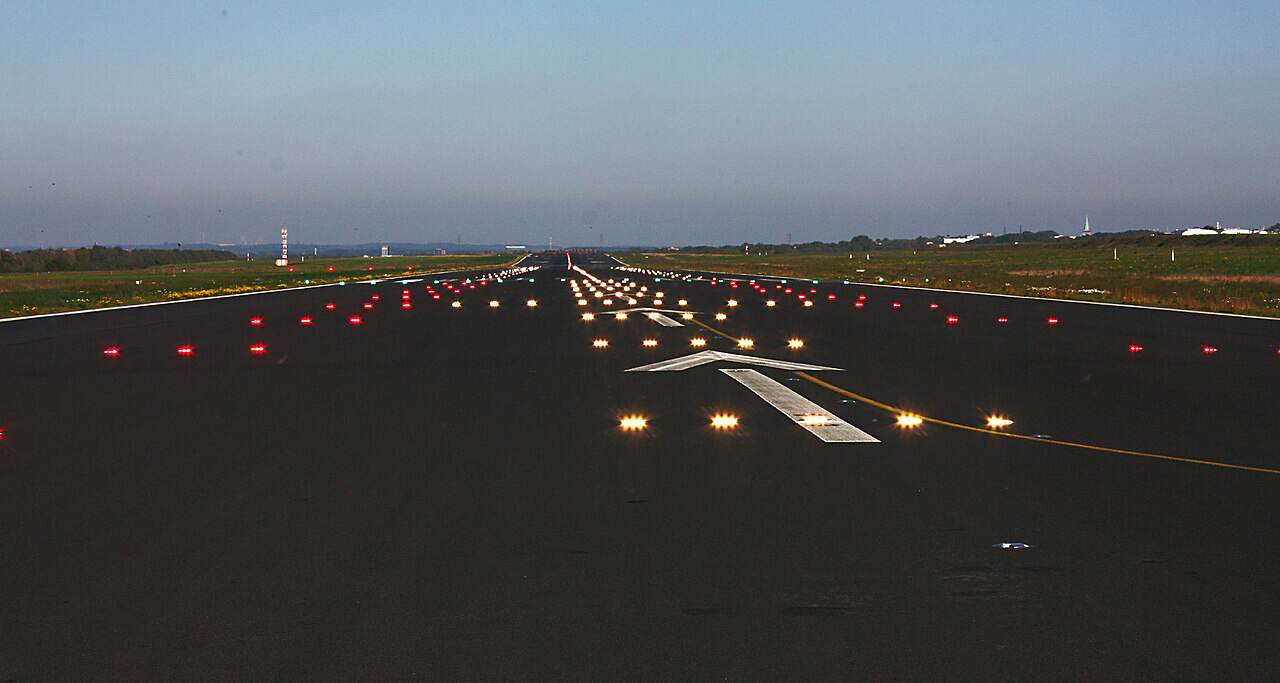
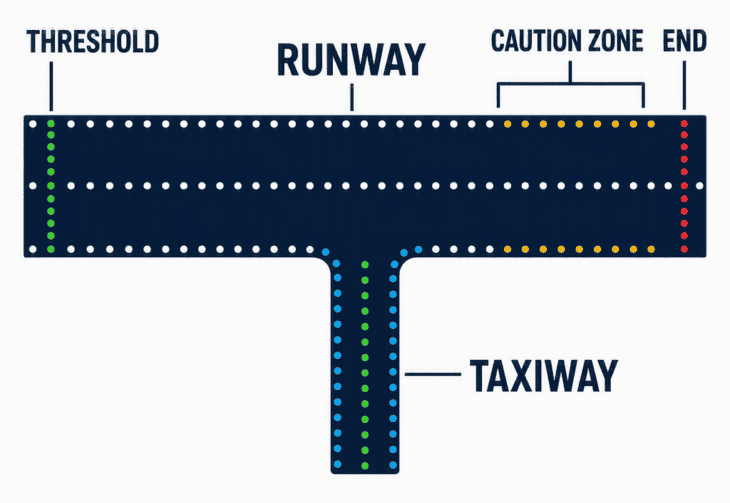
Runway edge lights are white. The one exception is written into the FAA’s Aeronautical Information Manual: on instrument runways, yellow (usually called amber) replaces white for the last 2,000 feet, or half the runway length, whichever is shorter.
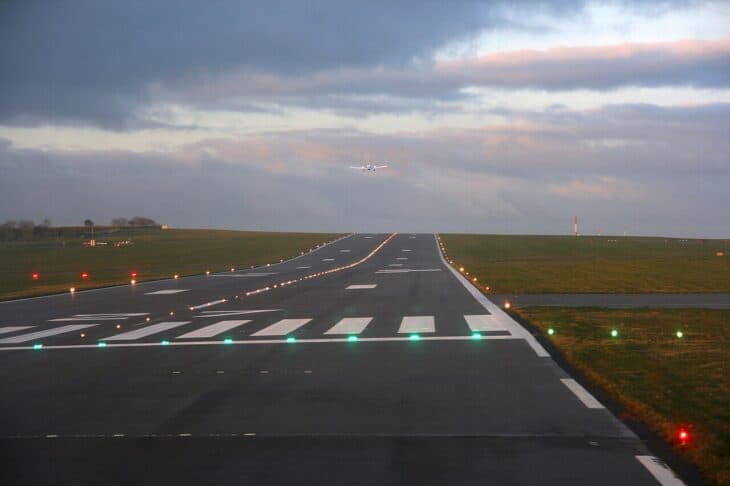
The ends of the runway are lit green and red at once, depending on which direction you are looking from. Everything blue is a taxiway, and steady green on the ground marks a taxiway centerline.
The whole code, in one line
White means runway. Blue means taxiway. Green means go this way or start here. Red means stop or the pavement ends. Yellow means caution, and flashing yellow means a runway begins just ahead.
One Rule Decodes Most of What You See
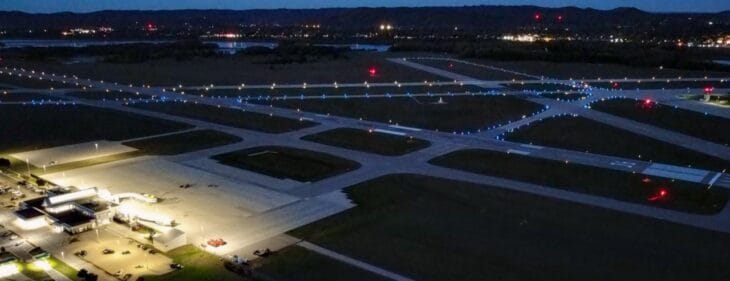
If you learn nothing else, learn this: white is runway, blue is taxiway. Taxiway edge lights emit blue light, and they do it for one reason, which is to be unmistakable for anything else on the field.
That is why the long blue corridors are the first thing you notice from the window. They are the outline of every path that is not a runway.
Inside that corridor, taxiway centerline lights are steady green. They run down the middle of straight sections, around curves, and across ramps and aprons, which is how a crew follows a cleared route in fog without seeing the painted line at all. The daytime equivalent is the painted system covered in our guide to airport taxiway markings.
| Color | Where you see it | What it tells a pilot |
|---|---|---|
| White | Runway edges, runway centerline, touchdown zone bars | You are on, or lined up with, a runway |
| Amber | Runway edge lights in the last 2,000 feet of an instrument runway | Caution: the runway is running out |
| Green | Runway threshold seen from the approach; taxiway centerlines | The landing surface starts here, or follow this line |
| Red | Runway end, last 1,000 feet of centerline, stop bars, runway status lights | Stop, or the pavement ends |
| Blue | Taxiway edges | This is not a runway |
| Flashing yellow | Runway guard lights at a holding position | A runway begins immediately ahead |
The Runway Counts Down to Its Own End
The best detail in the whole system is that a runway tells you how much of itself is left, in color, without anyone saying a word.
It starts at the edges. On an instrument runway, the white edge lights switch to amber for the final 2,000 feet, forming what the FAA calls a caution zone for landings.
Runways built for precision approaches go further. Centerline lights sit in the pavement at 50-foot intervals, and viewed from the landing threshold they are white until the last 3,000 feet of runway.
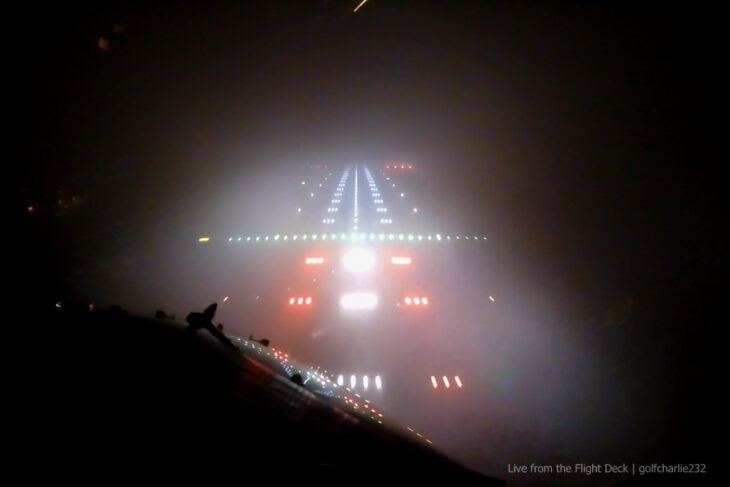

Then the white begins alternating with red for 2,000 feet. For the final 1,000 feet, every centerline light is red. A crew rolling out in fog knows exactly how much concrete remains from the color under the nose.
Touchdown zone lights complete the picture: two rows of white bars either side of the centerline, starting 100 feet past the threshold and running to 3,000 feet or the midpoint of the runway, whichever comes first.
They mark the part of the pavement the aircraft is supposed to arrive on. It is a smaller target than most passengers assume, and a big part of why runways are built as long as they are.
Green at One End, Red at the Other, From the Same Fixture
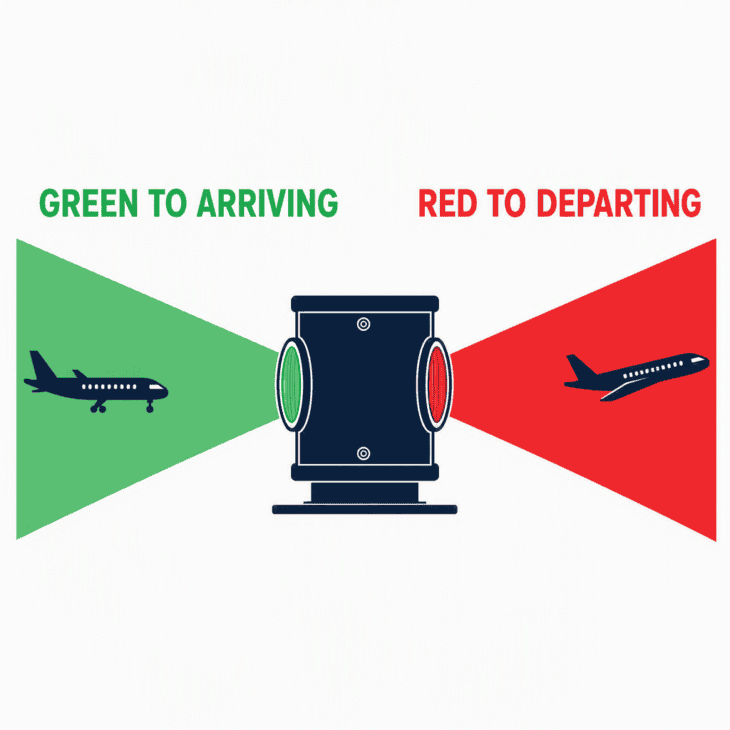
Here is the piece that surprises people who have spent years flying as passengers. The lights marking the ends of a runway are green and red simultaneously, and it is the same hardware doing both.
The AIM puts it plainly: those fixtures emit red toward the runway, to show a departing aircraft where the runway ends, and green outward from the runway end, to show a landing aircraft where the threshold begins.
So a single row of lights is a green welcome mat to the jet on final approach and a red wall to the jet accelerating toward it from the other direction. Which color you see depends entirely on where you are standing.
One light, two opposite messages
Runway end lights are bidirectional by design. The same fixture shows green outward to arriving traffic and red inward to departing traffic, so the runway can be lit correctly for both directions at once without a single switch being thrown.
The Colors That Exist Only to Stop You
An entire branch of airfield lighting exists because of one problem: aircraft ending up on a runway that somebody else is already using.
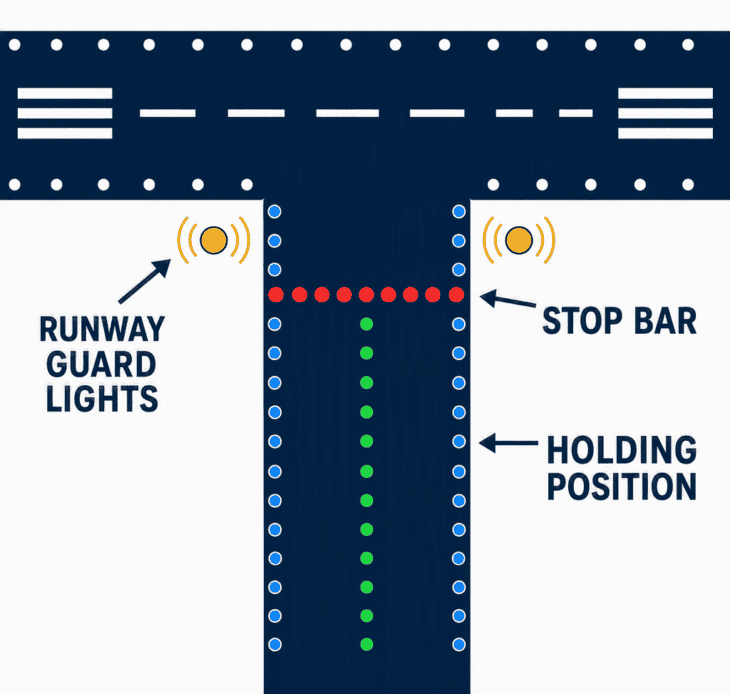
Runway guard lights sit where a taxiway meets a runway. They are either a pair of elevated flashing yellow lights on each side of the taxiway, or a row of in-pavement yellow lights across it, at the holding position. Pilots call the elevated pair wig-wags, and they are hard to miss on purpose.
Stop bars go further. In visibility below 1,200 feet of runway visual range, a row of red in-pavement lights across the taxiway, plus steady red lights on each side, confirms that a crew has not been cleared onto the runway. When the clearance comes, the stop bar goes out and the green lead-on lights come up.
Some airports now add a fully automatic layer called Runway Status Lights, which nobody operates at all. Red runway entrance lights illuminate when a departing aircraft passes roughly 30 knots, or when an arrival is about a mile from the threshold.
Red takeoff hold lights do the same job in the other direction, firing ahead of an aircraft lined up when the runway is occupied. The FAA’s instruction to pilots is unambiguous: never cross over illuminated red lights.
The Red and White Lights Beside the Touchdown Zone
Off to one side of the runway, usually the left, sits a short bar of four light boxes that are neither white nor red but both. This is the Precision Approach Path Indicator, and it is the only part of the system that tells a pilot whether they are too high or too low.
Each box projects white in the upper part of its beam and red in the lower part. Fly the correct glide path and you see an equal split, two white and two red. Drift high and more boxes turn white; sink low and more turn red.
Student pilots learned the older VASI as “red over white, you’re all right.” The full logic of both systems is covered in our explainers on PAPI lights and VASI lights.
Further out, beyond the threshold, precision runways carry approach light systems extending 2,400 to 3,000 feet into the approach area. Many include sequenced flashing lights that appear as a ball of light racing toward the runway twice a second, which crews simply call the rabbit.
The Myth: That All of This Burns All Night
The assumption almost everyone holds is that an airfield is simply lit from dusk to dawn, like a parking lot. At big airports, effectively yes. At many smaller ones, no.
The runway is dark until a pilot turns it on
At many airports with no tower, or with a tower that has closed for the night, the lights are off. A pilot keys the aircraft microphone on the published frequency to switch them on: seven clicks within five seconds for maximum intensity, five for medium, three for the lowest setting. The lights then burn for 15 minutes from the most recent activation.
This is radio-controlled lighting, and the FAA’s advice is to always key seven times first, because that guarantees everything controllable comes on at full brightness before you dial it back. It is one of the stranger facts about flying at night: at a quiet field, the runway exists in the dark until someone asks for it.
One light that does stay on is the rotating beacon, and it carries information too. White and green alternating means a lighted land airport, while white and yellow means a water airport.
Green, yellow and white together means a heliport.
Military fields use white and green like civil ones, but split the white into two quick flashes between the greens.
In controlled airspace, a beacon running in daylight is often a quiet signal that ground visibility is under 3 miles (4.8 km) or the ceiling is below 1,000 feet. The FAA is clear that pilots should never rely on it alone. Deciding where to go, and in what weather, runs on a much larger navigation stack.
The daytime version of the same information is painted rather than lit, in the numbers, stripes and threshold bars explained in our guide to runway markings and signs.
Next time you are at a window seat after dark, start with the blue. Follow it until it stops, because where blue ends and white begins is the edge of the runway, and the moment your aircraft crosses it, everything the crew needs to know is already written on the ground in front of them.
Then look for the amber. If you can see it from your seat, you are looking at the last 2,000 feet of pavement, which is the one color out there that exists to tell somebody they are running out of room.
Sources and references used for research and fact-checking.
- Federal Aviation Administration, Aeronautical Information Manual, Chapter 2 Section 1: Airport Lighting Aids
- Federal Aviation Administration, Aeronautical Information Manual, Chapter 2 Section 2: Air Navigation and Obstruction Lighting
- Federal Aviation Administration, Visual Glide Slope Indicators: Precision Approach Path Indicators (PAPI)
Get the Newsletter
The latest aviation news and stories sent to your inbox.
About the Author

Tim is the owner and lead editor of AeroCorner since 2019, overseeing aviation content covering aircraft, airlines, airports, and the broader aviation industry. Through years of researching, writing, editing, and publishing aviation-focused content, he has developed extensive practical knowledge of commercial aviation and air travel. Based in Asia and a frequent traveler himself, Tim also brings firsthand passenger experience to AeroCorner’s coverage. Outside of publishing, he has also explored aviation firsthand through hands-on flight training in New Zealand.