


Table of Contents
Taxiway markings are always yellow, and runway markings are always white. That one color rule tells a pilot which kind of pavement they are on before they read a single sign.
The marking that matters most is the runway holding position marking, the “hold short line”: four yellow lines across the taxiway, two solid and two dashed. The solid side faces the waiting aircraft, and at a towered airport nobody crosses it without a clearance.
Signs follow their own color code. Red means a mandatory instruction, black with yellow letters tells you where you are, and yellow with black letters tells you where to go. Everything below follows the FAA’s Aeronautical Information Manual (AIM), the reference US pilots fly by.
| Marking or sign | What it looks like | What it tells the pilot |
|---|---|---|
| Taxiway centerline | One solid yellow line | The path to follow |
| Enhanced centerline | Yellow dashes on both sides of the centerline | A runway hold line is within 150 feet |
| Solid double edge | Two continuous yellow lines | Do not cross; the pavement beyond is not for aircraft |
| Dashed double edge | Two broken yellow lines | The pavement beyond is for aircraft and may be crossed |
| Runway holding position | Two solid and two dashed yellow lines | Stop on the solid side unless cleared onto the runway |
| ILS critical area hold | A yellow “ladder” across the taxiway | Stop here when told to hold short of the ILS |
| Taxiway intersection hold | One dashed yellow line | Stop here when told to hold short of a taxiway |
| Nonmovement area boundary | One solid and one dashed yellow line | The edge of the area air traffic control manages |
| Mandatory sign | White on red | Runway or critical area ahead, or no entry |
| Location sign | Yellow on black, yellow border | The taxiway or runway you are on |
| Direction, destination and information signs | Black on yellow | Where a turn leads, the route to a place, local notices |
What Is a Taxiway?
A taxiway is the road an aircraft uses to move between the runway and the ramp. Some run alongside a runway for its whole length, while others are short connectors that let a landing aircraft leave the runway.
The standard way to name a taxiway is a single letter, read over the radio in the phonetic alphabet. Taxiway A is “Alpha” and Taxiway B is “Bravo.” According to SKYbrary, the letters O, I and X are not used.
Large airports can run out of letters, so double letters may name minor taxiways or short stubs. Some airports also add local terms such as “Inner” and “Outer” to the standard system.

The markings described here are the FAA standard used at US airports. Elsewhere, airports generally follow the International Civil Aviation Organization (ICAO) standards unless the country publishes a difference in its aeronautical information publication.
Taxiway Centerline and Edge Markings
Every taxiway should have a centerline: a single continuous yellow line, 6 to 12 inches (15 to 30 cm) wide. Pilots keep the aircraft centered over it while taxiing.
The FAA adds a caveat that surprises people: being centered on the line does not guarantee wingtip clearance from other aircraft or objects. The line marks a path, not a protected corridor, so pilots still watch their wingtips.
Mostly at larger commercial airports, the last stretch of centerline before a runway is “enhanced.” A line of yellow dashes runs parallel on each side of the centerline for up to 150 feet (46 m) before the runway holding position marking. It is an early warning to prepare to stop.
Edge markings appear where the taxiway’s edge does not match the edge of the pavement. They come in two kinds, and the difference tells the pilot whether the pavement beyond is usable.
- Continuous double yellow lines separate the taxiway from a shoulder or other pavement not meant for aircraft. Each line is at least 6 inches (15 cm) wide, with 6 inches between them.
- Dashed double yellow lines are used where the pavement next door is meant for aircraft, such as an apron. The dashes are 15 feet (4.5 m) long with 25-foot (7.5 m) gaps, and aircraft may cross them.
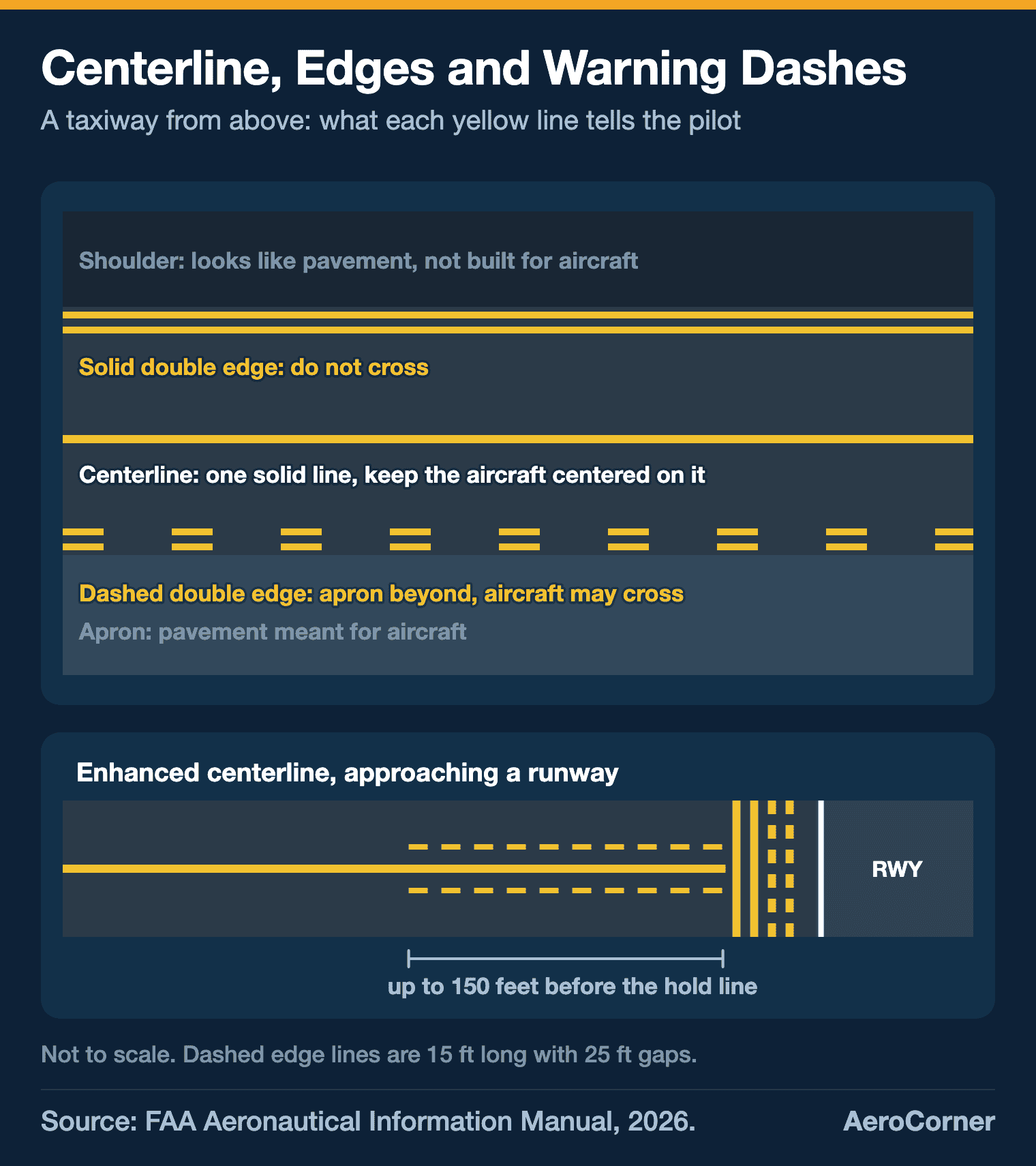
Paved shoulders protect against jet blast and water erosion, but they may not be strong enough to hold an aircraft. Where an island or a curve makes it unclear which side of the edge line is usable, yellow taxiway shoulder markings show which pavement is off limits.
Hold Short Markings: Where Pilots Must Stop
Holding position markings are the most safety-critical paint on an airport. The FAA tracks every case of an aircraft, vehicle or person wrongly on the protected area of a runway as a runway incursion, and these lines are the last physical barrier against one.
Runway Holding Position Markings
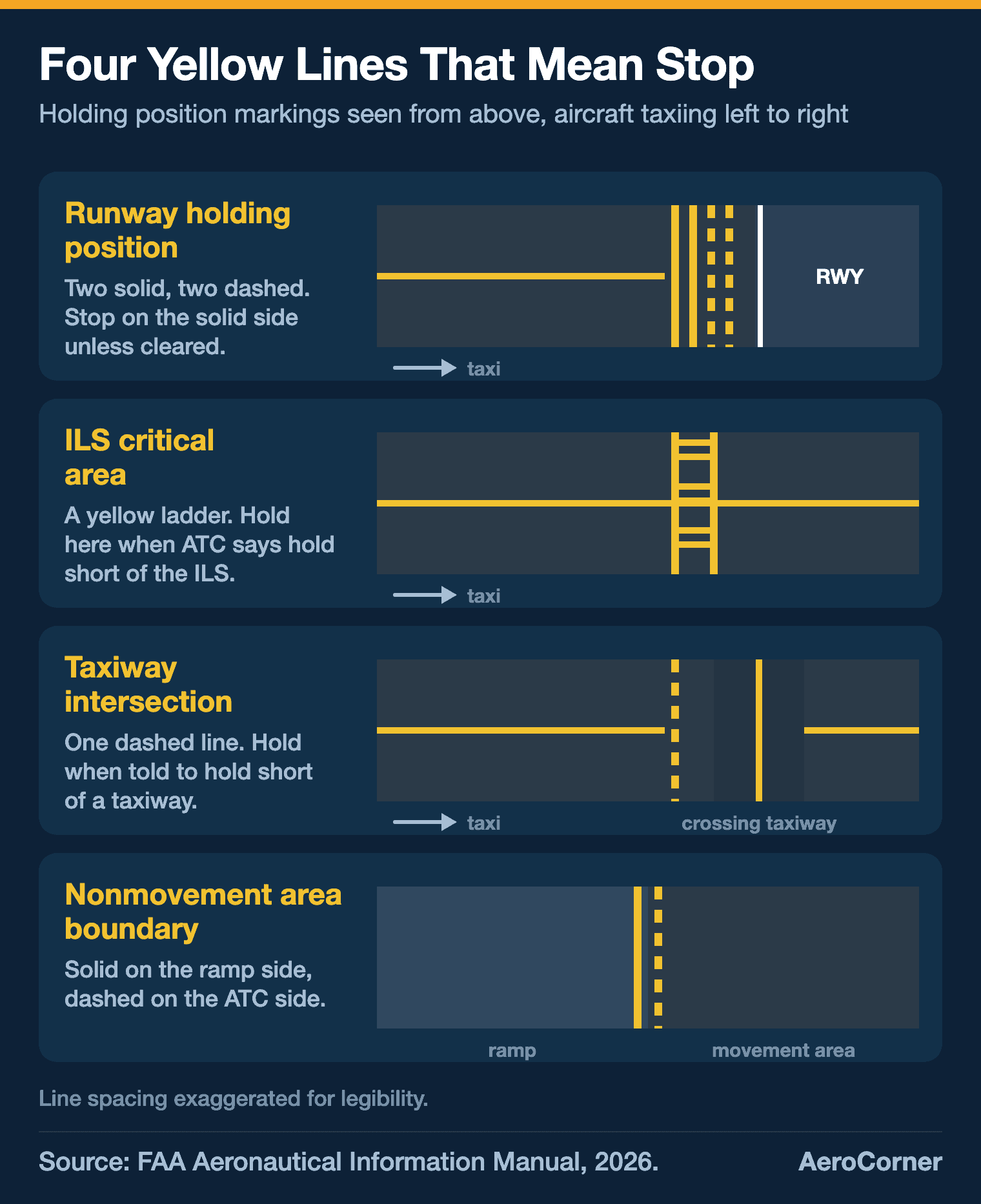
The runway holding position marking is four yellow lines across the full width of the taxiway: two solid and two dashed, spaced 6 or 12 inches apart. The solid lines are always on the side where the aircraft must hold.
When a controller says “hold short of Runway 22,” the pilot must stop so that no part of the aircraft extends past the marking. At an airport with an operating control tower, pilots never cross it without a clearance.

At an airport without an operating tower, nobody issues that clearance. The pilot must make sure there is adequate separation from other aircraft, vehicles and people before crossing the line.
The same marking works in reverse after landing. An aircraft is not clear of the runway until every part of it has crossed the holding position marking, which usually also marks the edge of the runway safety area.
The dashed side is the runway side
An easy way to remember it: dashes face the runway. Approaching from the taxiway you meet the solid lines first and stop. Leaving the runway you meet the dashed lines first, and you keep going until the whole aircraft is past the solid ones.
The marking also appears on runways themselves, where one runway crosses another or for Land and Hold Short Operations. A red sign stands next to it, and pilots stop there unless cleared to cross. Runway paint and the full holding-position rules are covered in our guide to runway markings and signs.

Where the holding position is more than 200 feet (60 m) wide, airports normally also paint the red holding position sign on the pavement. These surface-painted signs sit to the left of the centerline on the holding side, just before the marking.
ILS Critical Area Hold Lines
Many runways are served by an instrument landing system (ILS), whose ground antennas include the localizer and the glideslope. An aircraft parked too close to them can disturb the signal that a landing aircraft is following.
The area to keep clear is the ILS critical area, and its hold line looks like a ladder. Two solid yellow lines 2 feet apart cross the taxiway, joined by pairs of solid lines spaced 10 feet apart. A red sign reading “ILS” stands next to it.
Some airports need this extra hold only while the ILS is being used. Pilots stop there when air traffic control tells them to hold short of the ILS critical area, and an aircraft leaving the area is not clear until all of it has crossed the marking.
Taxiway Intersections and Approach Areas
Where controllers hold aircraft short of another taxiway, a single dashed yellow line runs across the taxiway. With no marking present, the pilot stops at a point that gives adequate clearance from aircraft on the intersecting taxiway.
Some taxiways cross the approach or departure path of a runway. There, a runway holding position marking sits beside a red sign such as “15-APCH,” and pilots stop there when told to hold short of that approach or departure area.
Ramp and Apron Markings
Airports are split into the movement area, which air traffic control manages, and the nonmovement area, usually the ramps and aprons where aircraft park, load and refuel. Air traffic control does not manage the nonmovement area, so pilots moving around it are responsible for their own spacing.
The line between the two is the nonmovement area boundary marking: two 6-inch (15 cm) yellow lines, one solid and one dashed. The solid line is on the nonmovement side, the dashed line on the movement side. Past it, the aircraft is in the movement area, under air traffic control.
Ground vehicles get their own lanes, painted in white so they never look like taxiway paint. A solid white line marks each edge of a vehicle roadway, a dashed white line separates the lanes, and some airports use a white “zipper” pattern for the edges instead.
Some airports also paint geographic position markings along low-visibility taxi routes: a pink circle inside white and black rings, with a number or a number and letter. They let controllers pinpoint a taxiing aircraft when the runway visual range drops below 1,200 feet (360 m).
A yellow cross means closed. Permanently closed runways and taxiways have their lighting disconnected, and a temporarily closed taxiway is usually barricaded or marked with a yellow cross at each entrance. Pilots confirm closures in the NOTAMs and the airport’s ATIS broadcast.
Taxiway Signs: Read the Color First
US airports use six types of signs: mandatory instruction, location, direction, destination, information and runway distance remaining. The colors are standardized, so a pilot knows what kind of message a sign carries before reading it.
Mandatory instruction signs are white on red. They mark the entrance to a runway or critical area, and areas aircraft may not enter. The runway holding position sign shows the intersecting runway’s numbers in the order of its thresholds: “4-22” means the Runway 4 threshold is to the left and Runway 22 to the right.
The same red family includes the “ILS” sign at an ILS critical area hold and the “APCH” and “DEP” signs at approach and departure area holds. The No Entry sign marks a one-way taxiway or a vehicle road that could be mistaken for a taxiway.
Location signs are yellow letters on black, with a yellow border, and name the taxiway or runway you are on. Runway location signs are typically installed where two or more runways sit close enough together to cause confusion.
Direction signs are black on yellow and show the taxiways leading out of an intersection, each with an arrow. They normally stand on the left before the intersection, and their designations run clockwise starting from the first taxiway on the pilot’s left.
When a location sign is grouped with direction signs, every left turn appears to its left, and straight-ahead and right turns appear to its right. A sign reading “←A | B | C→” therefore says: you are on B, A is to the left, C is to the right.
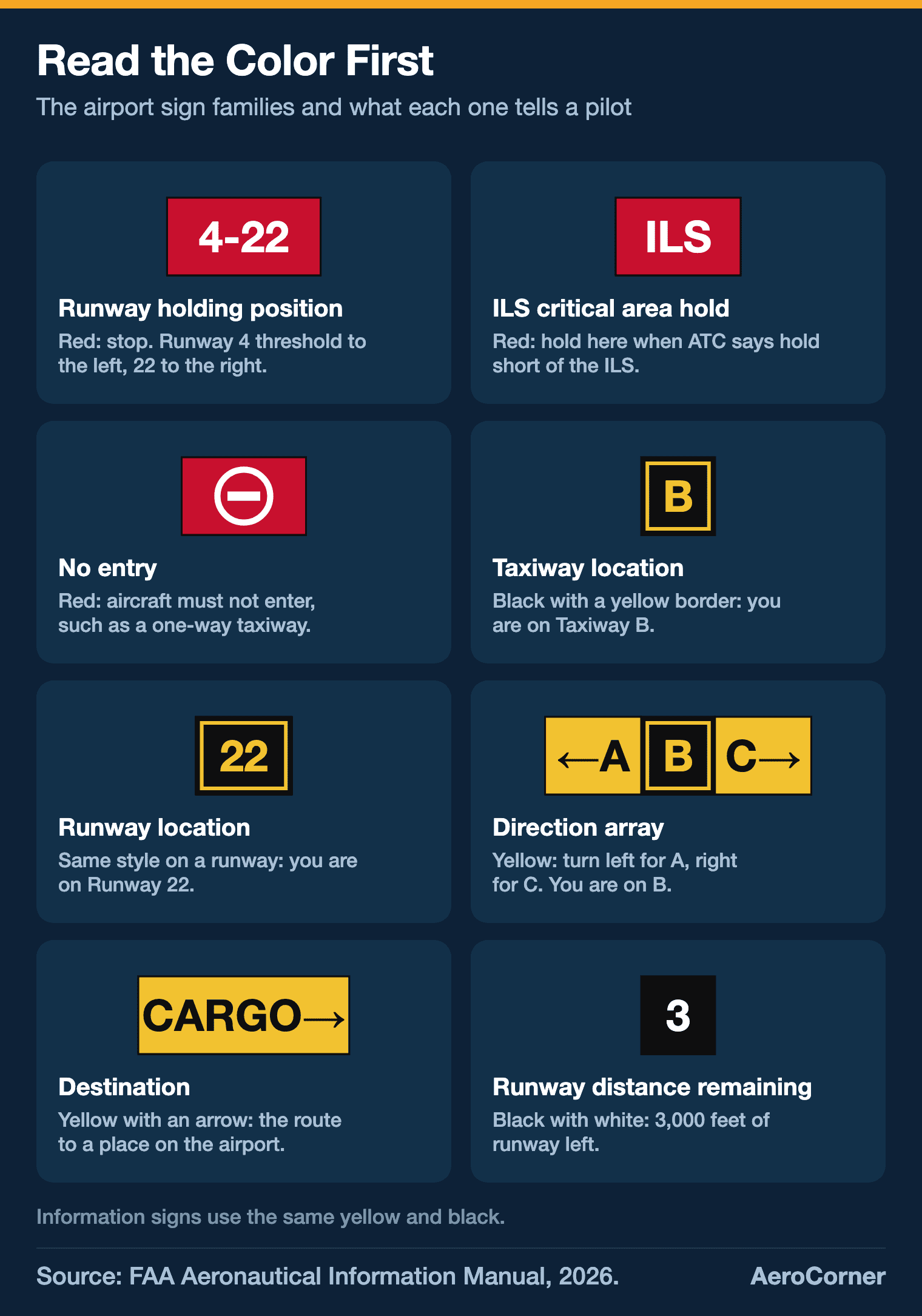
Destination signs are also black on yellow, always with an arrow, and point the way to places such as APRON, FUEL, CARGO, TERM or an FBO apron. Outbound versions show the way to the departure runways.
Information signs use the same black on yellow for local notices, such as radio frequencies, noise abatement procedures or areas the control tower cannot see. The airport operator decides where they go.
Runway distance remaining signs are white numbers on black along the runway edge, counting the thousands of feet left. The last one, reading “1,” stands at least 950 feet from the runway end.
Two yellow signs face the other way, toward an aircraft leaving the runway. The runway boundary sign and the ILS critical area boundary sign each carry a picture of the marking beside them, so a pilot can tell when the aircraft is clear.
Taxiway Lights: Blue Edges, Green Centerlines
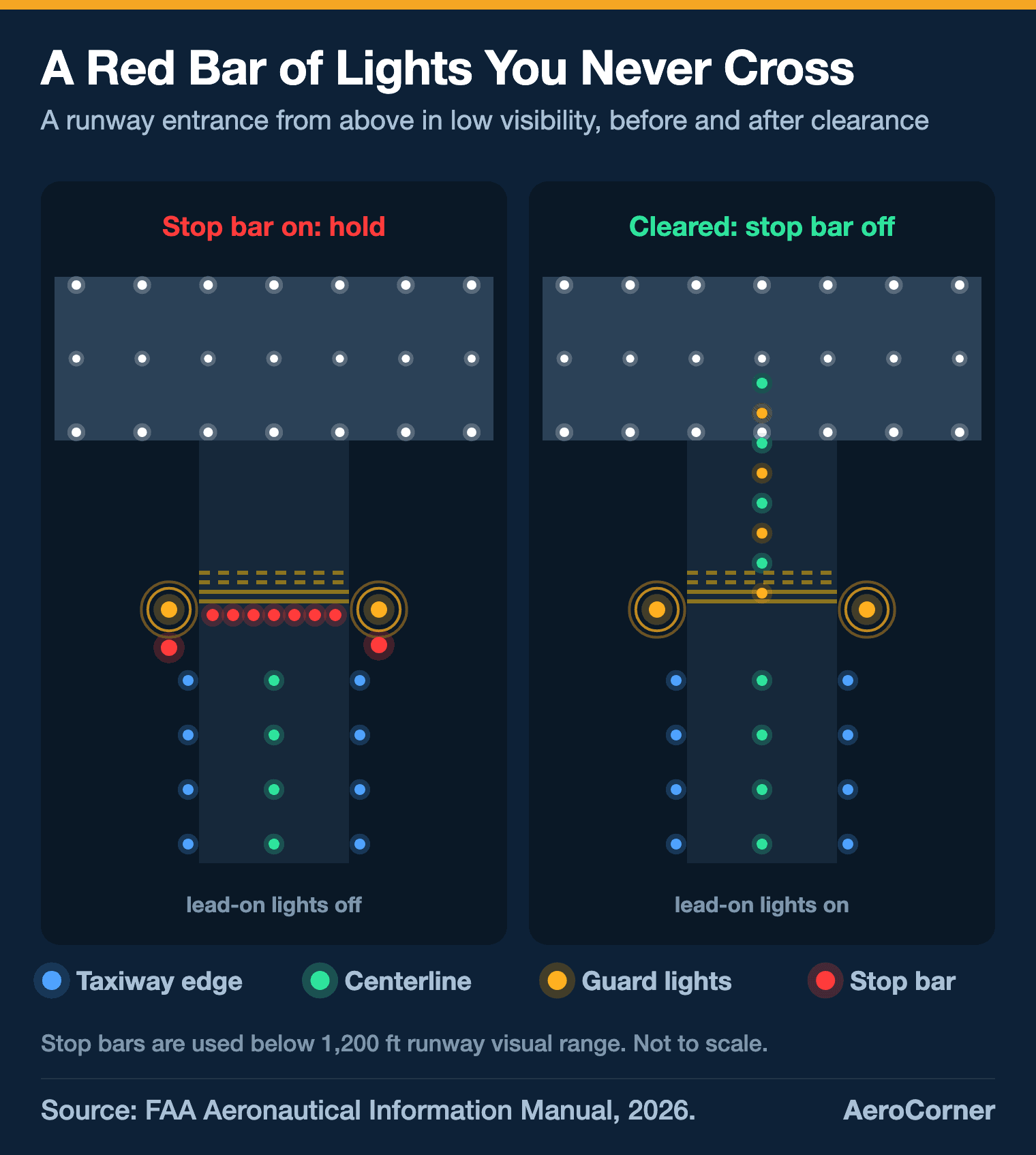
At night the colors take over from the paint. Taxiway edge lights are blue, and taxiway centerline lights, used to help low-visibility taxiing, are steady green. Runway edge and centerline lights are white, which keeps the taxiway-versus-runway distinction alive in the dark.

Yellow lights warn of a runway ahead. Runway guard lights sit at the runway holding position, either as a pair of flashing yellow lights on each side of the taxiway or as a row of in-pavement yellow lights across it. Clearance bars, three steady yellow in-pavement lights, can also mark a holding position in low visibility.
Red means stop. Where installed, a stop bar is a row of steady red in-pavement lights across the taxiway at the holding position, plus a raised red light on each side. It is used to confirm a clearance onto or across a runway when the runway visual range is below 1,200 feet.
Once the controller clears the aircraft, the stop bar goes off and lead-on lights come on toward the runway, alternating green and yellow. The FAA is blunt about the red bar: pilots should never cross an illuminated stop bar, even with a clearance.
Two lighting myths worth unlearning
Stop bars do not flash: they are steady red, and the flashing yellow lights beside them are runway guard lights. And runway centerline lights never turn yellow: they are white until the last 3,000 feet, alternate red and white for the next 2,000, and are all red for the final 1,000.
Yellow does show up on runways in one place. On instrument runways, the edge lights turn yellow for the last 2,000 feet or half the runway, whichever is less, as a caution zone. The rest of the runway color code is in our guide to runway lights.
Some airports go a step further with Runway Status Lights, a fully automatic system. Red runway entrance lights in the taxiway pavement come on when the runway ahead is unsafe to enter, but they never replace a clearance from the tower.
Why Every Line Is Standardized
The FAA defines a runway incursion as any occurrence at an airport involving the incorrect presence of an aircraft, vehicle or person on the protected area of a runway. It grades them from Category A, where a collision was narrowly avoided, to Category D, with no immediate safety consequences.
Uniform markings are the FAA’s answer: a pilot who learns them at one airport can read any other. The AIM asks pilots who find ineffective, incorrect or confusing markings to tell the airport operator, and they can also report them through the Aviation Safety Reporting Program.
FAQ
Sources and references used for research and fact-checking.
Get the Newsletter
The latest aviation news and stories sent to your inbox.
About the Author
Matt Claiborne is an FAA Airline Transport Pilot and Certified Flight Instructor with more than two decades of experience in flight training. He has served as an assistant professor and FAA Part 141 Assistant Chief Instructor for a university aeronautics program in Florida. His background in professional flying, flight instruction, and aviation education gives him firsthand expertise in aircraft operations, pilot training, flight procedures, and aviation safety.