

Table of Contents
Board a flight out of Orlando and the boarding pass reads MCO. Fly out of Chicago and it says ORD. New Orleans is MSY. None of those letters appear anywhere in the city’s name.
It is tempting to assume the codes are arbitrary, three letters IATA pulled out of a hat. They are not. Each one is a small fossil, a message frozen in place from the moment the code was assigned, sometimes describing a spot on the map that has not existed in decades.
Some of those fossils are ghost airfields: military bases and cattle land that quietly became major airports without ever updating their code.
Others are relics of a stricter rule: a letter reserved for the Navy, a letter borrowed from a weather station, or a filler letter tacked onto a two-letter code to make it fit the new three-letter system. Here is what your boarding pass is actually telling you.
The short answer
Most mismatched airport codes are not abbreviations of anything modern. They record whatever occupied that ground, a military base, a stockyard, an early airfield, when the three-letter code was first assigned, decades before the airport had its current name.
A smaller group of codes look strange for a different reason. They follow a letter rule from the earliest days of the coding system, like the X tacked onto Los Angeles, or the letter reserved nationwide for the US Navy.
Airports get renamed constantly. Codes almost never do, because too many reservation systems, baggage tags, and flight plans depend on them staying exactly where they are.
The pattern in one line
Airport codes are locked in at assignment and almost never updated, so the strangest ones are simply older than the name of the airport you know today.
The ghost airfields buried in your boarding pass
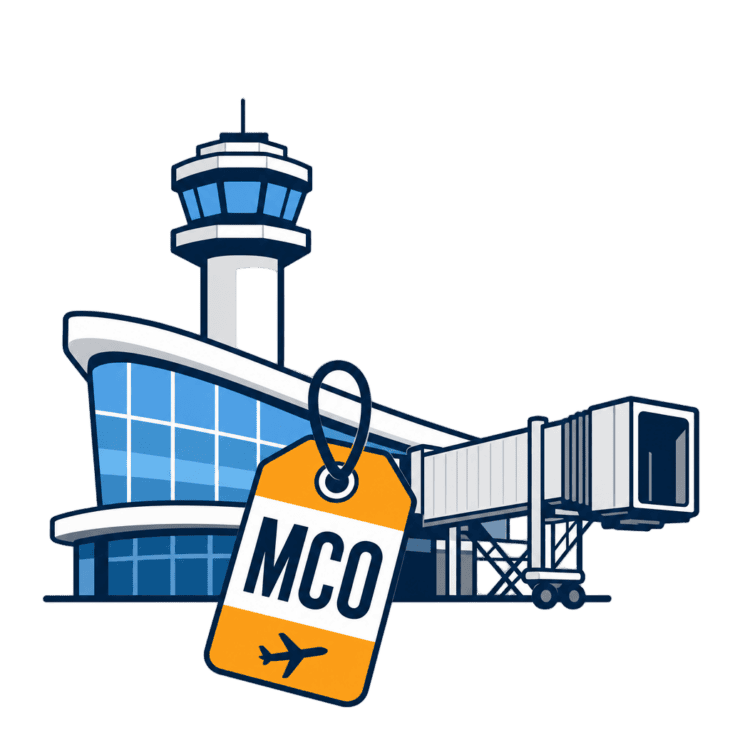
Orlando International Airport sits on the former McCoy Air Force Base. It was a Strategic Air Command installation that flew U-2 spy planes and stood ready during the Cuban Missile Crisis.
The base closed in 1975 and the site became a civilian airport. Its code, MCO, honors Colonel Michael N.W. McCoy, a pilot killed in a 1957 crash during a bombing competition held there. The code stayed on the boarding pass even after the base itself disappeared from the map.
New Orleans tells a stranger version of the same story. In 1910, pioneer aviator John Moisant crashed and died near Kenner, Louisiana.
Moisant was one of the most famous fliers of his era, the first pilot to cross the English Channel with a passenger and the first to fly over a major city. His death at the height of that fame is why the crash site stayed on the map at all.
The crash site was later used to pasture cattle and became known locally as the Moisant Stock Yards. A modern airfield opened nearby in 1946 as Moisant Field.
The airport has since been renamed twice, most recently to Louis Armstrong New Orleans International in 2001. Its code, MSY, still spells out a cattle yard named for a dead aviator.
Chicago’s O’Hare has a similar backstory. During the Second World War, Douglas Aircraft built a wartime plant there to assemble C-54 Skymaster transports.
The site was registered as Orchard Field, the source of the code ORD. It kept that name through the rest of the war.
The airport was renamed O’Hare International in 1949, honoring Lieutenant Commander Edward “Butch” O’Hare, a Medal of Honor recipient killed in action. Commercial service began there in 1955.
Today O’Hare handles roughly 1,461 flights a day, one of the busiest schedules of any airport in the United States. It still flies under a code describing an orchard that has not existed for eighty years.
Nashville hides a fourth ghost airfield in plain sight. Its code, BNA, is short for Berry Field Nashville, honoring Colonel Harry S. Berry, the WPA administrator who oversaw the airport’s construction.
Berry Field opened in 1937 with an air show and a mock aerial bombardment. The airport became Nashville International in 1988, and BNA has quietly outlived the name Berry Field ever since.
1943
Douglas Aircraft opens a wartime plant on the site to assemble C-54 Skymaster transports for the war effort.
1945
The airfield is registered as Orchard Field, giving it the three-letter code ORD.
1949
Chicago renames the airport O’Hare International to honor WWII flying ace Edward “Butch” O’Hare. The code ORD does not change.
1955
Commercial airline service officially begins at O’Hare.
| Code | What it actually records | Named for |
|---|---|---|
| MCO (Orlando) | McCoy Air Force Base | Col. Michael N.W. McCoy, killed in a 1957 crash |
| MSY (New Orleans) | Moisant Stock Yards | John Moisant, aviator killed in a 1910 crash nearby |
| ORD (Chicago) | Orchard Field | The airfield’s wartime name, before it became O’Hare in 1949 |
| BNA (Nashville) | Berry Field | Col. Harry S. Berry, who oversaw the airfield’s 1937 construction |
The letters that were never about the city at all
Not every odd code hides a ghost airfield. Some simply follow a rule from the earliest days of the coding system.
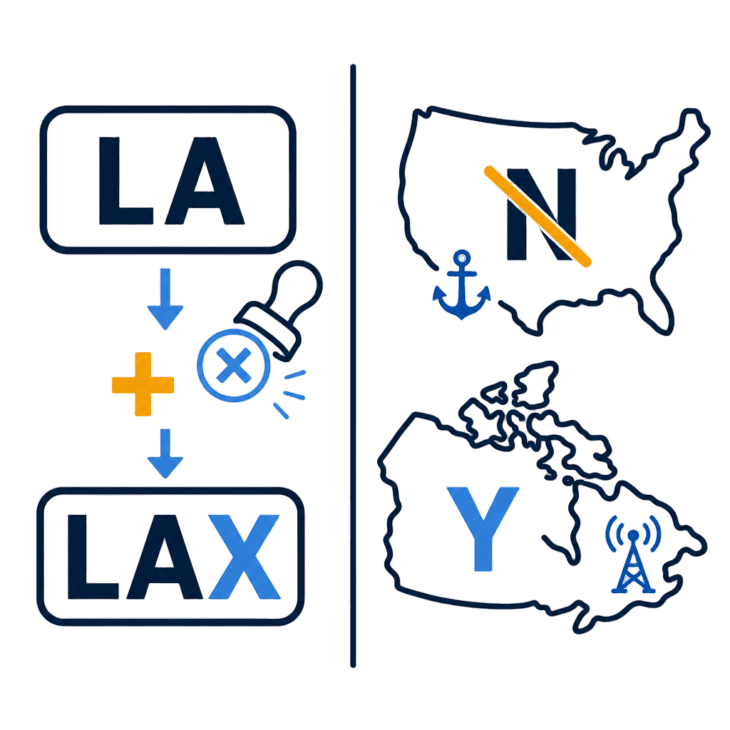
In the 1930s, airports and weather stations used two-letter identifiers built for Morse code and radio telegraph. When the industry adopted three-letter codes in the 1940s to keep up with growing air travel, many airports just added a filler letter to their existing two-letter tag to make the jump.
Los Angeles was simply LA. It became LAX by tacking on an X that means nothing at all.
Portland did the same to become PDX, and Phoenix became PHX. Sioux City, Iowa, took the same path from SU, landing on a code that has bedeviled its tourism board ever since.
The code Sioux City stopped fighting
Sioux Gateway Airport’s code, SUX, spent fourteen years under petition to the FAA for a change. In 2007 the city gave up and leaned in instead, selling “FLY SUX” t-shirts and mugs and turning the code into the airport’s best-known marketing line.
Two other rules explain the rest of the mismatches. Every code starting with N is reserved for the US Navy, which is why Newark is EWR instead of NWR, and Nashville needed a code that did not start with N in the first place.
In Canada, most codes start with Y instead, a leftover from a 1930s system. Airports with an on-site weather or radio station were marked Y for yes, and airports without one were marked W, a distinction absorbed wholesale into the modern three-letter code.
A second numbering system runs in parallel to all of this. The four-letter ICAO codes used by pilots and air traffic control add a K in front of the same three letters across the lower 48 states, so ORD becomes KORD and LAX becomes KLAX, a layer most passengers never see.
The myth vs. the reality
It is easy to assume every airport code is built from its current name, three letters pulled straight out of “Los Angeles” or “Orlando International.” The strangest codes are proof that this is not how the system works.
The myth
Codes are not renamed when an airport is. MCO, MSY, ORD, and BNA were locked in decades before the airports carried the names they have today, and Los Angeles never had a say in its own X.
The reality is closer to how tail numbers and aircraft designations work elsewhere in aviation. Identifiers get assigned once, under a specific system, and then stay fixed long after the story behind them fades from memory.
Reassigning a code baked into ticketing systems, baggage routing, and flight plans worldwide is far more disruptive than just living with the mismatch. It is easier to let a colonel, a cattle yard, or an orchard quietly outlive the name on the terminal.
Closing
Next time a boarding pass shows a code that has nothing to do with the city on the departures board, it is worth a second look.
MCO is a colonel’s name attached to a Cold War air base. MSY is a cattle yard named after a dead aviator. ORD is an orchard that stopped existing before the jet age began.
None of it was designed to be a puzzle. It is just what happens when a fast-moving industry locks a code in place and never looks back.
Sources and references used for research and fact-checking.
- Wikipedia, McCoy Air Force Base
- The Times-Picayune / Gambit (nola.com), Blakeview: What does MSY stand for? How the New Orleans airport was named after 'Moisant Stock Yards'
- Encyclopaedia Britannica, O'Hare International Airport
- Wikipedia, Nashville International Airport
- Ascend in Motion, Why Is LAX Called LAX?
- Fox News (AP), Sioux City Stops Fighting It, Embraces Identifier 'SUX'
- Simple Flying, Why Do Canadian Airport Codes Begin With The Letter Y?
Get the Newsletter
The latest aviation news and stories sent to your inbox.
About the Author
Tim is the owner and lead editor of AeroCorner since 2019, overseeing aviation content covering aircraft, airlines, airports, and the broader aviation industry. Through years of researching, writing, editing, and publishing aviation-focused content, he has developed extensive practical knowledge of commercial aviation and air travel. Based in Asia and a frequent traveler himself, Tim also brings firsthand passenger experience to AeroCorner’s coverage. Outside of publishing, he has also explored aviation firsthand through hands-on flight training in New Zealand.