

Table of Contents
Denver’s longest runway is just over 16,000 feet of concrete, more than three miles (4.9 km). London Heathrow, which handles far more passengers a year, gets by with 12,802 feet (3,902 m).
The aircraft are the same. A Boeing 777 leaving Denver is the same 777 leaving Heathrow, flown by the same kind of crew at roughly the same weight. So the extra 3,000 feet is not there for the airplane.
It is there for one particular day: the hottest afternoon of the year, with a full load, on a wet surface, when an engine quits at the worst possible second. That day is what a runway is actually built for, and it explains almost every runway length in the world.
How Long Is a Runway?
Most runways at large commercial airports fall between 8,000 and 13,000 feet (2,400 to 4,000 m). Small regional and general aviation fields run far shorter, often 3,000 to 5,000 feet (900 to 1,500 m).
For a sense of what an airliner actually uses, EUROCONTROL’s performance database puts a loaded Airbus A320’s takeoff distance at about 7,185 feet (2,190 m) and its landing distance at about 4,725 feet (1,440 m). Those are indicative figures, not operating limits.
But there is no single answer, and that is the honest response to the question. Runway length is not a property of the aircraft at all. It is the output of a calculation that takes the most demanding airplane expected to use the airport and runs it through its worst realistic day.
The short version
A runway is sized so the most demanding aircraft that regularly uses the airport can operate at full weight without restriction, on the hottest month’s typical high temperature, at that airport’s elevation, allowing for slope, a wet surface, and an engine failure at the worst moment of the takeoff roll. Every one of those factors adds length.
The Runway Is Built Around the Engine That Fails
The single biggest driver of runway length is a failure that almost never happens. Every airline takeoff is planned around losing an engine at the most awkward possible moment, and the runway has to be long enough to survive it either way.
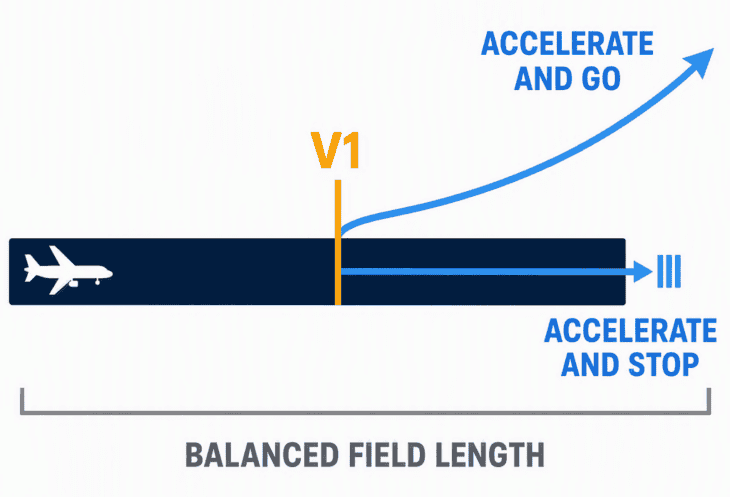
There are two distances involved. The accelerate-stop distance is the room needed to accelerate, lose an engine, and then bring the aircraft to a complete halt on the pavement.
The accelerate-go distance is the room needed to accelerate, lose an engine, and keep going on the remaining engines until the aircraft is 35 feet (11 m) above the surface. One asks how much room it takes to stop. The other asks how much room it takes to leave.
Those two distances move in opposite directions depending on how fast you are going when the engine quits. Early in the roll, stopping is easy and going is hard. Late in the roll, going is easy and stopping is hard.
Somewhere in the middle they cross, and that crossing point is the speed pilots call V1. When the runway is exactly long enough that stopping and going need the same distance, that length is the balanced field length, and it is the number airport planners design around.
The margins built into this are deliberately unforgiving. Under 14 CFR 25.109, the certified accelerate-stop distance must include a distance equivalent to two extra seconds of travel at V1, on top of everything the aircraft actually needs to stop.
V1 is not the speed where the pilot decides
Almost every popular explanation calls V1 the “takeoff decision speed.” That definition was officially scrapped because it caused, in the regulators’ own words, a great deal of misunderstanding. V1 is the maximum speed at which the pilot must already have taken the first stopping action: brakes, thrust, speed brakes. A crew that starts thinking at V1 is already too late, and the runway length assumes they were not.
Then It Is Designed for the Hottest Month of the Year
Once the engine-failure case is settled, the air itself takes over. Wings and engines both work by moving air, and thin air gives less of both.
Air thins with altitude and it thins with heat. An airport high above sea level, or an airport that bakes in summer, gives an aircraft less lift and less thrust for the same throttle setting, so the aircraft has to reach a higher true speed before the wing will fly. Reaching a higher speed takes more pavement.
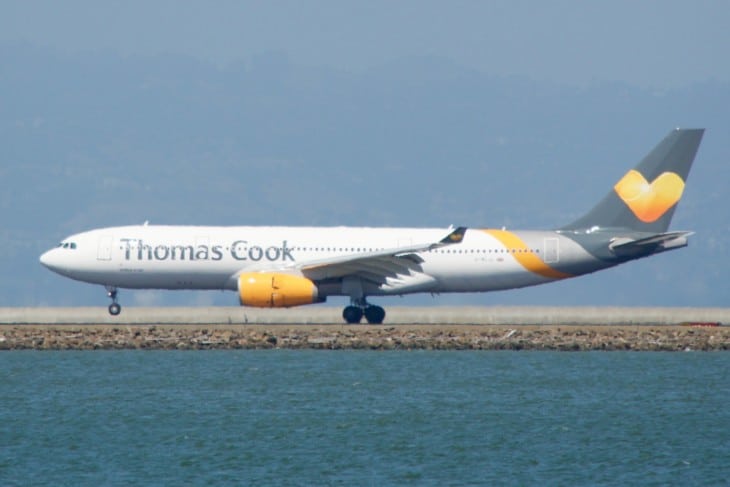
The FAA does not design for an average day. Its guidance for airport planners, Advisory Circular 150/5325-4B, instructs designers to use the airport’s elevation together with the mean daily maximum temperature of the hottest month of the year.
That is the “worst day” written into the rules. The stated design objective is a runway that serves every aircraft regularly using it “without causing operational weight restrictions,” meaning nobody should have to leave passengers or fuel behind on a normal hot afternoon.
You can see the result in the rankings. Of the five airports with the longest runways in AeroCorner’s ranking of airport runway lengths, four are either high, hot, or both.
| Airport | Longest runway | Airport elevation | What drives the length |
|---|---|---|---|
| Denver (DEN) | 16,037 ft (4,888 m) | 5,431 ft (1,655 m) | Altitude |
| Erbil (EBL) | 15,801 ft (4,816 m) | 1,363 ft (415 m) | Desert heat, military origins |
| Harare (HRE) | 15,538 ft (4,736 m) | 4,887 ft (1,490 m) | Altitude |
| Windhoek (WDH) | 14,970 ft (4,563 m) | 5,640 ft (1,720 m) | Altitude |
| Las Vegas (LAS) | 14,843 ft (4,524 m) | 2,181 ft (665 m) | Desert heat |
Denver sits at 5,431 feet (1,655 m) and handles more than 1,100 flights a day. It needs pavement nobody at sea level would ever build.
That same logic, applied across the whole site, is a large part of why Denver’s airport is so enormous. The rest of the American picture is in our guide to the longest runways in the US.
Erbil is the honest exception in that table. It sits low, but it endures brutal desert summers and was built as a military airfield, and military runways have never been sized by commercial logic.
The day Phoenix ran out of runway
On 20 June 2017, Phoenix Sky Harbor hit 119°F (48.3°C) and American Airlines canceled more than 40 American Eagle regional flights scheduled between 3pm and 6pm. The Bombardier CRJ aircraft on those routes have a maximum operating temperature of 118°F (47.8°C). American’s own explanation was blunt: hot air is less dense, the hotter it gets the more speed an aircraft needs to lift off, and a runway might simply not be long enough to reach it.
The Margins Nobody Sees: Wet Pavement and Slope
Takeoff is only half the problem. Landing carries its own legal margin, and it is far bigger than most passengers would guess.
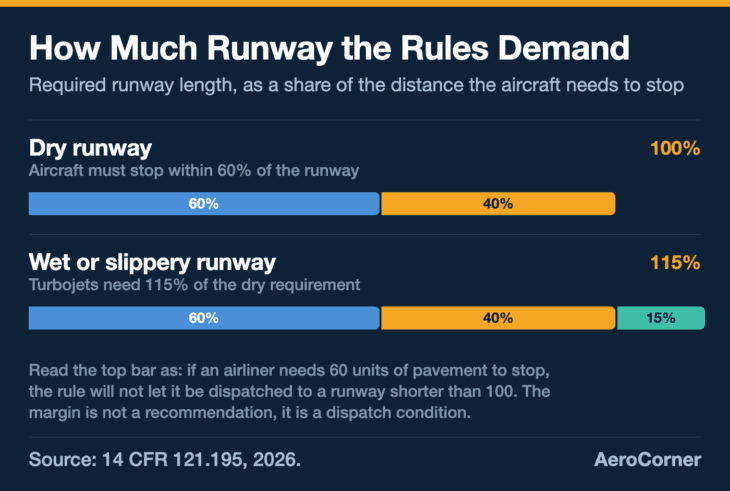
Under 14 CFR 121.195, an airliner may not be dispatched to a destination unless it can make a full stop landing within 60 percent of the runway’s effective length. The aircraft is required to be able to stop in well under two thirds of the concrete it is given.
Put the other way around, the runway has to be roughly 167 percent of the distance the aircraft actually needs on a good day. The remaining 40 percent is pure margin, and it is the reason a landing that feels leisurely still ends with thousands of feet to spare.
Then the weather takes a share. If the forecast says the runway will be wet or slippery on arrival, the same rule requires 115 percent of that already conservative figure for turbojet aircraft.
Slope costs length too, and the exchange rate is steep. The FAA’s planning guidance adds 10 feet of runway for every single foot of elevation difference between the high and low points of the centerline, so a runway with a 30-foot hump in it owes another 300 feet.
Which is why the famous short runways are famous. Lukla’s airstrip in Nepal is 1,729 feet (527 m) long, on an 11.7 percent slope, at 9,334 feet (2,845 m) of elevation.
No normal design rule would ever produce that combination. It is one of a small club of fields that require pilots to hold a special certification just to land there.
The Myth: Bigger Airplanes Need Longer Runways
The intuitive assumption is that runway length tracks aircraft size, and that the longest runways exist to accommodate the biggest jets. It is roughly true at the extremes and misleading everywhere else.
Phoenix in June 2017 is the cleanest possible counterexample. The aircraft that could not fly that afternoon were the small regional jets, while the Boeings and Airbuses around them kept operating, because those larger types are certified to 126°F and 127°F (52°C and 53°C) respectively.
Size is not the variable that matters
What actually sets the distance is weight relative to available lift and thrust on the day. A fully loaded narrowbody departing a hot, high airport in August can need more runway than a lightly loaded widebody leaving a cool, sea-level airport at dawn. The same aircraft, same airport and same crew can need very different amounts of pavement in January and July.
This is also why airlines offload weight rather than lengthen runways. When conditions turn bad enough, the fix is to carry less fuel, fewer bags, or fewer passengers, which is exactly the “operational weight restriction” the FAA’s design objective is written to avoid.
A runway, in other words, is a bet about weather and weight made decades in advance, in concrete, by people who will never fly the aircraft it serves.
So the next time your aircraft turns onto the runway and the pavement ahead looks absurdly long for the job, it probably is, on that day. That surplus is not waste, and it is not there for the aircraft you are sitting in.
It is there for the August afternoon when the air is thin, the pavement is wet, the aircraft is full, and something breaks at exactly the wrong moment. Most days the runway is far longer than anyone needs, which is the entire point of it.
Sources and references used for research and fact-checking.
- Federal Aviation Administration, AC 150/5325-4B, Runway Length Requirements for Airport Design
- Cornell Law School Legal Information Institute, 14 CFR 25.109 - Accelerate-stop distance
- Cornell Law School Legal Information Institute, 14 CFR 121.195 - Airplanes: Turbine engine powered: Landing limitations: Destination airports
- Flight Safety Foundation, AeroSafety World, High Time to Redefine V1
- NPR, It's Too Hot For Some Planes To Fly In Phoenix
- AeroCorner, Airport runway length rankings
- EUROCONTROL, Aircraft Performance Database: Airbus A320
- Wikipedia, Denver International Airport
- Wikipedia, Heathrow Airport
- Wikipedia, Tenzing-Hillary Airport
- Wikipedia, Robert Gabriel Mugabe International Airport
- Wikipedia, Hosea Kutako International Airport
- Wikipedia, Harry Reid International Airport
- Wikipedia, Erbil International Airport
Get the Newsletter
The latest aviation news and stories sent to your inbox.
About the Author

Tim is the owner and lead editor of AeroCorner since 2019, overseeing aviation content covering aircraft, airlines, airports, and the broader aviation industry. Through years of researching, writing, editing, and publishing aviation-focused content, he has developed extensive practical knowledge of commercial aviation and air travel. Based in Asia and a frequent traveler himself, Tim also brings firsthand passenger experience to AeroCorner’s coverage. Outside of publishing, he has also explored aviation firsthand through hands-on flight training in New Zealand.