

Table of Contents
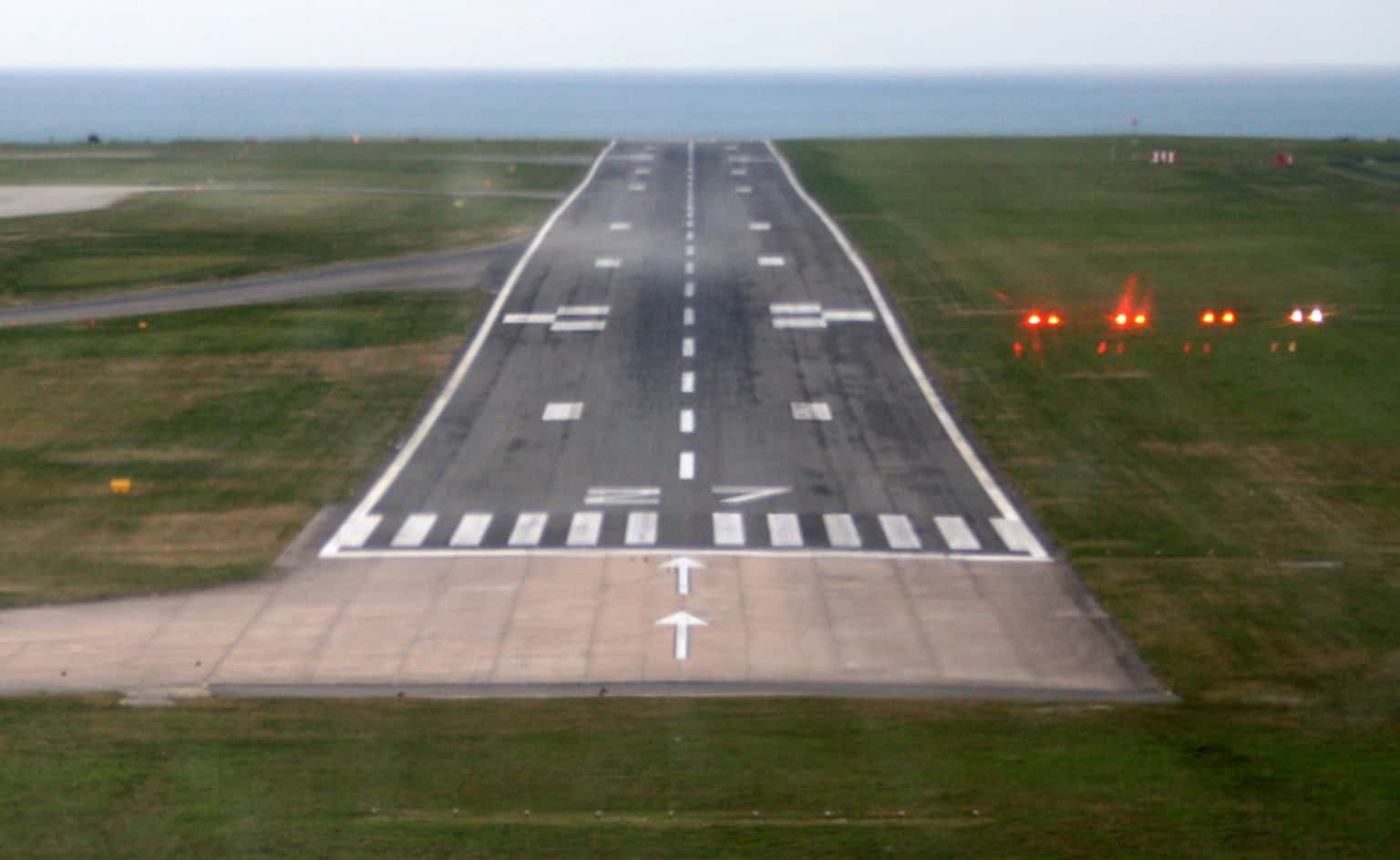
PAPI lights are a short row of red and white lights beside a runway that tell a pilot on final approach whether they are too high, too low or on the glide path. PAPI stands for Precision Approach Path Indicator. Most have four lights, normally on the left side of the runway.
The reading is simple: two white and two red means you are on the glide path, normally 3 degrees. More white means you are high, and more red means you are low.
It is also the system almost every pilot meets. The FAA’s own airport database for October 2026 lists a PAPI on 6,952 US runway ends at 3,005 airports, more than nine in ten of the runway ends that have any visual glide slope indicator at all.
| What you see | Where you are | What to do |
|---|---|---|
| 4 white | Well above the glide path | Fly down |
| 3 white, 1 red | Slightly above | Fly down a little |
| 2 white, 2 red | On the glide path | Hold it |
| 1 white, 3 red | Slightly below | Fly up a little |
| 4 red | Well below the glide path | Fly up |
What Are PAPI Lights?
A PAPI is a visual glide slope indicator: lights near the touchdown zone that give vertical guidance with no equipment in the cockpit. The runway and its lights show a pilot left and right. The PAPI answers the harder question of height.
The FAA’s Aeronautical Information Manual (AIM) describes it as a single row of two or four light units, normally on the left side of the runway. The lights are visible from about 5 miles by day and up to 20 miles at night, which helps pilots flying under visual flight rules set up a stable descent long before the runway markings are readable.

The design is British. According to Wikipedia’s history of the system, Tony Smith and David Johnson devised the PAPI at the Royal Aircraft Establishment in Bedford, England, in 1974.
How to Read PAPI Lights
Count the red lights, starting from the light nearest the runway. That inner light is aimed highest, so it is the first to turn red as you sink below the path. On the glide path, the two inner lights are red and the two outer lights are white.
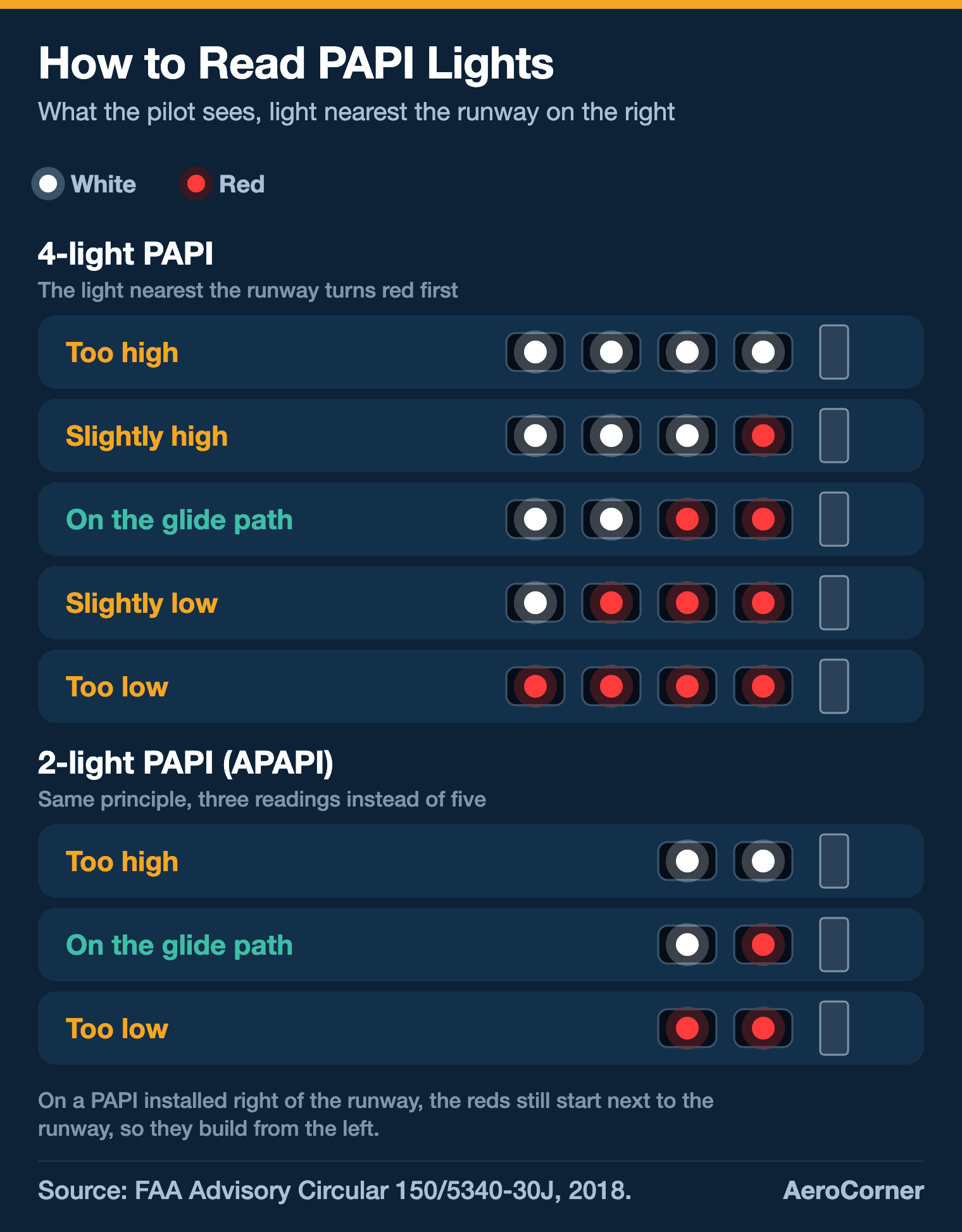
The change from one picture to the next is progressive, so a pilot sees the lights move one at a time. A drift from two red to three red is an early warning, long before the approach gets dangerous.
A PAPI on the right side reads backward
Some runways have the PAPI on the right side, where terrain, a taxiway or a crossing runway rules out the left. The FAA requires the lights nearest the runway to turn red first there too, so on a right-side PAPI the reds build from the left instead of the right.
The AIM adds a caution: do not start down using the PAPI until the aircraft is visually lined up with the runway. Its obstacle protection normally covers only 10 degrees either side of the extended centerline, out to 3.4 nautical miles from the threshold.
Some runways narrow that protected area, shorten its usable distance or offset the PAPI from the centerline. When they do, the restriction is published in the Chart Supplement or a NOTAM.
How PAPI Lights Change Color
The lights do not actually change color. Each light unit projects one beam that is white in its upper part and red in its lower part, so the color you see depends only on whether you are above or below that unit’s dividing angle.
The trick is how sharp that boundary is. The FAA’s equipment standard requires the switch from red to white to happen within 3 minutes of arc, a twentieth of a degree, at the center of the beam. That is why a PAPI light seems to flip rather than fade.
Each of the four units is then aimed at a slightly different angle. For a 3-degree glide path, the FAA sets them, from the runway outward, at 3°30′, 3°10′, 2°50′ and 2°30′.
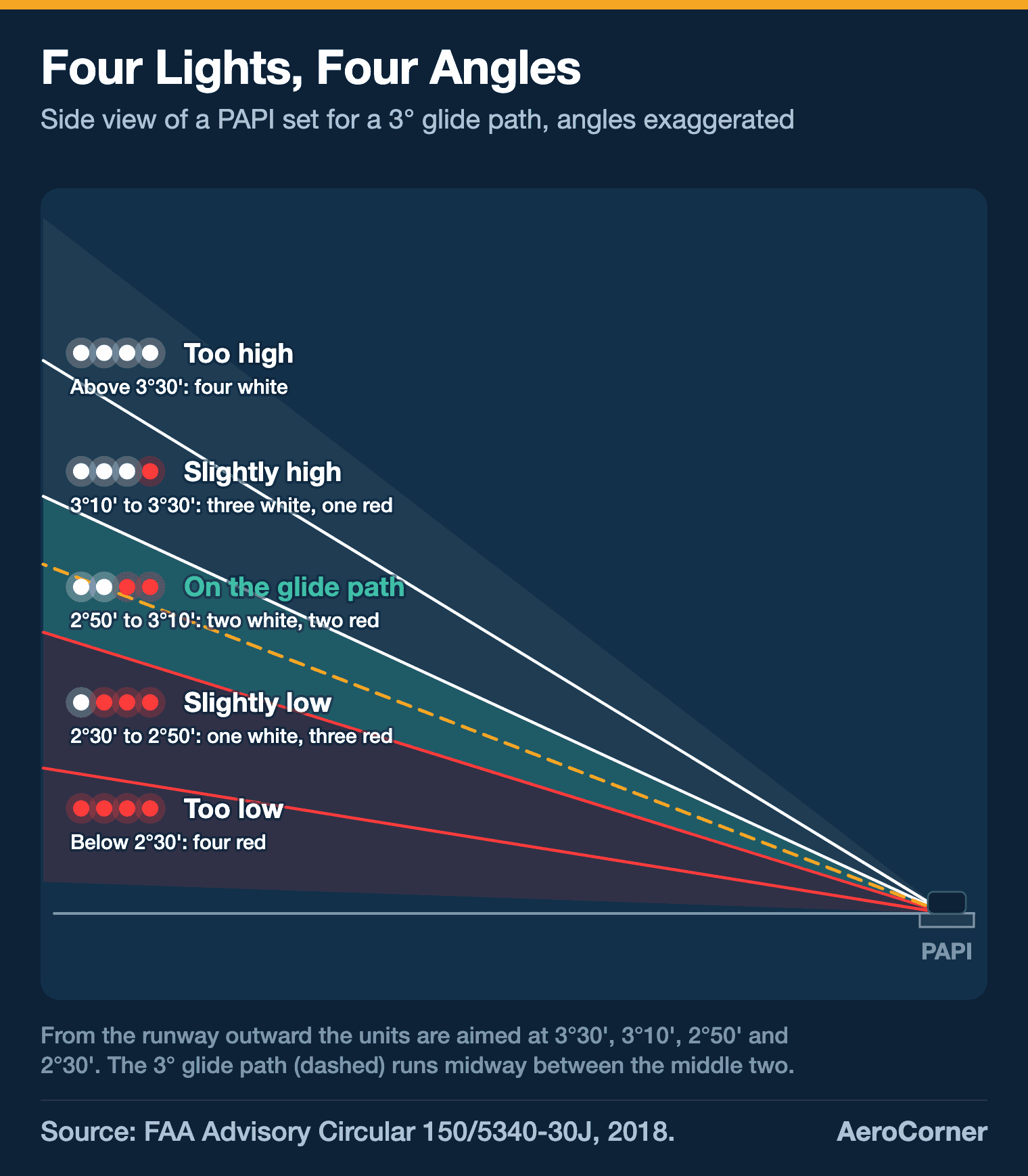
Those four angles create five zones. The on-path picture of two white and two red covers only the band between 2°50′ and 3°10′, a third of a degree wide, with the 3-degree path running down its middle.
Older PAPIs used incandescent lamps behind a red filter. The current FAA standard also allows LED light sources, as long as the beam still splits into white on top and red below.
Where the PAPI Sits, and Why
The FAA places the inner light unit 50 feet (15 m) from the left runway edge, or 30 feet (10 m) on small runways used only by non-jet aircraft. The units stand 20 to 30 feet (6 to 9 m) apart in a line square to the runway.
The distance from the threshold is calculated, not guessed. It is chosen so that an aircraft on the lowest on-path signal crosses the threshold at a set height, called the threshold crossing height, which depends on the aircraft the runway serves.
| Height group | Representative aircraft | Cockpit-to-wheel height | Threshold crossing height |
|---|---|---|---|
| 1 | General aviation, small commuters, corporate turbojets | 10 feet (3 m) or less | 40 feet (12 m) |
| 2 | Boeing 737, DC-9, DC-8, F-28 | 15 feet (4.5 m) | 45 feet (14 m) |
| 3 | Boeing 727, 707, 757 | 20 feet (6 m) | 50 feet (15 m) |
| 4 | Boeing 747 and 767, DC-10, L-1011, A300 | Over 25 feet (7.6 m) | 75 feet (23 m) |
The FAA’s own worked example: for a runway used by 737-class jets, with a 45-foot crossing height, the PAPI goes about 909 feet (277 m) past the threshold. The obstacle-free surface that protects the approach starts 300 feet (90 m) in front of the lights and slopes up at one degree below the lowest on-path signal.
Why a jumbo jet gets its own PAPI setting
A 747 pilot sits more than 25 feet above the main wheels, so a pilot whose eyes are on the glide path would bring the wheels in low. On runways with an instrument landing system that mostly serve these aircraft, the FAA moves the PAPI an extra 300 feet down the runway and spreads the four units 35 and 15 minutes of arc either side of the glide path instead of 30 and 10.
Where a runway has an instrument landing system (ILS) or a GPS approach with vertical guidance, the PAPI is sited so its path matches that electronic glide path. The UK Civil Aviation Authority notes one quirk: in aircraft whose ILS antenna sits above the pilot’s eyes, the PAPI may show slightly low while the airplane is exactly on the ILS glide path.
Not Every PAPI Is Set to 3 Degrees
Three degrees is the standard. The FAA allows the glide path to be raised to as much as 4 degrees on runways that do not serve jets when obstacles in the approach demand it.
We sorted all 6,952 US PAPI runway ends in the FAA’s October 2026 airport data by the glide path angle the FAA records for each one. The table shows the result.
| PAPI glide path angle | US runway ends |
|---|---|
| 3.0° | 5,416 |
| 4.0° | 467 |
| 3.5° | 384 |
| 3.1° to 3.4° | 294 |
| 3.6° to 3.9° | 143 |
| Below 3.0° | 132 |
| Above 4.0° | 49 |
| Not recorded | 67 |
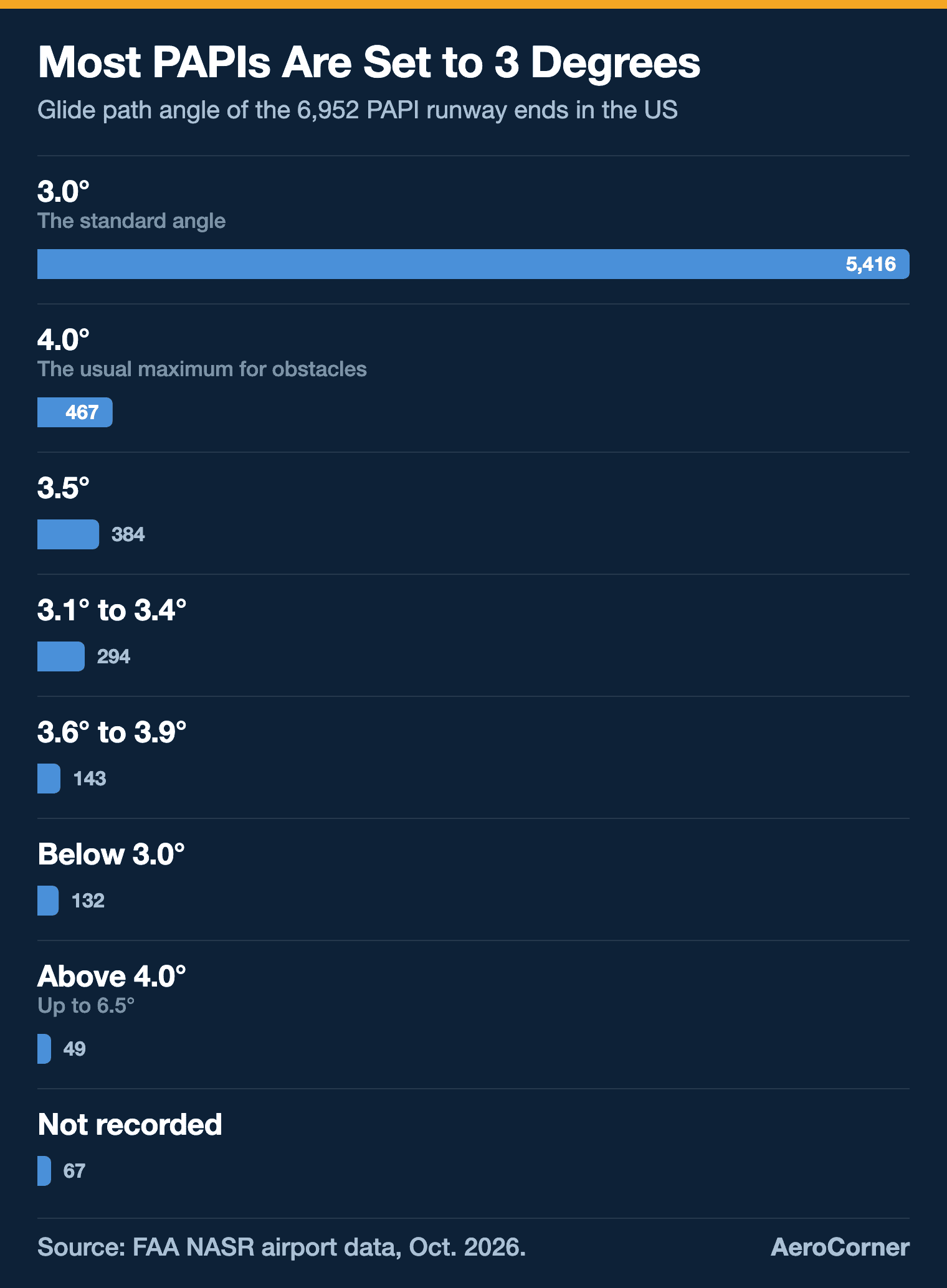
The steepest PAPI in the file is 6.5 degrees, on runway 31 at Grant County Airport in Petersburg, West Virginia. Three small fields in Maryland, Freeway, Lee and Potomac Airfield, list angles between 5.5 and 6 degrees.
A steep PAPI is not a mistake to correct. If the lights show two and two at 4 degrees, that is the path the airport intends, usually because something tall sits under the normal one.
Why Pilots Need a PAPI
Judging height on final approach by eye is harder than it looks, and the AIM lists the runway shapes that fool pilots. A narrower runway than you are used to makes you feel higher than you are, so you fly a lower approach and risk landing short. A wider one does the opposite.

Slope does it too. An upsloping runway or upsloping terrain also creates the illusion of being too high, and an approach over water, dark ground or snow does the same, so all three pull pilots low.
At an unfamiliar airport, the cues learned at home, such as the runway markings and the size of the runway in the windshield, no longer match. The AIM’s advice is to use an electronic glide slope or a VASI system when one is available. The PAPI, which has largely replaced the VASI, shows the real angle whatever the runway looks like.
The Rule: Stay On or Above the Glide Path
In controlled airspace, the glide path is more than advice. Under 14 CFR 91.129(e)(3), an airplane approaching a runway served by a visual approach slope indicator must stay at or above the glide path until a lower altitude is needed for a safe landing.
That rule sits in the Class D section, and the Class C and Class B rules require compliance with it as well. The text names a “visual approach slope indicator” rather than the PAPI, but the PAPI marks the same obstacle-protected path, so fly it the same way. Normal bracketing to stay on the path is allowed.
Some instrument approaches, such as a VOR approach, have no electronic glide path at all. On those, once the pilot breaks out of cloud and sees the runway, the PAPI is often the only vertical guidance left for the last miles.
PAPI vs VASI
The VASI, or visual approach slope indicator, uses the same red and white light units but stacks them in bars, one behind the other, and is read top to bottom. A two-bar VASI gives three readings where a four-light PAPI gives five.
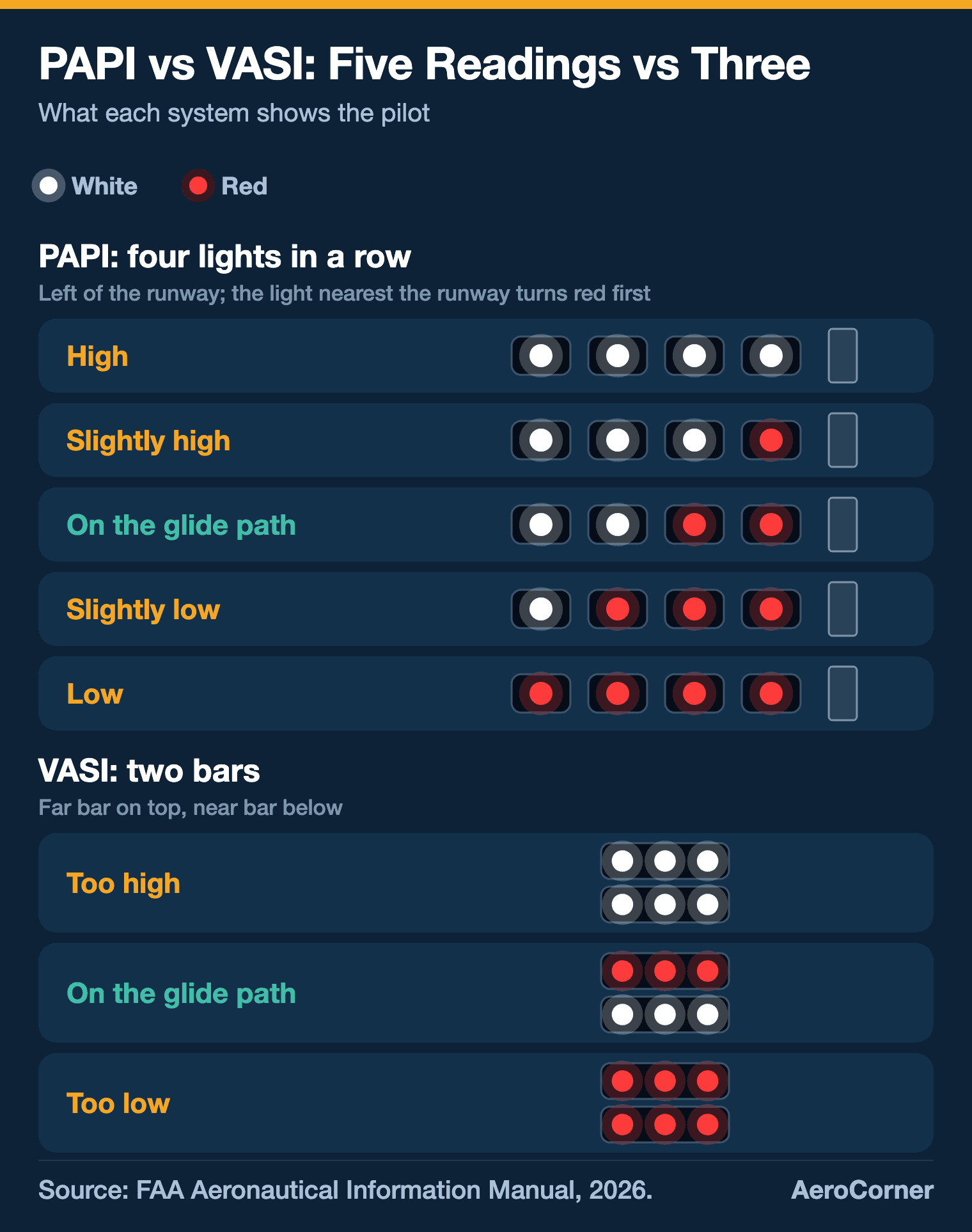
The extra two readings are the point. “Slightly high” and “slightly low” let a pilot fix a small drift before it becomes a big one.
In the US the swap is nearly complete. The same October 2026 FAA data lists 6,952 PAPI runway ends against just 522 with a VASI, and 498 of the 517 airports certificated under Part 139, the rule for airports that serve airlines, have at least one PAPI.
Two-Light PAPI (APAPI)
An abbreviated PAPI, or APAPI, has two light units instead of four, aimed 15 minutes of arc above and below the glide path. It gives three readings: two white is high, one red and one white is on the path, and two red is low.
The FAA normally installs the two-light version on runways without electronic guidance or at airports outside Part 139, and it can be expanded to four lights if jets arrive later. In the October 2026 data, 2,997 of the 6,952 US PAPI runway ends are two-light systems.
HAPI: The Helicopter Version
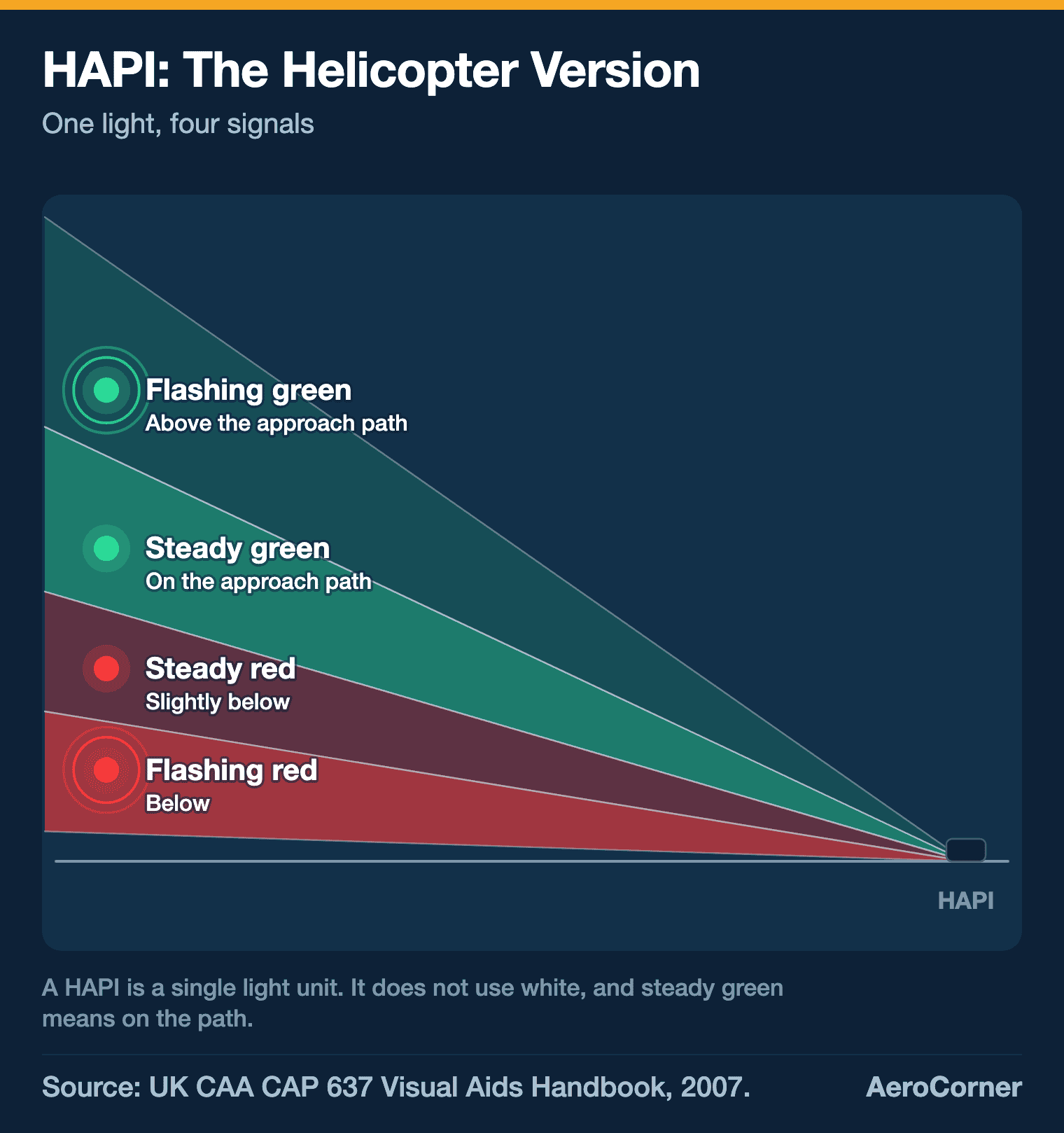
Helicopter landing sites can have their own version, the Helicopter Approach Path Indicator, or HAPI. It does the same job as a PAPI with a different display, from a single light unit.
A common HAPI mix-up
HAPIs are often described as two lights showing white, green and red, read like a small PAPI. The UK Civil Aviation Authority’s visual aids handbook shows something different: one light unit, no white at all, and four signals, with steady green meaning on the approach path.
Who Turns PAPI Lights On?
At an airport with an open control tower, controllers run the airport lighting, and pilots can ask for lights to be turned on, off, up or down. Many airports without a full-time tower put their lights on pilot-controlled lighting instead.
That means keying the aircraft microphone on the airport’s frequency: the AIM suggests seven clicks first, for full intensity, then five or three to dim. The lights stay on for 15 minutes from the last activation.
Pilot activation is common for PAPIs in particular. In the FAA’s October 2026 data, 2,020 of the 3,005 US airports with a PAPI carry a remark telling pilots to switch it on by radio, usually on the common traffic frequency.
FAQ
Sources and references used for research and fact-checking.
- Federal Aviation Administration, Aeronautical Information Manual, Chapter 2, Section 1: Airport Lighting Aids
- Federal Aviation Administration, Aeronautical Information Manual, Chapter 8, Section 1: Illusions in Flight
- Federal Aviation Administration, Advisory Circular 150/5340-30J, Design and Installation Details for Airport Visual Aids
- Federal Aviation Administration, Advisory Circular 150/5345-28H, Precision Approach Path Indicator (PAPI) Systems
- UK Civil Aviation Authority, CAP 637 Visual Aids Handbook
- eCFR, Office of the Federal Register, 14 CFR 91.129, Operations in Class D airspace
- eCFR, Office of the Federal Register, 14 CFR 91.130, Operations in Class C airspace
- eCFR, Office of the Federal Register, 14 CFR 91.131, Operations in Class B airspace
- Federal Aviation Administration, National Flight Data Center, 28 Day NASR Subscription, airport CSV, cycle effective October 1, 2026
- Wikipedia, Precision approach path indicator
Get the Newsletter
The latest aviation news and stories sent to your inbox.
About the Author
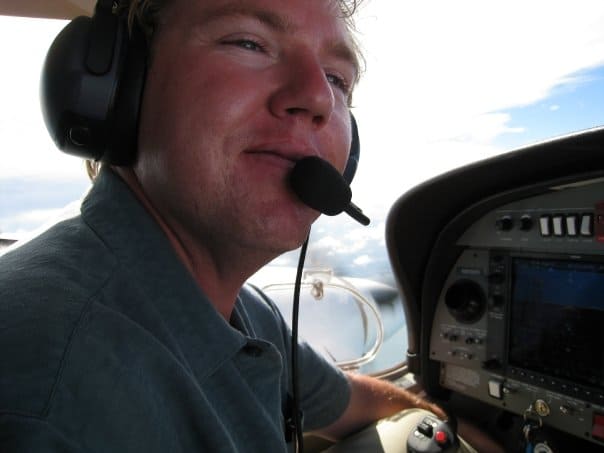
Matt Claiborne is an FAA Airline Transport Pilot and Certified Flight Instructor with more than two decades of experience in flight training. He has served as an assistant professor and FAA Part 141 Assistant Chief Instructor for a university aeronautics program in Florida. His background in professional flying, flight instruction, and aviation education gives him firsthand expertise in aircraft operations, pilot training, flight procedures, and aviation safety.