

Table of Contents
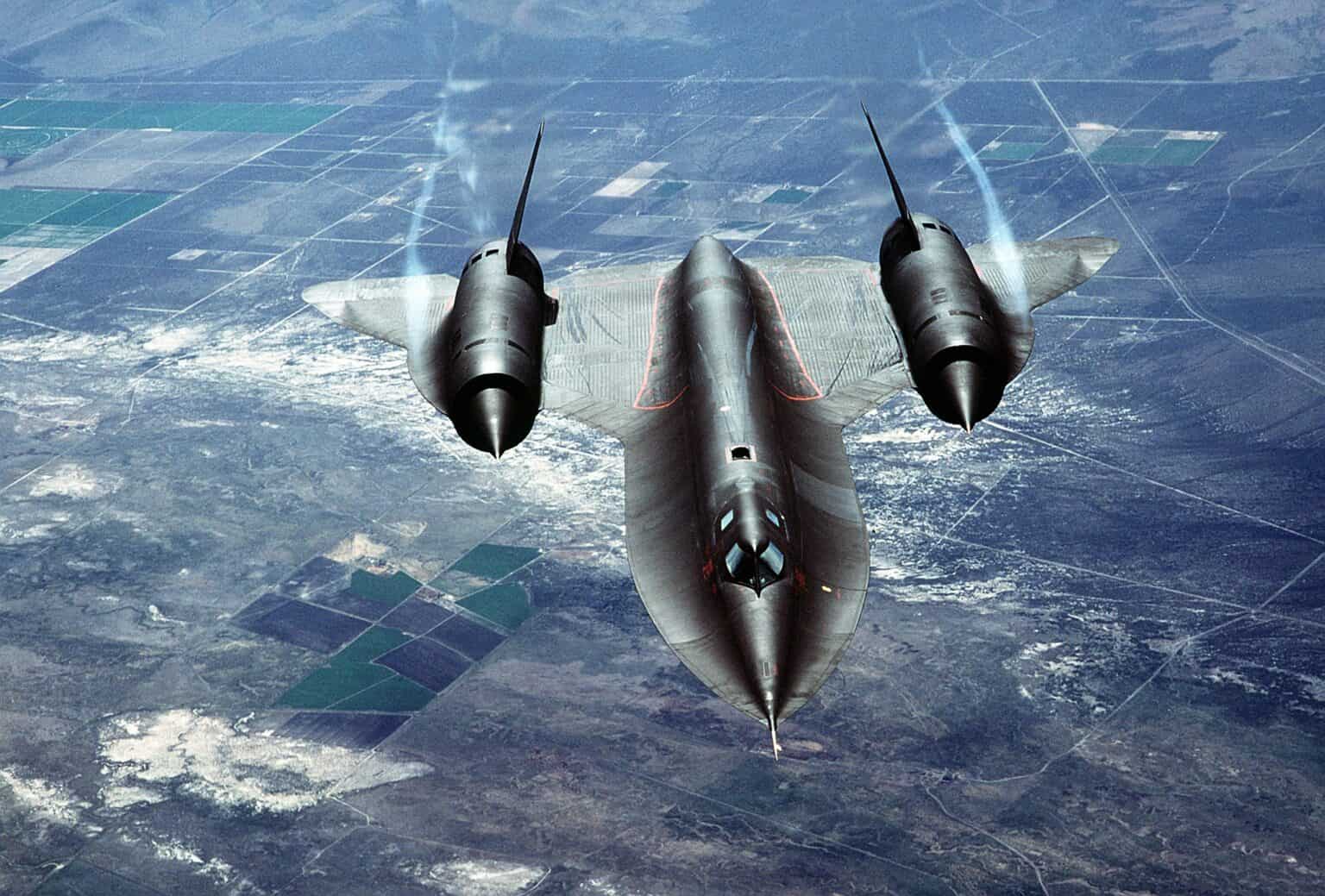
Twenty SR-71 Blackbirds survive as of November 2026, out of the 32 Lockheed built. The other 12 were destroyed in accidents between 1966 and 1989, none of them by enemy fire.
Nineteen of the survivors are in the United States and one is in England. None has flown since October 9, 1999, although the last one to fly was quietly pulled off its display stand in 2026.
How Many SR-71s Are Left?
Twenty complete Lockheed SR-71 Blackbird airframes are left: 18 SR-71As, the only surviving SR-71B trainer, and the one-off SR-71C. That count covers whole aircraft only, not cockpit sections or the earlier A-12 and YF-12 Blackbirds that often get mixed in.
Eighteen sit in museums or on air base display. The 19th, NASA 844, is in a hangar at Edwards Air Force Base, and the 20th is at the Imperial War Museum Duxford in Cambridgeshire, England.
The count at a glance
32 SR-71s built: 29 SR-71A, 2 SR-71B and 1 SR-71C. 12 destroyed in accidents (11 A models and 1 B). 20 survive, all retired: 19 in the United States, 6 of them in California, and 1 in England. None is airworthy as of November 2026.
Built, lost and left, by variant
Production stopped at 32 aircraft after the Pentagon ordered the tooling destroyed in 1968. Almost all of them were the SR-71A reconnaissance model.
| Variant | Built | Lost | Left |
|---|---|---|---|
| SR-71A (reconnaissance) | 29 | 11 | 18 |
| SR-71B (two-seat trainer) | 2 | 1 | 1 |
| SR-71C (hybrid trainer) | 1 | 0 | 1 |
| Total | 32 | 12 | 20 |
The trainers tell the most interesting story. The SR-71B that crashed, 61-7957, went down on approach in January 1968 after a double generator failure and a double flameout. Both crew ejected safely.
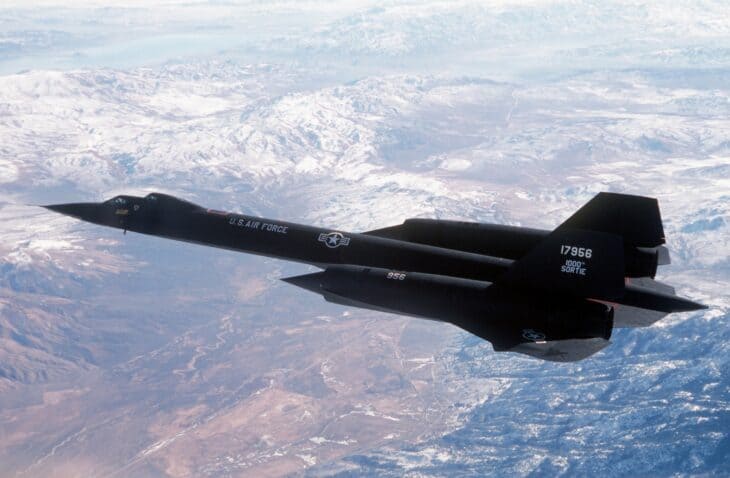

The fleet’s other trainer is the SR-71C, 61-7981, and it was built from parts. It joined the rear fuselage of a YF-12A wrecked in a 1966 landing accident to the front of an SR-71 static test airframe. Crews called it “The Bastard.”
The 12 losses cost one life: Lockheed flight test specialist Jim Zwayer, killed when 61-7952 broke up at Mach 3 in January 1966. Our story on the 12 Blackbirds that were destroyed, none by enemy fire covers every one of them.
Where all 20 surviving SR-71s are
Every survivor has a fixed home, and most can be visited. The serials below are the Air Force numbers, which the aircraft wear on their tails as 17951 to 17981.
| Serial | Variant | Where it is |
|---|---|---|
| 61-7951 | SR-71A | Pima Air & Space Museum, Tucson, Arizona |
| 61-7955 | SR-71A | Air Force Flight Test Museum, Edwards AFB, California |
| 61-7956 | SR-71B | Air Zoo, Kalamazoo, Michigan |
| 61-7958 | SR-71A | Museum of Aviation, Robins AFB, Georgia |
| 61-7959 | SR-71A | Air Force Armament Museum, Eglin AFB, Florida |
| 61-7960 | SR-71A | Castle Air Museum, Atwater, California |
| 61-7961 | SR-71A | Cosmosphere, Hutchinson, Kansas |
| 61-7962 | SR-71A | American Air Museum, IWM Duxford, England |
| 61-7963 | SR-71A | Beale AFB, Marysville, California |
| 61-7964 | SR-71A | Strategic Air Command & Aerospace Museum, Ashland, Nebraska |
| 61-7967 | SR-71A | Barksdale Global Power Museum, Bossier City, Louisiana |
| 61-7968 | SR-71A | Science Museum of Virginia, Richmond, Virginia |
| 61-7971 | SR-71A | Evergreen Aviation & Space Museum, McMinnville, Oregon |
| 61-7972 | SR-71A | Smithsonian Udvar-Hazy Center, Chantilly, Virginia |
| 61-7973 | SR-71A | Blackbird Airpark, Palmdale, California |
| 61-7975 | SR-71A | March Field Air Museum, Riverside, California |
| 61-7976 | SR-71A | National Museum of the US Air Force, Dayton, Ohio |
| 61-7979 | SR-71A | Lackland AFB, San Antonio, Texas |
| 61-7980 | SR-71A | NASA Armstrong Flight Research Center, Edwards AFB, California (off display, in a hangar) |
| 61-7981 | SR-71C | Hill Aerospace Museum, Hill AFB, Utah |
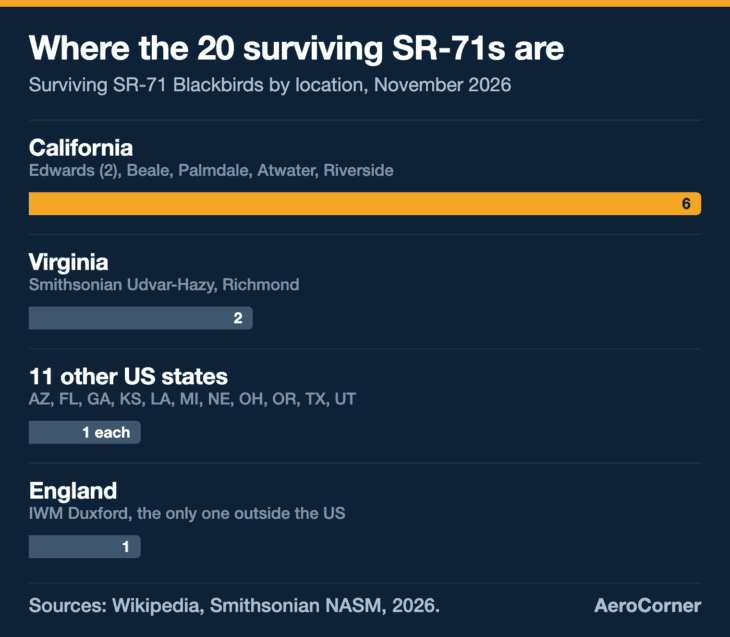
California has six because it was the Blackbird’s home state. Lockheed built them at Palmdale, the operational wing flew from Beale, and the test and NASA fleets lived at Edwards.
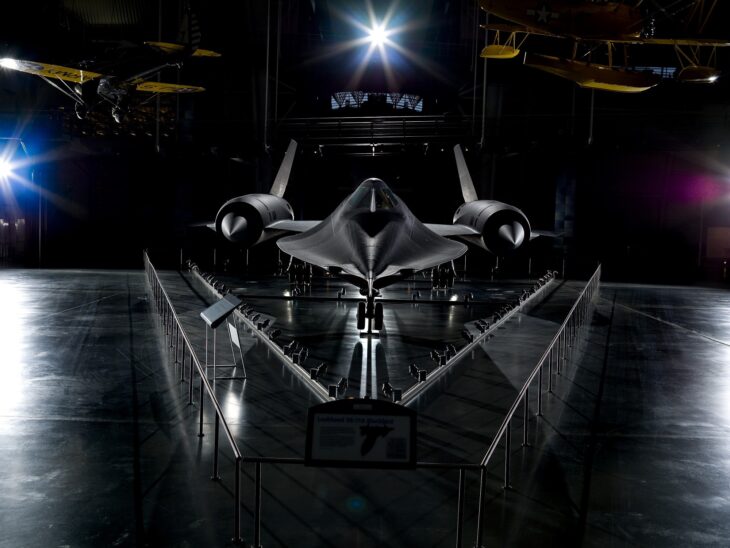
The best-known survivor is 61-7972 at the Smithsonian. On March 6, 1990, it flew from Los Angeles to Washington, DC, in 1 hour, 4 minutes and 20 seconds, then went straight onto display.

Why some sources say a different number
Twenty is the figure most careful sources give, but you will see 21, 30 and even “none” quoted. Each comes from counting something slightly different.
Not every Blackbird is an SR-71
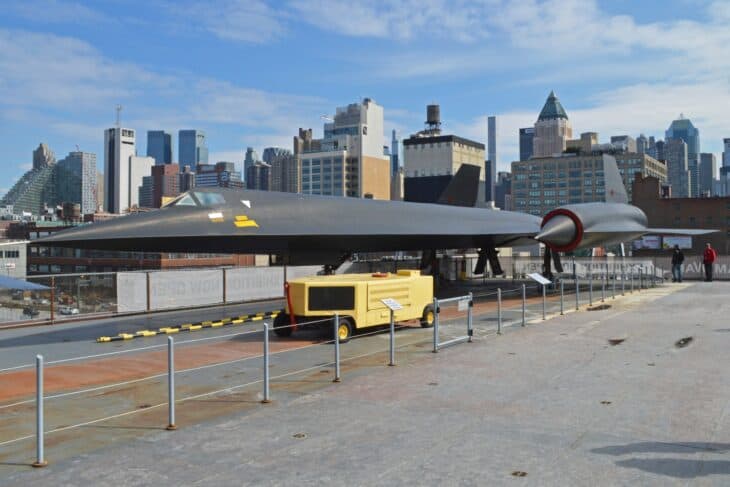
The black jet on the deck of the USS Intrepid in New York is an A-12, the CIA’s single-seat predecessor, not an SR-71. So are the Blackbirds at the California Science Center, San Diego Air & Space Museum and CIA headquarters. The two types look almost identical, so the A-12s are easy to mistake for SR-71s.
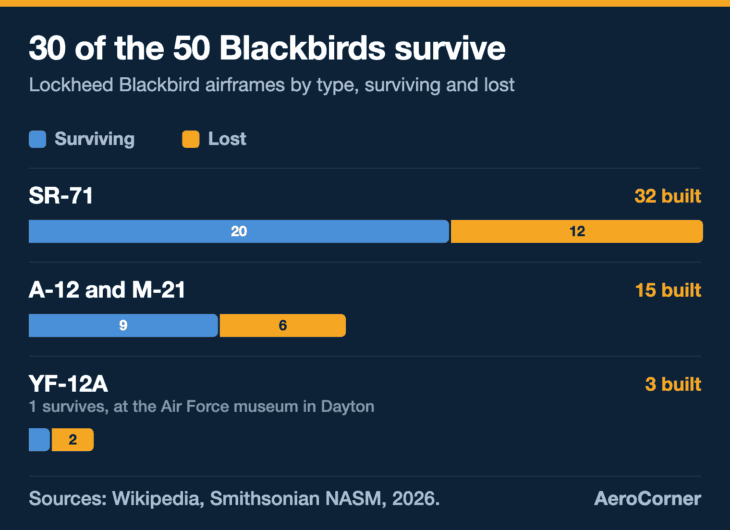
Thirty counts the whole family. Lockheed built 50 Blackbird airframes: 15 A-12s for the CIA (two converted to M-21 drone carriers), three YF-12A interceptor prototypes and the 32 SR-71s. Nine A-12s and M-21s and one YF-12A survive, so the family total is 30.
The differences between the types are real. Our A-12 vs SR-71 comparison sets the CIA jet and its Air Force successor side by side, and the Lockheed A-12 page covers the original.

Twenty-one counts a piece. 61-7977 was destroyed in October 1968 when a wheel failure forced an aborted takeoff at Beale, but its cockpit section survived and is at the Museum of Flight in Seattle. A cockpit is not an aircraft, so it stays out of the 20.
“None” means none flying. The Air Force retired the SR-71 in 1989 and 1990, brought a few back after Congress funded a reactivation in 1994, and retired the type for good in 1998. NASA flew its last Blackbird in 1999. Every survivor exists, but not one is airworthy.
Serial numbers cause the last mix-ups. 61-7951 spent years on loan to NASA disguised as “YF-12C 06937,” and some secondary sources print the serials in a wrong 64-series form, such as 64-17980.
Could the count of flying SR-71s go above zero?
NASA 844, Air Force serial 61-7980, was the last SR-71A built and flew the type’s final flight at an Edwards air show on October 9, 1999. For more than two decades afterward it stood on display outside NASA’s Armstrong Flight Research Center.
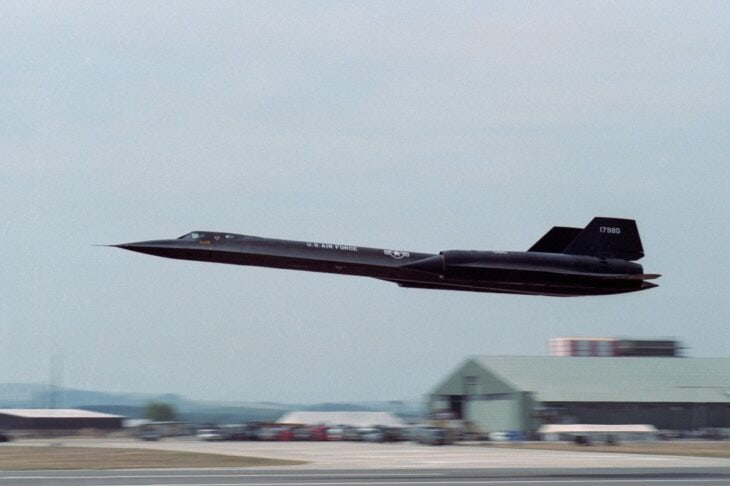

Satellite imagery shows it gone from that spot since at least May 17, 2026. Aviation Week reported it was moved into a hangar for inspection, and that former SR-71 staff were sounded out about flying it again, as our report on NASA 844 vanishing from its display details.
NASA has confirmed none of it and published no plan as of November 2026. The obstacles are steep: the last SR-71 spare parts were destroyed in 2007, and the J58 engines burned JP-7, a fuel no longer in regular production.
So the count that matters for the record books is unchanged. The SR-71 still holds the absolute speed record for a crewed air-breathing aircraft, 2,193.2 mph (3,529.6 km/h) set in July 1976, which keeps it at the top of our ranking of the fastest aircraft in the world.
FAQ
Sources and references used for research and fact-checking.
- Wikipedia, Lockheed SR-71 Blackbird
- Wikipedia, Lockheed A-12
- Wikipedia, Lockheed YF-12
- Smithsonian National Air and Space Museum, Lockheed SR-71 Blackbird
- The War Zone, An SR-71 Blackbird Has Vanished (Updated)
- Task & Purpose, Could an SR-71 fly again? NASA may recall one to service
- The Aviationist, Is An SR-71 Blackbird Returning to Flight 27 Years Later?
Get the Newsletter
The latest aviation news and stories sent to your inbox.
About the Author

Tim is the owner and lead editor of AeroCorner since 2019, overseeing aviation content covering aircraft, airlines, airports, and the broader aviation industry. Through years of researching, writing, editing, and publishing aviation-focused content, he has developed extensive practical knowledge of commercial aviation and air travel. Based in Asia and a frequent traveler himself, Tim also brings firsthand passenger experience to AeroCorner’s coverage. Outside of publishing, he has also explored aviation firsthand through hands-on flight training in New Zealand.