

Table of Contents
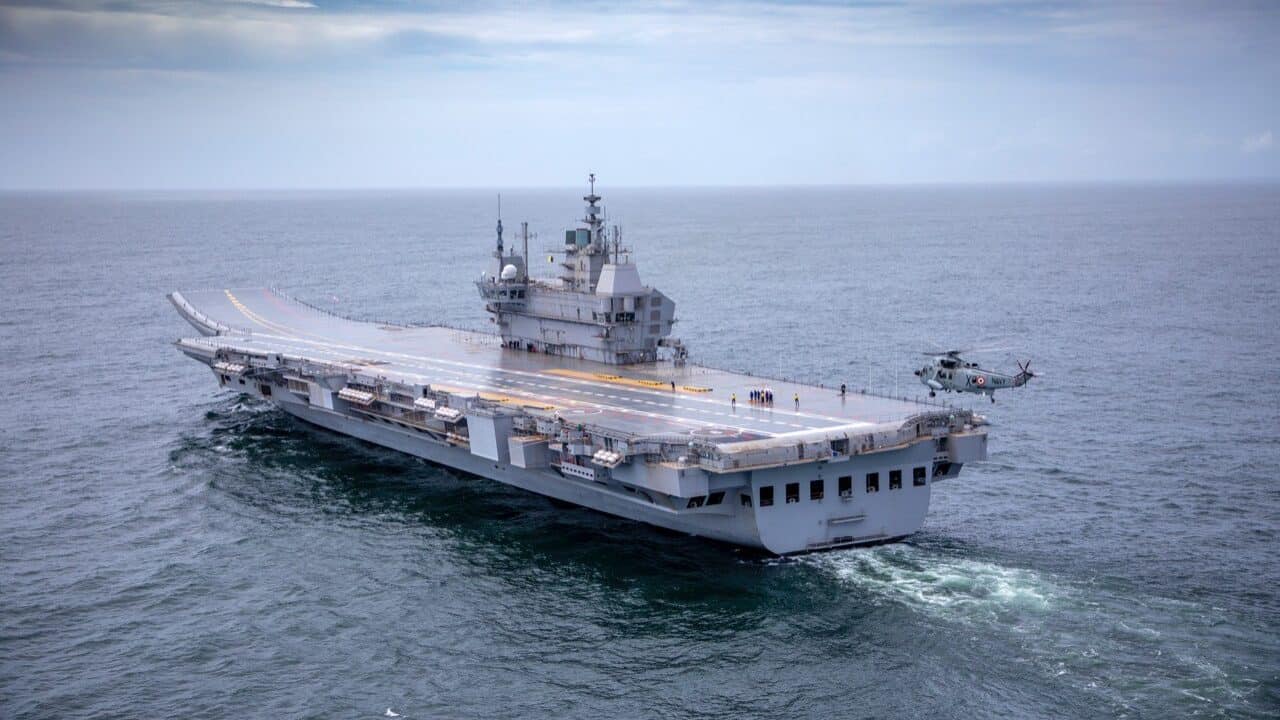
India has two aircraft carriers in commission as of November 2026: INS Vikramaditya, a rebuilt Soviet ship that joined the Indian Navy in 2013, and INS Vikrant, the first carrier India built itself, commissioned on September 2, 2022.
That makes four carriers since 1961. Two were British hulls, one was Soviet, and only the newest was designed and built in India.
How Many Aircraft Carriers Does India Have?
Two. Both are ski-jump carriers of about 45,000 tons, and both fly the MiG-29K as their fighter. Neither has catapults, so jets take off under their own power up a curved ramp at the bow and land on arrester wires.
A third carrier has been discussed for more than 20 years but has not been ordered. Some recent reporting says the next one would replace Vikramaditya rather than join it, which would keep the count at two.
The count at a glance
In service: INS Vikramaditya (commissioned November 16, 2013) and INS Vikrant (commissioned September 2, 2022). Retired: the first INS Vikrant (1961 to 1997) and INS Viraat (1987 to 2017). Planned: a second Indian-built carrier, often called IAC-2, with no construction order announced as of November 2026.
Every aircraft carrier India has operated
India has commissioned four carriers in all. Two of the names repeat, which is one reason the count gets muddled online.
| Carrier | Built as | In Indian service | Status |
|---|---|---|---|
| INS Vikrant (R11) | HMS Hercules, UK | March 4, 1961 to January 31, 1997 | Retired, scrapped from 2014 |
| INS Viraat | HMS Hermes, UK | May 12, 1987 to March 6, 2017 | Retired, scrapped at Alang |
| INS Vikramaditya | Admiral Gorshkov, USSR | November 16, 2013 to present | In service |
| INS Vikrant | Built in India, Cochin Shipyard | September 2, 2022 to present | In service |
| IAC-2 (unnamed) | Planned, based on Vikrant | Not ordered | Awaiting approval |
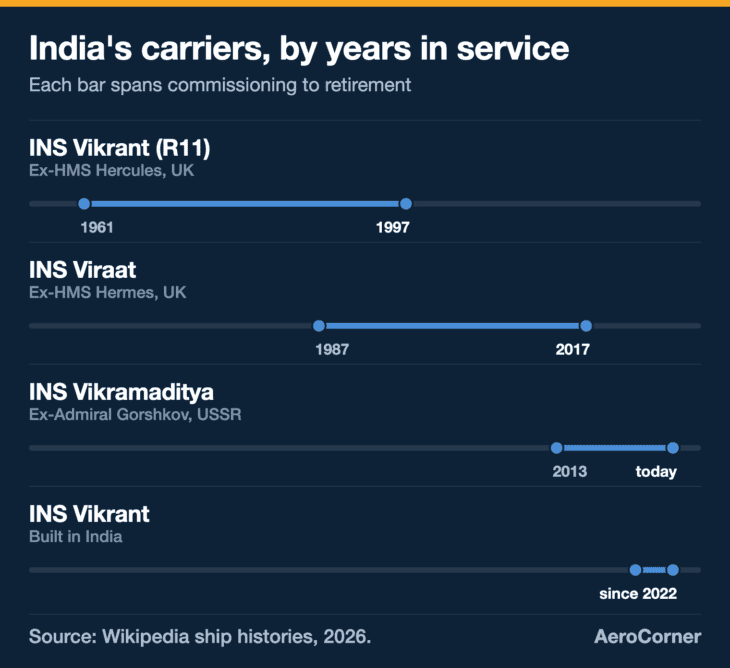
Read the bars side by side and the two-carrier navy turns out to be the exception. India had two carriers from 1987 to 1997 and again from 2013 to 2017, and has had two since 2022. For the rest of its history it sailed one.
The longest single-carrier stretch ran from 1997 to 2013, when the aging Viraat carried the job alone for 16 years.
The two carriers in service
INS Vikramaditya was laid down in the Soviet Union on February 17, 1978, as the Baku and later renamed Admiral Gorshkov. India signed for the ship in January 2004, and in March 2010 the price of the rebuild was settled at $2.35 billion.
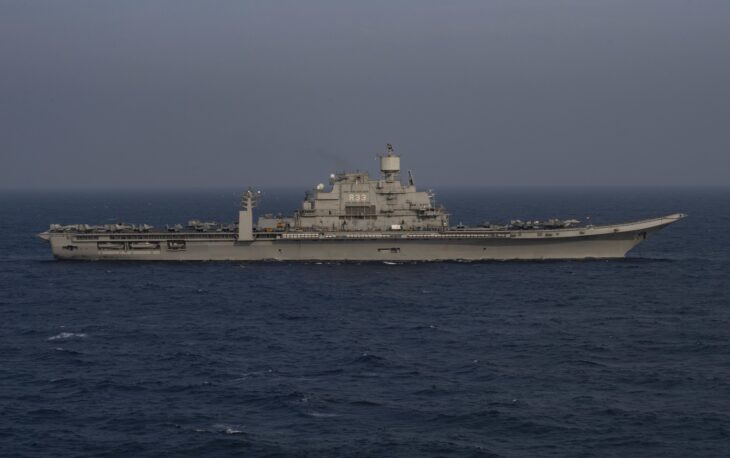

It was commissioned at Severodvinsk in northern Russia on November 16, 2013, and is based at INS Kadamba in Karwar, on India’s west coast. At 932 feet (284 m) it is the longer of the two ships.
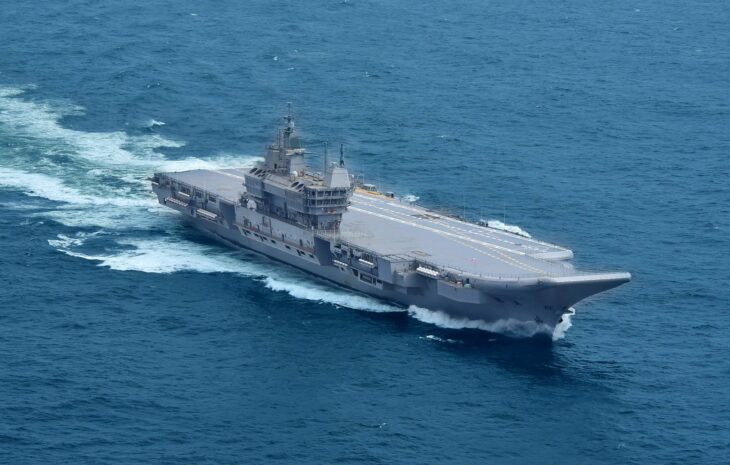
INS Vikrant is the first carrier India designed and built itself. Its keel was laid at Cochin Shipyard in Kochi on February 28, 2009, it was launched in August 2013, and Prime Minister Narendra Modi commissioned it at the shipyard on September 2, 2022. It is 861 feet (262.5 m) long.

Vikrant has already been to a crisis
After the Pahalgam attack in April 2025, Vikrant sailed into the Arabian Sea within 96 hours during the standoff with Pakistan that India called Operation Sindoor. In October 2025 it exercised alongside a British carrier strike group in Exercise Konkan, the first dual-carrier drill between the two navies.
Vikrant is also where India’s next carrier fighter is being tested. India signed for 26 Dassault Rafale M jets on April 28, 2025, 22 single-seat and four two-seat, and a Rafale M made its first landing on Vikrant during trials at the end of October 2026.
The jets themselves are not due until late 2028 or early 2029, according to The Week. Until then the MiG-29K is the fighter on both decks. The naval Rafale is a variant of the French Air Force jet.
Why some sources say three, or one
Two is the number the Indian Navy uses, and it is the right one. The other numbers that circulate each come from a specific mix-up.
Myth: India ordered a third carrier in 2023
In November 2023 Bloomberg reported that a defense acquisition council had approved a second Indian-built carrier worth about $5 billion, and headlines called it India’s third. The Ministry of Defence announcement that week did not mention a carrier, and no construction order for the ship had been announced as of November 2026.
The third-carrier idea is older than either ship in service. Planning in 2003 settled on a three-carrier navy, and 2012 reports christened the ship INS Vishal. As of April 2026, Indian Defence News was still describing the project as elusive amid government silence.
In February 2025, Livefist reported that the three-carrier plan had been quietly shelved in favor of nuclear attack submarines. Senior naval sources told it a second Vikrant-class ship would replace Vikramaditya, not join it.
The Navy has not let the argument go. Asked about a third carrier on May 30, 2026, the day before he retired, Admiral Dinesh K. Tripathi said aircraft carriers “remain central to maritime power projection, sea control, deterrence and strategic influence.”
The “one carrier” answer comes from the other direction. Every carrier spends long periods in the dockyard, and the Ministry of Defence signed a Rs 1,207.5 crore contract with Cochin Shipyard on November 30, 2024, for a short refit and dry docking of Vikramaditya. A navy with two carriers often has one ready.
The repeated name causes the last error. The Vikrant of 1961 and the Vikrant of 2022 are different ships, so a list that counts “Vikrant, Viraat and Vikramaditya” as India’s current fleet is about nine years out of date.
The carriers India retired
The first Vikrant began life as HMS Hercules, laid down in Britain in 1943 and launched in 1945, but never commissioned into the Royal Navy. India bought the unfinished hull in January 1957 and commissioned it in Belfast on March 4, 1961.
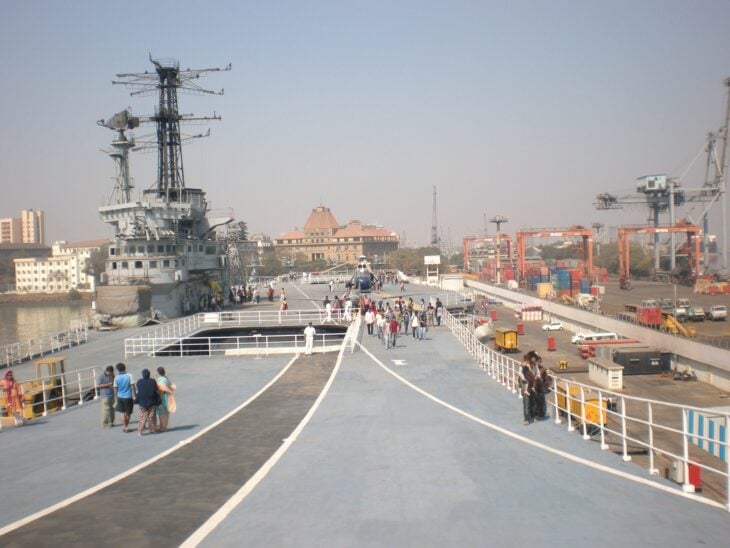

It is the carrier that fought India’s 1971 war. That December its Sea Hawk jets struck shipping and harbors at Chittagong and Cox’s Bazar in what was then East Pakistan.
Vikrant retired on January 31, 1997, and spent about a decade as a museum ship in Mumbai. Scrapping began in November 2014, and in February 2016 Bajaj unveiled a motorbike, the Bajaj V, made with metal from the ship.
INS Viraat had already had one career when India got it. As HMS Hermes it was the flagship of the British task force in the 1982 Falklands War. India bought it in April 1986 and commissioned it on May 12, 1987.
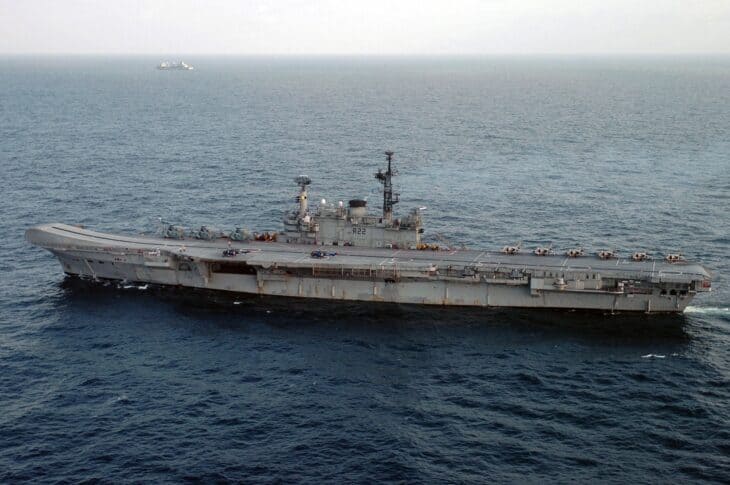

It served India for almost 30 years, retiring on March 6, 2017, by then the oldest aircraft carrier in service anywhere. It was beached for scrapping at Alang in Gujarat on September 28, 2020.
How India compares with its neighbors
Two carriers puts India in a small group, but it is now behind China. China has three aircraft carriers after commissioning Fujian in November 2025, and a fourth is under construction.
The US Navy has 11 carriers, all nuclear powered and all fitted with catapults. Our ranking of the best aircraft carriers in the world sets Vikrant and Vikramaditya against all of them, and the full guide to the Indian Navy covers the escorts and submarines that sail with them.
FAQ
Sources and references used for research and fact-checking.
- Wikipedia, INS Vikrant (2013)
- Wikipedia, INS Vikramaditya
- Wikipedia, INS Vishal
- Wikipedia, INS Vikrant (1961)
- Wikipedia, INS Viraat
- Broadsword by Ajai Shukla, MoD inks Rs 1,207 crore contract with Cochin Shipyard for maintaining aircraft carrier
- Livefist, 3-Carrier Plan Shelved, India Wants Sharks ASAP
- Newsweek, India orders $5 billion aircraft carrier with eye on China, report says
- NewKerala, Aircraft carriers remain central to maritime power projection: Navy chief
- The Week, In first step towards operationalisation, Rafale Marine fighter jet makes successful first landing on INS Vikrant
Get the Newsletter
The latest aviation news and stories sent to your inbox.
About the Author

Tim is the owner and lead editor of AeroCorner since 2019, overseeing aviation content covering aircraft, airlines, airports, and the broader aviation industry. Through years of researching, writing, editing, and publishing aviation-focused content, he has developed extensive practical knowledge of commercial aviation and air travel. Based in Asia and a frequent traveler himself, Tim also brings firsthand passenger experience to AeroCorner’s coverage. Outside of publishing, he has also explored aviation firsthand through hands-on flight training in New Zealand.