

Table of Contents
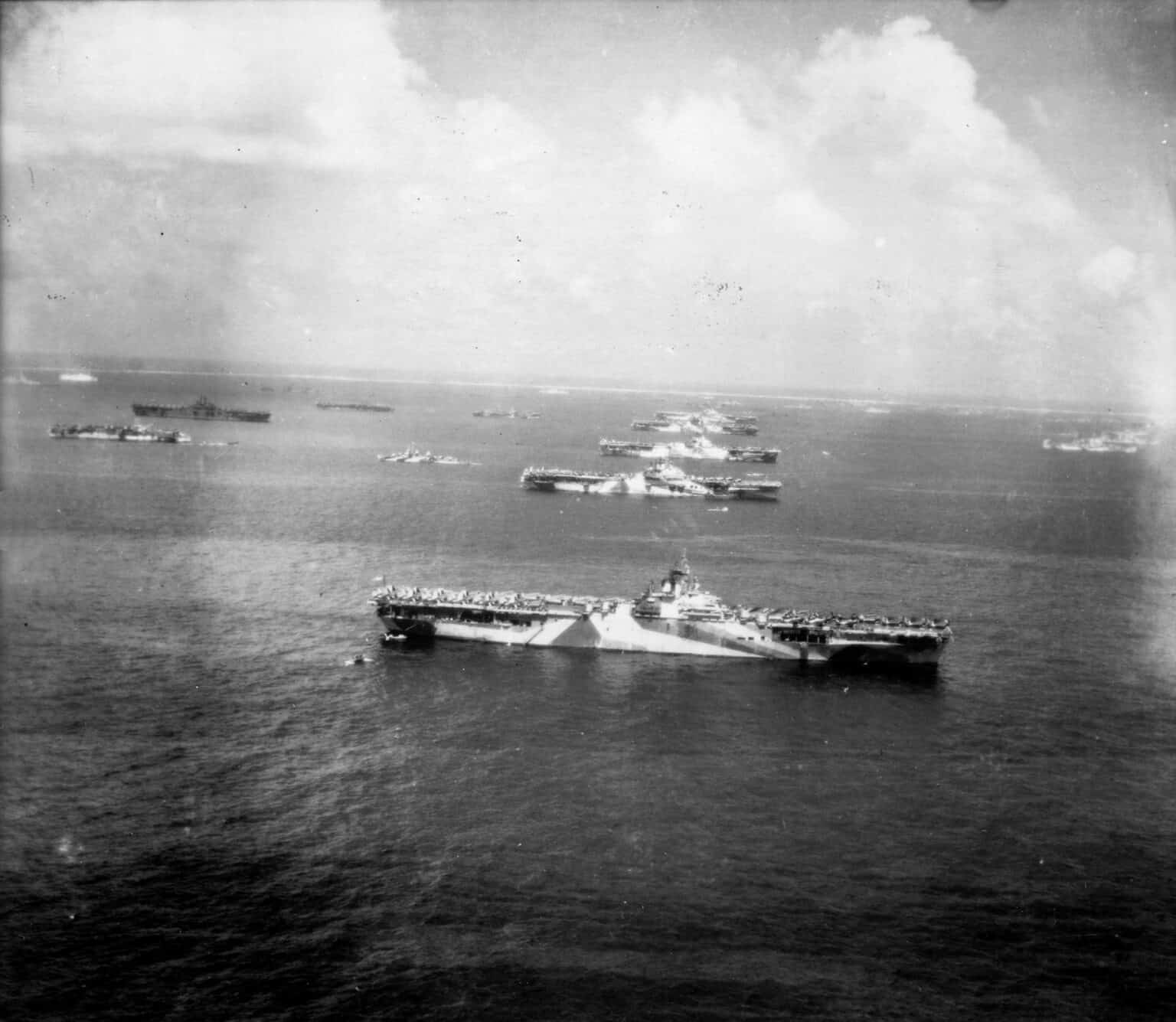
On Dec. 7, 1941, the US Navy had seven fleet aircraft carriers and one small escort carrier. By the Japanese surrender on Sept. 2, 1945, it had commissioned 110 carriers of all types, lost 11 of them, and still had 99 in commission.
Those figures come from the commissioning and loss dates of every ship, as listed in the Navy’s carrier and escort carrier rosters. The 110 is the number most other answers are reaching for, and it is easy to get wrong in both directions.
How Many Aircraft Carriers Did the US Have in WW2?
It depends on the date you pick. The US started the war with 8 carriers, 7 of them fleet carriers, and finished it with 99 in commission. Across the whole war, 110 different carriers served under the US flag.
That 110 counts 33 fleet and light carriers and 77 escort carriers. It leaves out the 38 escort carriers built in American yards for Britain’s Royal Navy, and two converted Great Lakes paddle steamers the Navy used to train pilots.
The count at a glance
Dec. 7, 1941: 8 carriers (7 fleet, 1 escort). Served during the war: 110 (24 fleet, 9 light, 77 escort). Lost: 11. In commission at the surrender on Sept. 2, 1945: 99 (20 fleet, 8 light, 71 escort).
The Breakdown: Every Class of Carrier the Navy Sailed
The Navy fought the war with three kinds of carrier. Fleet carriers (CV) were the big strike ships, light carriers (CVL) used the design of the Cleveland-class light cruiser and carried about 30 aircraft, and escort carriers (CVE) were small, slow flight decks built on merchant ship and tanker designs.
| Type and class | Served in WW2 | Lost | In commission Sept. 2, 1945 |
|---|---|---|---|
| Prewar fleet carriers (Lexington, Saratoga, Ranger, Yorktown, Enterprise, Wasp, Hornet) | 7 | 4 | 3 |
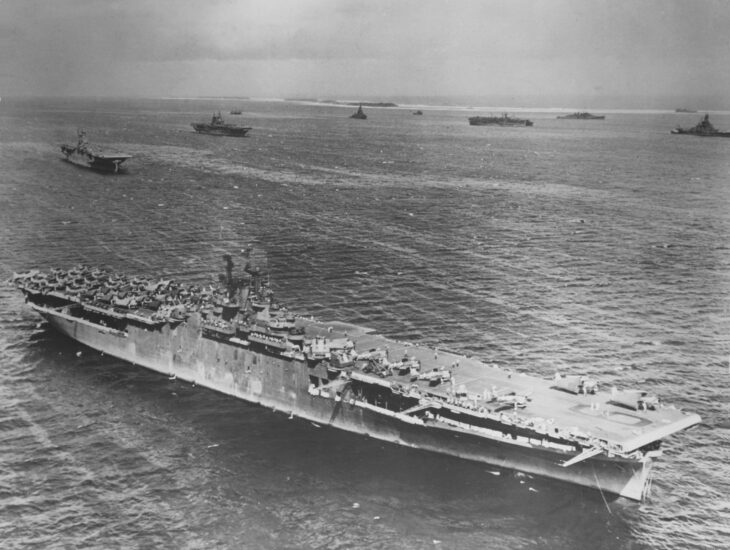
| Essex-class fleet carriers | 17 | 0 | 17 |
| Independence-class light carriers | 9 | 1 | 8 |
| Long Island and Charger escort carriers | 2 | 0 | 2 |
| Bogue-class escort carriers | 11 | 1 | 10 |
| Sangamon-class escort carriers | 4 | 0 | 4 |
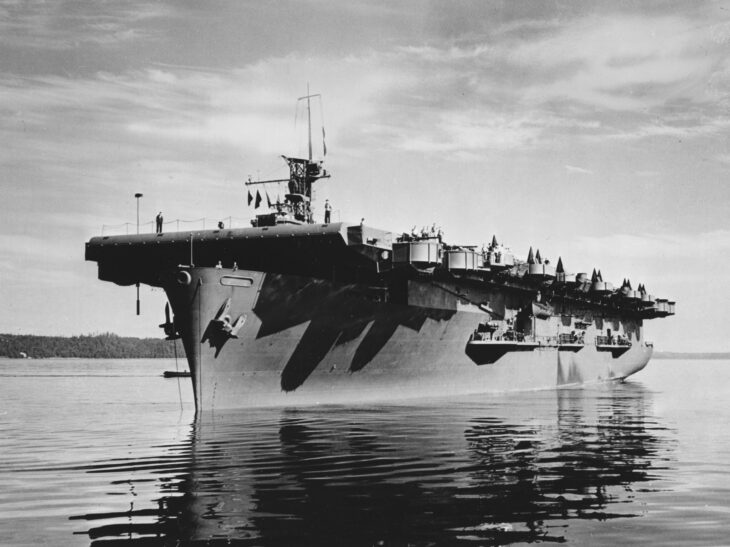
| Casablanca-class escort carriers | 50 | 5 | 45 |
| Commencement Bay-class escort carriers | 10 | 0 | 10 |
| Total | 110 | 11 | 99 |
Escort carriers made up 77 of the 110, or 70%. The Casablanca class alone supplied 50 ships, all laid down, launched and commissioned between Nov. 3, 1942, and July 8, 1944.

The fleet that did the heavy fighting was much smaller. The Essex class put 17 carriers into commission before the surrender, and 14 of them saw combat. None was sunk.

Counting each carrier in commission at the end of each year shows how fast the fleet grew once the shipyards caught up:
| Date | Fleet | Light | Escort | Total |
|---|---|---|---|---|
| Dec. 7, 1941 | 7 | 0 | 1 | 8 |
| Dec. 31, 1942 | 4 | 0 | 12 | 16 |
| Dec. 31, 1943 | 10 | 9 | 35 | 54 |
| Dec. 31, 1944 | 17 | 8 | 65 | 90 |
| Sept. 2, 1945 | 20 | 8 | 71 | 99 |
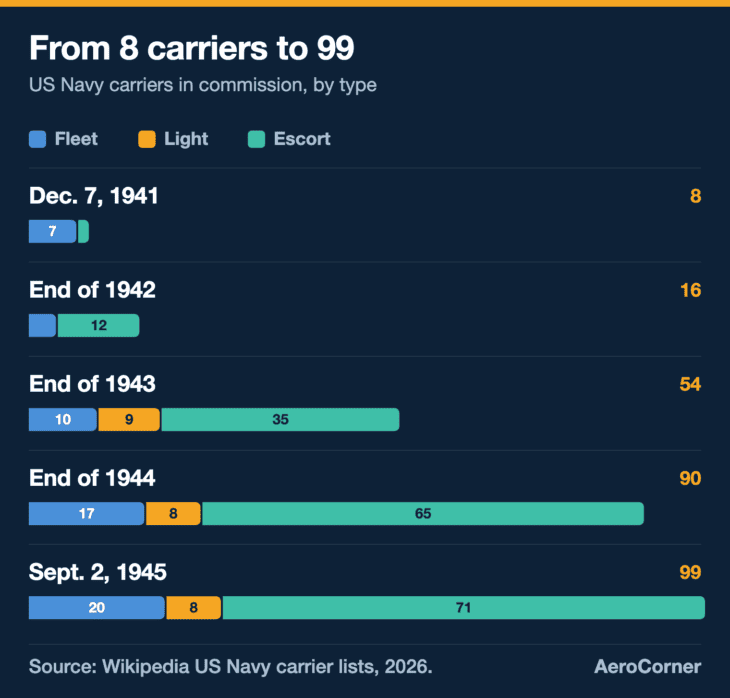
The low point is the surprise. By the end of 1942 the Navy had lost Lexington at Coral Sea, Yorktown at the Battle of Midway, Wasp off Guadalcanal and Hornet at Santa Cruz, leaving four fleet carriers, one of them the brand-new Essex.
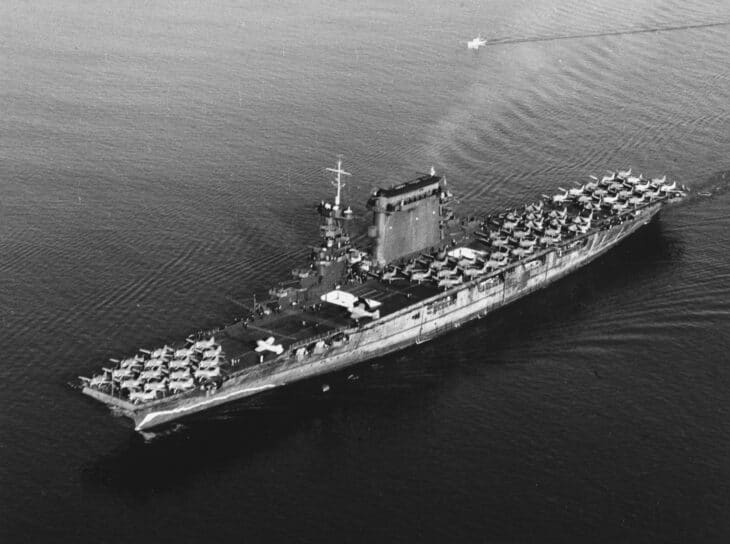

From 1943 the curve turns almost vertical. Nine light carriers joined in that year alone, and the escort carrier count rose from 12 to 65 in just two years.
Why the Numbers Differ
Search this question and you will see 7, 8, 28, 99, “over 100” and figures near 150. Most of them are correct answers to slightly different questions.
7 or 8 at the start. Seven fleet carriers were in commission on Dec. 7, 1941. The eighth ship is Long Island, an escort carrier commissioned in June 1941, which counts of fleet carriers leave out because she was a converted cargo ship.
Langley, the Navy’s first carrier, sometimes appears as a ninth. She had been reclassified as a seaplane tender, AV-3, in April 1937 and was sunk on Feb. 27, 1942, while ferrying aircraft to Java.
The most repeated mistake
The US never had more than 100 carriers at once. The peak was 99, reached at the surrender. The figure of 110 is every carrier that served at any point in the war, including the 11 that were sunk.
28 at the end. This is fleet and light carriers only: 3 surviving prewar ships, 17 Essex-class carriers and 8 Independence-class carriers. Add the 71 escort carriers and you get 99.
Figures near 150. These usually count carriers built in the US rather than carriers the US Navy operated. American yards turned out 38 escort carriers that went to the Royal Navy under Lend-Lease, which takes 110 to 148.
Some lists also add Wolverine and Sable, two Great Lakes paddle steamers fitted with flight decks. From 1943 to 1945 they trained 17,000 pilots, landing signal officers and other personnel on Lake Michigan, but the Navy classed them as miscellaneous vessels (IX), not carriers.
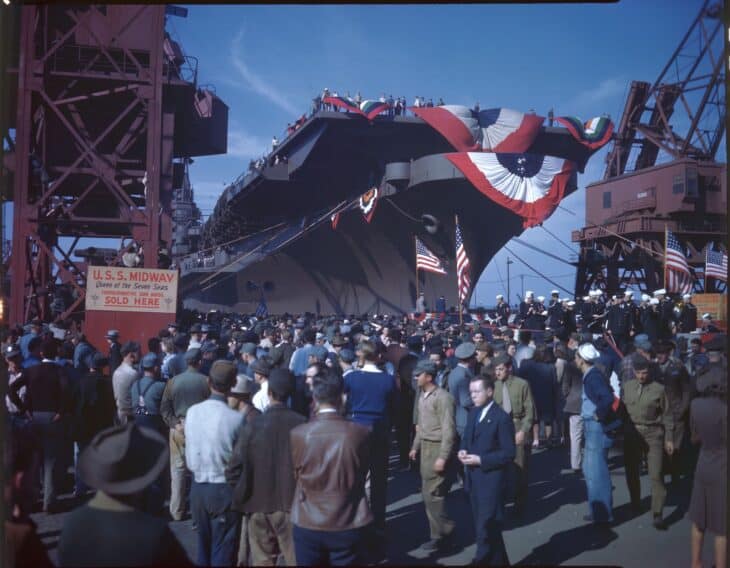
The carrier that just missed. USS Midway, the first of the larger Midway class, was commissioned on Sept. 10, 1945, eight days after the surrender. Boxer, the last Essex to make the cut, joined on April 16, 1945.

The 11 Carriers the US Lost
Four fleet carriers, one light carrier and six escort carriers were sunk. All four fleet carrier losses came in 1942, the year the US had the fewest to lose.
May 8, 1942
Lexington (CV-2). Sunk at the Battle of the Coral Sea.
June 7, 1942
Yorktown (CV-5). Sunk at the Battle of Midway.
Sept. 15, 1942
Wasp (CV-7). Sunk during the Guadalcanal campaign.
Oct. 1942
Hornet (CV-8). Sunk at the Battle of the Santa Cruz Islands, a year after her commissioning.
Nov. 24, 1943
Liscome Bay (CVE-56). Torpedoed by a Japanese submarine off Makin, the first US escort carrier lost.
May 29, 1944
Block Island (CVE-21). The only US Bogue-class carrier lost.
Oct. 24-25, 1944
Princeton (CVL-23), Gambier Bay (CVE-73) and St. Lo (CVE-63). Three carriers lost in the Battle of Leyte Gulf.
Jan. 4, 1945
Ommaney Bay (CVE-79). Sunk by a kamikaze in the Sulu Sea, en route to Lingayen Gulf.
Feb. 21, 1945
Bismarck Sea (CVE-95). Sunk by a kamikaze off Iwo Jima, the last US carrier lost in the war.
Not one of the 17 Essex-class carriers was lost, although Franklin and Bunker Hill were so badly damaged in 1945 that neither was ever recommissioned after the war.
How That Compares With Today
The 99 carriers of September 1945 compare with 11 in the Navy today, all nuclear-powered supercarriers. Our count of how many aircraft carriers the US has now breaks those down by class and readiness.
The aircraft changed as much as the ships. The Grumman F6F Hellcat was the standard fighter of the Essex-class air groups, and it shared the decks with Dauntless and later Helldiver dive bombers.
FAQ
Sources and references used for research and fact-checking.
- Wikipedia, List of aircraft carriers of the United States Navy
- Wikipedia, List of escort carriers of the United States Navy
- Wikipedia, Essex-class aircraft carrier
- Wikipedia, Independence-class aircraft carrier
- Wikipedia, Casablanca-class escort carrier
- Wikipedia, Commencement Bay-class escort carrier
- Wikipedia, Bogue-class escort carrier
- Wikipedia, USS Langley (CV-1)
- Wikipedia, USS Wolverine (IX-64)
- Wikipedia, Attack on Pearl Harbor
Get the Newsletter
The latest aviation news and stories sent to your inbox.
About the Author

Tim is the owner and lead editor of AeroCorner since 2019, overseeing aviation content covering aircraft, airlines, airports, and the broader aviation industry. Through years of researching, writing, editing, and publishing aviation-focused content, he has developed extensive practical knowledge of commercial aviation and air travel. Based in Asia and a frequent traveler himself, Tim also brings firsthand passenger experience to AeroCorner’s coverage. Outside of publishing, he has also explored aviation firsthand through hands-on flight training in New Zealand.